July 24, 2026
Company Raised the Salary Range for Your Job but Won’t Raise Your Pay: What Should You Do?
Yes, it is usually worth pushing once, professionally, with evidence. Document the new salary range, compare it to your current pay, show your performance and market value, then ask for a written compensation review. If leadership refuses to address compression, start a parallel job search or side-income plan immediately.
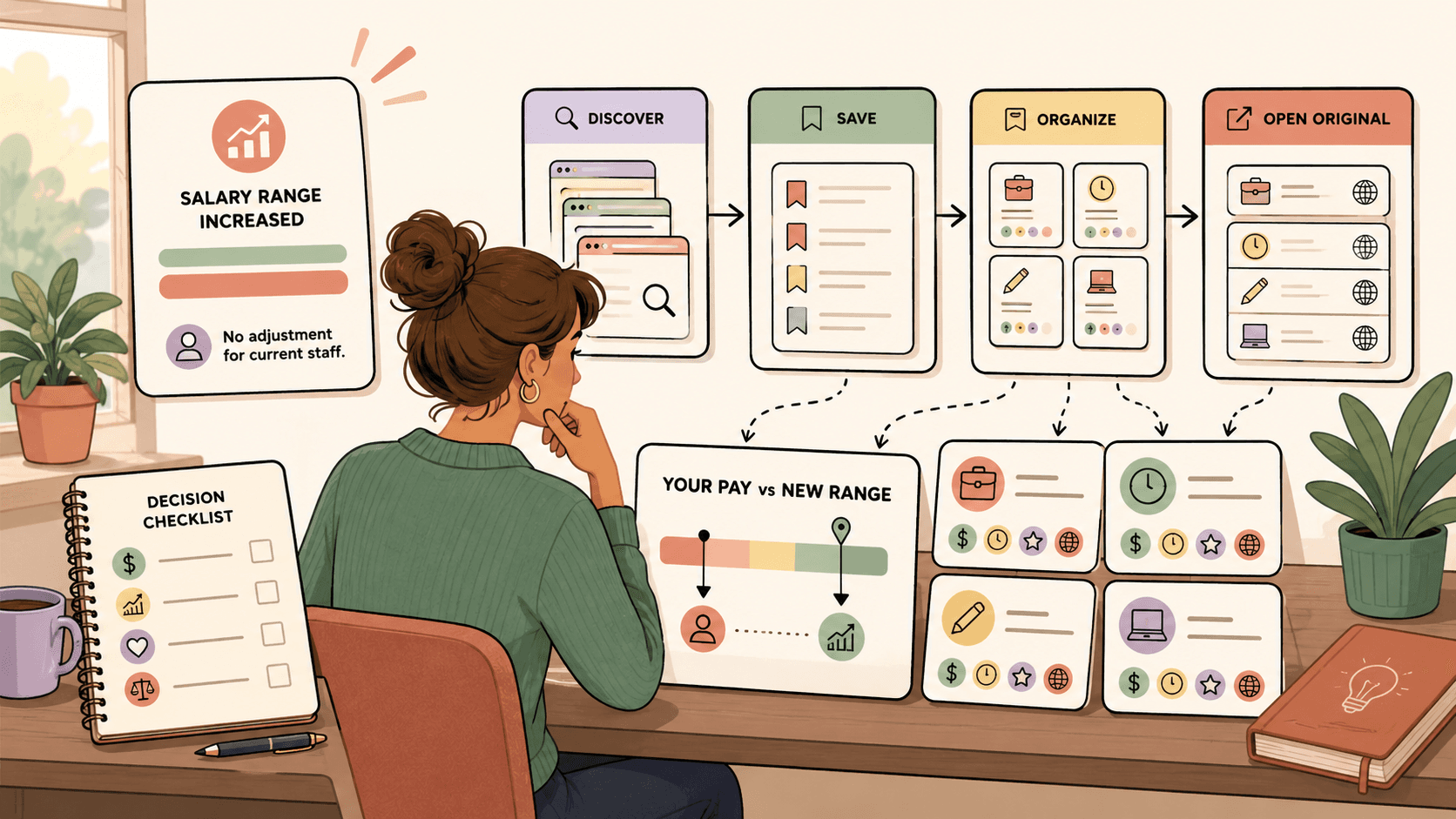
Should you fight for a pay increase if the posted salary range went up?
Yes, but do it strategically. If your company increased the public salary range for your exact role and refuses to adjust current employees, you may be dealing with pay compression. That means new hires can earn as much as, or more than, experienced employees already doing the job.
The wrong move is to walk into a meeting angry and say, “This is unfair.” The right move is to build a short compensation case, ask for a defined review, and quietly create alternatives in case the answer stays no.
This matters because public salary ranges are now easier to see on company career pages, LinkedIn job posts, Glassdoor, and state pay-transparency postings. Employees are noticing when the market moves faster than their internal raises. A Reddit discussion in r/jobs recently drew hundreds of comments around this exact situation: a company raised the salary range for a current employee’s position but said it would not adjust existing staff pay. That reaction is not surprising. Compensation gaps feel personal, but the solution is tactical.
Do this today: save screenshots or PDFs of the posted range before it changes, including the job title, location, date, and listed requirements.
What should you verify before asking again?
Before you escalate, confirm that the new range really applies to your role. Companies often create confusion by using similar titles across levels, locations, departments, or employment types.
Check these details:
- Exact job title: “Marketing Specialist II” is not the same as “Senior Marketing Specialist.”
- Location or remote eligibility: a New York or California range may differ from a national remote range.
- Level and scope: compare responsibilities, direct reports, revenue ownership, tools used, and required experience.
- Employment type: full-time employee compensation is not the same as contract or temporary work.
- Range meaning: some companies list a broad hiring range while current salary bands are managed separately.
Use the company careers page first. Then compare against LinkedIn job listings, Glassdoor salary pages, and Levels.fyi if your role exists there, especially for tech, product, engineering, design, and operations roles. If you want outside input, r/personalfinance has more than 20M members and is useful for sanity-checking compensation decisions, budgeting around a possible job change, and thinking through whether a raise dispute is worth the risk.
A practical example: suppose you are a Customer Success Manager earning $72,000. Your company posts the same role at $82,000 to $105,000, remote, requiring three years of experience and the same CRM tools you use every day. You have four years of experience and train new hires. That is a strong compression case. If the new post requires enterprise account ownership and you handle small business accounts, your case is weaker unless your actual duties already match the posting.
Do this today: create a one-page comparison table with columns for “posted requirement,” “my current work,” and “evidence.”
See fresh gigs on Sidequestboard
How should you build a compensation case your manager can actually use?
Your manager may agree with you privately but still need a clean package to send to HR or finance. Make their job easy. Keep it factual, short, and tied to retention risk without threatening to quit.
Your compensation case should include:
- Current base pay and date of last raise.
- New posted salary range with screenshot or link.
- Your tenure in the role.
- Measurable performance, such as quota attainment, tickets resolved, projects shipped, revenue influenced, cost savings, or training ownership.
- Expanded responsibilities since hire.
- External comparison from LinkedIn, Glassdoor, Levels.fyi, or relevant public postings.
- Specific ask, such as “adjust base salary to $88,000” or “move me to the midpoint of the posted range.”
Avoid vague claims like “I work hard” or “I deserve more.” Use business language. A manager can forward “I reduced onboarding time from 21 days to 14 days and now train two new analysts” more easily than “I feel underpaid.”
Here is a simple structure I would use:
“Since the company has posted my current role at $82,000 to $105,000, I’d like to request a compensation review. I’m currently at $72,000. My responsibilities match the posted role, and in the past 12 months I’ve taken on onboarding, weekly client reporting, and escalation coverage. Based on the posted range and my current scope, I’m requesting an adjustment to $88,000. If that isn’t possible now, can we set a written timeline and criteria for review?”
That last sentence matters. If they refuse the raise, you want a date, decision-maker, and measurable criteria. “Maybe later” is not a compensation plan.
Do this today: write your ask in six sentences or fewer and remove every emotional phrase before sending it.
What should you say if your manager says no current staff will be adjusted?
Treat “we are not adjusting current staff” as the first answer, not the final answer. Ask clarifying questions calmly. You are trying to learn whether there is any path inside the company or whether you should redirect your energy elsewhere.
Ask:
- “Who owns the decision on internal range alignment?”
- “Is there a formal process for reviewing pay compression?”
- “Can this be reviewed as part of retention or equity adjustment rather than annual merit?”
- “What specific criteria would justify moving me into the posted range?”
- “Can I get the timeline and criteria in writing?”
If they refuse to define criteria, that is useful information. It means you may not be negotiating against your manager. You may be negotiating against a company policy designed to preserve payroll budgets until employees leave.
Do not threaten to resign unless you are ready to follow through. A better line is:
“I understand that may be the current policy. Since my role is now being posted at a materially higher range, I need to make an informed decision about my compensation. I’d appreciate a written answer on whether there is any internal review path.”
This keeps the door open while signaling that you are paying attention.
Do this today: ask for the review path in writing by email or Slack after the conversation, using neutral language.
When is it better to stop fighting and start applying elsewhere?
You should start applying elsewhere as soon as the company gives a firm no with no timeline. You do not need to quit, argue, or make a dramatic move. Just stop relying on the company to correct the gap voluntarily.
Here are signs your time is better spent outside the company:
- HR says the new range applies only to external candidates.
- Your manager agrees but says their hands are tied.
- You are below the new minimum and they still refuse adjustment.
- The company will not give written criteria for review.
- New hires are coming in near or above your pay.
- Your annual raise cycle is more than three months away and no exception is possible.
A job search gives you leverage, but more importantly, it gives you options. If you discover that similar roles pay $10,000 to $25,000 more, the decision becomes clearer. If the market is weak, you can still build side income while waiting for better openings.
Walkthrough scenario: open LinkedIn and search your exact title, then filter by remote or your metro area. Save 10 roles with salary ranges that match your experience. Next, check Glassdoor for your company and competitors. Then build a simple tracker in Notion, Google Sheets, or Trello with columns for company, role, salary range, source link, date found, application status, and follow-up date. Apply to the best five roles first, not the easiest five.
Do this today: start a 20-role comparison list before making any career decision based on one company’s policy.
How can you protect your income while you look for better work?
A salary fight can take weeks, and a job search can take longer. If your budget is tight, build a short-term income buffer without letting it consume your full job-search energy.
The research-backed options that make the most sense are:
- Freelance in your current skill: typical time to first pay is 1 to 4 weeks, with potential of $500 to $5,000 per month.
- Part-time remote contract work: typical time to first pay is 1 to 3 weeks, with potential of $500 to $3,000 per month.
- Weekend gig work such as delivery or local tasks: typical time to first pay is 1 to 3 days, with potential of $200 to $1,500 per month.
- Sell a digital product such as a template, course, or guide: typical time to first pay is 2 to 6 weeks, with potential of $100 to $10,000 per month, though results vary heavily by audience and distribution.
Use r/sidehustle, which has about 1.2M members, for examples of side-income models people are testing. Use r/beermoney, with about 1.5M members, for smaller quick-income ideas, but be selective. Many posts are better for grocery-money experiments than serious income replacement. Use r/personalfinance to pressure-test whether a side gig is worth your time after taxes, vehicle costs, platform fees, and burnout.
Walkthrough scenario: if you are a data analyst, do not start with random delivery work unless you need cash this week. Start by packaging a narrow freelance offer: “I clean and visualize messy spreadsheet reports for small teams in 48 hours.” Create a one-page portfolio in Notion with before-and-after screenshots, then look for public posts from founders, creators, and small teams asking for spreadsheet, dashboard, or reporting help. Your first goal is not a perfect business. It is one paid project in 1 to 4 weeks.
Do this today: choose one income strategy based on urgency. If you need money this week, use weekend gig work. If you can wait two to four weeks, freelance in your current skill.
How should you search for fresh opportunities without living in 20 tabs?
When you are underpaid, speed matters. Good remote roles, freelance projects, and contract opportunities can get crowded quickly. The problem is that opportunities appear across scattered public places: Reddit communities, X/Twitter posts, Discord servers, company career pages, LinkedIn, niche Slack groups, and personal newsletters.
A calm workflow beats constant refreshing. Set three daily search blocks:
- Morning: check saved searches and fresh posts for 20 minutes.
- Lunch: respond to the best two opportunities, not every opportunity.
- Evening: update your tracker and send follow-ups.
For public community leads, sort by freshness. On Reddit, that means sorting relevant communities by New rather than Hot. In r/sidehustle, look for posts where people describe a specific business need, not vague “how do I make money” threads. In r/beermoney, scan for ideas that can realistically produce quick cash but avoid anything that requires upfront fees or suspicious personal information. In r/personalfinance, search for salary negotiation and job-change threads to compare how others evaluate pay gaps.
This is where Sidequestboard can help if your search has become scattered. It is a curated opportunity discovery dashboard for fresh public work opportunities from communities and social platforms. Instead of manually checking too many tabs, you can review a cleaner feed, save relevant opportunities, open the original source, and apply or respond there directly. It does not replace your judgment, negotiation plan, or applications. It helps you spend less time searching and more time acting.
Do this today: create a daily search routine with fixed time blocks so your salary frustration turns into consistent market action.
Should you tell your company you are applying elsewhere?
Usually, no. Do not announce that you are applying elsewhere unless you have an offer or are prepared for the relationship to change. Some managers respond supportively, but others treat it as a loyalty issue.
If you receive an outside offer, decide what you actually want before using it as leverage. If you would stay for a match, ask clearly. If the company already refused to fix compression, be cautious about accepting a counteroffer unless the new pay, title, and responsibilities are documented. A counteroffer can solve immediate pay but not always the underlying compensation culture.
A practical decision rule:
- If you like the work, manager, and growth path, give the company one structured chance to fix pay.
- If the company refuses and your role is clearly worth more outside, prioritize leaving well.
- If you need stability, build a pipeline first, then decide from options instead of frustration.
Keep your materials ready: updated resume, LinkedIn profile, portfolio, references, and a spreadsheet of roles. If you freelance or contract, keep a short pitch template ready so you can respond quickly when a relevant public opportunity appears.
Do this today: update your resume with measurable outcomes from the last 12 months before you emotionally check out.
What is the best action plan for the next 14 days?
Use a two-track plan: internal compensation review and external opportunity search. Do not wait for one to finish before starting the other.
Day 1: Save the posted salary range, job description, and date. Compare it to your current role.
Day 2: Gather proof of performance. Pull metrics, project outcomes, customer feedback, and expanded duties.
Day 3: Check market data on LinkedIn, Glassdoor, company career pages, and Levels.fyi where relevant.
Day 4: Write your compensation request. Keep it factual and specific.
Day 5: Meet with your manager and ask for a salary adjustment or written review path.
Days 6 to 7: Start your external tracker in Google Sheets, Notion, or Trello. Add at least 20 roles or public opportunities.
Days 8 to 10: Apply or respond to five high-fit opportunities. Do not spray generic applications.
Days 11 to 12: Pick one side-income experiment if cash flow is a concern. Use r/sidehustle for strategy examples, r/beermoney for quick-income ideas, and r/personalfinance for budgeting decisions.
Days 13 to 14: Follow up internally. If the company cannot provide a timeline or criteria, shift more energy to external opportunities.
The point is not to rage-apply for one night. The point is to create leverage steadily. A company can ignore one uncomfortable conversation. It cannot control your market value once you have other options.
If you want a calmer way to monitor fresh public opportunities while you handle the negotiation, try Sidequestboard and build a daily habit around saving, reviewing, and responding to relevant leads before they go cold.
Do this today: choose the first step from the 14-day plan and put it on your calendar, not your mental to-do list.
FAQs?
Is it legal for a company to pay new hires more than current employees?
Often, yes, unless the pay difference violates specific equal pay, discrimination, contract, union, or local labor laws. Legality and fairness are different questions. If you suspect discrimination or a legal violation, speak with an employment attorney or your state labor department.
Should I ask HR or my manager first?
Start with your manager unless your company policy says compensation issues go directly to HR. Your manager usually needs to support the business case. After that, ask HR about the formal compensation review process and whether pay compression reviews exist.
What if I am below the new minimum salary range?
That is a stronger case than being somewhere inside the range. Ask directly whether the company intends to bring current employees to the new minimum. If the answer is no, request the reason and review timeline in writing, then start comparing external roles.
Should I accept a counteroffer if I get another job offer?
Only if the counteroffer fixes more than salary. Ask for the new base pay, effective date, title, reporting line, and future review criteria in writing. If the company only responds after you threaten to leave, consider whether the same issue will return next year.
Can a side hustle replace the missing raise?
Sometimes, but it depends on the gap and your available time. Freelancing in your current skill can produce $500 to $5,000 per month in 1 to 4 weeks for some workers, while weekend gig work may pay faster but usually has lower upside. Treat side income as a buffer, not a substitute for fair compensation.