August 11, 2026
Can Your Boss Make You Attend an Unpaid Mandatory Meeting? When Required Meeting Time Must Be Paid
Yes, an employer can generally require you to attend a work meeting. But under the Fair Labor Standards Act, required meeting time is usually paid work time for hourly and other non-exempt employees. Ask how to record it, save the request and your time records, and check state rules or seek legal help if the time is not paid.
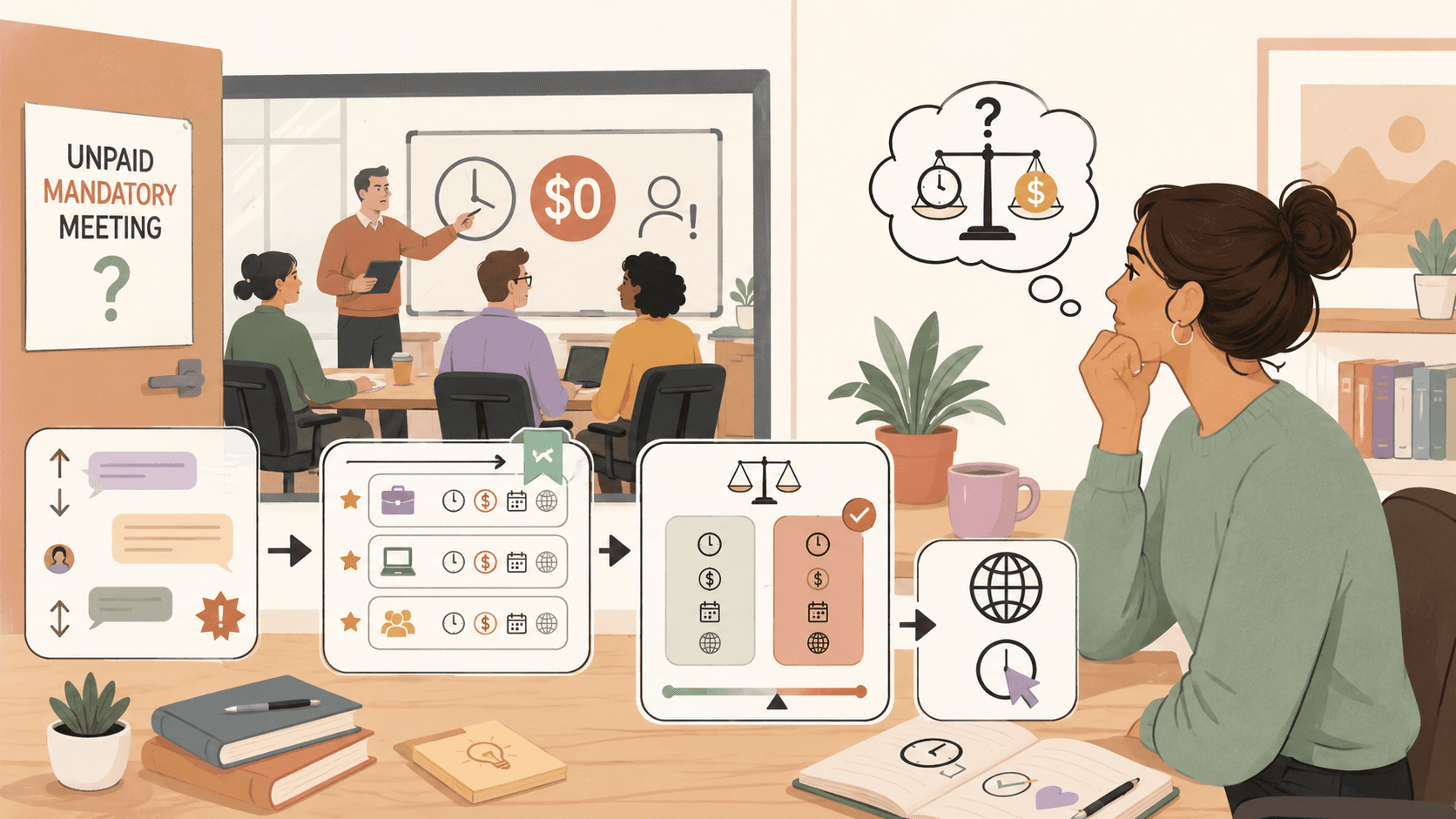
Can your boss require you to attend an unpaid meeting?
An employer can generally require employees to attend a work meeting. The separate question is whether the meeting time must be paid.
For hourly and other non-exempt employees covered by the Fair Labor Standards Act (FLSA), required meeting time is usually hours worked. Calling a meeting “unpaid,” holding it before a shift, or scheduling it over a meal period does not automatically remove the employer’s obligation to pay for the time.
This is general information, not legal advice. Your state may provide additional protections, and the result can depend on your worker classification, schedule, and what happened during the meeting.
When must a mandatory meeting be paid?
Under the U.S. Department of Labor’s general FLSA guidance, meeting or training time is usually excluded from hours worked only when all four of these conditions are met:
- Attendance occurs outside the employee’s regular working hours.
- Attendance is truly voluntary.
- The meeting is not directly related to the employee’s job.
- The employee performs no productive work during the meeting.
If attendance is required, the voluntary condition is not met. Time spent listening, participating, completing required exercises, or performing related work may therefore need to be counted as hours worked.
The FLSA rules can differ for exempt employees, independent contractors, and some other classifications. If you are unsure whether you are non-exempt, review your pay records and classification information and consider asking a qualified employment lawyer or your state labor agency.
Does “voluntary” really mean voluntary?
An employer may describe a meeting as voluntary, but the practical consequences matter. Attendance may not be genuinely voluntary if workers are told they must attend, are warned about discipline, are expected to explain an absence, or reasonably believe that declining could affect their schedule, evaluation, or continued employment.
Save messages that show what your employer actually required. Relevant records can include:
- Calendar invitations and meeting notices
- Emails, Slack messages, Microsoft Teams messages, or other instructions
- Texts or announcements describing attendance expectations
- Timecards, timesheets, pay stubs, and schedules
- Notes showing the meeting’s start and end time
- Evidence of work performed before, during, or after the meeting
You do not need to argue about the law in your first message. Start by creating a clear record of the time worked.
How should you ask your employer to pay for the meeting?
A neutral written question can help you get a direct answer and document your position. For example:
“I attended the required meeting on [date] from [start time] to [end time]. Should I add those hours to my time record, and where should I record them?”
If you were told not to record the time, you can write:
“Because attendance was required, I want to make sure the meeting time is recorded correctly. Please confirm how I should report it.”
Keep the response. Do not alter your time records to hide work that you performed. If your employer uses a specific timekeeping system, follow the normal process while retaining your own contemporaneous notes.
What if the meeting pushes you into overtime?
For a covered non-exempt employee, paid meeting time generally counts toward the workweek total. Under federal law, overtime is generally due after more than 40 hours worked in a fixed 168-hour workweek, although state law may be more protective.
For example, if you worked 39 hours and attended a required one-hour meeting, your total could be 40 hours. If you worked 41 hours and then attended a required one-hour meeting, your total could be 42 hours, which may affect overtime calculations. The actual calculation can depend on your regular rate, workweek, classification, and state law.
Do state laws provide additional meeting or reporting-time protections?
Yes. State rules can add protections beyond the FLSA. For example, California has reporting-time-pay rules that can apply when an employee reports to work but is furnished less than the expected amount of work, subject to exceptions and detailed requirements. That rule is not the same as a general rule that every meeting must be paid, so verify the facts with the California Labor Commissioner’s Office or the labor agency where you work.
Other states may have rules concerning call-in pay, show-up pay, meal periods, training time, or wage deductions. Check your state labor department’s current guidance rather than relying only on federal law.
What should you do if your employer refuses to pay?
Use a measured escalation process:
- Confirm the time. Write down the date, start and end time, location or platform, attendees, and what you did.
- Review your records. Compare your notes with the schedule, invitation, timecard, and pay stub.
- Ask payroll or a manager in writing. Request instructions for correcting the time and keep the response.
- Check company policy. Look for timekeeping, training, overtime, and complaint procedures.
- Contact the appropriate agency or adviser. The U.S. Department of Labor’s Wage and Hour Division, your state labor agency, a union representative, or an employment lawyer may help you evaluate next steps.
- Watch for retaliation. Keep records of negative schedule changes, discipline, threats, or other treatment that follows a wage complaint.
Do not delete messages or rely on memory alone. A simple chronological log can make it easier to explain what happened.
When is this a sign to compare other workplaces?
One disputed meeting does not establish that an employer is violating wage law. But repeated instructions to work off the clock, pressure to falsify time records, missing overtime, or retaliation can indicate a broader workplace problem.
If you are evaluating whether to stay, you can also compare legitimate work opportunities while preserving your records and considering your legal options. Get Sidequestboard for iPhone to monitor fresh public job opportunities in one feed while you decide whether this workplace is worth staying in. collects fresh public job and freelance opportunity posts in one feed, which can reduce the need to monitor communities such as Reddit, LinkedIn, and Discord separately. It is an opportunity-discovery tool, not a legal service and not a substitute for recovering unpaid wages.
Official sources
- U.S. Department of Labor: Fact Sheet #22, Hours Worked Under the Fair Labor Standards Act — federal guidance on meetings, training, and other time that may count as hours worked.
- U.S. Department of Labor: Wage and Hour Division — federal wage-and-hour information and complaint resources.
- California Labor Commissioner’s Office: Reporting Time Pay — an example of a state-specific rule; verify whether it applies to your circumstances.
Laws and agency guidance can change. Check the current official sources for the rules in effect where you work.
Sources
- U.S. Department of Labor, Wage and Hour Division — FLSA Hours Worked (Fact Sheet #22)
- Contra — Pricing — Official platform fee information; verify current terms before relying on pricing.
- U.S. Department of Labor — Termination — Official federal employment reference; state law, contracts, and employer policies may differ.
- Fact Sheet #22: Hours Worked Under the Fair Labor Standards Act — Official or institutional source referenced in the article body.
- Wage and Hour Division contact page — Official or institutional source referenced in the article body.
- U.S. Department of Labor: Wage and Hour Division — Official or institutional source referenced in the article body.
- California Labor Commissioner’s Office: Reporting Time Pay — Official or institutional source referenced in the article body.
Sources
- U.S. Department of Labor, Wage and Hour Division — FLSA Hours Worked (Fact Sheet #22)
- Contra — Pricing — Official platform fee information; verify current terms before relying on pricing.
- U.S. Department of Labor — Termination — Official federal employment reference; state law, contracts, and employer policies may differ.
- Fact Sheet #22: Hours Worked Under the Fair Labor Standards Act — Official or institutional source referenced in the article body.
- Wage and Hour Division contact page — Official or institutional source referenced in the article body.
- U.S. Department of Labor: Wage and Hour Division — Official or institutional source referenced in the article body.
- California Labor Commissioner’s Office: Reporting Time Pay — Official or institutional source referenced in the article body.