July 27, 2026
How to Compare Paid Projects with No Experience
To compare paid projects with no experience, score each opportunity by pay, scope clarity, portfolio value, credibility, response speed, and learning upside. Avoid vague unpaid tests, unclear ownership terms, and projects with no decision-maker. Start with small, well-defined work where the deliverable, deadline, and payment range are obvious.
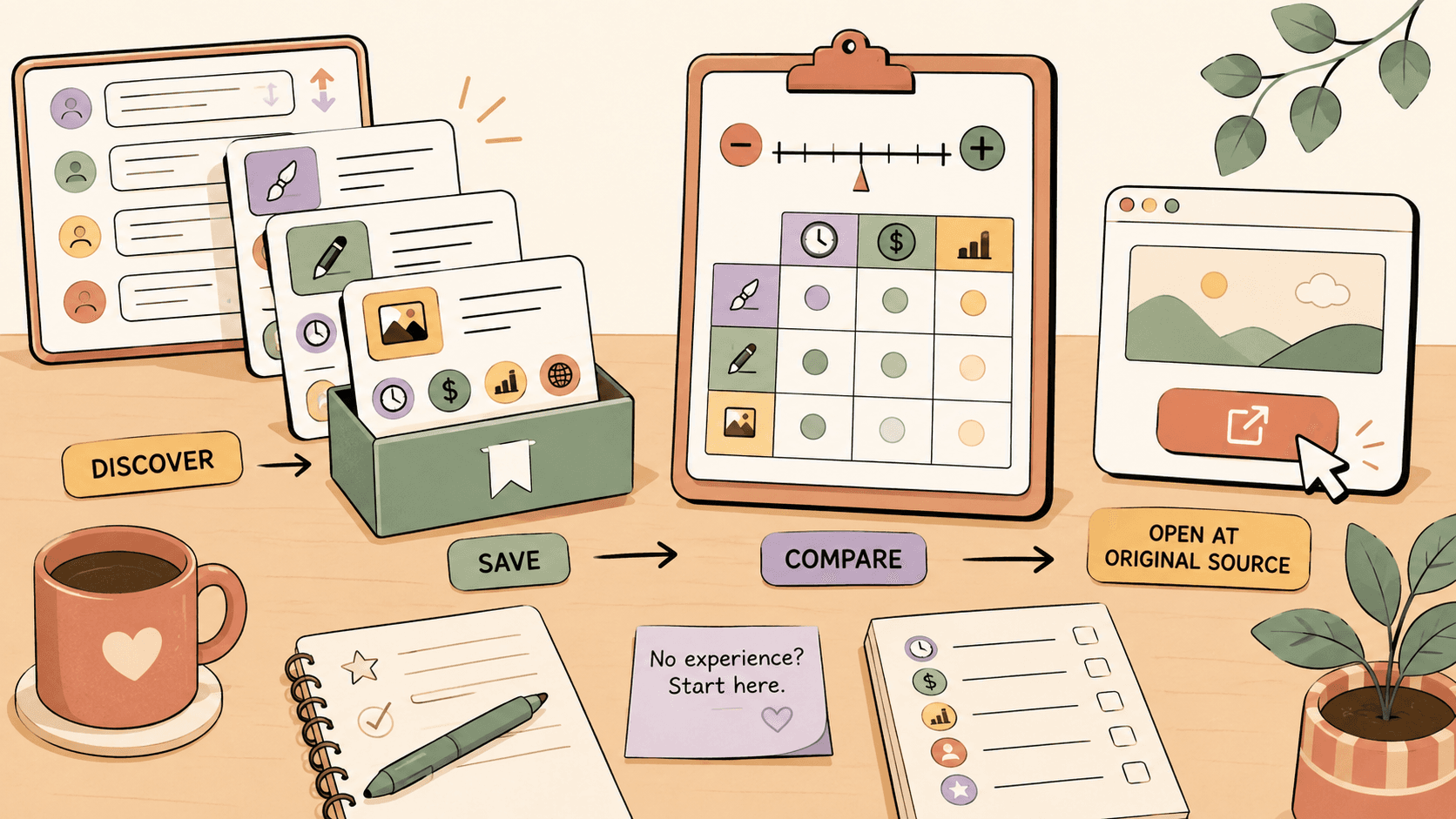
What should you compare first when you have no experience?
Compare scope before pay. Beginners often chase the biggest number and ignore how much work the project actually requires. A logo design project paying $200 with one concept, two revision rounds, and a one-week deadline can be healthier than a $700 “full brand identity” request that includes logo, colors, typography, social templates, packaging mockups, and unlimited revisions.
Use these rate benchmarks as a sanity check:
- Logo design: $200 to $2,000+
- UI design: $50 to $150/hr
- Graphic design: $30 to $100/hr
- Illustration: $50 to $500+ per illustration
These are not guarantees. They are comparison anchors. If a post asks for a full UI design system, five landing page mockups, and developer handoff for $75 total, the issue is not your lack of experience. The scope and pay do not match.
When I compare beginner opportunities, I put every project into one of three buckets:
- Clear small paid project: “Need one event poster by Friday, $150, print and Instagram sizes.” This is beginner-friendly if you can show relevant samples.
- Ambiguous project: “Looking for a designer for a cool startup. DM rates.” This needs clarification before you invest time.
- Speculative work: “Submit a full logo concept and we might pick you.” This may be practice, but it should not be treated like paid work until payment terms are real.
Use a simple formula: estimated hourly rate equals total pay divided by realistic hours. If a $200 logo project will take 8 hours including communication and revisions, it is roughly $25/hr. If a $300 illustration will take 3 hours, it is roughly $100/hr. Your immediate task: estimate hours before deciding whether the price is good.
Which platforms are worth checking for beginner paid projects?
Use a mix of communities and job boards because each source behaves differently. The best beginner workflow is not “apply everywhere.” It is “learn where each type of opportunity appears and compare them consistently.”
r/forhire has about 1.3M members and is one of the broadest places to watch for public freelance requests. Search for “designer” or “design” inside [Hiring] posts, then sort by New. You will see everything from quick one-off tasks to longer freelance contracts. Because it is broad, you need to check the poster’s account history, payment details, and whether the request is specific.
r/designjobs has about 150K members and is more focused. Check the [Hiring] flair for design projects. You may see logo, branding, UI, product design, and illustration requests. The quality varies, but the niche focus makes it easier to compare similar projects side by side.
r/Design has about 400K members. It is not only a jobs feed, but discussions can reveal leads. Networking here looks different: comment thoughtfully on process posts, share useful critiques, and pay attention when people mention needing help with design work. Do not spam pitches. Build visibility by being specific and helpful.
Dribbble Jobs at https://dribbble.com/jobs is useful for UI/UX, graphic design, and illustration roles. It is free to browse, and listings often look more polished than social posts. The tradeoff is competition and higher expectations for portfolio quality.
Behance Joblist at https://behance.net/joblist is free and focused on creative design roles. It is useful when your portfolio already lives on Behance or when a listing asks for visual work similar to what you have published.
99designs at https://99designs.com is different because it includes logo and branding design contests. Commission varies by contest. Contests can help you practice reading briefs and producing polished work, but you are competing against other designers and may not be paid unless selected. Compare contest work carefully against direct paid opportunities.
Your immediate task: pick three sources, not six. For example, check r/forhire, r/designjobs, and Dribbble Jobs for one week, then compare which source gives you the clearest beginner opportunities.
Track fresh opportunities on Sidequestboard
How do you know whether the pay is fair for a beginner?
Fair pay is not only about whether you are new. It is about the deliverable, usage rights, timeline, revision count, and communication load. A beginner can accept lower-end work to build proof, but low-end should not mean chaotic or unpaid.
For design work, compare the listed or implied rate against market ranges:
- A basic logo below $200 may be acceptable only if the scope is tiny, usage is limited, and revisions are minimal.
- A logo in the $200 to $500 range can be reasonable for an early portfolio project if the client has a clear brief.
- UI design below $50/hr is low compared with the $50 to $150/hr benchmark, so the project should be simple or strategically valuable.
- Graphic design around $30/hr can be a beginner entry point, while $100/hr usually requires stronger proof, speed, or specialization.
- Illustration priced at $50 can make sense for a small spot illustration, but not for a detailed commercial artwork with broad usage.
Walkthrough scenario: say you find a post on r/designjobs with [Hiring] flair: “Need a logo for a local coffee cart, $250, deadline next Friday, two concepts, two revision rounds, usage for website and packaging.” This is worth comparing. You estimate 6 to 8 hours total, so the project lands around $31 to $42/hr. It is below high-end branding rates, but reasonable for a beginner if you can use it in your portfolio and the payment terms are clear.
Now compare that with a 99designs branding contest offering a $300 prize. The brief asks for a logo, brand colors, and multiple mockups. You may spend 10 hours and still not win. The possible rate is $30/hr if selected, but $0 if not. That does not mean never use 99designs. It means limit contest entries and treat them as practice or portfolio attempts, not reliable income.
Your immediate task: calculate best-case and worst-case pay before responding. If the worst case is unpaid work, label it correctly in your sheet.
What red flags should beginners avoid before pitching?
Beginners are often targeted by vague posts because they are eager. You can avoid most bad projects by checking for clarity and credibility before sending a custom pitch.
Watch for these red flags:
- No budget or a budget hidden behind “DM me.”
- “Great exposure” instead of payment.
- Large unpaid test tasks that produce usable work.
- Unlimited revisions.
- No deadline, no deliverables, no decision-maker.
- Requests for source files before payment terms are set.
- A brand-new Reddit account posting an urgent paid request with no history.
- Contest-style wording in a supposedly direct paid gig.
On r/forhire, click the poster’s profile before replying. Check whether the account has normal history, prior hiring posts, or comments that make sense. If the account is empty and the post asks you to start immediately without payment details, slow down.
On r/designjobs, compare the [Hiring] post against other posts from the same week. A legitimate beginner-friendly post usually names the deliverable, rough budget, style direction, timeline, and contact method. A weak post often says only “Need designer ASAP.”
On Dribbble Jobs and Behance Joblist, red flags are usually different. Listings may look polished, but you still need to check whether the role is actually entry-level, whether it asks for years of experience, and whether the required portfolio matches your current work. Do not spend an hour applying to a senior UI role if the listing expects full product design ownership and you only have two landing page mockups.
Your immediate task: write one clarification message template. Example: “Hi, I’m interested. Before I send examples, can you confirm the deliverables, budget range, timeline, revision expectations, and whether the final work can be included in my portfolio?”
How should you compare portfolio value against immediate pay?
When you have no experience, portfolio value matters, but it should not be used to justify bad terms. The best beginner project gives you three things: a clear deliverable, a usable portfolio piece, and a testimonial or reference if the work goes well.
Score portfolio value from 1 to 5:
- 1: The work is private, generic, or cannot be shown.
- 2: You can describe it, but not show visuals or details.
- 3: You can show the final deliverable with limited context.
- 4: You can show before and after, process, and final output.
- 5: You can build a complete case study with problem, constraints, decisions, and measurable result.
A $150 event poster from r/forhire might score a 3 if you can show the final design. A $400 UI redesign from Dribbble Jobs might score a 5 if you can show user flow, wireframes, visual design, and final screens. A 99designs contest entry might score a 2 or 3 if it is not selected, because you can show the concept but not a real client result.
Here is a practical comparison:
- Project A: $200 logo, one week, clear owner, permission to show work. Portfolio score: 4.
- Project B: $500 anonymous startup deck redesign, cannot show publicly. Portfolio score: 1.
- Project C: $0 contest entry with good brief and no guarantee. Portfolio score: 2.
For a beginner, Project A may be the best move even though Project B pays more. You need proof you can finish real work with real constraints. That proof makes your next pitch easier.
Your immediate task: before accepting, ask for portfolio permission in plain language: “If the project is completed successfully, may I include the final work and a short summary in my portfolio?”
How do you compare multiple gigs from different websites?
Use a scoring system so you do not rely on emotion. I like a 25-point score because it is simple enough to use daily.
Score each opportunity from 1 to 5 in five categories:
- Pay fit: Does it match realistic rates for the work?
- Scope clarity: Are deliverables, deadlines, and revisions clear?
- Credibility: Does the poster or company look legitimate?
- Portfolio value: Can you show the work later?
- Speed to respond: Is the post fresh enough to be worth pitching?
Example walkthrough: you check r/forhire and search “designer” in [Hiring] posts, sorted by New. You find a post from 3 hours ago asking for a social media graphic pack for a podcast. Budget is $180 for 6 graphics. The poster has normal account history and gives a style reference. You score it:
- Pay fit: 3, because $30 per graphic can be acceptable if templates are similar.
- Scope clarity: 4, because the number of graphics and style direction are clear.
- Credibility: 4, because the account history looks normal.
- Portfolio value: 3, because you can show selected graphics.
- Speed: 5, because the post is only 3 hours old.
Total: 19 out of 25. That is worth a quick, tailored response.
Now compare a Behance Joblist post for a junior visual designer role. It is free to browse and the company looks real, but the listing asks for 2 years of agency experience, motion design, Figma, Adobe Illustrator, and packaging. You score pay fit unknown, scope broad, credibility high, portfolio value high, speed medium. If you have no experience, this might be a stretch application, not your highest-priority pitch.
Your immediate task: only respond immediately to opportunities scoring 18 or higher. Save 14 to 17-point opportunities for later review. Skip anything below 14 unless you have a strategic reason.
How can Sidequestboard help you compare opportunities without tab chaos?
Once you know how to score projects, the bottleneck becomes discovery. Checking r/forhire, r/designjobs, r/Design, Dribbble Jobs, Behance Joblist, 99designs, Discord communities, and X/Twitter searches can turn into a full-time task before you send a single pitch.
Sidequestboard is a curated opportunity discovery dashboard for fresh public posts from communities and social platforms. It helps you keep a calmer feed, save relevant opportunities, open the original listing or source, and respond directly there. It is not a marketplace and it does not act as a middleman. The value is workflow: less tab switching, more timely comparison.
A practical setup is simple. Use your scoring sheet as the decision layer, then use Sidequestboard as one place to spot and save fresh public opportunities that look relevant. When something promising appears, open the original source, verify the details, score it, and respond with a tailored message. That keeps you from losing good posts because they were buried in a noisy subreddit or social feed.
Your immediate task: if your current workflow is more than five recurring tabs, replace the first 20 minutes of manual checking with a saved-opportunity workflow and measure how many qualified pitches you send this week.
What should your first response include when you have no experience?
Your first response should reduce risk for the person hiring. Do not open with “I have no experience, but...” Open with relevance, proof, and a small next step.
Use this structure:
- Mention the exact project.
- Show one relevant sample, even if it is a self-initiated piece.
- Confirm you understand scope and timeline.
- Ask one smart question.
- Suggest the next step.
Example response for r/designjobs:
“Hi, I saw your [Hiring] post for a logo for a local coffee cart. I can help with two initial directions and two revision rounds this week. Here are two relevant logo samples: [link]. Before I quote final timing, do you need the logo for packaging as well as web/social? If the $250 budget is still available, I can send a short direction outline today.”
Example response for r/forhire:
“Hi, I found your post while searching [Hiring] designer posts. I can create the 6 podcast graphics using a reusable template so the set feels consistent. Similar sample: [link]. Can you confirm the required sizes and whether you already have brand colors? If yes, I can start with one draft concept before producing the full set.”
For Dribbble Jobs or Behance Joblist, make the response more portfolio-focused. Reference the role title, name the tools or deliverables listed, and point to the closest project in your portfolio. If you only have concept work, label it clearly as concept work.
Your immediate task: write three reusable pitch blocks: one for logo work, one for UI/UX work, and one for graphic design or illustration.
How many beginner projects should you take before raising your standards?
Do not stay in beginner mode forever. Your first 3 to 5 paid projects should build proof: finished deliverables, client communication practice, testimonials, and portfolio case studies. After that, start filtering harder.
Raise your standards when you have:
- At least 3 completed paid projects.
- At least 2 portfolio pieces you can show publicly.
- One testimonial, reference, or repeat client.
- A clear sense of how long common deliverables take you.
- A minimum acceptable hourly target.
If your first logo took 12 hours for $200, your effective rate was about $17/hr. If your third logo takes 6 hours at $300, you are at $50/hr. That is the kind of progress you can only see if you track time and scope. Use Toggl Track, Clockify, or a simple Google Sheet to record actual hours.
Your immediate task: after every project, write down quoted price, actual hours, number of revisions, and whether you would take a similar project again.
What is the simplest decision rule for beginners?
Use this rule: choose the project with the clearest paid scope, the lowest credibility risk, and the best reusable proof, not automatically the highest dollar amount.
For no-experience applicants, a good project usually looks like this:
- The budget is named or easy to confirm.
- The deliverable fits a known rate range, such as $200 to $2,000+ for logo design or $30 to $100/hr for graphic design.
- The post is fresh enough to justify responding.
- The source is specific, such as r/designjobs [Hiring], r/forhire [Hiring], Dribbble Jobs, Behance Joblist, or a clearly scoped 99designs contest.
- The work can become a portfolio piece.
- The first response can be short and specific.
Your immediate task: compare your next three opportunities using the 25-point score before sending any pitch. If none score above 18, keep looking instead of forcing a bad fit.