September 17, 2026
Which Freelance Marketplaces Pay Designers Better? Fees, Take-Home Pay, and Direct Channels Compared
Vetted networks like Toptal and direct clients tend to offer the strongest pay potential, but they take more effort to win. Upwork, Fiverr, and PeoplePerHour are easier entry points where fees and competition shrink take-home pay. Contra charges freelancers no commission, per its pricing page. Compare take-home after fees, not headline rates.
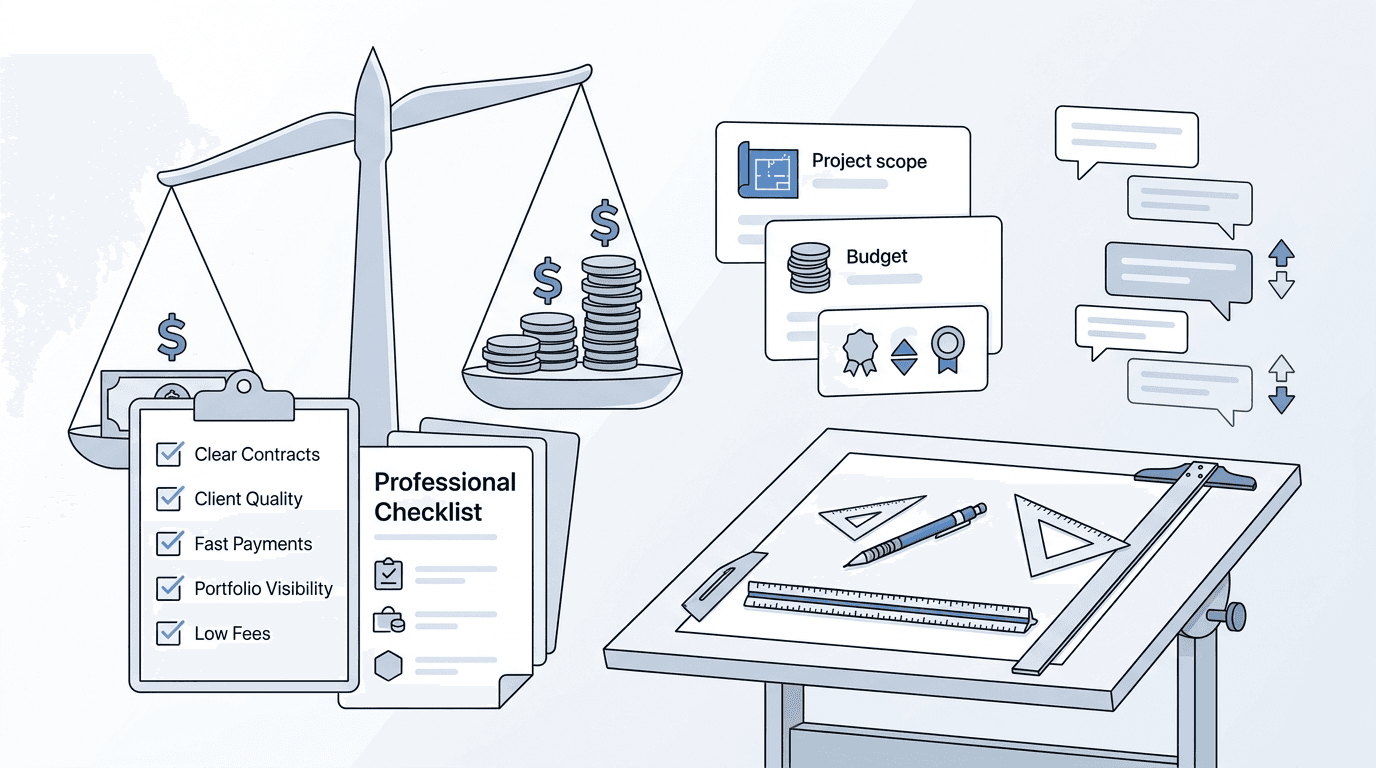
Which freelance marketplaces pay designers better?
No public, verified ranking of designer pay by platform exists, so be skeptical of any list that names a single winner. What you can say reliably is how each channel affects what you keep:
- Vetted networks (Toptal): clients pay the platform, and freelancers are not charged to join, per Toptal's model. Budgets tend to be higher, but screening is selective and slow.
- Direct clients (Reddit, Discord, referrals): no platform commission, so you keep the full payment. The cost is your time spent finding, screening, and contracting clients.
- Open marketplaces (Upwork, PeoplePerHour): high volume and easy entry, but service fees, paid proposals on Upwork, and many bidders pull effective pay down on small jobs.
- Gig marketplaces (Fiverr): buyers come to you with a defined scope, which helps for productized work. Commission is taken from each order, and buyers often compare on price.
- Commission-free profiles (Contra): Contra states it takes no commission from freelancers, but it usually brings less inbound demand, so you supply more of the leads.
Most working designers run two or three of these at once: one channel for steady inbound work and one for higher-margin direct clients.
How much do you keep from a $500 logo job after fees?
Headline rates mislead because fees and sourcing time both come out of what you earn. The numbers below are illustrative arithmetic, not any platform's actual rates. Check the official fee pages linked in Sources for current terms.
| Fee taken from the payment | Fee on a $500 job | You keep |
|---|---|---|
| 0% (direct client) | $0 | $500 |
| 10% | $50 | $450 |
| 20% | $100 | $400 |
Now factor in time. Say the logo takes 6 hours to design:
- Direct client, 4 hours spent finding and screening: $500 ÷ 10 hours = $50/hr.
- Marketplace with a 10% fee, 1 hour of proposals and messaging: $450 ÷ 7 hours = about $64/hr.
- Marketplace with a 20% fee and 4 hours lost to unsuccessful proposals: $400 ÷ 10 hours = $40/hr.
The lesson: a direct channel is not automatically better. It pays more only once you find clients faster, or win repeat work that removes the sourcing hours. A marketplace with a higher fee can still win if it fills your calendar quickly. If a platform charges for proposals, as Upwork does with Connects, add that cost per won job to the fee.
For your own channels, track net payment ÷ total hours, including pitching.
What should you compare before picking a marketplace?
Define "better work" first, then score each option on six criteria:
- Client vetting. Vetted networks like Toptal screen freelancers. Open marketplaces leave more screening to you.
- Fee model. Commission on earnings, paid proposals, optional paid tools, or none. Small projects feel fees most.
- Payment protection. Platform-mediated payment protects you. Moving payment off-platform usually removes that protection.
- Portfolio fit. Visual specialties need a place to show finished work, not just a text proposal.
- Competition level. Open job posts attract many bidders. Gigs and direct briefs behave differently.
- Demand you must bring. Commission-free and showcase platforms often expect you to drive your own traffic.
Red flags on any platform: unpaid spec work, pressure to pay or get paid outside the platform, and briefs with no budget or scope.
How do Upwork, Fiverr, Toptal, Contra and PeoplePerHour compare for designers?
| Platform | Type | Fee model | Best for | Competition | Effort to start |
|---|---|---|---|---|---|
| Upwork | Open marketplace | Service fee on earnings; paid Connects for proposals | Long-term clients, first reviews | High | Medium |
| Fiverr | Gig marketplace | Commission on orders | Productized design services | Very high | Low |
| Toptal | Vetted network | No charge to freelancers; clients pay | Senior designers | Screening-gated | High |
| Contra | Profile and project network | No commission for freelancers; optional paid tools | Keeping full earnings | Growing | Medium |
| PeoplePerHour | Open marketplace | Service fee on earnings | UK/EU clients, hourly work | Medium | Low–Medium |
Fee terms change, so each platform's official fee page (linked in Sources) is the authority for current percentages.
Upwork
Best for: designers who want long-term clients and a fast review history. You buy Connects to submit proposals, and clients can also invite you. Target small, specific jobs ("redesign a five-page Squarespace site") rather than broad briefs. Fees and Connects costs squeeze margins on small jobs, and generic briefs invite race-to-the-bottom pricing.
Fiverr
Best for: designers who can productize a service. You list tiered gigs (Basic/Standard/Premium), so tight scope wins: "brand identity kit, 5-day delivery, 2 revisions." "I will design a logo" drowns in the results, while "brand kit for SaaS startups" surfaces.
Toptal
Best for: senior designers. Toptal presents itself as highly selective and cites a small acceptance rate. Read that as marketing for "highly selective," not a precise statistic. Expect a multi-stage screening process that takes weeks, which makes it a poor fit for early-career designers.
Contra
Best for: designers who already have some demand and want to keep full earnings. Contra says it charges freelancers no commission and monetizes through optional paid tools. Use it as a profile-plus-invoicing home base, and bring your own traffic.
PeoplePerHour
Best for: UK/EU clients and hourly work. It charges service fees on earnings and has medium competition, which makes it a lower-pressure complement to Upwork.
Are Behance, Dribbble and 99designs worth using?
They serve different purposes than the general marketplaces:
- Behance: Adobe's portfolio platform. Best for designers with strong visual case studies. Treat it as a discovery and credibility channel, not a guaranteed source of paid projects.
- Dribbble: a design community and portfolio network that also runs a job board. It suits UI, product, and brand designers who can show polished work and process.
- 99designs: clients commission design through contests or direct projects. In contests, designers typically submit work hoping to be selected, which means unpaid effort for everyone who isn't chosen. Read its payment rules for the format before entering.
A showcase profile works best next to a marketplace profile: one proves your taste, the other gives clients a way to hire you.
Do direct clients pay designers more than marketplaces?
Often they can, because there is no platform commission and you set the scope and price. The trade is work: you screen posters, negotiate terms, and handle invoicing. Subreddits like r/forhire, r/designjobs, and r/HireanArtist, plus design Discord servers where studios post briefs, are the most common places to find direct design work.
A practical daily loop:
- Search, don't scroll. Use queries like
[Hiring] logo OR branding, or filter by hiring flair, sorted by new. - Verify the poster. Check account age, post history, and whether earlier [Hiring] posts resolved. Ask for a call or deposit before producing work.
- Reply early. Popular posts can collect dozens of replies. Lead with one concrete observation about the brief, then two relevant samples, never a generic pitch.
Timing is where designers lose direct work. Imagine a seed-stage SaaS founder posting "[Hiring] brand identity, logo plus color system" in r/forhire. Seen within the first half hour, you can reply with a specific observation and two matching samples. Found six hours later, you're one of dozens of replies, and the founder may already be on a call with someone else. Checking several subreddits, Discords, and marketplaces by hand makes late discovery common.
Sidequestboard is a discovery layer for that problem, not a marketplace. It pulls fresh opportunity posts from public communities like Reddit into one feed. A designer's morning might be: scan the feed, save the brand and UI posts that fit, open each original post, and send a reply built on one specific observation plus two samples. You apply at the original source with no commission and no middleman, so you keep the client relationship. It doesn't guarantee replies or clients. It helps you spend less time searching and more time pitching.
Which platforms fit your design specialty?
These are starting points, not rankings:
| Specialty | Channels to try | Why |
|---|---|---|
| Brand/logo | Fiverr, 99designs, Upwork, Behance | Packageable scope and visual proof |
| UI/UX product design | Dribbble, Upwork, Toptal (senior), direct clients | Clients hire for process and outcomes, often over longer engagements |
| Illustration | Behance, Contra, r/HireanArtist | Clients hire on style, so visibility matters |
| Presentation/social graphics | Fiverr, Upwork, PeoplePerHour | Repeatable, quick-turnaround work that can recur |
Rates differ sharply between specialties, so benchmark against portfolios in your niche rather than platform averages.
How do you turn your profile into better-paid work?
- Position in a niche. "Brand kits for SaaS startups" beats "graphic designer."
- Publish two or three case studies. Show the brief, the key decision, and the result in plain language.
- Scope your offer. On Fiverr, build gigs with clear deliverables and revisions. On Upwork, write proposals around one specific observation about the brief plus two relevant samples.
- Test higher prices. Once you have a handful of strong reviews, raise your price 15–20% on your next three gigs or proposals. Track whether inquiries and win rate hold. This is a rule of thumb, not a guarantee, so let your own numbers decide.
How do you avoid scams on marketplaces and Reddit?
- Keep payment on-platform until you have a track record with that client. Going off-platform can void escrow-style protection.
- On Reddit, ask for a deposit or milestone payments before starting. Resistance to milestones is a top red flag.
- Verify identity: a real company site, a video call, a professional footprint. Be skeptical of new accounts posting urgent, high-budget briefs.
- Refuse unpaid test or spec work beyond a small, clearly paid trial.
- Scope in writing: deliverables, revision count, timeline, and usage rights. Vague usage rights cause disputes later.
Which mix should you start with?
If you're new: Fiverr gigs, Upwork proposals, a Behance or Dribbble profile, and a daily 20-minute scan of direct channels. Once you have solid reviews, shift weight toward Contra and direct clients. If you're senior: a vetted network like Toptal plus direct channels from the start, since open marketplaces can cost you margin at that level.
FAQ
Which freelance marketplace pays designers the most?
No verified, public ranking names one. Vetted networks and direct clients tend to bring larger budgets and less price competition, but both take more upfront effort. Upwork and Fiverr are easier places to build your first reviews.
Does Fiverr or Upwork take a bigger cut from designers?
Both charge freelancers fees, structured differently and subject to change. Upwork uses service fees plus paid Connects for proposals, while Fiverr takes a commission on orders. Compare current terms on each platform's official fee page, then calculate take-home on a sample job.
Is Contra really commission-free for designers?
Contra states that it does not take a commission from freelancers and monetizes through optional paid tools. It generally brings less inbound demand than Upwork or Fiverr, so many designers use it alongside other channels. Verify current terms on its pricing page.
Are Behance and Dribbble freelance marketplaces?
Primarily they are portfolio and showcase platforms. Dribbble also has a job board, but neither works like a gig marketplace where you bid or sell packages. Use them to build credibility and be discovered, alongside a platform where clients can hire you.
How do I compare take-home pay across platforms?
Divide the net payment (after fees and any proposal costs) by total hours, including time spent pitching and messaging. Run that number for each channel on a recent project to see which one actually pays you best.
Sources
- Upwork — Freelancer Service Fee — Upwork's official help page on freelancer service fees.
- Fiverr — Your Earnings — Fiverr's official help page on seller earnings and fees.
- PeoplePerHour — Service Fees — PeoplePerHour's official help page on freelancer fees.
- Contra — Pricing — Contra's official pricing page, including its stated commission-free model for freelancers.
- Toptal — Toptal's official site, for its selectivity and screening description.
- Contra — Source consulted for the article research.