August 21, 2026
How to Ask for a Raise Without Getting Fired: Scripts, Timing, and a Backup Plan
Ask for a raise as a business conversation, not an ultimatum. Choose a calm time, show measurable results, research comparable pay by location and level, and make a specific request. If your manager says no, ask what would change the decision, document the answer, and quietly review outside opportunities.
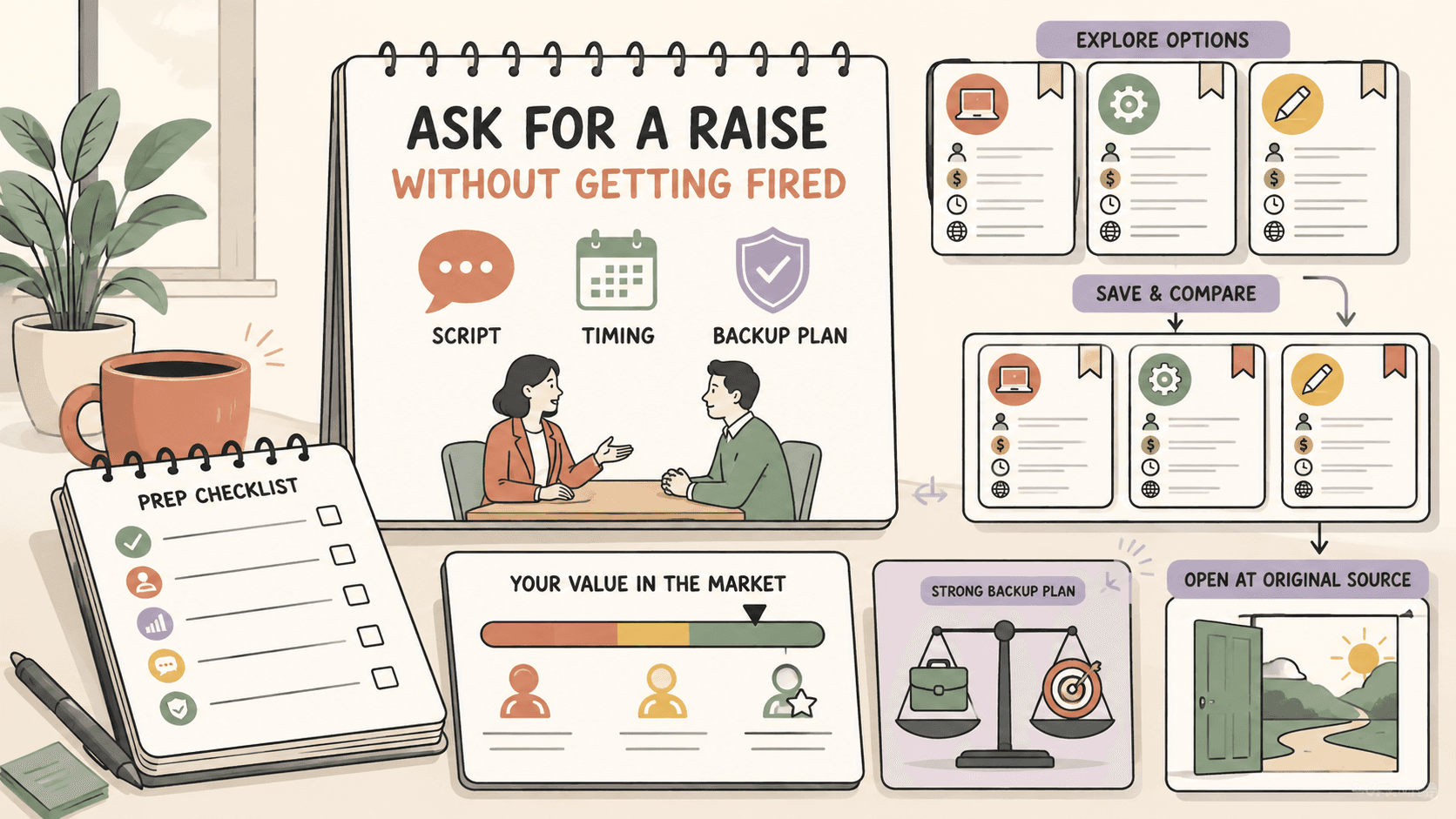
How should you prepare before asking for a raise?
Start by building a short evidence file. Focus on work that mattered to the organization rather than simply listing everything you have done.
Useful evidence can include:
- Revenue generated, costs reduced, or time saved
- Projects delivered early or under difficult conditions
- Increased customer retention, quality, efficiency, or satisfaction
- Responsibilities you now handle beyond your original role
- Positive feedback from customers, colleagues, or senior stakeholders
- Specialized skills, certifications, or tools that make your work more valuable
- Clear examples of problems you solved without close supervision
Write each example in a simple format:
Situation → action → measurable result
For example: “The weekly reporting process took most of Monday. I automated the recurring steps and reduced preparation time, giving the team more time for analysis.” Use your real result where you can. Do not exaggerate, claim credit for team achievements alone, or include confidential information.
Also decide what you are requesting. A specific percentage or salary figure is easier to discuss than “I want to be paid more.” Prepare a target, a reasonable minimum, and alternatives you would consider if the budget is limited. Alternatives might include a review date, a title change, additional paid leave, training support, a bonus, or a change in responsibilities. These are not equivalent to base pay, so treat them as separate options rather than silently accepting a substitute.
When is the best time to ask for a raise?
Choose a private, scheduled conversation when your manager has enough time to listen. A short request for a dedicated meeting is usually better than raising compensation during a rushed hallway conversation, a public meeting, or a stressful deadline.
Good timing may include:
- After you have completed a meaningful project successfully
- During a normal performance or compensation review cycle
- When your responsibilities have materially expanded
- After you have collected several recent examples of strong performance
- Before planning and budgeting decisions are finalized, if you know that timing
Avoid making the request immediately after a mistake, during a crisis, or when your manager is visibly distracted. You do not need to wait for a perfect moment, but you should choose a conversation where both people can focus.
You can ask for the meeting with this message:
“Could we schedule 30 minutes to discuss my responsibilities, recent results, and compensation? I’d like to review how my role has developed and talk about the next step.”
This wording gives your manager context without turning the calendar invitation into a demand.
Track fresh opportunities on Sidequestboard
How do you research a realistic salary range?
Use more than one source, and compare roles that actually resemble yours. Salary data can vary substantially by location, level, industry, company size, responsibilities, and whether the role is remote or in person.
Depending on your role and location, check sources such as:
- Glassdoor
- Levels.fyi, particularly for comparable technology roles
- Payscale
- Salary.com
- The U.S. Bureau of Labor Statistics for relevant occupation and wage data
- Professional associations or unions in your field
- Recent job postings with disclosed compensation ranges
Filter results by geography, seniority, role scope, and required skills. For a remote position, check how the employer defines location-based pay. Treat online ranges as research, not proof that your employer owes you a particular number. Before using a figure in the meeting, verify that the source is current and that the comparison is genuinely relevant. Official employer postings and government labor data can be especially useful, but they may not cover every occupation or company.
What should you say when asking for a raise?
Keep the conversation direct and evidence-based. A useful structure is:
- State that you value the role and want to discuss compensation.
- Summarize your most important results.
- Explain how your responsibilities or contribution have changed.
- Make a specific request.
- Ask what the decision process and timeline look like.
A sample script is:
“I appreciate the opportunity to work on this team. Over the past several months, I delivered [result], took ownership of [responsibility], and helped [measurable outcome]. My role has expanded beyond the original scope, and I’d like to discuss adjusting my salary to [specific figure or range]. How does that fit with the team’s compensation process?”
After making the request, stop talking. Give your manager time to respond. You do not need to fill the silence by apologizing, minimizing your contribution, or immediately offering to accept less.
How can you ask for a raise without sounding threatening?
Avoid language that turns the discussion into a test of loyalty. Do not say that you will resign tomorrow, compare yourself aggressively with a named colleague, or imply that your manager is incompetent for not agreeing immediately.
Instead of:
“Pay me more or I’m leaving.”
Try:
“I want to continue contributing here, and I’d like my compensation to reflect the scope and results of my work. What options are available?”
If you have another offer, be honest about it and do not use a fabricated offer as leverage. A genuine outside offer may change the conversation, but it can also make your employer question whether you intend to stay. Mention it only if you are prepared for the possibility that the company cannot or will not match it.
What should you do if your manager says no?
A “no” can mean several different things: the company has a budget freeze, the timing is wrong, your manager needs more evidence, your role is not currently eligible, or the organization does not plan to adjust your pay. Do not guess which explanation applies. Ask calmly for specifics.
You can say:
“I understand that you cannot approve this today. Could you help me understand the main reason, what results or changes would support a future review, and when we should revisit the conversation?”
If the answer is vague, follow up with questions such as:
- Is the constraint the company budget, my performance, my level, or the timing?
- What specific outcomes would demonstrate readiness for an adjustment?
- Who is involved in the decision?
- Can we put a review date on the calendar for 60 or 90 days from now?
- What compensation alternatives, if any, are available now?
Send a brief follow-up email summarizing the agreed criteria and date. Keep the tone neutral. Written clarity helps you determine whether the “not now” is a real plan or an indefinite delay.
How do you handle a budget freeze?
A budget freeze does not automatically mean your request was rejected permanently. Ask whether the freeze affects all compensation decisions, whether exceptions exist, and when the budget will be reviewed again. Do not assume that a promised future review will happen without a date and measurable criteria.
A practical response is:
“Thanks for explaining the budget constraint. I’d like to keep working toward this. Could we agree on the outcomes you want to see and schedule a review for 90 days from now? If base pay cannot change then, I’d also like to discuss whether another form of compensation is available.”
Then document your progress. If the review date passes without a meaningful discussion, treat that information as part of your career decision-making.
Should you look for other opportunities after a raise request is rejected?
A quiet backup plan can reduce pressure without forcing you to resign. It is especially reasonable when your responsibilities have grown repeatedly without recognition, your manager will not provide criteria or a timeline, or the organization has communicated that compensation is unlikely to change.
Keep the search discreet and professional. Do not use company time, equipment, confidential data, or internal contacts improperly. Begin with a focused routine:
- Define the roles, locations, work arrangements, and minimum requirements that fit your situation.
- Choose a few relevant public sources, such as LinkedIn Jobs, Indeed, Wellfound, industry job boards, professional associations, or communities for your field.
- Spend 25 minutes reviewing new opportunities on a consistent schedule.
- Save only roles that meet your criteria and record the original source.
- Apply or respond selectively instead of collecting dozens of unsuitable listings.
- Review your notes before the next compensation conversation.
A software engineer might monitor technology job boards and professional communities. A marketer might track agency roles, contract projects, and specialist communities. A teacher, analyst, healthcare worker, salesperson, or operations professional can use sources specific to their profession. The point is not to search every platform; it is to create a repeatable way to notice relevant work while it is still available.
Sidequestboard can be a useful next step for people who monitor public communities and social platforms for freelance, job, or project leads. It brings relevant public opportunity posts into a calmer feed, lets you save interesting listings, and opens the original source so you can review and respond there. It is a discovery workflow, not a promise of employment or income.
What does a realistic backup-plan routine look like?
Suppose your manager says the company is under a budget freeze but agrees to review your results in 90 days. On the same day, you write down the agreed criteria and calendar date. During the next few weeks, you spend a short, regular block reviewing opportunities that match your skills and constraints. You save a small number of relevant listings, open the original posts to check their details, and prepare applications only for roles worth pursuing.
After a month, you have better information about the market and your alternatives. At the review date, you can discuss your documented results with less anxiety. If the raise is approved, you can make an informed decision about staying. If it is not, you have already begun exploring options rather than starting from zero.
What mistakes should you avoid when asking for a raise?
Avoid these common errors:
- Asking without examples of business or team impact
- Using personal expenses as the main justification
- Demanding a figure you cannot explain
- Relying on one unverified salary post
- Threatening to leave when you are not ready to do so
- Comparing your pay publicly with a coworker
- Accepting a vague promise without criteria or a review date
- Discussing confidential salary or company information carelessly
- Searching for outside work on company systems
- Assuming a rejected request means you must resign immediately
A strong conversation combines preparation with patience. You are asking for a business decision, and the answer also gives you information about how your employer evaluates and rewards work.
Frequently Asked Questions About Asking for a Raise
Can asking for a raise get me fired?
A professional request does not automatically justify termination, but workplace rules and legal protections vary by location and circumstance. Avoid threats, dishonesty, harassment, and misuse of confidential information. If you fear retaliation or discrimination, consult official labor guidance or a qualified employment professional before acting.
How much should I ask for in a raise?
There is no universal percentage. Base your request on comparable compensation research, your location and level, the scope of your role, and measurable results. Give a specific figure or narrow range you can explain, and verify salary data before relying on it.
What if my manager says there is no budget?
Ask whether the restriction is temporary, what criteria would support a future adjustment, and when the issue can be reviewed. Request a specific date and summarize the agreement in writing. You may also ask whether other forms of compensation are available, while recognizing that they are not the same as a salary increase.
Should I mention that I am interviewing elsewhere?
Mention an outside offer only if it is genuine and you are prepared for the possibility that your employer will not match it. Do not invent leverage. If you are only beginning to explore, you can keep that search private and focus the raise conversation on your results and responsibilities.
How can I search for work quietly after a rejected raise request?
Use personal devices and accounts, search outside working hours, and avoid sharing confidential information. Select a small number of relevant public sources for your profession, review them on a consistent schedule, save promising listings, and open the original source before applying or responding.