August 29, 2026
How to Become a Freelance Videographer in 2026: A Practical Beginner’s Guide
To become a freelance videographer, choose a focused service, create three to five relevant portfolio samples, define your process and pricing, and contact potential clients with a specific idea. Look for work on Upwork, Fiverr, Contra, Reddit, and other public communities, then track each opportunity and follow up consistently.
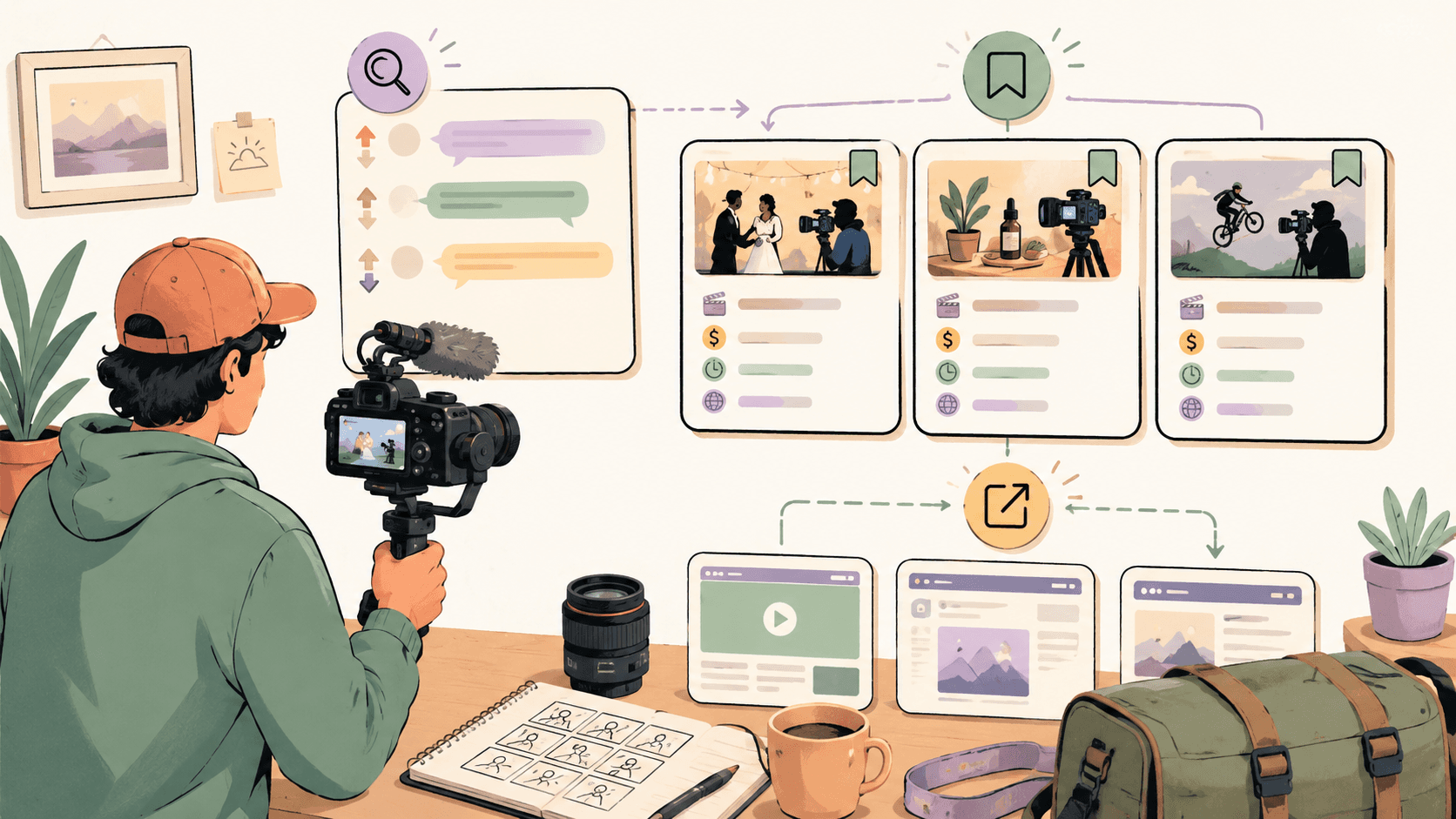
What does a freelance videographer do?
A freelance videographer works independently on video projects for clients rather than holding a permanent role with one employer. Depending on the project, the work may include planning, filming, lighting, audio, editing, color correction, captions, exporting, and delivery.
Common freelance services include:
- Event and wedding videography
- Short-form videos for TikTok, Instagram, YouTube Shorts, and other social channels
- Video editing for creators, coaches, agencies, and small businesses
- Product demonstrations and promotional videos
- Interviews, testimonials, and talking-head content
- Real-estate walkthroughs
- YouTube filming and editing
- Motion graphics, subtitles, and repurposing long videos into clips
You can start with filming, editing, or both. Editing-only work may be easier to perform remotely, while filming work usually requires local availability, equipment, and travel planning.
How should you choose a freelance videography niche?
Start with the overlap between your skills, available equipment, location, and the type of client you can realistically reach. A niche does not have to be permanent. It is simply a clear starting position.
Use this formula:
I help [type of client] create [type of video] for [specific purpose].
Examples:
- I help fitness studios turn class footage into short social videos.
- I edit educational YouTube videos into polished episodes and short clips.
- I film customer testimonials for local service businesses.
- I create product demonstration videos for online brands.
A focused offer is easier to show in a portfolio than a general statement such as “I make all kinds of videos.” You can expand your services after you understand which projects you enjoy and which clients respond to your work.
See fresh gigs on Sidequestboard
What equipment do you need to start freelance videography?
You can begin with equipment you already own if it produces footage suitable for your chosen service. The right setup depends on whether you are filming, editing, or both.
For filming, consider:
- A camera or smartphone that can produce appropriate video for the client’s platform
- A stable tripod or support
- An external microphone or a plan for recording clean audio
- Basic lighting or access to suitable natural light
- Spare batteries, storage, and a reliable backup process
For editing, consider:
- A computer that can handle your expected footage and editing software
- Storage for project files and backups
- Editing software you know well
- A method for collecting footage, notes, revisions, and final exports
Do not buy a large amount of equipment before you know what clients request. Rent or borrow specialized gear when a project justifies it, and include equipment, travel, and production time in your project scope.
How do you build a freelance videography portfolio with no clients?
You can create portfolio samples without waiting for a paid client. The goal is to demonstrate the exact service you want to sell.
Create three to five samples such as:
- A 15- to 30-second promotional clip for a fictional local business
- A before-and-after editing example
- A short product video using an item you already own
- A talking-head video with captions, sound cleanup, and purposeful cuts
- A long recording repurposed into several short clips
- A short event-style sequence filmed at a permitted personal or community gathering
Label personal or self-directed work honestly. Do not present a spec project as paid client work.
A simple portfolio structure is enough:
portfolio/
  showreel.mp4
  sample-01-social-clips.mp4
  sample-02-product-video.mp4
  sample-03-interview-edit.mp4
  services-and-process.pdf
  contact.txt
For each sample, explain the objective, your role, the tools or techniques used, and the final deliverables. A client should be able to understand what you can do without watching every piece in full.
You can host work on a personal website, Vimeo, YouTube, or a portfolio page. Check privacy, music licensing, and permission requirements before publishing footage that includes other people or commercial material.
How should you price freelance videography work?
Choose a pricing method that matches the project. Common options include an hourly or day rate for clearly defined labor, a project price for a specific package, and a recurring monthly arrangement for repeat content.
Before quoting, clarify:
- What needs to be filmed or edited
- How much raw footage is involved
- The number and length of final videos
- The required aspect ratios and platforms
- Turnaround time
- Number of revision rounds
- Whether travel, equipment, actors, music, or locations are included
- Who owns or can use the final files
- Whether the client needs project files or only exported videos
A simple quote can be structured as:
Pre-production: included or separately priced
Filming or editing: defined by hours, days, or deliverables
Included revisions: clearly stated
Extra revisions: priced separately
Travel and external costs: listed separately
Delivery: file format, deadline, and transfer method
Payment schedule: stated before work begins
Avoid copying an exact rate from a generic online guide. Prices vary by location, specialization, footage volume, turnaround, equipment, client requirements, and experience. Marketplace fees and payment terms also vary by platform, plan, contract, and seller status, so verify current details on the official platform page before accepting work.
A short written scope prevents many disputes. If a client asks for “a video,” ask what success looks like, where it will be published, and what they expect you to deliver.
Where can freelance videographers find clients?
Use several channels, but make each search specific to your service.
Freelance marketplaces
Upwork, Fiverr, and Contra can help you present services or respond to project briefs. Each platform has its own profile rules, fees, payment process, and competition. Review the current official terms before relying on any platform for income.
Your profile should state:
- The type of video work you provide
- The client or industry you understand
- Your typical deliverables
- Your turnaround assumptions
- A link to relevant samples
- The information you need before quoting
Public communities
Reddit and other public communities may contain relevant project posts, but quality and availability vary. Search for the service rather than browsing every general work forum.
Useful search patterns include:
site:reddit.com/r/forhire videographersite:reddit.com/r/forhire video editorsite:reddit.com/r/forhire "short-form video"site:reddit.com/r/forhire "video editing"
Filter for recent posts and read the complete listing. Prioritize opportunities that identify a real scope, deliverables, timeline, location or remote requirements, and a way to respond. Treat requests for unpaid work, vague promises, or sensitive personal information cautiously.
Direct outreach
Make a list of businesses, creators, agencies, venues, and organizations whose existing video could be improved. Send a short message that references something specific and proposes one useful next step.
For example:
Hi, I noticed your recent class videos explain the workout well but are mostly horizontal. I edit short vertical clips with captions for fitness businesses. I could turn one existing recording into three platform-ready clips. Here are two relevant samples: [links]. Would you like a brief scope and estimate?
Do not send the same generic pitch to hundreds of people. Relevance matters more than volume.
How do you write a strong pitch for a video project?
A useful first message can fit into four parts:
- Context: Show that you read the opportunity or understand the business.
- Relevant capability: State the specific video service you offer.
- Proof: Link to one or two matching samples.
- Next step: Ask a simple question or suggest a short call.
For a fitness studio opportunity, you might propose turning one class recording into a set of short clips, then ask whether the studio already has footage and which platform matters most. That is more useful than sending a general reel with no explanation.
Keep a record of where you applied, the contact, the requested deliverables, the date sent, and the follow-up date. A spreadsheet, Notion database, or Trello board can work. The system matters less than keeping the information current.
How can you organize a 30-day beginner plan?
| Period | Main goal | Practical output |
|---|---|---|
| Days 1–7 | Choose an offer | One target client, one service, and a list of required skills |
| Days 8–14 | Build proof | Three relevant samples and a simple portfolio page |
| Days 15–21 | Prepare to sell | A service description, quote template, and pitch template |
| Days 22–30 | Find opportunities | Targeted applications, direct outreach, and recorded follow-ups |
Review the results at the end of the month. If people view your work but do not respond, improve the offer or make the samples more relevant. If people ask questions but do not proceed, clarify scope, timing, revisions, or pricing.
The goal of the first month is not to look like a full production company. It is to create enough proof and consistency to have better conversations with potential clients.
How can you find fresh video opportunities without checking every site manually?
Monitoring marketplaces, Reddit communities, creator groups, and social feeds can become a time-consuming routine. Relevant posts may be mixed with unrelated work, and a good opportunity may no longer be available by the time you see it.
Sidequestboard can be a useful next step for a videographer who wants a calmer way to monitor public opportunities. You can save posts that request video editing, social clips, event coverage, or product video, then open the original source to verify the location, footage requirements, budget, deadline, and usage rights before responding.
That does not replace reviewing the original listing or evaluating the client. It gives you a place to find and save relevant leads so less of your working time goes toward repeatedly searching across separate communities.
What should you do before accepting a project?
Confirm the following in writing:
- Client name and communication channel
- Exact deliverables and file formats
- Source footage and who provides it
- Deadline and review milestones
- Number of included revisions
- Total price and payment schedule
- Travel, equipment, music, and other external costs
- Usage rights and ownership terms
- Cancellation or rescheduling expectations
For filming projects, confirm the location, access, lighting, audio conditions, release permissions, and backup plan. For editing projects, request a representative sample of the footage before promising a deadline.
Do not begin substantial work based only on a vague chat message. A clear scope protects both sides and gives you a professional way to handle changes.
How do you grow after your first freelance videography projects?
After each project, record what actually happened:
- How long planning, filming, editing, and revisions took
- Which client questions appeared repeatedly
- Which deliverables were most profitable or enjoyable
- Where the project exceeded the original scope
- Whether you can request a testimonial or permission to show the work
Use those observations to improve your packages. You may eventually specialize in a client type, offer monthly content support, raise your project minimum, or subcontract parts of production. Growth usually comes from a clearer offer and repeatable process, not from adding every possible service.
FAQ
Can I become a freelance videographer without a degree?
Yes. Clients generally need evidence that you can produce the requested result. A focused portfolio, clear communication, reliable delivery, and relevant samples can demonstrate your ability more directly than a credential alone.
Can I start freelance videography with a smartphone?
You can create some portfolio samples and social videos with a smartphone, especially when the service emphasizes editing, vertical content, or controlled lighting. Use equipment appropriate to the client’s requested quality, audio needs, and production setting.
How many portfolio samples should a beginner have?
Three to five relevant samples are enough to start a focused portfolio. Relevance is more valuable than a large collection of unrelated work. Show the type of video and client problem you want to handle.
Where should a freelance videographer look for work?
Try Upwork, Fiverr, Contra, Reddit communities, direct outreach, local business networks, and creator groups. Search for specific services such as video editing, short-form video, event coverage, or product video, and verify the current rules and fees for each platform.
Should I charge hourly or per project?
Use hourly or day-based pricing when the scope is uncertain or labor is the main variable. Use project pricing when the deliverables, revisions, and deadline are clear. In either case, define what is included and how additional work will be priced.