July 27, 2026
How to Compare Contract Opportunities as a Beginner: Pay, Scope, Fees, and Red Flags
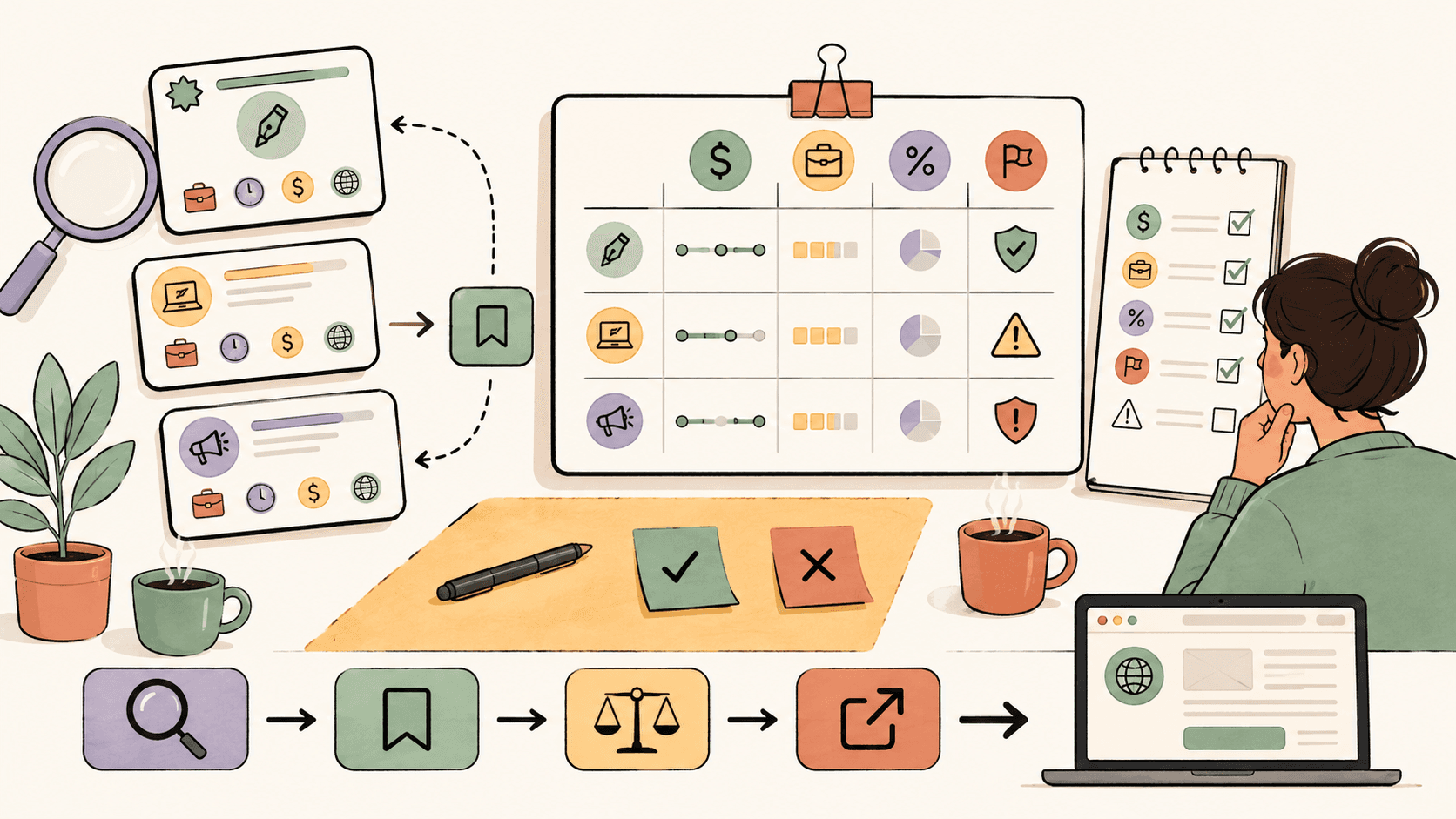
To compare contract opportunities as a beginner, score each option by pay, scope clarity, time required, platform or payment fees, client legitimacy, deadline pressure, and portfolio value. Prefer small, specific projects with clear deliverables and payment terms. Avoid vague posts, unpaid tests, rushed requests, and offers where fees make the work unprofitable.
What should beginners compare before accepting contract work?
Beginners should compare contract opportunities on seven things: pay, scope, time, fees, client legitimacy, portfolio value, and risk. A project that looks exciting can still be a poor choice if the deadline is unrealistic, the deliverables are unclear, or platform/payment fees reduce the actual take-home amount.
The goal is not to find the “perfect” first contract. The goal is to avoid bad-fit work while choosing projects that help you build proof, confidence, and repeatable client experience.
Use this beginner-friendly scoring method before you apply, pitch, or accept.
A simple scoring checklist for contract opportunities
Score each opportunity from 1 to 5 in each category. A score of 5 means strong fit. A score of 1 means high concern.
| Category | What to check | Good sign | Warning sign |
|---|---|---|---|
| Pay | Is the compensation clear and worth the effort? | Fixed budget or rate is stated, payment terms are clear | “Exposure,” vague budget, or pay only discussed after unpaid work |
| Scope | Are deliverables specific? | Clear task, format, quantity, and deadline | “Help with everything,” no defined finish line |
| Time | Can you complete it without overcommitting? | Small project with realistic turnaround | Urgent deadline with unclear requirements |
| Fees | What do platforms, payment processors, or currency conversion reduce? | You can calculate approximate take-home pay | Fees or payment terms are unclear |
| Legitimacy | Does the client or source look real? | Public history, website, verified profile, clear contact details | New anonymous account, pressure tactics, off-platform payment demands |
| Portfolio value | Will this create useful proof? | You can show the result or describe the impact | Confidential, low-quality, or unrelated to your goals |
| Response fit | Can you reply with a strong, relevant pitch? | Your skills match the post directly | You would need to exaggerate experience |
A good beginner opportunity usually scores high on scope clarity and legitimacy, even if the pay is modest. A vague opportunity with high promised pay can be riskier than a smaller, clearly defined project.
Find current openings on Sidequestboard
How do you compare pay without being misled?
Do not compare only the headline budget. Compare the likely take-home amount after time, fees, revisions, and communication.
Ask yourself:
- Is the pay fixed, hourly, milestone-based, commission-based, or unclear?
- How many hours will research, setup, communication, revisions, and delivery take?
- Are there platform fees, payment processing fees, withdrawal fees, or currency conversion costs?
- Does the project include rights transfer, commercial usage, rush delivery, or ongoing support?
- Is the client asking for a free test that resembles usable work?
Platform fee structures can change, so check the official fee page for any marketplace or payment tool before pricing or accepting work. This matters on platforms such as Upwork, Fiverr, Contra, PeoplePerHour, and other freelance marketplaces because the visible budget may not equal what you receive.
A simple formula:
Estimated take-home pay ÷ estimated total hours = practical hourly value
Example:
$120 project - estimated fees/costs = $105 take-home
$105 ÷ 7 total hours = $15/hour practical value
This is only an estimate, but it helps you avoid projects where the budget looks acceptable until you count revisions, calls, platform fees, and admin time.
What contract scopes are safest for beginners?
The safest beginner contracts are small, specific, and easy to define. Look for projects with one clear outcome, not open-ended responsibility.
Beginner-friendly scopes often look like:
- Write 3 product descriptions for an ecommerce store
- Design 5 social media graphics from an existing brand guide
- Build a one-page landing page from provided copy
- Edit a 10-minute podcast clip into short social videos
- Clean and format a spreadsheet with defined columns
- Research 30 leads using a provided checklist
- Set up a basic Notion workspace from a template
Riskier beginner scopes often look like:
- “Manage our entire marketing strategy”
- “Build an app like Airbnb”
- “Need someone to grow my business fast”
- “Looking for a rockstar who can do everything”
- “Simple task, should only take 10 minutes” without details
The more open-ended the project, the more important it is to ask clarifying questions before agreeing.
How should beginners judge client legitimacy?
Beginners are often targeted by vague, rushed, or suspicious posts because they are eager to get started. Before replying, check whether the opportunity has enough public proof.
Look for:
- A real company, creator, or client identity
- A website, portfolio, social profile, or public work history
- Specific deliverables and payment expectations
- A communication path that makes sense for the source
- No pressure to send money, buy equipment, or share sensitive personal information
- No request to move payment into an unsafe or untraceable process
Be cautious if the post includes:
- Very high pay for very little work
- Requests for bank details, ID documents, or sensitive data too early
- Payment by check before work starts
- Pressure to act immediately without a contract or written scope
- Free sample work that could be used as the final deliverable
- Refusal to describe the company, project, or decision-maker
If anything feels off, skip it. Beginners do not need every opportunity. They need enough good opportunities to build proof safely.
How do you compare opportunities from different sources?
Contract opportunities can come from marketplaces, job boards, Reddit communities, X/Twitter posts, Discord groups, Slack communities, newsletters, referrals, and public founder or creator posts. Each source has different strengths and risks.
| Source type | Strength | Risk | Beginner tip |
|---|---|---|---|
| Freelance marketplaces | Built-in profiles and structured listings | Platform rules and fees vary | Read current fee and payment policies before pricing |
| Job boards | Clearer role descriptions | More competition | Apply quickly with a tailored message |
| Reddit/public communities | Fresh informal leads | Mixed quality and scam risk | Check poster history and ask clear questions |
| Discord/Slack communities | Fast access to niche opportunities | Posts can disappear quickly | Save details before replying |
| Social platforms | Direct access to founders and creators | Harder to verify | Confirm scope and payment in writing |
| Referrals | Higher trust | Scope may still be vague | Treat it professionally and document terms |
This is where a calmer discovery workflow helps. Instead of checking many tabs manually, you can use Sidequestboard to monitor fresh public opportunities in one cleaner feed, save the ones worth reviewing, and open the original source when you are ready to respond.
What red flags should make beginners skip a contract?
Skip or pause when you see these red flags:
- No clear deliverable — You cannot tell what “done” means.
- No clear payment terms — The client avoids discussing budget, timing, or method.
- Unpaid test that looks like real work — Especially if multiple applicants are asked to produce usable samples.
- Extreme urgency — “Need this in two hours” can mean poor planning and high stress.
- Scope creep before starting — The task keeps expanding during the first conversation.
- Too-good-to-be-true pay — High pay for simple work can be a scam signal.
- Requests for money from you — Legitimate clients should not require you to pay to start a normal contract.
- No public proof — No website, profile history, company information, or credible context.
- Off-platform pressure — Especially when it conflicts with marketplace rules or safety systems.
- Vague ownership terms — Rights, usage, licensing, or confidentiality are unclear.
One red flag does not always prove a scam, but beginners should not spend much time rescuing unclear opportunities. There are usually better posts to pursue.
How can you compare portfolio value?
For beginners, portfolio value can be almost as important as pay. A first contract should ideally create proof you can reuse.
Score portfolio value by asking:
- Is this related to the type of work I want more of?
- Can I show the finished work publicly, or at least describe the result?
- Will the project help me learn a repeatable process?
- Does the client or niche add credibility?
- Could this lead to a testimonial, referral, or repeat project?
A lower-paid project may be worth considering if it is clear, safe, short, and highly relevant to your target niche. A better-paid project may be a poor choice if it is chaotic, confidential, unrelated, or likely to create stress without usable proof.
A beginner comparison example
Imagine you find three opportunities:
| Opportunity | Pay | Scope | Risk | Portfolio value | Verdict |
|---|---|---|---|---|---|
| Write 5 blog intros for a SaaS company | Medium | High clarity | Low | Medium | Good beginner fit |
| “Need marketing help ASAP” | Unknown | Low clarity | High | Unknown | Skip or ask questions first |
| Design a landing page for a local business | Medium | Medium clarity | Medium | High | Worth investigating |
The first option is strong because it has clear deliverables. The second may waste time unless the client can define the work. The third could be valuable if you clarify copy, assets, deadline, revision limits, and payment terms.
A useful rule: if you cannot explain the project in one sentence, you probably do not understand the scope well enough to accept it.
What questions should beginners ask before applying?
You do not need to interrogate the client in your first reply, but you should clarify enough to protect your time.
Good questions include:
- What are the exact deliverables?
- What is the deadline or desired turnaround?
- What materials, access, or examples will you provide?
- How many revision rounds are included?
- What is the budget or payment structure?
- How will payment be handled?
- Can this work be shown in a portfolio after completion?
- Who will approve the final work?
If the opportunity is public and competitive, keep your first message concise. Ask only the most important question or include a simple next step.
First-reply templates for beginner contract opportunities
Template 1: Clear small project
Hi [Name], I saw your post about [specific project]. I can help with [specific deliverable].

A relevant example of my work is [link or short proof]. Based on your post, I’d approach it by [brief process].

Could you confirm the deadline and whether you already have [assets/copy/access/examples] ready?
Template 2: Vague but potentially good opportunity
Hi [Name], I’m interested in helping with [general area]. Before suggesting a timeline, could you clarify the main deliverable?

For example, are you looking for [option A], [option B], or [option C]? Once I know the scope, I can tell you whether I’m a fit.
Template 3: Budget check
Hi [Name], this sounds relevant to my work in [skill/niche]. Before we go further, do you have a budget range or preferred payment structure for this project?

That will help me suggest a realistic scope and timeline.
Template 4: Portfolio-focused beginner pitch
Hi [Name], I’m building experience in [specific skill] and your project caught my attention because [specific reason].

I can help with [defined deliverable] by [deadline/timeline]. If useful, I can send a short outline of how I’d approach it before we decide whether to move forward.
Avoid claiming experience you do not have. A focused, honest reply is stronger than a generic overpromise.
How many opportunities should beginners compare at once?
Compare three to five opportunities at a time. Fewer than three makes it easy to overvalue a weak lead. More than five can slow you down and keep you in research mode.
A simple workflow:
- Collect three fresh opportunities that match your skill.
- Remove any obvious scams or vague posts.
- Score each remaining option with the checklist.
- Reply to the best one or two quickly.
- Save the rest only if they are still worth revisiting.
Sidequestboard fits this workflow well because you can find fresh public posts, save relevant opportunities, and open the original listing when you are ready to apply or respond.
What should beginners write down before accepting?
Before accepting, document the basics in writing. This can be a formal contract, marketplace agreement, statement of work, or clear written message depending on the project size and source.
Capture:
- Deliverables
- Deadline
- Price or rate
- Payment schedule
- Revision limits
- Ownership or usage rights
- Communication channel
- Required materials from the client
- Cancellation or delay expectations
For small beginner projects, even a clear confirmation message is better than relying on memory.
Final checklist before you apply or accept
Before you move forward, ask:
- Do I understand exactly what the client wants?
- Can I complete it with my current skill level?
- Is the practical pay acceptable after time and fees?
- Have I checked current platform/payment fees from official sources?
- Does the client or source look legitimate?
- Are the deadline and revision expectations realistic?
- Will this help my portfolio, proof, niche, or confidence?
- Is there a safer or clearer opportunity I should choose instead?
If the answer is mostly yes, apply quickly with a specific reply. If the answer is mostly no, skip it and keep looking. The best beginner contractors are not the ones who say yes to everything. They are the ones who learn to choose well.