July 28, 2026
How to Compare Small Gigs as a Beginner: Pay, Scope, Risk, and Best Platforms
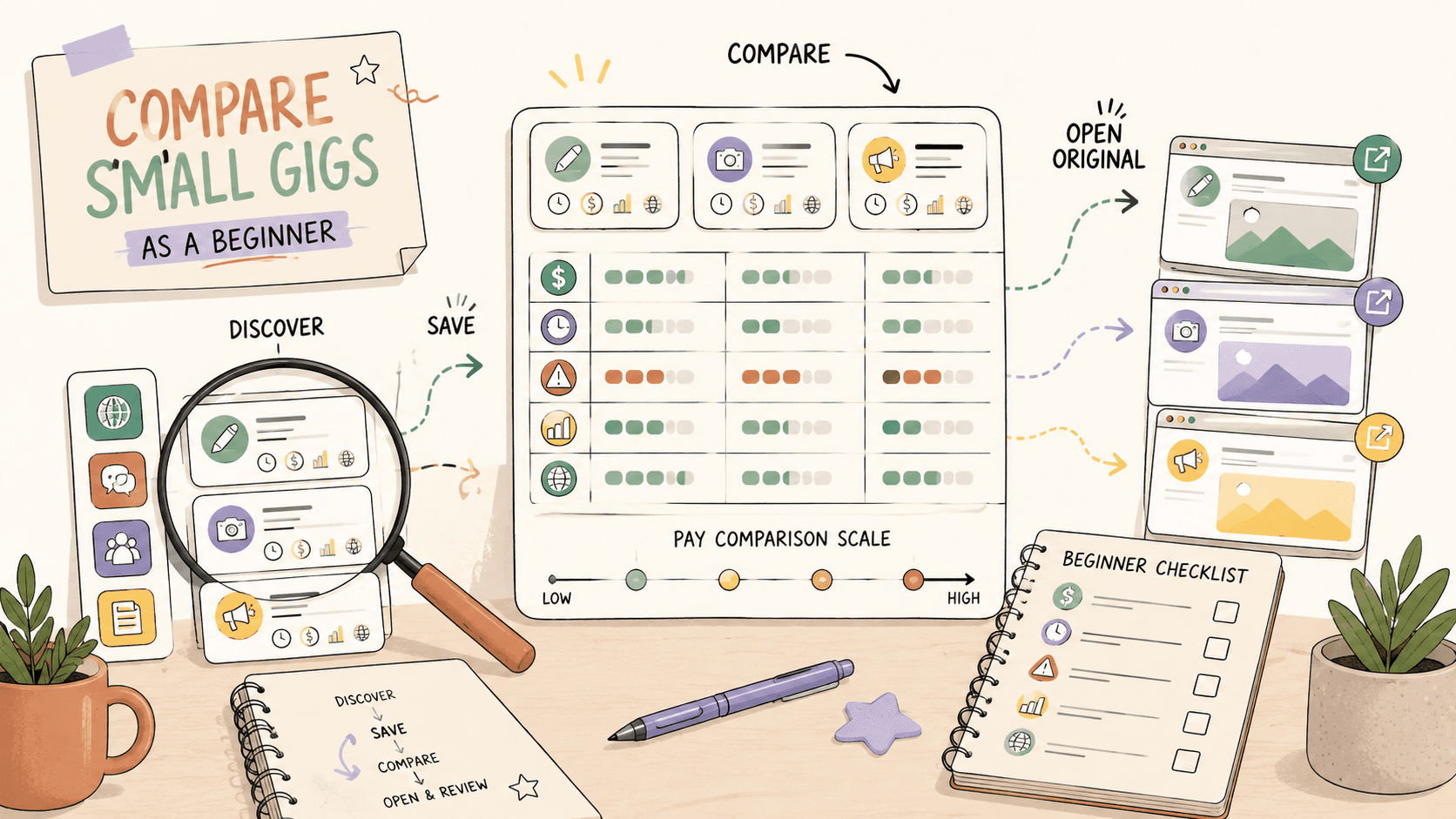
Compare small gigs by estimating real hourly pay after fees, checking whether the scope is clear, confirming payment terms, judging client risk, and deciding whether the project helps your portfolio. Beginners should prioritize simple, specific gigs they can pitch quickly over vague posts with unclear budgets or unpaid trial work.
What makes a small gig worth it for a beginner?
A good beginner gig usually has five traits:
- The outcome is specific. You know what the client wants delivered.
- The timeline is realistic. You can finish without rushing or guessing.
- The payment terms are clear. You know how, when, and where you will be paid.
- The risk is low. The client does not ask for unpaid custom work, suspicious account access, or vague “revenue share” promises.
- The project gives you useful proof. You can learn, earn, get a testimonial, or add a sample to your portfolio.
A gig with lower pay can still be useful if it is fast, safe, and creates proof. A better-paying gig can be a poor choice if it is vague, high-friction, or likely to expand beyond the original scope.
Step 1: Calculate real hourly pay, not just the listed budget
Beginners often compare gigs by headline price:
- “$50 for a logo”
- “$100 for a landing page fix”
- “$25 for a blog outline”
- “$200 for social media templates”
That is not enough. You need to estimate your real hourly pay.
Use this formula:
Real hourly pay = expected take-home pay ÷ total estimated hours
Your total estimated hours should include:
- reading the brief,
- asking questions,
- writing the proposal,
- doing the work,
- revisions,
- file formatting or delivery,
- client messages,
- platform admin,
- invoicing or payment follow-up.
If a gig pays $80 but takes 8 total hours, it is roughly $10/hour before taxes and other costs. If another pays $50 but takes 90 minutes total, it may be the better beginner gig.
Do not rely on outdated platform fee assumptions
Platform commissions and payment rules change. Before pricing work on Upwork, Fiverr, PeoplePerHour, Contra, or any similar platform, check the current official fee page and terms for that platform.
When comparing gigs, ask:
- Does the platform charge a freelancer service fee or commission?
- Are there withdrawal, currency conversion, or payment processing costs?
- Is there a waiting period before funds can be withdrawn?
- Does the platform provide escrow, milestone payments, or dispute support?
- Are taxes, VAT, or local reporting obligations relevant to you?
Avoid using old rules of thumb like “this platform always takes X%.” Verify the current official terms before quoting a price.
Find current openings on Sidequestboard
Step 2: Check whether the scope is clear
Scope is the difference between a clean $75 task and a stressful project that turns into unpaid consulting.
A clear gig includes:
- the exact deliverable,
- the number of pages, words, designs, edits, or assets,
- the deadline,
- the number of revision rounds,
- examples or references,
- the tools or format required,
- who provides content, assets, or access.
A vague gig sounds like:
- “Need help with my website.”
- “Looking for a social media person.”
- “Quick design job.”
- “Need someone creative.”
- “Should be easy if you know what you’re doing.”
Vague does not always mean bad, but it means you need to ask clarifying questions before accepting.
Beginner scope checklist
Before you pitch, answer these questions:
| Question | Good sign | Risk sign |
|---|---|---|
| What is the deliverable? | Specific output | General help |
| How many items? | Fixed quantity | “As needed” |
| When is it due? | Clear deadline | “ASAP” with no detail |
| Are revisions limited? | 1–2 rounds stated | Unlimited changes |
| Are assets provided? | Client has materials ready | You must create everything |
| Is success defined? | Client names the goal | Client wants you to “figure it out” |
If you cannot describe the final delivery in one sentence, the scope is probably not clear enough yet.
Step 3: Compare payment risk
Payment risk matters more when you are new because one unpaid project can drain your time and confidence.
Lower-risk payment setups often include:
- escrow or milestone payments on a reputable platform,
- upfront deposits for direct clients,
- written agreement on deliverables and payment schedule,
- clear client identity and communication history,
- small first milestone before a larger project.
Higher-risk setups include:
- “payment after we see if we like it,”
- unpaid custom samples,
- commission-only work with no track record,
- requests to use your personal accounts,
- unclear buyer identity,
- pressure to move off-platform in a way that violates platform rules,
- promises of “exposure” instead of payment.
For beginner gigs, it is usually better to choose a modest, clearly paid task than a large, exciting opportunity with unclear payment terms.
Step 4: Judge portfolio value
Not every beginner gig needs to pay perfectly. Some are useful because they create proof.
Portfolio value is high when the gig gives you:
- a public-facing result you can show,
- a testimonial or review,
- a before-and-after case study,
- experience in a niche you want more work in,
- a repeatable service you can sell again,
- permission to mention the project in your portfolio.
Portfolio value is low when:
- the work is private and cannot be shown,
- the client does not allow attribution,
- the task is unrelated to your target service,
- the deliverable is too generic to prove skill,
- the project takes time but does not teach anything useful.
A $60 project that becomes a strong portfolio sample can be better than a $100 project that leaves you with nothing you can reuse.
Step 5: Compare response speed and competition
Small gigs often move fast. If a post is public on Reddit, X/Twitter, Discord, a job board, or a freelance platform, many other people may see it too.
You do not need to be online all day. You need a simple response system.
Look for:
- how recently the gig was posted,
- whether the client is still replying,
- how many proposals or comments already exist,
- whether the post asks for a specific answer,
- whether you can send a relevant pitch in under 10 minutes.
A fresh, specific gig that matches your skills is often better than an older, higher-paying post that already has dozens of strong replies.
This is where a calmer opportunity workflow helps. Sidequestboard can reduce tab-switching by bringing fresh public opportunities into one cleaner feed, so you can save promising leads and open the original source when you are ready to respond.
A simple 25-point scorecard for beginner gigs
Use this scorecard before pitching. Give each category 0 to 5 points.
| Category | 0 points | 3 points | 5 points |
|---|---|---|---|
| Real pay | Unclear or too low | Acceptable if fast | Good for the time required |
| Scope clarity | Vague | Mostly clear | Specific deliverables and limits |
| Payment safety | Risky or unpaid | Some protection | Clear terms, escrow, deposit, or trusted process |
| Portfolio value | No reusable proof | Some learning value | Strong sample, review, or niche proof |
| Speed fit | Hard to respond or old | Possible | Fresh and easy to pitch now |
How to interpret your score
| Score | Meaning | Action |
|---|---|---|
| 21–25 | Strong fit | Pitch today |
| 16–20 | Possible fit | Pitch if you can clarify concerns |
| 11–15 | Weak fit | Only pitch if you need practice or proof |
| 0–10 | Poor fit | Skip |
The scorecard is not meant to be perfect. It is meant to stop you from making emotional decisions based only on the listed budget.
Example: comparing three beginner gigs
Imagine you find these three opportunities.
Gig A: $40 blog post edit
- 1,000-word article already drafted
- needs grammar, structure, and headline improvements
- one revision round
- payment through a platform with clear terms
- client wants delivery in 48 hours
Estimated time: 2 hours total.
This may score well because the scope is clear, risk is low, and the timeline is manageable. Even if the budget is modest, it could be a useful first editing sample.
Gig B: $150 “help with website”
- unclear number of pages
- no platform or payment details
- client says it is “easy”
- no deadline or asset list
- likely requires discovery calls and troubleshooting
Estimated time: unknown.
This looks higher-paying, but it is risky. You should ask clarifying questions before pitching seriously. If the client cannot define the deliverable, skip it.
Gig C: $75 landing page copy review
- review one landing page
- provide a written audit with 5–10 recommendations
- no implementation required
- public startup niche you want to work in
- client allows testimonial if satisfied
Estimated time: 2–3 hours total.
This may be a strong beginner gig because the deliverable is contained and the portfolio value is high.
Best places to look for small beginner gigs
Different sources work for different people. The best option depends on your skill, location, risk tolerance, and how quickly you can respond.
Reddit communities
Public communities such as r/forhire, r/WorkOnline, r/HireaWriter, and r/designjobs can surface small gigs, freelance requests, and hiring posts.
Pros:
- fast-moving opportunities,
- direct communication,
- useful for niche or one-off work,
- easy to see how the client describes the problem.
Cons:
- quality varies widely,
- payment protection may be limited,
- scams and vague posts exist,
- you need to follow each community’s rules.
Always read subreddit rules before posting or replying.
Freelance platforms
Platforms such as Upwork, Fiverr, PeoplePerHour, and Contra can help beginners find structured freelance opportunities, though competition and platform rules vary.
Pros:
- built-in profiles,
- reviews or public work history,
- platform messaging,
- possible payment protections depending on the platform and contract type.
Cons:
- fees and terms can change,
- competition can be high,
- your profile may take time to build,
- each platform has its own rules for communication, payments, and disputes.
Check each platform’s current official fee and payment policy before setting prices or accepting work.
Social platforms and communities
X/Twitter, Discord communities, Slack groups, LinkedIn posts, and niche forums can also surface small projects.
Pros:
- opportunities may appear before they reach formal job boards,
- niche communities can have warmer leads,
- direct replies can move quickly.
Cons:
- posts are easy to miss,
- search can be noisy,
- payment protection depends on your agreement,
- some communities restrict promotion or pitching.
If you monitor many sources, save only the gigs that pass your basic scorecard. Otherwise, your search process becomes another full-time job.
Search phrases that help beginners find small gigs
Try combining your skill with intent phrases like:
- “hiring freelance [skill]”
- “looking for [skill] freelancer”
- “need help with [task]”
- “paid gig [skill]”
- “contract [skill] needed”
- “quick [skill] task”
- “remote freelance [skill]”
- “one-off project [skill]”
Examples:
- “hiring freelance video editor”
- “need help with Webflow landing page”
- “paid gig copywriter SaaS”
- “looking for Notion consultant”
- “contract designer needed pitch deck”
Use filters for recency where possible. Freshness matters because small gigs can close quickly.
How to write a fast beginner pitch
A good beginner pitch is short, specific, and focused on the client’s problem.
Use this structure:
- Mention the exact task.
- Show relevant proof or a similar example.
- State how you would approach it.
- Confirm one key scope detail.
- Invite the next step.
Template:
Hi [Name] — I saw you need help with [specific task].

I can help with this. I’ve done [relevant example or skill proof], and for your project I’d start by [brief approach].

Quick question: does the scope include [important detail], or only [limited deliverable]?

If helpful, I can send a short plan or start with a small milestone.
For public communities, keep the first reply concise and follow the community’s rules. If the post asks for a portfolio, rate, location, or specific subject line, include it.
Red flags beginners should skip
Skip or be very cautious with gigs that include:
- unpaid custom work before any agreement,
- requests for government ID or sensitive personal data without a legitimate reason,
- requests to create or lend accounts,
- payment only in vague future equity or exposure,
- pressure to communicate in suspicious ways,
- inconsistent client details,
- unclear ownership of assets or rights,
- unlimited revisions for a fixed low price,
- a task that sounds illegal, deceptive, or against platform rules.
If something feels off, you do not need to prove it is a scam. You can simply move on.
A 30-minute daily workflow for comparing gigs
Here is a simple routine for beginners.
0–5 minutes: Open your sources
Check your main sources: relevant communities, platforms, saved searches, and opportunity feeds.
5–15 minutes: Save only likely fits
Save gigs that match your service, budget range, and skill level. Do not pitch yet. Just collect possible leads.
15–22 minutes: Score the best options
Use the 25-point scorecard. Prioritize gigs with clear scope, safe payment terms, and fresh posting time.
22–30 minutes: Send 1–3 focused pitches
Write short, relevant replies. Do not mass-send generic pitches. A beginner with a specific pitch often beats a generic profile with more experience.
If you want to make this workflow easier, use Sidequestboard to find and save fresh public gig opportunities, then apply the scorecard before opening the original listing and responding.
Final rule: choose clarity over excitement
Beginners often chase gigs that sound impressive. In practice, your best early wins usually come from clear, contained, paid tasks.
Choose the gig where you understand:
- what the client wants,
- how long it will take,
- how you will be paid,
- what risk you are accepting,
- what proof you will gain.
A small, clean project can lead to a testimonial, repeat work, and confidence. A vague project can consume days and leave you with nothing. Compare before you pitch.