August 23, 2026
How to Explain a Career Gap in an Interview: 3-Part Script and Examples
Explain a career gap in three parts: what happened (one sentence, factual), what you did during it (skills, freelance projects, caregiving, coursework), and why you're ready now. Keep it under 60 seconds, stay neutral about the past, and pivot to evidence of current capability, like recent paid work or a portfolio.
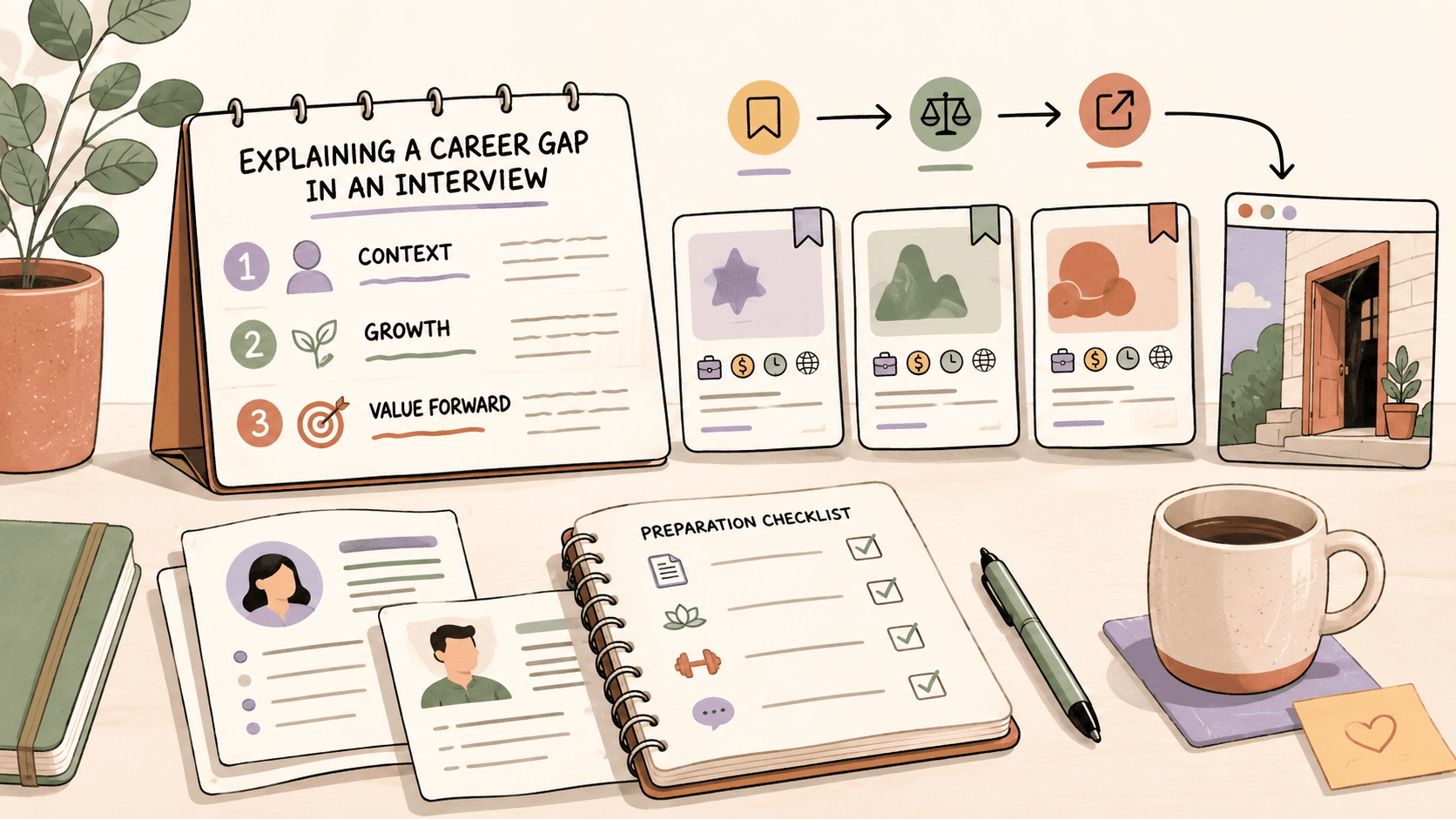
How do you explain a career gap in an interview?
Interviewers don't reject people for having gaps — they reject vague, defensive, or evasive answers. A strong explanation has three parts:
- What happened — one sentence, factual, no apology.
- What you did during the gap — skills, freelance projects, caregiving, coursework, anything concrete.
- Why you're ready now — a forward-looking pivot to the role in front of you.
Keep the whole thing under 60 seconds. The gap is a fact; your job in the interview is to make the present the most interesting part of your story.
The 3-part script
Part 1: What happened (one sentence)
State the cause plainly, without shame or oversharing:
"I took eight months away from full-time work after a layoff to care for a family member."
"I left my last role in a restructuring and used the time to reassess my direction."
That's it. Don't explain the layoff economics, don't blame anyone, don't apologize.
Part 2: What you did during the gap
This is where you win or lose the interviewer. Bring evidence, not adjectives:
- Freelance or contract projects (even small ones)
- Courses or certifications completed
- Caregiving or health recovery, framed as a completed chapter
- Volunteer work, open-source contributions, or a personal project shipped
"During that time I completed a UX certification and picked up three freelance clients through Reddit communities, which kept my skills current."
Part 3: Why you're ready now
Close the gap and pivot forward:
"That chapter is closed, and I've been doing paid work again since March. I'm ready to bring that momentum into a full-time role like this one."
Browse today’s opportunities on Sidequestboard
Example answers for common gap reasons
Layoff or restructuring
"My previous company cut my department in a restructuring. I used the time to take on contract work — two design projects and a landing-page build — which sharpened skills I'm already using in this conversation."
Health or caregiving
"I stepped away for a year to handle a family health situation. That's resolved, and during the last few months I've been freelancing part-time to ramp back up."
Burnout or voluntary break
"I deliberately took six months off after five intense years. I rested, then rebuilt deliberately: I shipped two personal projects and took a short contract before applying here."
What not to say
- Don't apologize repeatedly or call the gap "a mess."
- Don't badmouth a former employer.
- Don't ramble past two minutes — long answers make small gaps feel big.
- Don't lie. Gaps are easy to verify; freelance claims should be backed by something real.
How to fill the gap with fresh work fast?
The strongest gap explanation is recent, verifiable work. Even one or two small paid projects in the last month change the interview from "explain your past" to "look at my present."
Where to find quick, real work while job searching:
- r/forhire — a large, active Reddit community where people post and hire for paid gigs across writing, design, development, marketing, and more. Check the current subscriber count on the subreddit itself; what matters more is that new posts appear daily across many skill categories. Sort by new, respond within hours, and include rates in your post.
- r/hiring and r/jobbit — additional Reddit communities with job and gig posts, useful for developers, writers, and marketers who want more than one feed to watch.
- r/designjobs — a smaller community for design-specific gigs.
- Upwork and Fiverr — slower to start but reliable for contract work in almost any profession, including non-design fields.
- LinkedIn contract posts and #hiring posts — good for professional-services gigs.
- Dribbble, Behance, and 99designs — portfolio-plus-gig platforms for designers.
The pattern is the same in every field: watch the general gig listings, plus one or two niche communities for your profession, and respond fast while posts are fresh.
A realistic 4-week fill-the-gap plan
- Week 1: Post a short, specific offer on r/forhire and update your LinkedIn headline to "available for contract work." Pitch 3–5 small jobs.
- Week 2: Follow up on every reply within 24 hours — most freelance posts get the most responses in the first few hours, so speed matters on both sides. Aim to close one small project, even at a modest rate — the point is a verifiable line on your resume.
- Week 3: Deliver the work, ask for a short testimonial, and add the project to your portfolio or LinkedIn.
- Week 4: In interviews, lead with the recent project: "Most recently, I completed a freelance project for a client I found on Reddit — here's what I delivered."
How Sidequestboard helps you fill the gap faster?
The hard part of the plan above isn't the work — it's monitoring Reddit, X, Discord, and job boards across a dozen tabs so you catch gigs while they're still fresh. Most freelance posts get the most responses in the first few hours, which means checking late costs you the gig.
Sidequestboard pulls fresh opportunity posts from public communities into one calmer feed, so you can scan, save the relevant ones, and respond directly at the original source — instead of spending your job-search hours refreshing tabs. Less time searching means more time doing paid work you can point to in your next interview.
Key takeaways
- Use the 3-part script: what happened, what you did, why you're ready.
- Keep it under 60 seconds and stay neutral about the past.
- Recent paid work is the best gap filler — even small projects count.
- Back freelance claims with real deliverables, and verify any community or platform details you cite in interviews.