August 24, 2026
How to Get Clients as a Personal Trainer: A 30-Day Plan for Your First Paying Clients
To get clients as a personal trainer, choose a niche and write a one-line offer, then work your channels in order: ask your warm network for referrals, run a few capped intro sessions, partner with local professionals, build simple proof, and reply quickly to fresh online requests. Follow up with every lead and track which source produces conversations. The 30-day plan below puts these steps in sequence; results depend on your market, niche, and consistency.
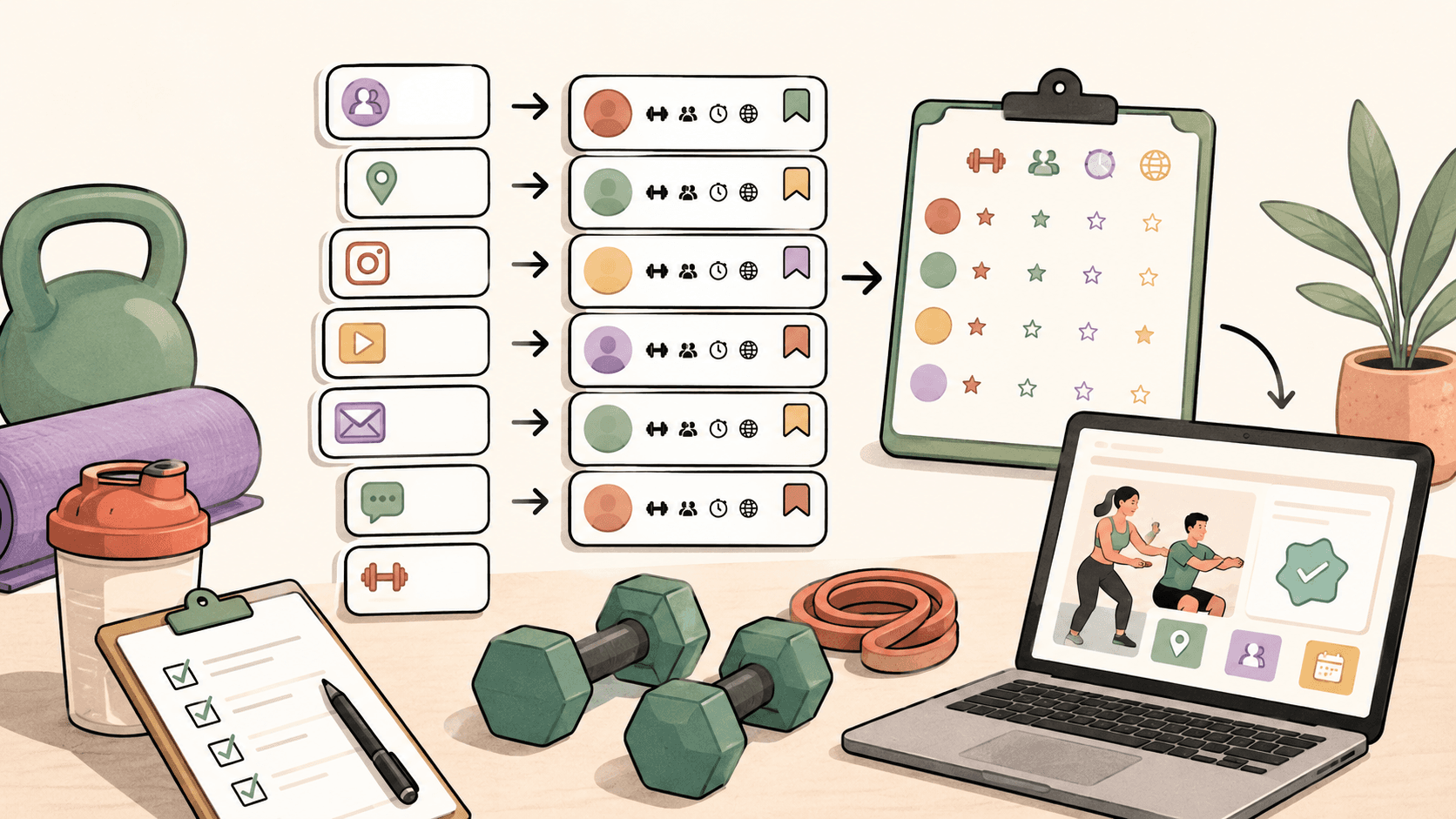
How Do You Get Clients as a Personal Trainer? A 30-Day Plan
Most advice arrives as a flat list of tactics. Sequence matters more, because each week produces something the next week needs.
| Week | Focus | What to finish |
|---|---|---|
| 1 | Niche, offer, proof | A one-line offer and 2–3 proof items |
| 2 | Warm network and referrals | Message every current and past client and personal contact |
| 3 | Intro sessions and local partners | Up to three capped intro sessions; visit one or two local businesses |
| 4 | Online channels and follow-up | One community post or marketplace offer; follow up with every lead; review your tally |
This is a framework, not a promise. How fast clients arrive depends on your market, your niche, and how consistently you do the work.
What Niche and Offer Should You Start With?
"Personal trainer" is hard to remember. A specific offer is easy to repeat and easy to refer. Use this formula: who + outcome + timeframe + format.
- Beginners returning to the gym: "Strength basics in 8 weeks, small-group sessions twice a week."
- Busy professionals: "A 12-week online plan with weekly check-ins and 30-minute workouts."
- Recreational runners: "Six weeks of in-person strength training to build a consistent routine."
Test the offer in three conversations before committing. If people ask "what does that involve?", simplify the wording. If they ask "how much is it?", you're close.
In-Person vs Online: Which Channels Fit You?
| Channel | Fits |
|---|---|
| Gym floor and intro sessions | In-person |
| Local business partnerships | In-person |
| Referrals and proof | Both |
| Email and social content | Both |
| Community posts and marketplaces | Online |
If you're a gym employee, start with the gym floor and referrals. Independent in-person trainers should add local partners. Online coaches should lean on proof, content, communities, and marketplaces.
Ask Your Network and Current Clients for Referrals
Referrals work because trust transfers, but they only happen reliably if you ask. The best timing is right after a visible milestone, like a first pull-up or a finished program.
Keep the message short: "Know anyone who'd want results like yours? I have two openings this month."
A small thank-you, such as a free session or a discount on next month, makes asking easier without cheapening your service. You can also set up a cross-referral: tell a physio, nutritionist, or run-club organiser you'll send people their way, and ask them to do the same.
Work the Gym Floor and Run Capped Intro Sessions
Trainers who are visibly coaching get approached more than trainers who wait by the desk. Offer members a quick form check or a 15-minute mini-session, but check your gym's rules on approaching members first. If you're independent, ask small boutique studios whether they rent floor time or split sessions.
Cap intro sessions ("I take three per month") so they stay valuable. A 30-minute assessment can run like this:
- Movement screen
- Goal mapping
- One coached exercise
- A clear next step, with a package option
At the end, ask for an email address and a short testimonial.
Partner With Local Businesses and Professionals
Physio clinics, chiropractors, yoga studios, run clubs, and nutritionists all serve your future clients. Bring a one-page summary of your offer and a simple reciprocal arrangement. Follow up two weeks later with a short message. Partnerships cost mostly time, and they build slowly.
Build Proof: Testimonials, Case Studies, and Simple Content
Few people hire on promises alone. Collect testimonials, and take before/after photos only with permission. A one-page portfolio with three short case studies, built in Notion, Carrd, or Google Sites, is enough to start.
Add one content habit you can sustain, such as a short video showing a single coaching cue or one post a week. Then send one useful email a month to the addresses you collected at intro sessions. Email reaches people who already know you.
How Do You Find Online Clients in Communities and Marketplaces?
Communities. Subreddits such as r/forhire and r/freelance_forhire use a [For Hire] post format. Read each community's rules first, because some restrict self-promotion. Lead with your niche and outcome, add one proof point, and state your availability. How often fitness requests appear varies, so treat this as a channel to test, not a sure thing.
Speed and specificity. Older threads go stale, so reply to recent requests quickly with a short, specific message: "I coach busy professionals through 12-week strength plans online. Here's one client result, shared with permission, and I have two spots open. Want a quick call?" Avoid copy-pasting the same message everywhere.
Marketplaces. Upwork, Fiverr, Contra, and PeoplePerHour host program design, meal-plan, form-review, and monthly coaching gigs. Fiverr suits productized, tiered offers such as a "custom 4-week training plan." Fee structures differ and change, so check each platform's current terms before setting prices.
The weak point is usually keeping up. Checking several communities in separate tabs is how good leads get missed. Get Sidequestboard for iPhone to find and save fresh public opportunities. It helps you find and save posts, then open the original to reply yourself. It doesn't coach you or guarantee clients.
How Do You Turn Conversations Into Paying Clients?
Leads rarely convert on the first message. A simple structure helps.
Reply template: "Thanks for reaching out about [goal]. What's the main thing you'd like to change over the next 12 weeks? I'm free [two times] for a 15-minute chat."
Three-step consult:
- Goal: what they want and why now.
- Current habits and constraints: schedule, training history, equipment.
- Plan and next step: outline your approach and propose the package or first session.
Follow-up: If someone goes quiet, follow up after two or three days, once more a week later, then stop politely. For lapsed clients, send a short check-in asking how training is going and whether they'd like to restart.
Packages over single sessions: A 4-week starter or 12-week package gives clients a clear outcome and gives you a more predictable schedule than one-off bookings.
What Should You Charge as a New Personal Trainer?
Rates vary by city, format, and experience, so generic numbers can mislead. Instead, compare three to five local trainers or online coaches with a similar niche. Note their single-session and package prices, then set yours based on what you can sustain. Underpricing can fill your schedule at rates you can't keep up.
A simple structure: a 4-week starter package (weekly sessions plus messaging support) and a 12-week package with a mid-point progress review.
How Do You Track What Works?
Keep a weekly tally so you can see which channel earns your time:
| Source | Conversations started | Intro sessions booked | Clients signed |
|---|---|---|---|
| Referrals | |||
| Gym floor | |||
| Local partners | |||
| Online communities |
After 30 days, keep your top two sources and drop the weakest.
FAQ
How long does it take to get your first personal training client?
There's no fixed timeline. It depends on your market, niche, and effort. Warm-network outreach, referrals, and intro sessions tend to be the most direct routes because they start with people who already know you.
Do I need a website to get clients?
Not at first. A one-page portfolio with your offer, three short case studies, and a clear way to contact or book you is enough while you test your niche.
Is it better to work at a gym or go independent?
A gym gives you foot traffic and members to approach. Independent work gives you more control over niche and pricing. Many trainers build referrals and proof at a gym first, but check your contract for rules about taking clients elsewhere.
Sources
- Upwork — Freelancer Service Fee — Official platform fee information; verify current terms before relying on pricing.
- Fiverr — Your Earnings — Official platform fee information; verify current terms before relying on pricing.
- PeoplePerHour — Service Fees — Official platform fee information; verify current terms before relying on pricing.
- Contra — Pricing — Official platform fee information; verify current terms before relying on pricing.