August 17, 2026
How to Get Illustration Clients Online as a Beginner
To get your first illustration clients online, choose one service focus, prepare six to ten relevant portfolio samples, and test two or three channels such as Reddit, Upwork, Fiverr, Contra, or direct email. Send personalized pitches, clarify scope and payment terms in writing, and track outreach for 30 days instead of waiting for a perfect portfolio.
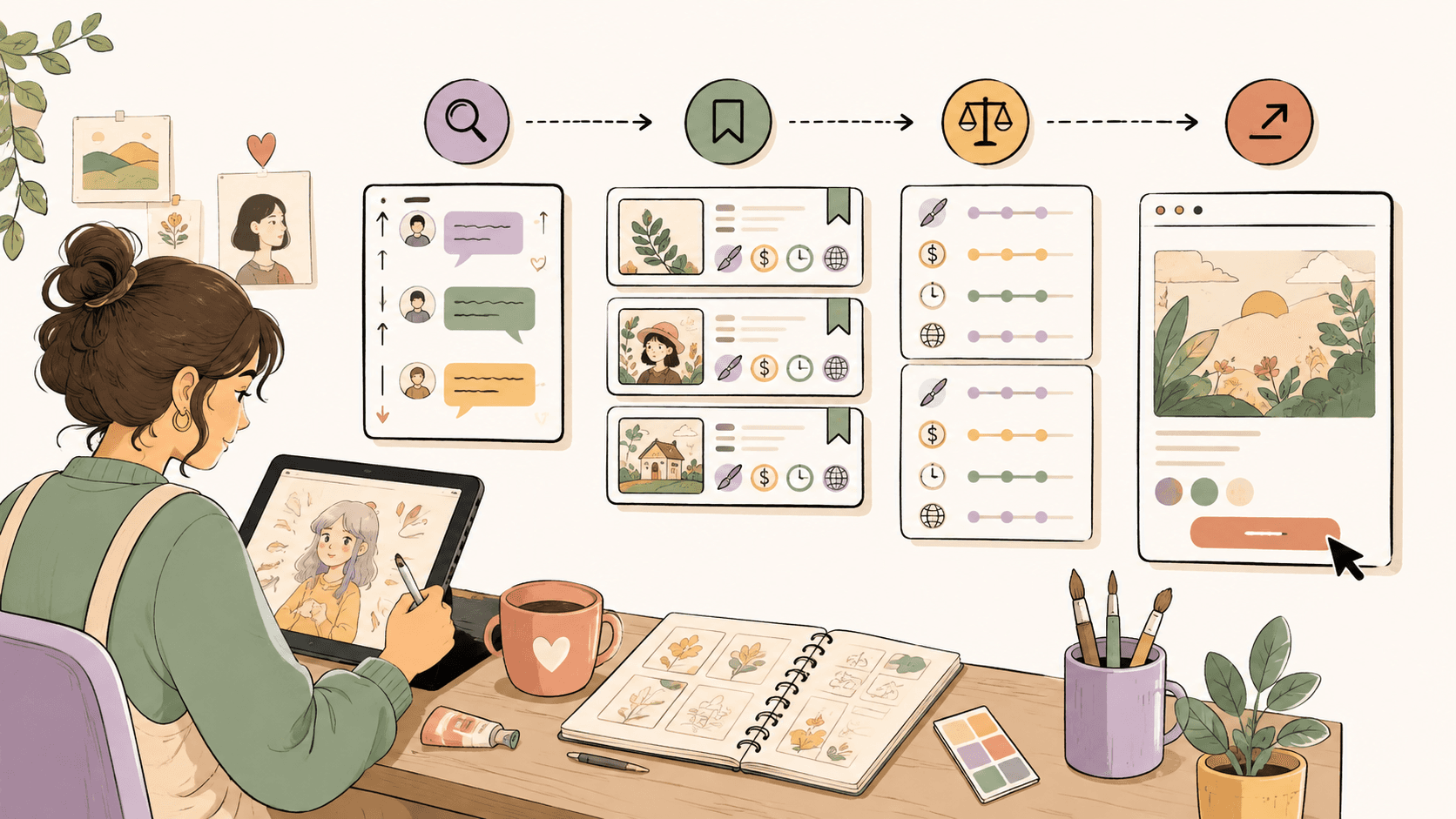
What should you prepare before looking for illustration clients?
Before contacting clients, prepare four basic assets:
- A focused offer: State what you illustrate, such as podcast covers, editorial illustrations, character art, book covers, portraits, or social media graphics.
- Six to ten relevant samples: Choose work that resembles the projects you want. Personal or speculative work is acceptable when it is clearly labeled as such.
- A simple portfolio link: Use a page that is easy to open and navigate. Behance, ArtStation, a personal website, or a well-organized shared document can work.
- A short introduction: Explain your specialty, location or time zone if relevant, availability, and the kind of project you can help with.
You do not need a large portfolio to start. A smaller collection with a consistent style is usually easier for a potential client to evaluate than a large collection of unrelated experiments.
Build samples around a service, not only a style
A client usually searches for an outcome rather than a broad artistic identity. Instead of presenting only “digital illustration,” organize samples around possible needs:
- Three podcast-cover concepts
- Two editorial spot illustrations
- Three character-design sheets
- Two illustrated social posts
For example, if you want podcast-cover work, create several fictional covers with different audiences and moods. Label them as personal or speculative projects. Do not describe them as paid client work.
Where can beginners find illustration clients online?
Test two or three channels for a month rather than creating inactive profiles everywhere.
Freelance platforms
Upwork, Fiverr, Contra, and PeoplePerHour can expose beginners to active project searches. Read each platform's current terms, fees, proposal rules, and payment policies before accepting work. Your profile should lead with a specific service and show samples that match it.
A useful profile headline is more specific than “Illustrator for hire.” Consider a format such as:
Illustrator creating bold podcast covers and social graphics for independent creators
Only use a headline that accurately describes your work.
Public communities and social platforms
Reddit communities, Discord groups, LinkedIn, Instagram, Behance, and ArtStation can all help you find conversations where illustration is relevant. Search for communities connected to your target clients, such as podcasting, publishing, tabletop games, indie games, or small businesses.
Read the rules before posting. Some communities prohibit self-promotion, while others have dedicated hiring or feedback threads. On Reddit, for example, check the specific community's requirements and respond only when your service fits the request.
Direct outreach
Direct email or social messages can work when you have identified a clear business need. Look for organizations with outdated graphics, a new launch, an active newsletter, or content that would benefit from custom illustrations. Keep the message brief and refer to something specific about the recipient's work.
Avoid sending the same generic pitch to a large list. A smaller number of relevant messages gives you more opportunity to show why your sample matches the project.
A calmer way to monitor public opportunities
Checking Reddit, Discord, LinkedIn, and other public communities manually can take time, and relevant posts may be easy to miss. Sidequestboard can provide a cleaner place to discover fresh public opportunities, save promising listings, open the original source, and respond there directly.
For example, a beginner interested in podcast art could monitor relevant opportunity sources, save a listing that asks for cover artwork, open the original post to review its details, and record the response in an outreach tracker. It does not replace your portfolio, pitch, or client screening; it helps reduce the time spent searching across separate tabs.
Browse today’s opportunities on Sidequestboard
How do you write a pitch that gets a response?
A strong beginner pitch is specific, short, and easy to answer. Include:
- The project you are responding to
- The relevant sample you selected
- What you can deliver
- One useful question
- A portfolio link
Use this template as a starting point:
Hi [name],
I saw your post about [specific project]. I create [type of illustration], and this sample is relevant because [one-sentence connection].
I could help with [specific deliverable] and can confirm the scope, timeline, and file requirements before starting. My portfolio is here: [link].
Do you already have the final dimensions and intended use for the illustration?
Best, [name]
Change the sample and explanation for every serious inquiry. A matching sample is more persuasive than linking to your entire portfolio without context.
Example: responding to a fictional podcast-cover request
Suppose a podcast producer asks for a bold illustrated cover for a business interview show. A relevant response might say:
Hi Maya, I saw your request for cover art for a business interview podcast. I included a sample with a high-contrast layout and a single focal character because it is close to the clear, readable style that works well at small sizes. I can provide a primary cover, a social crop, and final files after we confirm the dimensions and usage. Would you like the artwork to include a host portrait or a symbolic concept?
This works because it connects the sample to the request instead of simply saying that you are available.
How should a beginner price an illustration project?
There is no universal beginner rate. Price depends on the complexity, number of concepts, revisions, usage, deadline, and final file requirements. Treat any amount as a planning example rather than a guaranteed market benchmark.
A simple quote can separate the work into components:
- Creative concept and sketch: $40–$80
- Final illustration: $75–$150
- Additional revision round: $20–$50
- Rush delivery or expanded usage: discuss separately
These figures are examples for building a quote, not rules you must charge. If the project is unusually complex or the client requests broad commercial usage, ask more questions before giving a final price.
A quote should state:
- Deliverables and file formats
- Number of concepts and revisions
- Timeline and milestones
- Total price and payment schedule
- Intended usage or license
- What happens if the scope changes
If you are unsure about licensing, write down the intended use and ask the client to clarify whether the illustration will be used for an individual project, advertising, merchandise, publishing, or another purpose.
How can beginners stay safe when working with online clients?
Use a basic screening and documentation process:
- Keep project details and changes in writing.
- Confirm the client's identity, organization, and intended use when appropriate.
- Avoid starting substantial work without an agreed scope and payment arrangement.
- Be cautious of checks, overpayment requests, requests to forward money, or pressure to move unusually fast.
- Do not send final high-resolution files before the agreed payment conditions are met.
- Keep copies of the brief, invoices, messages, and delivered files.
- Review the current safety and payment guidance of the platform you are using.
A real client may have a limited budget, but unclear scope, suspicious payment behavior, or refusal to document the agreement are reasons to pause.
How often should you follow up?
If the client has not specified a response deadline, send one concise follow-up after three to five business days. Refer to the original project and include your portfolio link again if useful.
Hi [name], just following up on my message about [project]. I would be glad to help with [deliverable]. If the project is still open, I can review the brief and confirm a quote and timeline. Thanks.
After one follow-up, move on unless the client responds. Your goal is to build a pipeline, not wait indefinitely for one lead.
What should a beginner do during a 30-day client search?
Use a manageable routine of 20 to 30 minutes per day:
Days 1–7: Prepare
- Choose one main service and one target audience.
- Select six to ten relevant samples.
- Update your portfolio and profile description.
- Write one adaptable pitch template.
- Create a tracker with columns for source, project, contact, date, status, follow-up date, and notes.
Days 8–14: Test channels
- Choose two or three channels, such as Reddit, Upwork, Contra, LinkedIn, or direct email.
- Find opportunities that genuinely match your work.
- Send a small number of personalized pitches.
- Record every serious inquiry in your tracker.
Days 15–21: Improve the offer
- Review which samples receive the most interest.
- Rewrite unclear service descriptions.
- Prepare answers about revisions, timeline, file formats, and usage.
- Follow up with suitable prospects after three to five business days.
Days 22–30: Repeat what works
- Continue using the channel that produces the most relevant conversations.
- Remove channels that consume time without useful leads.
- Ask completed clients for permission to display the work when appropriate.
- Turn recurring requests into clearer packages or portfolio sections.
The purpose of the 30-day plan is not to guarantee a client. It is to create enough consistent activity to learn which offer, sample, and channel attract the right type of inquiry.
What are the most common beginner mistakes?
- Showing unrelated work: A client cannot easily tell whether you fit their project.
- Sending generic pitches: The message gives no reason to choose you.
- Quoting before clarifying scope: Revisions, usage, and deadlines can change the workload.
- Claiming speculative work is paid work: Label personal and fictional projects honestly.
- Relying on one platform: Platform activity and opportunities can change, so test more than one route.
- Ignoring tracking: Without dates and statuses, it is difficult to know what needs a follow-up.
- Accepting vague payment terms: Confirm the agreement before investing significant time.
FAQ
How many portfolio pieces do I need to get illustration clients?
Six to ten relevant samples are enough to begin testing an offer. Prioritize consistency and relevance over a large portfolio, and label personal or speculative projects honestly.
Which platforms are best for beginner illustrators?
There is no single best platform for everyone. You can test two or three options such as Reddit, Upwork, Fiverr, Contra, PeoplePerHour, LinkedIn, Behance, ArtStation, or relevant Discord communities. Compare the quality of opportunities, competition, rules, fees, and your ability to present your work.
How much should a beginner charge for an illustration?
There is no universal beginner price. Use the project's complexity, revisions, deadline, deliverables, and intended usage to create a quote. Example figures can help with planning, but they are not guaranteed market benchmarks; confirm the scope before giving a final price.
How quickly should I reply to an illustration opportunity?
Respond promptly while the listing is active, but do not skip basic screening. Read the original brief, check the community or platform rules, choose a relevant sample, and clarify scope and payment terms before committing.
Can Sidequestboard find illustration clients for me?
Sidequestboard is an opportunity-discovery dashboard, not a marketplace, agent, or guarantee of work. It can help you find and save fresh public opportunity posts, open the original listing, and respond directly. You still need to evaluate the lead, send the pitch, and agree on the project terms.