July 20, 2026
How to Prioritize Freelance Clients Without Wasting Time
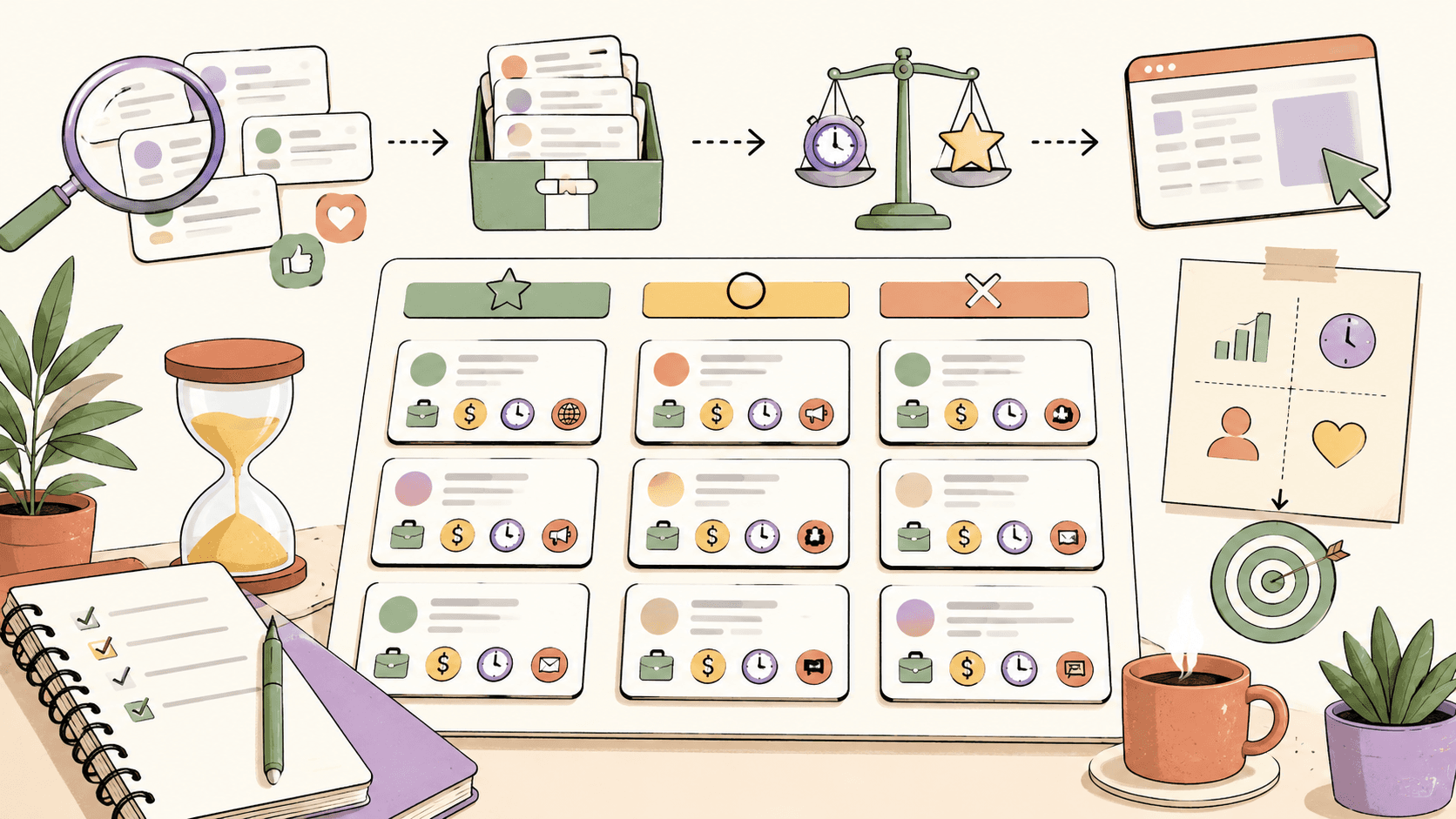
Prioritize freelance clients by scoring each lead on freshness, budget fit, project fit, trust signals, and response effort. Reply first to recent, clearly scoped opportunities that match your skills and rates. Skip vague, underpriced, suspicious, or high-friction leads unless there is a strong strategic reason to pursue them.
What is the fastest way to prioritize freelance clients?
The fastest way is to score every lead against five criteria:
- Freshness: How recently was the opportunity posted or sent?
- Budget fit: Does the budget appear compatible with your minimum rate?
- Project fit: Is the work clearly aligned with what you do well?
- Trust signals: Does the client look legitimate and professional?
- Response effort: Can you send a strong, relevant reply quickly?
Give each lead a score from 0 to 2 for each factor:
| Factor | 0 points | 1 point | 2 points |
|---|---|---|---|
| Freshness | Old or likely filled | Somewhat recent | Very recent |
| Budget fit | Below minimum or unclear | Possible but needs clarification | Clearly within range |
| Project fit | Weak match | Partial match | Strong match |
| Trust signals | Risky or vague | Some signals | Clear, credible client |
| Response effort | Requires heavy unpaid work | Needs some tailoring | Easy to answer well |
Then prioritize like this:
- 8–10 points: Reply now.
- 6–7 points: Reply if you have time or the upside is strong.
- 4–5 points: Save for later or ask one qualifying question.
- 0–3 points: Skip unless there is a specific strategic reason.
This keeps you from spending your best energy on the loudest lead instead of the best one.
Why freshness matters so much for freelance leads
Many public freelance opportunities are time-sensitive. Posts in communities, social feeds, and job boards can receive replies quickly, especially when the scope is clear and the budget is decent.
Freshness does not mean “rush blindly.” It means you should check recency before writing a long pitch.
A practical rule:
- Less than a few hours old: High priority if the fit is strong.
- Same day: Still worth considering.
- One to two days old: Worth a reply only if the fit is unusually strong.
- Several days old: Lower priority unless the post says applications are still open.
For platform-specific opportunities, always check the original listing for the current status. Public posts can be edited, closed, removed, or filled.
Track fresh opportunities on Sidequestboard
How should freelancers judge budget fit?
Budget fit means the project can realistically support your required rate, not that the client has published a perfect budget.
Before you reply, ask:
- Does the post include a budget, rate, or range?
- If there is no budget, does the scope suggest a serious buyer?
- Would this project meet your minimum hourly or fixed-project threshold?
- Are platform fees, payment processing, taxes, revisions, licensing, or meetings likely to affect your actual take-home pay?
- Is the client asking for too much unpaid planning before a paid agreement?
Rates vary widely by niche, country, seniority, client type, deliverables, licensing, and platform. Treat any public benchmark as a rough screening tool, not a universal pricing rule. For marketplaces such as Upwork, Fiverr, Contra, PeoplePerHour, or other platforms, verify current fees and policies directly on the official platform before pricing your work.
A simple budget score:
- 0 points: Clearly below your minimum, unpaid, speculative, or vague with many red flags.
- 1 point: Budget is unclear but the client seems serious enough to qualify.
- 2 points: Budget or scope appears compatible with your rate.
If the lead is otherwise strong but the budget is missing, do not write a full proposal immediately. Ask a short qualifying question first.
Example:
Thanks for sharing this. Before I suggest an approach, do you have a target budget or range for the first phase?
That one question can save you from a long unpaid sales conversation.
How do you identify strong project fit?
A good freelance client is not just someone who can pay. They need something you can deliver well, explain clearly, and support without stretching into the wrong role.
Score project fit by looking for overlap between the request and your strongest proof.
Ask:
- Have I done this type of work before?
- Do I have a relevant portfolio sample, case study, testimonial, or result?
- Can I explain my approach in a few sentences?
- Do I understand the audience, market, stack, channel, or deliverable?
- Would this project help me build more of the work I want?
A lead with a perfect budget but poor fit can become expensive in hidden ways: extra research, slower delivery, more revisions, and weaker results. A lead with strong fit is easier to pitch, easier to deliver, and easier to turn into repeat work.
Use this fit score:
- 0 points: Outside your skill set or likely to require pretending.
- 1 point: Adjacent to your skills but not a direct match.
- 2 points: Strong match with proof you can share quickly.
What trust signals should you check before replying?
Trust signals help you avoid scams, unclear buyers, and clients who may drain your time.
Look for signs such as:
- A clear project description.
- A real company, product, creator profile, or public identity.
- Specific deliverables or outcomes.
- Reasonable communication style.
- A realistic timeline.
- Payment terms that do not require risky upfront work from you.
- Platform history, reviews, or verified details where applicable.
- Consistency between the client’s profile, website, and request.
Red flags include:
- “Exposure” instead of payment.
- Requests for free samples that look like usable work.
- Vague promises of future equity or future volume.
- Pressure to move to unusual payment methods immediately.
- Poorly defined scope with urgent demands.
- Requests that violate a platform’s terms.
- Suspicious links, attachments, or identity claims.
Trust score:
- 0 points: Multiple red flags or unclear identity.
- 1 point: Some uncertainty but not obviously risky.
- 2 points: Clear, credible, and professional.
You do not need to investigate every lead deeply. If the opportunity already looks risky, skip it before it steals more time.
How much response effort is worth it?
Some leads are valuable but require a custom proposal, audit, estimate, call, or technical review. Others can be answered with a short, relevant message and one portfolio link.
Prioritize leads where you can send a strong reply quickly.
A good first reply usually includes:
- A direct acknowledgement of the client’s need.
- One sentence showing relevant experience.
- One proof point or portfolio link.
- One useful next step.
- One qualifying question if needed.
Example:
Hi — I saw you’re looking for help rewriting onboarding emails for a SaaS product. I’ve worked on lifecycle and activation emails for similar subscription products, including welcome flows and trial conversion sequences. Here’s a relevant sample: [link]. If helpful, I can suggest a first-pass structure after I understand your current conversion goal and target segment.
Response effort score:
- 0 points: Requires a long unpaid proposal, speculative work, or heavy research.
- 1 point: Needs moderate tailoring.
- 2 points: You can respond well in under 10 minutes.
This does not mean you should only chase easy work. It means your first pass should favor opportunities where speed and relevance give you an advantage.
A simple 45-minute daily lead prioritization workflow
Use this routine once or twice a day instead of checking tabs all day.
1. Spend 10 minutes collecting leads
Check your main sources: referrals, email, inbound messages, public communities, social platforms, job boards, and marketplaces. Do not reply yet. Just collect anything that looks potentially relevant.
If you monitor public communities and social platforms, a tool like Sidequestboard can help you scan fresh opportunities in one cleaner feed instead of bouncing between too many tabs.
2. Spend 10 minutes removing obvious bad fits
Immediately skip leads that are:
- Clearly below your minimum.
- Too old to be worth pursuing.
- Outside your skill set.
- Suspicious or vague.
- Asking for unpaid work before basic qualification.
This step is where you protect your calendar.
3. Spend 10 minutes scoring the remaining leads
Use the 10-point system:
- Freshness: 0–2
- Budget fit: 0–2
- Project fit: 0–2
- Trust signals: 0–2
- Response effort: 0–2
Sort highest to lowest.
4. Spend 10 minutes replying to the best leads
Start with 8–10 point leads. Send short, specific replies. Do not over-propose before the client confirms budget, scope, timeline, and decision process.
5. Spend 5 minutes saving and tracking
For every serious lead, save:
- Source link.
- Client name or handle.
- Project summary.
- Score.
- Date found.
- Date replied.
- Next action.
A spreadsheet, Notion database, Trello board, CRM, or saved-opportunity workflow can work. The tool matters less than the habit: never rely on memory for active leads.
What should you do with medium-priority leads?
Medium-priority leads are not automatic rejections. They are leads that need qualification before you invest heavily.
Use a short question instead of a full pitch.
For unclear budget:
This looks relevant to my work. Do you have a target budget or range for this project?
For unclear scope:
Could you clarify the main deliverable you need first: strategy, implementation, or ongoing support?
For unclear timeline:
What timeline are you hoping to work toward, and is there a deadline driving it?
For unclear decision process:
Who will be involved in reviewing proposals or choosing a freelancer?
If the client answers clearly, rescore the lead. If they avoid basic details, move on.
Which freelance clients should you skip?
Skipping is a skill. The more confident you are about skipping poor leads, the more time you have for good ones.
Usually skip leads that have several of these traits:
- No clear deliverable.
- No budget or unwillingness to discuss one.
- Unrealistic deadline.
- Large unpaid test request.
- “Simple job” language attached to complex work.
- Disrespectful communication.
- Unclear payment process.
- A request that keeps expanding before a contract exists.
- Weak fit with your best services.
You can also skip clients who are technically legitimate but not strategic for you. For example, if you are trying to move from low-cost production work into higher-value consulting, not every paid task deserves a yes.
How do you prioritize repeat clients versus new leads?
Repeat clients often deserve higher priority because trust, context, and payment history already exist. But they should still be scored.
Give repeat clients extra weight when:
- They pay reliably.
- They respect scope.
- They communicate clearly.
- They bring recurring work.
- Their projects align with your long-term positioning.
Do not automatically prioritize repeat clients when:
- They always negotiate downward.
- They create urgent requests from poor planning.
- They delay payment.
- They block you from better-fit work.
- Their work no longer matches your direction.
A healthy freelance pipeline has a mix: reliable existing clients, warm referrals, and fresh opportunities.
How can you avoid wasting time across too many platforms?
The biggest hidden cost in freelance lead generation is context switching. Checking Reddit, X/Twitter, Discord, email, job boards, marketplaces, and private communities throughout the day can make you feel productive while reducing the time you spend pitching and delivering.
Build a calmer workflow:
- Choose your best lead sources.
- Check them at set times.
- Save promising opportunities immediately.
- Score before replying.
- Reply at the original source with a tailored message.
- Review what converted every week.
Sidequestboard is useful for this kind of workflow because it helps opportunity seekers find fresh public posts, save interesting leads, open the original source, and respond directly there. It is not a marketplace and it does not guarantee clients, but it can reduce the tab-hopping that makes prioritization harder.
A practical freelance lead scoring example
Imagine you find three leads.
Lead A: Fresh, clear, strong fit
- Posted today.
- Client needs exactly the service you offer.
- Budget appears realistic for your minimum.
- Company and requester look credible.
- You have a portfolio sample ready.
Score: 9 or 10
Action: Reply immediately with a concise, relevant pitch.
Lead B: Good niche, unclear budget
- Recent post.
- Project fits your skills.
- No budget listed.
- Client seems legitimate.
- Reply would require some tailoring.
Score: 6 or 7
Action: Ask a budget or scope question before writing a full proposal.
Lead C: Vague, old, low trust
- Several days old.
- No budget.
- Broad request with unclear deliverables.
- Client identity is hard to verify.
- Would require a long unpaid response.
Score: 0 to 3
Action: Skip.
This simple ranking prevents Lead C from taking the time that Lead A deserves.
What should your tracking sheet include?
A lightweight lead tracker can be enough. Use columns like:
| Column | Purpose |
|---|---|
| Date found | Helps you measure freshness |
| Source | Shows which channels produce good leads |
| Client / company | Keeps context clear |
| Link | Lets you return to the original post |
| Project type | Helps you spot patterns |
| Score | Forces prioritization |
| Budget notes | Records what is known or unknown |
| Status | Saved, replied, qualified, call booked, won, lost |
| Next action | Prevents leads from going stale |
Review this weekly. Your goal is not just to collect leads. Your goal is to learn which sources, project types, and client signals actually turn into paid work.
The bottom line
To prioritize freelance clients without wasting time, stop treating every lead as equal. Score opportunities by freshness, budget fit, project fit, trust signals, and response effort. Reply quickly to high-score leads, qualify medium-score leads with short questions, and skip low-score leads before they consume your day.
A calmer discovery and scoring routine helps you spend less time searching and more time responding to the clients most likely to be a good fit.