July 24, 2026
How to Prioritize Freelance Leads Faster: A 10-Point Scoring System
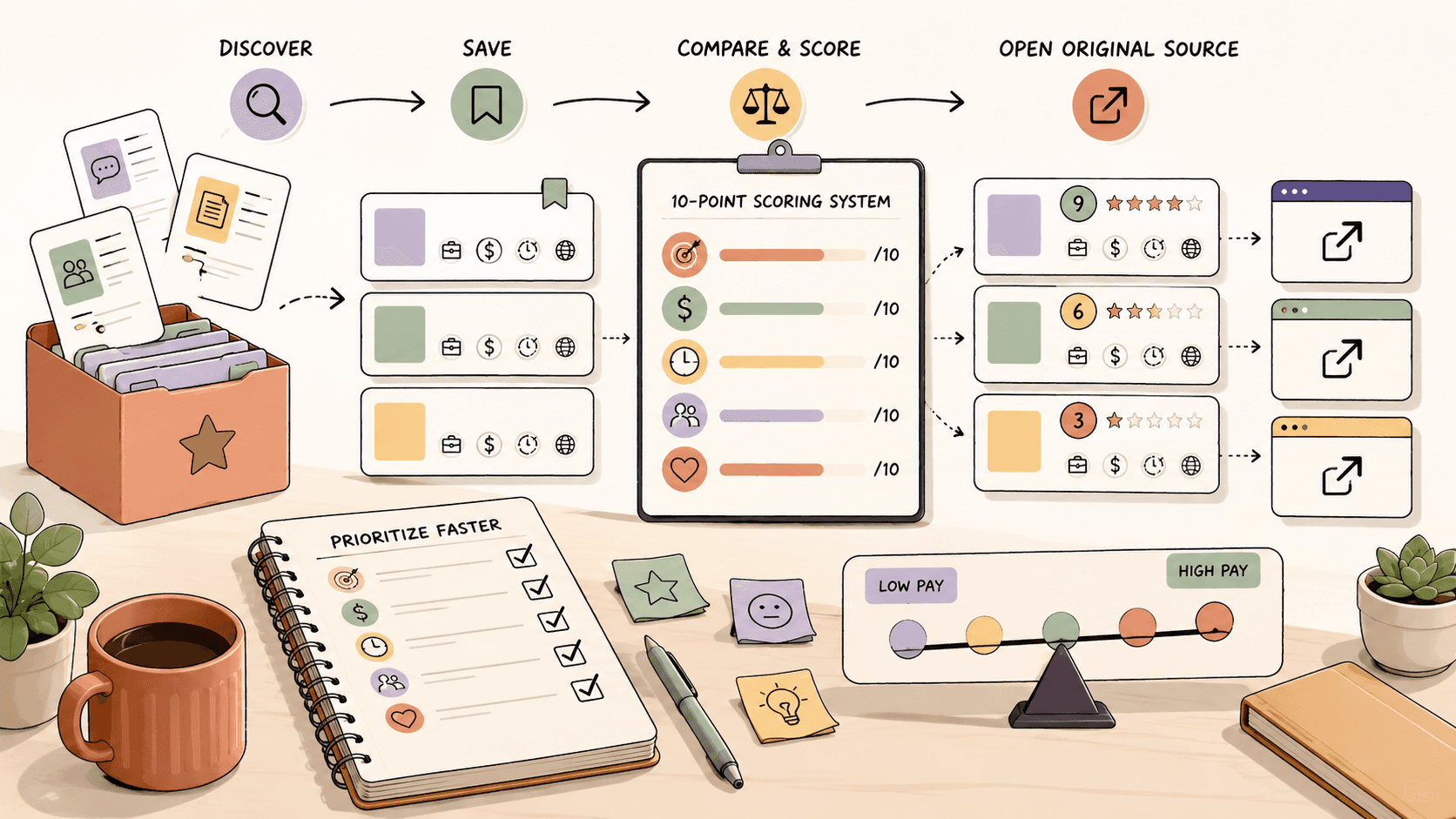
Prioritize freelance leads faster by scoring each opportunity on freshness, budget, skill fit, client clarity, urgency, and pitch effort. Respond first to recent, well-scoped posts with realistic pay and clear next steps. Skip vague, stale, or underpriced leads unless they offer strategic value.
What is the fastest way to prioritize freelance leads?
The fastest way is to score each lead before you emotionally commit to it.
Use this 10-point framework:
| Signal | Points | What to check |
|---|---|---|
| Freshness | 0-2 | Was it posted recently enough that a reply still has a chance? |
| Budget or rate quality | 0-2 | Is the pay realistic for your niche, experience, and scope? |
| Skill fit | 0-2 | Does it match work you can do well and prove quickly? |
| Client clarity | 0-2 | Is the scope, deliverable, timeline, or problem clear? |
| Pitch effort | 0-2 | Can you send a strong reply without spending too much unpaid time? |
Then use this rule:
- 8-10 points: pitch now
- 6-7 points: save and pitch if your top leads are handled
- 4-5 points: only pursue if there is strategic value
- 0-3 points: skip
This keeps you from treating every lead like an emergency.
How should you score freshness?
Freshness matters because many public freelance leads get crowded quickly. A strong opportunity found too late may be less valuable than a decent opportunity found early.
Score freshness like this:
- 2 points: posted very recently and likely still open
- 1 point: posted recently enough to be plausible, but may already have many replies
- 0 points: old, inactive, deleted, closed, or already flooded with responses
The exact window depends on the source. A fast-moving subreddit or social post may become crowded within hours. A formal job board listing may stay useful for days. A referral from a trusted contact may remain warm longer.
Your goal is not to be first everywhere. Your goal is to notice good-fit leads while they are still actionable.
This is where a cleaner opportunity workflow helps. Instead of manually cycling through too many tabs, a dashboard like Sidequestboard can help you monitor fresh public opportunities, save interesting leads, and open the original source when you are ready to respond.
Browse today’s opportunities on Sidequestboard
How do you judge whether a freelance lead pays enough?
Budget is not only about the number. It is about whether the pay makes sense after scope, complexity, platform fees, revisions, communication time, and opportunity cost.
Score budget quality like this:
- 2 points: budget or rate looks realistic for the scope and your level
- 1 point: budget is unclear but the client appears serious enough to ask
- 0 points: obviously underpriced, unpaid, speculative, or dependent on vague future upside
Use any rate examples as rough prioritization filters, not guaranteed market rates. Freelance pricing varies by niche, seniority, region, usage rights, licensing, revision load, turnaround time, and project complexity.
If a platform charges freelancer fees or commissions, check that platform’s current official fee page before pricing your work. Fee structures can change, and you should compare net earnings rather than only the headline budget.
A quick budget check can save hours. If the lead cannot support your minimum acceptable rate, it should not outrank a better-fit opportunity just because it arrived first.
How do you score skill fit without overthinking it?
Skill fit is about proof, not possibility.
Many freelancers waste time on leads they could technically handle but cannot pitch convincingly. A better lead is one where your portfolio, past results, niche knowledge, or process makes the reply easy to trust.
Score skill fit like this:
- 2 points: directly matches your strongest service, portfolio, or niche
- 1 point: adjacent to your strengths, but would require explanation
- 0 points: outside your focus, weak proof, or likely to stretch you too far
For example:
- A Shopify conversion audit is a high-fit lead for a designer with ecommerce case studies.
- A B2B SaaS landing page is a high-fit lead for a copywriter with SaaS examples.
- A vague “need someone good at marketing” post is usually lower fit unless you can quickly clarify the actual problem.
The best leads are not always the highest-paying ones. They are the ones where you can make a credible case quickly.
How do you evaluate client clarity?
Client clarity predicts how much unpaid discovery work you will need before a project becomes real.
Score clarity like this:
- 2 points: clear problem, deliverable, timeline, budget range, and response instructions
- 1 point: some useful details, but you need to ask clarifying questions
- 0 points: vague request, no scope, no budget signal, or unclear decision-maker
Good signs include:
- a specific business problem
- a defined deliverable
- examples of what they like or need
- a realistic timeline
- a named tool, platform, or workflow
- instructions for how to apply or reply
Weak signs include:
- “Looking for a rockstar” with no details
- “Quick job” attached to a complex request
- “Great exposure” instead of compensation
- no mention of budget, timeline, or decision process
- requests for extensive unpaid strategy before any commitment
A clear client with a medium-sized project often deserves priority over a vague client with a big-sounding idea.
How should you score pitch effort?
A lead can be good but still not worth immediate attention if it requires too much unpaid effort to respond.
Score pitch effort like this:
- 2 points: you can send a strong, relevant reply in 10-15 minutes
- 1 point: you need 20-30 minutes to tailor a thoughtful response
- 0 points: it requires a custom audit, long proposal, test task, or heavy research before basic qualification
This does not mean you should avoid thoughtful pitches. It means you should protect your best energy for leads that deserve it.
A strong fast pitch usually includes:
- One sentence showing you understand the problem
- One relevant proof point
- One practical next step
- One simple question that moves the conversation forward
Example:
Hey, I saw you’re looking for help improving a SaaS landing page before launch. I’ve worked on similar pages where the main issue was clarifying the offer above the fold and reducing friction in the signup path. I can review the page and suggest conversion-focused changes. Are you looking for a quick audit, a rewrite, or full page implementation?
That is more useful than a generic “I’m interested” and faster than writing a full proposal before the client has confirmed fit.
Which freelance leads should you pitch first?
Pitch leads that are fresh, clear, realistic, and easy to match with your proof.
Here is a simple priority order:
- Warm referrals with clear scope and budget
- Recent public posts that match your niche closely
- Platform invites or messages from serious clients
- Public community posts with specific deliverables
- Broad job-board listings that require longer applications
- Vague posts that need extensive clarification
The mistake is letting the loudest source control your day. A notification is not a priority. A good-fit, time-sensitive opportunity is.
How can you use this system across Reddit, Upwork, Fiverr, Contra, and other sources?
Different platforms produce different kinds of leads, so the scoring system should stay consistent even when the source changes.
For public communities such as Reddit, X/Twitter, Discord, Slack groups, forums, and niche communities, prioritize:
- recent posts
- clear requests
- visible budget or serious buying signals
- posts where you can reply directly with relevant proof
- communities where your niche is actually discussed
For freelance marketplaces and portfolio platforms, prioritize:
- direct invites or messages over cold browsing
- clients with clear project history or detailed briefs
- listings that match your exact service
- opportunities where the platform’s current fee structure still leaves enough net pay
For referrals, prioritize:
- relationship strength
- decision-maker access
- scope clarity
- likelihood of closing
- whether the project fits the type of work you want more of
Do not rank a lead higher only because it came from a famous platform. Rank it higher because it scores higher.
What should your daily freelance lead workflow look like?
A simple workflow beats a complicated tracking system you abandon after two days.
Try this 45-minute daily routine:
1. Scan for fresh opportunities for 15 minutes
Check your highest-signal sources first. Sort by newest where possible. Ignore anything obviously stale, vague, or misaligned.
If you use Sidequestboard, this is the stage where you can review fresh public opportunities in a calmer feed instead of jumping between every community manually.
2. Score the best leads for 10 minutes
Do not score everything. Only score leads that pass a basic sanity check.
Use five columns:
- Freshness
- Budget
- Skill fit
- Client clarity
- Pitch effort
Anything under 6 points should usually wait or be skipped.
3. Pitch your top 1-3 leads for 20 minutes
Send your best replies while the leads are still fresh. Keep them short, specific, and proof-based.
Use this structure:
I noticed [specific problem or goal]. I’ve helped with [relevant proof]. I’d approach it by [simple first step]. Are you looking for [option A] or [option B]?
This creates a real conversation instead of dumping a long proposal into a crowded inbox.
What should you track after pitching?
Track only what helps you improve decisions.
At minimum, record:
- source
- date found
- date pitched
- score
- service type
- quoted budget or rate range if available
- reply status
- outcome
After two to four weeks, review patterns:
- Which sources produce replies?
- Which scores correlate with calls or paid work?
- Which niches close fastest?
- Which lead types waste time?
- Which pitches get ignored?
This turns prioritization from guesswork into a feedback loop.
When should you skip a freelance lead?
Skip faster when the lead shows signs of poor fit.
Common skip signals:
- no clear deliverable
- no realistic budget signal
- unpaid trial work before basic qualification
- urgent timeline with unclear scope
- client wants many unrelated skills in one person
- request is far outside your strongest service
- old post with many existing replies
- vague promise of future equity, exposure, or revenue share
Skipping is not laziness. It is how you protect time for leads that can actually become paid work.
Example: scoring three freelance leads
Imagine you are a freelance web designer.
Lead A: Recent SaaS landing page request
A founder posted one hour ago asking for a landing page redesign before a launch. They mention the product, timeline, budget range, and examples.
- Freshness: 2
- Budget: 2
- Skill fit: 2
- Client clarity: 2
- Pitch effort: 2
Total: 10/10 — pitch now.
Lead B: Marketplace listing for a “simple website”
The listing is recent but vague. The budget may be low for the likely scope, and the client has not explained what pages or functionality they need.
- Freshness: 2
- Budget: 1
- Skill fit: 2
- Client clarity: 0
- Pitch effort: 1
Total: 6/10 — save, clarify only if you have capacity.
Lead C: Old community post asking for “any designer”
The post is several days old, has many replies, no budget, and no clear deliverable.
- Freshness: 0
- Budget: 0
- Skill fit: 1
- Client clarity: 0
- Pitch effort: 0
Total: 1/10 — skip.
This is the point of scoring: it makes the next action obvious.
How do you avoid spending all day searching for freelance work?
Set a search limit before you start.
A healthy freelance lead routine has three separate actions:
- Discover potential leads
- Prioritize the best ones
- Respond while they are fresh
Most freelancers overinvest in discovery and underinvest in response quality. They keep opening more tabs because it feels productive, but the real money is usually in timely, relevant replies.
Use saved searches, community bookmarks, alerts, or an opportunity dashboard to reduce the search burden. Sidequestboard is useful if your current process involves checking many public communities and social platforms manually, because it helps you review, save, and act on relevant opportunities from one cleaner place.
The bottom line
Prioritizing freelance leads faster is not about rushing. It is about using consistent filters.
Score every serious lead on:
- freshness
- budget quality
- skill fit
- client clarity
- pitch effort
Then pitch the highest-scoring opportunities first. Skip vague or stale posts quickly. Save borderline leads only when they are worth a second look. The better your prioritization system, the more time you can spend doing the work that actually wins clients: sending timely, specific, credible replies.