July 16, 2026
How to Start a Freelance Graphic Design Business: Portfolio, Pricing, Clients, and Contracts
To start a freelance graphic design business, choose a focused service, define your ideal client, build 3-5 relevant portfolio samples, set simple starter pricing, prepare proposal, contract, and invoice templates, then find leads through referrals, LinkedIn, freelance platforms, communities, and public opportunity feeds.
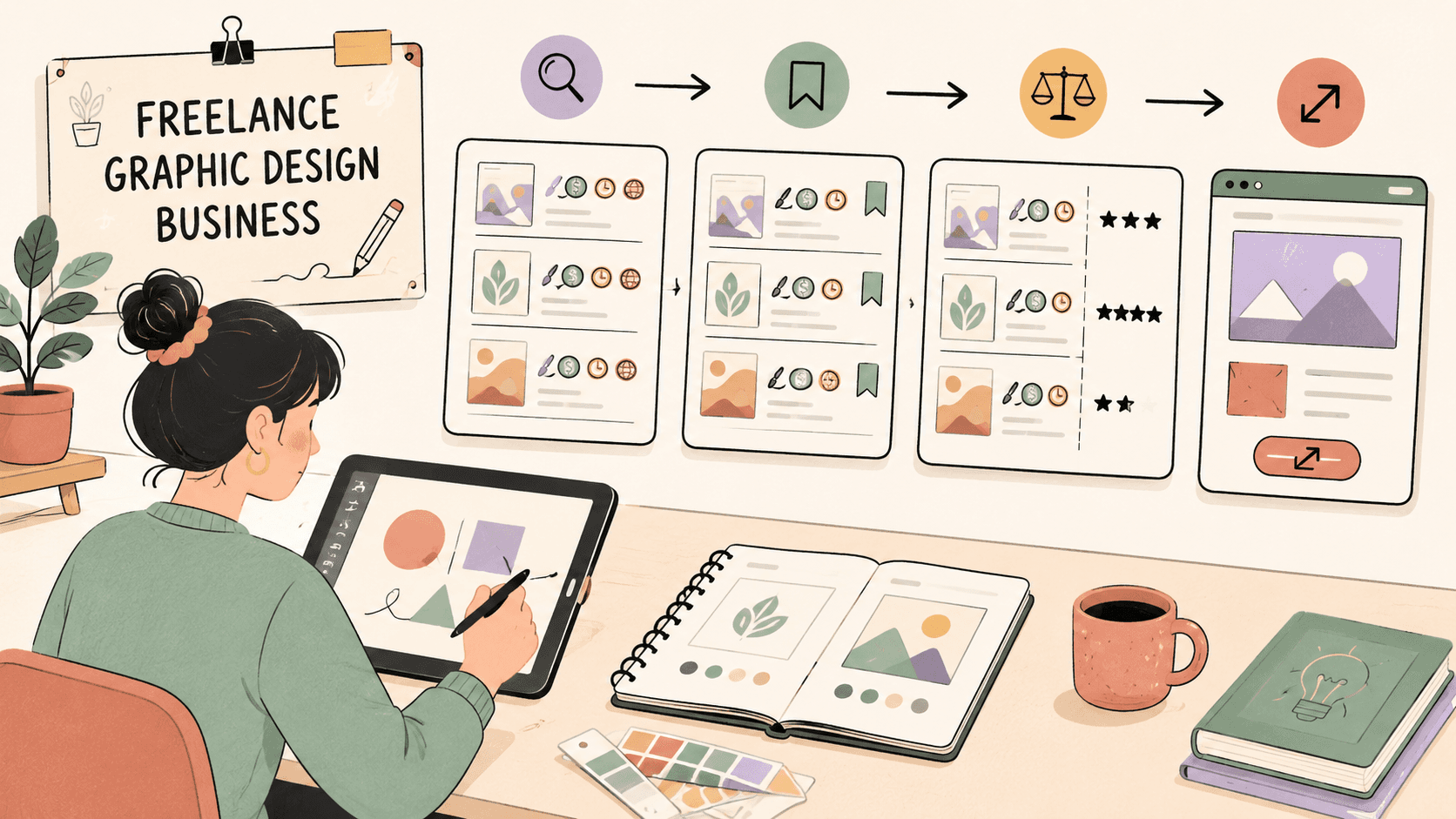
How do you start a freelance graphic design business?
Starting a freelance graphic design business is not just about being good at design. You need a clear offer, proof that you can solve a client problem, a repeatable way to find leads, and a basic system for proposals, contracts, invoices, and follow-ups.
A lean start is usually better than spending months perfecting a brand for your own business. Your first goal is to become easy to hire for a specific design outcome.
A simple launch plan looks like this:
- Pick one or two design services to sell first.
- Define the type of client who needs those services.
- Build 3-5 portfolio pieces that match that client’s needs.
- Create a one-page business plan with your offer, pricing, outreach channels, and monthly goals.
- Set up basic templates for proposals, contracts, invoices, and onboarding.
- Start pitching and tracking leads every week.
- Improve your packages based on real client conversations.
You do not need a large agency-style website to begin. You do need enough clarity that a client can quickly understand what you do, what problem you solve, and how to start working with you.
What services should a new freelance graphic designer offer?
New freelance designers often make the mistake of offering everything: logos, websites, packaging, social media posts, pitch decks, ads, email graphics, illustrations, and brand strategy all at once. That can make you look flexible, but it can also make you harder to remember.
Start with a focused service that has a clear buyer and a clear deliverable. Examples include:
- Logo and starter brand identity packages for new local businesses
- Social media graphics for coaches, creators, or small ecommerce brands
- Pitch deck design for startups and consultants
- Menu, flyer, and poster design for restaurants and events
- Presentation templates for agencies or sales teams
- Packaging label design for small product brands
- Website hero graphics and landing page visuals for SaaS or online services
A focused service does not mean you can never take other work. It simply gives your marketing a sharper message. “I design social media launch graphics for fitness coaches” is easier to understand than “I do all kinds of graphic design.”
If you are unsure where to start, choose the service that best matches three things: your current skill level, the kind of work you can show in a portfolio, and the clients you can realistically reach.
Track fresh opportunities on Sidequestboard
How do you build a freelance graphic design portfolio without clients?
You can build a credible starter portfolio before you have paid clients, as long as you clearly present the work as concept, student, personal, or self-directed projects. Do not imply that a made-up project was commissioned by a real company.
Aim for 3-5 strong portfolio pieces instead of 20 mixed-quality samples. Each piece should show a business problem, your design choices, and the final deliverables.
For example, if you want to sell starter brand identity packages, you could create three self-directed portfolio projects:
- A logo, color palette, typography system, and business card for a fictional coffee cart
- A mini brand identity and Instagram launch graphics for a fictional fitness instructor
- A logo refresh, packaging label, and simple style guide for a fictional candle brand
For each project, include:
- The client type or scenario
- The goal of the design
- The deliverables you created
- A few mockups showing how the design works in context
- A short explanation of your decisions
Useful tools for building and presenting your portfolio include Figma, Adobe Illustrator, Photoshop, Canva, Behance, Dribbble, Adobe Portfolio, Webflow, Squarespace, or a simple Notion page. The tool matters less than the clarity of the work.
A strong portfolio page should answer: “Can this designer solve the type of design problem I have?” If the answer is yes, you are ready to start outreach.
How should freelance graphic designers price their work?
There is no universal right price for freelance graphic design. Pricing depends on your experience, market, service complexity, client budget, rights usage, revision scope, timeline, and business value. Readers should verify legal, tax, and local business requirements with official sources or qualified professionals.
For beginners, the simplest structure is usually project-based packages with clear scope. Hourly pricing can work, but it often makes clients focus on time instead of outcome. A package is easier to understand and easier to quote.
Example starter packages might look like this:
- Basic social media graphics package: 10 static templates, 1 revision round, source files if included
- Starter logo package: 2 initial concepts, 1 selected logo direction, 2 revision rounds, final files
- Pitch deck refresh: up to 12 slides, visual redesign, 1 revision round
- Event flyer package: 1 main flyer, 2 social media sizes, 1 revision round
A practical pricing walkthrough:
Imagine you offer a starter brand package for a new solo business. The package includes a primary logo, alternate logo, color palette, font recommendations, and a one-page style guide. You estimate the project will take 12-15 hours, including discovery, design, revisions, export, and communication. You also know you need to account for admin time, taxes, software, and unpaid lead generation.
Instead of quoting only by the hour, you could create a fixed package price that reflects the total project effort and the value of a usable brand system. If you are new, you may price lower while building proof, but avoid pricing so low that you cannot deliver carefully. As you gain testimonials and stronger case studies, raise your pricing and narrow your scope.
Always define what is included:
- Number of concepts
- Number of revision rounds
- File formats
- Timeline
- Payment schedule
- Usage rights or licensing terms
- What counts as extra work
Clear scope protects both you and the client.
What basic business setup do freelance designers need?
You do not need a complicated operation on day one, but you do need a professional workflow.
At minimum, set up:
- A portfolio link
- A professional email address
- A short service description
- A proposal template
- A contract or service agreement template
- An invoice template or invoicing tool
- A way to accept payment
- A lead tracker
- A folder system for client files
Tools often used by freelancers include Google Drive, Dropbox, Notion, Trello, Asana, Google Sheets, Wave, Stripe, PayPal, Bonsai, HoneyBook, and QuickBooks. Availability, fees, and legal requirements can vary, so check official pricing pages and local regulations before choosing tools.
Your contract should cover scope, timeline, payment terms, revision limits, cancellation terms, ownership or licensing, and how extra work is billed. If you are unsure what your contract needs, consult a qualified legal professional or use reputable templates as a starting point rather than copying random terms from the internet.
Where can graphic designers find their first freelance clients?
The best early clients often come from warm networks, targeted communities, and timely public opportunities. Do not rely on one channel. Test several and track what produces real conversations.
Places to look include:
- Personal referrals from friends, former coworkers, classmates, and local business owners
- LinkedIn posts and direct outreach to founders, marketers, coaches, consultants, and agencies
- Freelance platforms such as Upwork, Fiverr, Contra, and PeoplePerHour
- Portfolio communities like Behance and Dribbble
- Reddit communities such as r/forhire, r/designjobs, and niche business communities where design help is requested
- Public Slack or Discord communities for startups, creators, ecommerce, or local business groups
- Local chambers of commerce, coworking spaces, events, and small business meetups
- Job boards and project boards that list contract design work
The key is relevance. A generic “I’m a graphic designer, hire me” message rarely works. A better approach is to match your offer to a visible need.
For example, if you design pitch decks, look for early-stage founders, consultants, or sales teams discussing fundraising, launches, webinars, or sales presentations. If you design restaurant menus and event flyers, look for local businesses announcing openings, seasonal events, or new promotions.
How do you pitch freelance graphic design clients?
Your first message should be short, specific, and low-pressure. The goal is to start a conversation, not send your life story.
A simple pitch structure:
- Mention why you are reaching out.
- Identify a relevant design problem or opportunity.
- State what you help with.
- Link to a matching portfolio piece.
- Ask a simple question.
Example outreach message:
“Hi Maya, I saw your post about launching a new online workshop next month. I help coaches create clean launch graphics for Instagram, email headers, and landing page visuals. Here’s a relevant sample: [portfolio link]. Are you already covered for the workshop design assets, or would it be useful if I sent over a simple package option?”
That message works because it is specific. It connects to a real event, offers a clear service, and asks an easy question.
Follow up once or twice if there is no reply. A reasonable follow-up after a few business days could be:
“Just checking back on this in case design assets are still on your list for the workshop. Happy to send a quick outline if helpful.”
If there is still no response, move on. Freelancing requires consistent outreach without becoming pushy.
How do you track freelance design leads without getting overwhelmed?
A freelance design business can become chaotic quickly if leads live in browser tabs, social media DMs, screenshots, bookmarks, and memory. Use a simple tracker from the beginning.
Your lead tracker can be a Google Sheet, Notion database, Airtable base, or CRM. Include columns such as:
- Lead name or company
- Source
- Service fit
- Date found
- Contact link
- Status
- Next follow-up date
- Notes
- Outcome
Statuses can be simple: saved, pitched, replied, proposal sent, won, lost, follow up later.
This helps you see which channels are working. If LinkedIn creates replies but freelance marketplaces do not, spend more time on LinkedIn. If Reddit produces fast-moving opportunities but you find them too late, improve your monitoring routine.
Once your portfolio, pricing, and templates are ready, the real bottleneck is usually finding fresh, relevant opportunities before they disappear into noisy feeds. Sidequestboard can help here by giving freelancers a cleaner dashboard for discovering and saving fresh public opportunities from communities and social platforms, then opening the original source to respond directly.
A practical 14-day launch plan for new freelance graphic designers
Here is a realistic two-week plan if you are starting from scratch.
Days 1-2: Choose your offer
Pick one primary service and one backup service. Define the client type, deliverables, turnaround time, and what problem the service solves.
Example: “I design launch graphics for online coaches who need Instagram posts, story graphics, and email header visuals for a new program.”
Days 3-5: Build portfolio proof
Create or polish 3 portfolio pieces that match your offer. If you do not have client work, create self-directed concept projects and label them honestly.
Post them on Behance, Dribbble, Adobe Portfolio, your own website, or a clean Notion page. Add short case-study notes so clients understand the goal behind the design.
Days 6-7: Create templates
Prepare a proposal template, invoice template, onboarding questionnaire, and contract or service agreement. Keep everything simple and reusable.
Your onboarding questionnaire can ask:
- What is the project goal?
- Who is the audience?
- What assets already exist?
- What examples do you like or dislike?
- What deadline matters?
- Who approves the work?
Days 8-10: Build your first lead list
Create a list of 30-50 potential leads. Mix warm contacts, LinkedIn prospects, public community posts, freelance platform listings, and local businesses.
Use your tracker to record each opportunity. Save the original link, note why it is relevant, and decide whether to pitch now or later.
Days 11-14: Send targeted pitches
Send 5-10 thoughtful messages per day. Customize each one. Link only to relevant portfolio pieces. Follow up after a few business days when appropriate.
Do not judge the business after five messages. Track your numbers: messages sent, replies, calls booked, proposals sent, and projects won. That data will tell you what to improve.
How do you turn first projects into repeat work?
Your first clients are not just revenue. They are proof, referrals, and learning material.
After each project:
- Ask for feedback
- Request a short testimonial if the client is happy
- Ask whether they need related assets
- Offer a maintenance or monthly design support option if it fits
- Turn the project into a brief case study, with permission when needed
For example, a logo client may later need social media templates, business cards, packaging, presentation slides, or website graphics. A pitch deck client may need a one-page sales sheet. A restaurant flyer client may need monthly event graphics.
The easiest freelance business to grow is one where clients understand what else they can hire you for.
Common mistakes to avoid
Avoid these early freelance design mistakes:
- Spending months branding your own business before pitching anyone
- Offering too many unrelated services at once
- Building a portfolio that does not match the clients you want
- Quoting without clear scope or revision limits
- Starting work without written agreement and payment terms
- Forgetting to follow up
- Taking every project even when the client, budget, or timeline is a poor fit
- Relying on one platform for all leads
- Not saving and tracking opportunities
A freelance graphic design business improves through repetition: better portfolio pieces, clearer packages, better-fit leads, stronger pitches, and smoother delivery.
When should you use an opportunity dashboard?
If you are still defining your service, focus first on your offer, portfolio, and templates. But once you are ready to pitch, lead discovery becomes part of your weekly job.
Many freelance designers check LinkedIn, Reddit, Discord, X/Twitter, job boards, and freelance platforms manually. That can work, but it also creates too many tabs and a lot of noise. Good opportunities can be easy to miss when you find them hours or days too late.
Sidequestboard is designed for people who want a calmer way to discover fresh public work opportunities, save the ones that look relevant, and open the original listing or post to apply or respond. It is not a marketplace, agency, or guarantee of clients; it is a discovery dashboard that can support a more consistent outreach workflow.
Final checklist before you pitch your first client
Before you start outreach, make sure you can answer yes to these questions:
- Do I have one clear service offer?
- Do I know who the offer is for?
- Do I have 3-5 relevant portfolio samples?
- Can I explain my process in simple language?
- Do I have a starting price or package structure?
- Do I have proposal, contract, and invoice templates?
- Do I have a lead tracker?
- Do I have a weekly outreach goal?
- Do I know where I will look for fresh opportunities?
You do not need everything perfect. You need enough structure to look professional, protect your time, and start real conversations with potential clients.