August 18, 2026
How to Write a Late Payment Reminder for Freelance Clients: 3 Templates and Next Steps
Verify the invoice number, due date, amount, currency, contract terms, and payment instructions before contacting a client. Send a concise written reminder, ask for a specific payment date, and keep a record of every response. Follow up after 1–3 business days, then escalate after about a week only as your agreement and local rules allow.
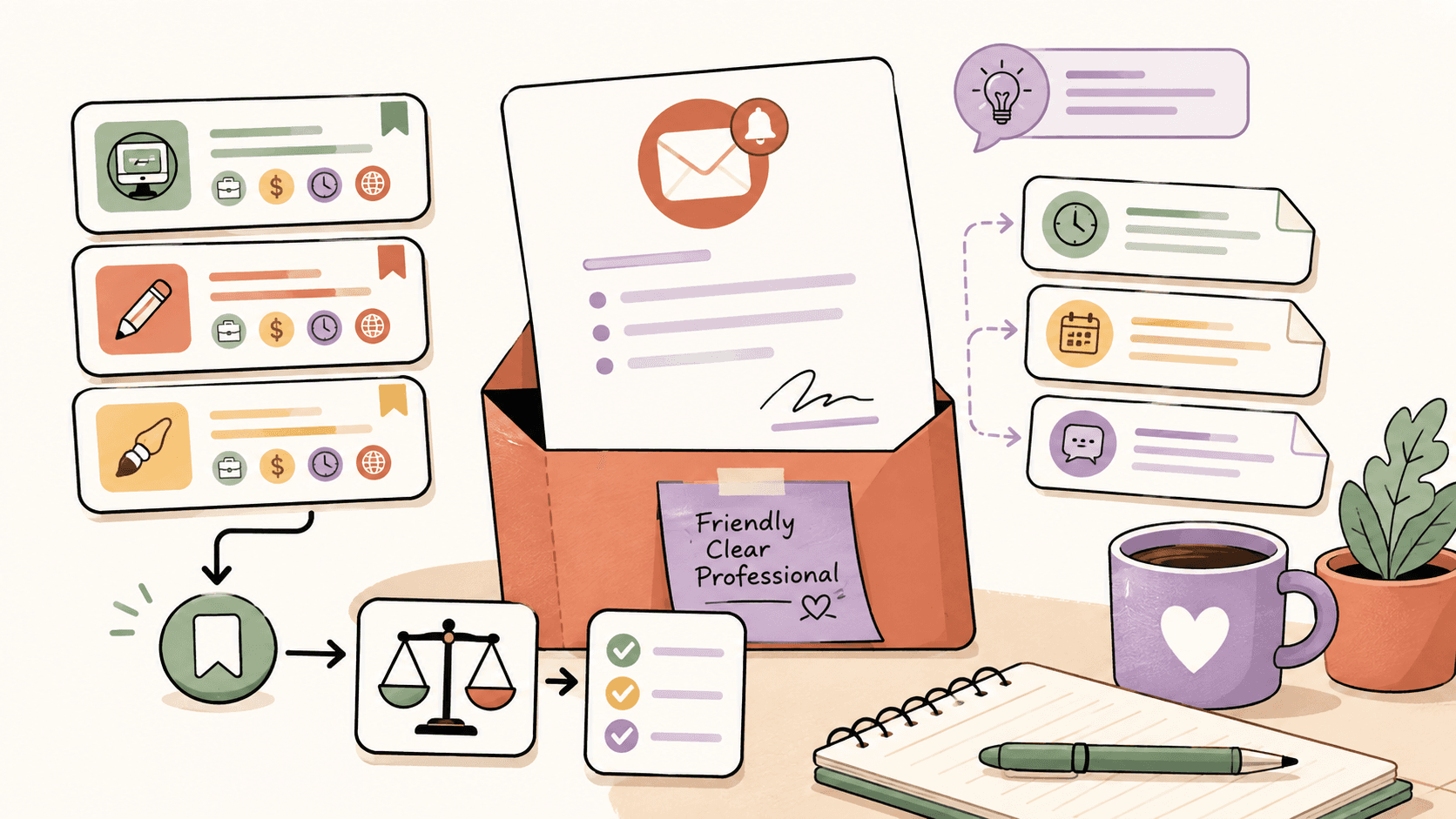
What should you check before sending a late payment reminder?
Before writing, confirm:
- Invoice number: Use the exact reference shown on the invoice.
- Due date: Check whether the due date was based on the invoice date, delivery date, approval, or another event in the contract.
- Amount and currency: Confirm the total, taxes if applicable, and currency.
- Payment instructions: Include the payment link, bank details, or other instructions already provided.
- Purchase order or project reference: Add it if the client uses one.
- Accounts-payable contact: Send the reminder to the correct person and copy the project contact when appropriate.
- Contract terms: Review any approval process, late-fee clause, payment schedule, dispute procedure, or right to pause work.
You can track this information in a simple spreadsheet, Notion, or Google Docs. The tool matters less than keeping one consistent record of invoices, dates, promises, and follow-ups.
When should you send a late payment reminder?
A practical follow-up cadence is:
- First reminder: 1–3 business days after the due date. Assume the delay may be an oversight and keep the tone neutral.
- Second reminder: About one week later. Restate the amount and request a definite payment date.
- Escalation: After the second reminder or a missed promise. Refer to the contract and explain the next step you are taking.
Adjust this timing if your contract specifies a different process. A client may also have a stated invoice-review period or a scheduled accounts-payable run, so ask for the next concrete payment date rather than relying on a vague promise such as “soon.”
Track fresh opportunities on Sidequestboard
What should a late payment reminder include?
A useful message normally contains five parts:
- A clear subject line with the invoice number.
- The invoice date, due date, and outstanding amount.
- A direct link or attachment to the invoice.
- A request for confirmation or a specific payment date.
- A simple question about whether anything is blocking payment.
Avoid adding unrelated project complaints to the first reminder. Keeping the message focused creates a clearer record if the matter later becomes a contract or dispute issue.
Template 1: First late payment reminder
Subject: Payment reminder: Invoice [number] due [date]
Hi [Client name],
I’m following up on invoice [number] for [amount and currency], which was due on [due date]. I’ve attached the invoice again here: [invoice link or attachment].
Could you please confirm that it has been received and let me know the expected payment date?
If anything is missing from the invoice or payment instructions, please tell me and I’ll send it promptly.
Thank you, [Your name]
This version works best when the client has not previously said there is a problem. It gives the client an easy way to identify a missing document or internal processing issue.
Template 2: Follow-up requesting a payment date
Subject: Follow-up needed: Invoice [number] overdue
Hi [Client name],
I’m following up again regarding invoice [number] for [amount and currency]. The invoice was due on [due date], and the outstanding balance is still [amount].
Please confirm by [specific date] when payment will be sent. If the invoice is under review, could you let me know what information or approval is still needed?
For convenience, the invoice and payment instructions are here: [invoice link or attachment].
Best, [Your name]
Use this message after the first reminder has not produced a payment date. A specific response deadline helps distinguish between an invoice awaiting routine processing and a client who is avoiding a clear commitment.
Template 3: Escalation after a missed promise
Subject: Action required: Invoice [number] remains unpaid
Hi [Client name],
Invoice [number] for [amount and currency] was due on [due date]. On [date], you indicated that payment would be made by [promised date], but I have not received it.
Please arrange payment or send a written update by [specific date]. If payment is not received or a mutually agreed plan is not confirmed, I will follow the next step available under our agreement, which may include pausing further work or using the contract’s dispute process.
Please let me know today if there is an issue with the invoice that needs to be resolved.
Regards, [Your name]
Only mention a pause in work, late fee, collection process, mediation, or legal action if the contract and applicable rules support that step. Do not threaten a consequence you cannot or will not follow.
What if the client says the invoice is missing?
Resend the invoice and payment instructions immediately, then ask the client to confirm receipt. Keep the original due date in your records unless both sides agree in writing to change it.
You can reply:
Thanks for letting me know. I’ve attached invoice [number] again and included the payment instructions below. Please confirm receipt and let me know the expected payment date.
If the invoice was sent to the wrong person or address, update your records and note when the corrected copy was delivered.
What if the client says the work is still under review?
Ask what specifically remains to be reviewed, who must approve it, and when that review will be complete. Compare the response with your contract. Some agreements tie payment to approval, while others set payment deadlines that are separate from informal feedback.
A useful reply is:
Thanks for the update. Could you confirm which deliverable or item is still under review, who is handling approval, and the expected approval date? I’d also appreciate confirmation of the payment date once approval is complete.
Keep the discussion specific. “The project is still being reviewed” is less useful than a named deliverable and a date.
What if the client disputes the invoice?
Do not argue by email before reviewing the scope, change requests, time records, acceptance terms, and previous approvals. Ask the client to identify the disputed line item and the basis for the dispute.
You can write:
I understand there is a concern about the invoice. Please identify the specific line item or deliverable in question so I can compare it with the agreed scope and our project records. The undisputed balance remains [amount], unless our agreement states otherwise.
If the dispute continues, follow the contract’s notice and resolution process. Consider getting advice from a qualified professional in your jurisdiction before imposing fees, suspending work, sending the account to collections, or starting legal action.
What should you do while waiting for payment?
First, preserve your records. Save the invoice, contract, scope, approvals, work logs, delivery confirmations, reminders, and payment promises in one folder or workspace.
Second, protect your workload. If a late-paying client is using time that could have gone toward new work, maintain a separate opportunity pipeline instead of waiting passively. Having several active sources of potential work can reduce the financial impact of one client paying late, although it cannot guarantee replacement income.
For example, you might review relevant communities on Reddit, monitor public posts on LinkedIn, or check opportunities shared in Discord communities. A calmer option is to create a Sidequestboard feed for fresh public opportunities, save the listings that fit your skills, and open the original source when you are ready to respond. Set a small target, such as saving your first relevant opportunity, rather than trying to search every platform at once.
When should you pause work for a late-paying client?
Pause work only after checking:
- Whether the contract allows work to be paused for nonpayment.
- Whether you must send written notice first.
- Whether a notice period applies.
- Whether the unpaid invoice is disputed.
- Whether stopping work could affect a delivery, milestone, or third party.
- Whether local rules impose additional requirements.
If you pause work, state what is unpaid, what notice you are giving, what work is being paused, and what needs to happen before work resumes. Keep the message professional and retain proof of delivery.
How can you prevent late payments on future projects?
A reminder helps with one overdue invoice, but your wider workflow can reduce repeat problems:
- Use a written contract with payment dates and deliverables.
- Request a deposit or milestone payment when appropriate and permitted.
- Define the approval process and the person responsible for approval.
- Put invoice requirements, purchase-order details, and payment instructions in one place.
- Send invoices promptly after the agreed milestone.
- Record scope changes and obtain written approval.
- Review a prospective client’s payment process before committing to a large project.
- Keep searching for new opportunities so one client does not represent your entire pipeline.
Tools such as Notion and Google Docs can help organize project records, while platforms such as Upwork and Fiverr may have their own messaging, billing, or dispute workflows. Check each platform’s current terms and use its official process where applicable.
A simple late-payment checklist
Before sending your next reminder, confirm:
- The invoice number is correct.
- The due date and amount are accurate.
- The invoice is attached or linked.
- Payment instructions are still correct.
- The right client or accounts-payable contact is included.
- Your requested response date is specific.
- The message matches the contract.
- You have saved a copy of the email and any reply.
A short, documented reminder is usually more useful than an emotional or overly detailed message. Start with the facts, ask for a date, and escalate only through steps your agreement and local rules permit.