August 30, 2026
10 Interview Answers That Help You Get Hired: Sample Scripts and STAR Frameworks
Strong interview answers are specific, concise, and connected to the role. Use a STAR-style structure for behavioral questions: explain the situation, describe your actions, share the result, and connect the lesson to the job. Prepare flexible examples for teamwork, conflict, failure, leadership, motivation, and problem-solving instead of memorizing scripts.
How should you structure an interview answer?
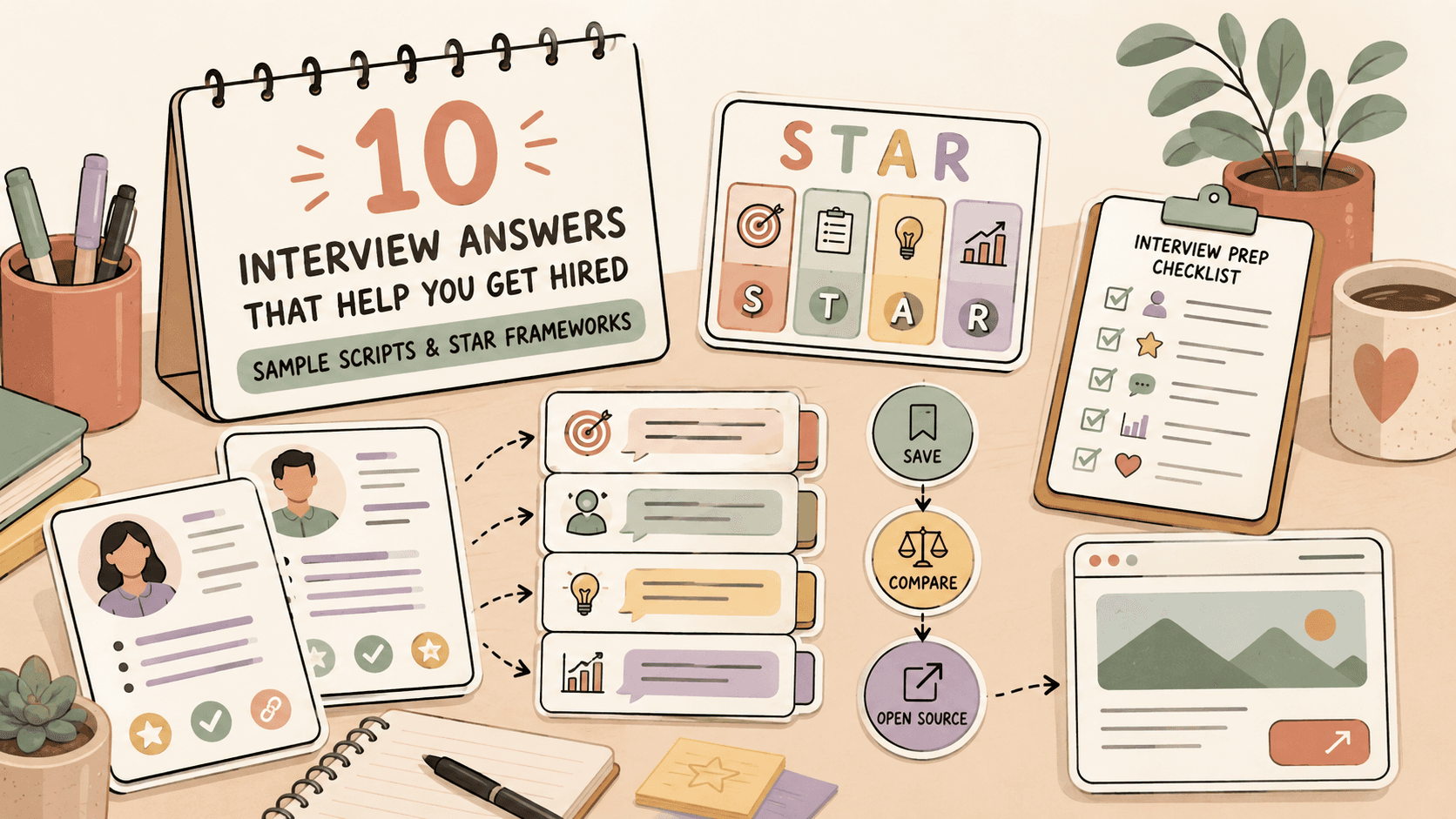
For behavioral questions, use a STAR-style structure:
- Situation: Give the necessary context.
- Task: Explain the responsibility, challenge, or goal.
- Action: Describe what you personally did.
- Result: Share the outcome, lesson, or observable change.
- Relevance: Connect the example to the role when appropriate.
A useful timing guide is 30–45 seconds for a concise introduction and about 60–90 seconds for most behavioral answers. Go longer only when the interviewer asks for more detail.
Avoid claiming results you cannot verify. If you do not have an exact metric, describe an observable outcome, such as a completed deliverable, resolved issue, clearer process, positive feedback, or lesson you applied later.
1. Tell me about yourself
What the interviewer is looking for: A focused summary of your relevant background and direction—not your entire life story.
Sample answer:
“I’m a [role or area of expertise] with experience in [relevant skill or type of work]. In my recent work, I focused on [responsibility or project], where I developed stronger skills in [skill]. I’m now interested in this opportunity because it combines [relevant requirement] with [team, product, or mission]. I’d be excited to bring my experience in [specific strength] to the role.”
Keep this answer to roughly 30–45 seconds. Start with your current professional identity, mention one or two relevant strengths, and finish with why this role is a logical next step.
Browse today’s opportunities on Sidequestboard
2. Why do you want this job?
What the interviewer is looking for: Evidence that you understand the role and have a specific reason for applying.
Sample answer:
“I’m interested in this role because it brings together my experience in [relevant skill] and my interest in [industry, product, or problem]. The responsibilities around [specific requirement from the job description] are especially appealing because I’ve worked on [related example]. I’m also looking for a role where I can contribute to [desired outcome], and this position appears closely aligned with that goal.”
Before the interview, identify two details from the job description or company materials and connect them to your experience. Avoid relying only on broad statements such as “I want to grow” or “I like the company.”
3. What is your greatest strength?
What the interviewer is looking for: A strength that matters for the position and is supported by evidence.
Sample answer:
“One of my strengths is turning unclear requirements into an organized plan. On a recent project, I clarified the desired outcome, separated the work into milestones, and confirmed priorities with the people involved. That helped me deliver the work with fewer revisions. I would bring the same structured approach to this role, especially when priorities are changing.”
Choose a strength that appears in the job description. Then support it with a short example rather than listing several positive traits.
4. What is a weakness you are working on?
What the interviewer is looking for: Self-awareness and a credible improvement process.
Sample answer:
“Earlier in my career, I sometimes spent too long refining work before sharing an initial version. I’ve been improving by defining the review standard at the start, sharing earlier drafts when feedback would be useful, and setting a time limit for polishing. That has helped me get input sooner while still maintaining quality.”
Pick a real but manageable development area. Explain the system you use to improve it, and do not present a disguised strength such as “I care too much.”
5. Tell me about a time you solved a difficult problem
STAR framework:
- Situation: A project faced an unclear requirement, delay, error, or constraint.
- Task: State what you were responsible for solving.
- Action: Explain how you investigated options and made decisions.
- Result: Describe what changed and what you learned.
Sample answer:
“A project was delayed because the requirements had changed but were documented in several places. I was responsible for helping the team establish a workable plan. I compared the current requests, listed the conflicts, and asked the project owner to confirm the priority order. We then created one shared checklist and reviewed it before starting the next phase. The team had a clearer source of truth, and I learned to confirm changing requirements before building on them.”
Focus on your reasoning and actions. The challenge does not need to be dramatic; a clear example of reducing confusion can be effective.
6. Tell me about a conflict at work
STAR framework:
- Situation: Two people or groups disagreed about an approach, priority, or expectation.
- Task: Explain your role in addressing the disagreement.
- Action: Describe how you listened, clarified the issue, and proposed a path forward.
- Result: Share the agreement, decision, or lesson.
Sample answer:
“A teammate and I disagreed about whether to add more features before delivering an initial version. I wanted to understand the underlying concern, so I asked which user need the additional features addressed. We compared the options against the deadline and agreed to deliver the essential workflow first, while documenting the other ideas for a later review. That gave us a shared decision rule and kept the discussion focused on the project goal.”
Do not blame the other person. Show that you can disagree respectfully and move toward a practical decision.
7. Tell me about a time you failed or made a mistake
STAR framework:
- Situation: Describe a mistake or unsuccessful approach without hiding your responsibility.
- Task: Explain what you were trying to accomplish.
- Action: State what you did after recognizing the problem.
- Result: Explain the correction and the process change you made.
Sample answer:
“I once began a task before confirming an important dependency, which meant part of the work had to be revised. I took responsibility, checked the dependency with the relevant teammate, and updated the plan before continuing. Afterward, I added a short pre-work checklist for similar tasks. The experience taught me to validate assumptions early rather than treating an incomplete plan as final.”
Choose an example that shows learning and accountability. Avoid an error so severe that you cannot explain how trust or quality was restored.
8. Tell me about a time you showed leadership
Sample answer:
“During a project with several contributors, ownership of the next steps was unclear. I summarized the open decisions, suggested owners based on the work involved, and created a short check-in schedule. I did not manage the team formally, but the structure helped everyone see what was needed and where to raise blockers. I learned that leadership can mean creating clarity and momentum, not only assigning work.”
Leadership can include mentoring, coordinating, improving a process, or taking responsibility during uncertainty. Use the version that matches your actual experience.
9. Why should we hire you?
What the interviewer is looking for: A concise case connecting your evidence to the employer’s needs.
Sample answer:
“You should consider me because I bring experience in [key requirement], a practical approach to [relevant problem], and a track record of following work through to completion. For example, I [brief evidence]. I’m also comfortable learning where I have gaps, and I’ve already started building familiarity with [tool, process, or area named in the role].”
Do not repeat every qualification. Select two or three requirements from the job description and support them with evidence.
10. Do you have any questions for us?
Always prepare questions. Strong options include:
- “What would you want the person in this role to accomplish in the first few months?”
- “Which part of the role is most challenging right now?”
- “How does the team give feedback and make decisions?”
- “What would distinguish a strong performance from an adequate one?”
- “Is there anything about my experience that you would like me to clarify?”
Ask questions that help you evaluate the opportunity as well as demonstrate thoughtful preparation. Avoid asking questions answered clearly on the company’s website.
How can you build an interview answer bank?
Instead of preparing one script for every possible question, prepare five flexible stories. Choose examples involving:
- A difficult problem
- Collaboration or conflict
- A mistake and what changed afterward
- Leadership or initiative
- A project connected to the role you want
Store the stories in a tool you will actually review. Google Docs works well for a simple document, Notion can organize stories with tags, and Trello can turn each example into a review card. You can also use LinkedIn, Reddit communities such as r/jobs, or relevant Discord groups to compare common interview themes—but adapt advice to your own experience and verify any hiring-specific claims with the employer or an authoritative source.
Copyable interview answer-bank template
Question or competency:
Role targeted:

Situation:
Task or responsibility:
Actions I personally took:
Result or observable outcome:
Metric, evidence, or feedback (if verified):
What I learned:
Why this matters for the target role:
Follow-up questions the interviewer may ask:

Answer length:
Key words from the job description:
Write bullet points first. Practice speaking naturally from the bullets, then shorten anything that does not support the answer.
How do you tailor an answer to a specific job?
Use this five-step process:
- Highlight the recurring skills and responsibilities in the job description.
- Match each requirement to one answer-bank story.
- Replace generic language with the employer’s terminology when it is accurate.
- Lead with the part of the story most relevant to the role.
- Practice a concise version and prepare one additional detail for follow-up questions.
For example, the same teamwork story can emphasize stakeholder communication for a coordinator role, prioritization for an operations role, or technical handoffs for a project role. The facts should stay the same; the emphasis can change.
What is a practical seven-day interview preparation plan?
Day 1: Understand the role. Highlight responsibilities, required skills, and likely competencies.
Day 2: Choose five stories. Select examples that cover problem-solving, teamwork, conflict, learning, and initiative.
Day 3: Draft your answer bank. Fill in the template and remove unsupported claims.
Day 4: Tailor the stories. Match each example to the target role and prepare likely follow-ups.
Day 5: Practice aloud. Record yourself or practice with a friend. Check whether each answer has a clear beginning, action, and outcome.
Day 6: Run a mock interview. Practice concise answers, pauses, and questions for the interviewer.
Day 7: Review lightly. Revisit key points, confirm logistics, and avoid trying to memorize every sentence.
How can you turn preparation into more applications?
Interview preparation works best when it is connected to a specific opportunity. After preparing your answer bank, review fresh public job, freelance, and project listings that match your experience. Save three relevant listings, note the skills each one emphasizes, and choose the STAR story that best demonstrates those skills. Then open the original listing to apply or respond directly.
Sidequestboard can make that workflow easier by bringing public opportunities from communities and social platforms into one feed, where you can discover and save relevant listings before opening their original sources. It is useful when you want to spend less time checking Reddit, X, Discord, and other public communities manually and more time tailoring an application or response.
For example, a freelance designer could save three suitable project posts, compare their requested skills, adapt one collaboration story for each opportunity, and open the original posts to respond. The dashboard does not replace application quality; it helps make opportunity discovery and tracking more manageable.
Final interview-answer checklist
Before the interview, confirm that each prepared answer:
- Addresses the question directly
- Uses a specific example where appropriate
- Makes your personal contribution clear
- Includes a result, observable outcome, or lesson
- Avoids unverified numbers or exaggerated claims
- Connects naturally to the role
- Can be delivered without reading a script
The goal is not to sound rehearsed. It is to make it easier to recall accurate evidence when the interviewer asks a familiar question in an unfamiliar way.