August 16, 2026
Is This Too Formal for a Job Interview? How to Dress One Level Above the Role
If you are unsure, dress one level more polished than the role’s usual workwear. A suit fits formal industries, senior roles, and client-facing positions. Smart casual is often better for startups, remote interviews, creative teams, and freelance calls. Aim to look credible, comfortable, and not distracting.
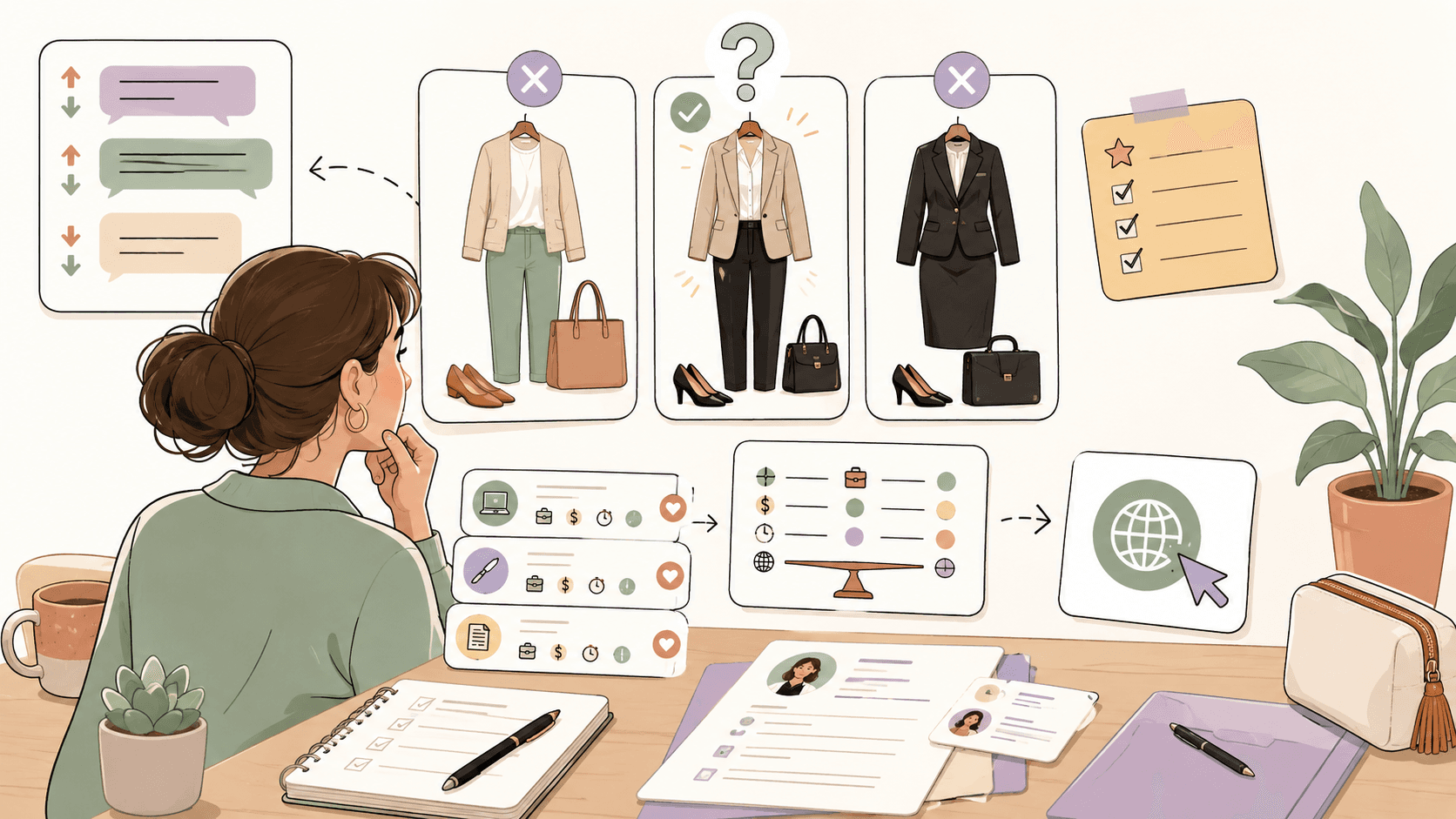
Quick rule: dress one level above the role
If you are asking, “Is this too formal for a job interview?” the safest answer is usually: dress one level above what people in that role normally wear at work.
That means:
- If the team wears T-shirts and jeans, wear a neat shirt, blouse, sweater, polo, or casual blazer with clean shoes.
- If the team wears smart casual, wear business casual or a blazer.
- If the team wears business casual, wear a suit or a more formal jacket-and-trouser combination.
- If the job is in finance, law, consulting, executive leadership, government, or a high-stakes client-facing environment, a suit is usually safer.
The goal is not to look expensive. The goal is to look intentional, respectful, and ready for the context.
When is an interview outfit too formal?
An outfit is probably too formal when it makes you look disconnected from the role, the team, or the company culture.
For example, a dark suit and tie might be perfect for a corporate finance interview, but it may feel stiff for a casual startup product support call, a junior design role, or a freelance creator interview. A full formal outfit can also work against you if it makes you visibly uncomfortable or distracts from the conversation.
Your outfit may be too formal if:
- Everyone on the company website, LinkedIn, or social posts is dressed casually.
- The role is hands-on, creative, technical, or informal, and the company has a relaxed culture.
- The recruiter explicitly says the interview is casual.
- You feel like you are wearing a costume rather than a polished version of yourself.
- The formality creates a power-distance mismatch, especially in a small startup or peer-style team interview.
That said, being slightly overdressed is usually less risky than being clearly underdressed. If the outfit is clean, simple, and not distracting, a little extra polish often reads as effort.
Browse today’s opportunities on Sidequestboard
When is an outfit too casual for an interview?
An outfit is too casual when it makes the interviewer wonder whether you understood the seriousness of the meeting.
Avoid anything that looks like you did not prepare, including:
- Wrinkled or stained clothing
- Gym wear, pajamas, or loungewear
- Flip-flops or worn-out shoes, unless the context truly supports them
- Distracting slogans or graphics
- Clothes that are uncomfortable enough to affect your confidence
- Anything that conflicts with company instructions
A clean T-shirt may be fine for some tech, startup, or creative interviews, especially if paired with a neat jacket or overshirt. But a random T-shirt you would wear to run errands is usually not the best choice.
How to research the right interview dress code?
Before choosing your outfit, spend 10 to 15 minutes checking the company’s public signals.
Look at:
- The company’s website team page
- LinkedIn employee photos and hiring posts
- Glassdoor interview reviews, if available
- Instagram, YouTube, or TikTok posts from the company
- Event photos, conference panels, or office videos
- Recruiter emails or interview instructions
- The role itself: client-facing, internal, creative, technical, field-based, or executive
Local norms, climate, accessibility needs, religious clothing, and company-specific instructions should override generic industry advice.
If you are interviewing through Zoom, Google Meet, or Microsoft Teams, also check how the outfit looks on camera. Some patterns, shiny fabrics, or very bright colors can be distracting on video even if they look fine in person.
Interview outfit guide by company type
| Interview type | Safer outfit direction | What to avoid |
|---|---|---|
| Corporate finance, law, consulting, executive role | Suit, dress shirt, formal blouse, blazer, polished shoes | Looking too casual or experimental |
| Government, education administration, healthcare administration | Business formal or polished business casual | Distracting accessories or overly casual clothes |
| Startup, SaaS, tech support, product, operations | Smart casual, clean shirt, knit, polo, blazer optional | Looking like you did not prepare |
| Creative agency, design, media, content role | Polished personal style, smart casual, intentional details | Overly stiff corporate look if culture is relaxed |
| Retail, hospitality, customer-facing service | Neat, approachable, role-appropriate polish | Untidy shoes, wrinkled clothing, heavy perfume or cologne |
| Trades, field work, warehouse, practical roles | Clean practical clothing, neat boots or shoes, simple layers | Formal clothing that looks impractical for the role |
| Freelance or contract discovery call | Clean smart casual, camera-ready top, minimal distractions | Looking like the call is not a real business meeting |
This table is a starting point, not a rulebook. If the employer gives specific guidance, follow that first.
Is a suit too formal for a job interview?
A suit is not automatically too formal. It depends on the industry, seniority, and audience.
A suit is often appropriate for:
- Banking, finance, law, consulting, insurance, and executive roles
- Senior leadership interviews
- Client-facing business development or account roles
- Formal second-round or final-round interviews
- Interviews with conservative organizations
A suit may be more formal than necessary for:
- Early-stage startups
- Casual software teams
- Creative studios
- Internal technical roles with a relaxed culture
- Freelance discovery calls where the client appears informal
If you own a suit but worry it is too much, you can soften it: skip the tie, choose a simpler shirt, wear a less formal shoe, or use separates instead of a full matching suit.
What to wear for a remote interview?
Remote interviews still count. You do not need to dress as if you are walking into a boardroom, but you should look prepared from the waist up and avoid anything that distracts on camera.
For video interviews:
- Wear a clean top that contrasts with your background.
- Avoid tiny stripes or busy patterns that can flicker on camera.
- Check lighting before the call.
- Sit in the outfit for a few minutes to make sure it is comfortable.
- Test the look in Zoom, Google Meet, or Microsoft Teams before the interview.
- Keep accessories simple if they create noise or glare.
For most remote interviews, smart casual works well: a neat shirt, blouse, sweater, polo, or simple blazer. If the industry is formal, dress more formally even if the interview is online.
What if the recruiter says “dress casual”?
If the recruiter says “dress casual,” do not interpret that as “wear anything.” Interpret it as: do not overdo formal businesswear, but still look interview-ready.
Good options include:
- A clean button-down shirt without a tie
- A blouse or knit top
- A neat polo
- A simple sweater
- Dark jeans or chinos if the company is casual
- Clean shoes
- A casual blazer if you want extra polish
When in doubt, choose “clean and intentional” over “relaxed and effortless.” Interviewers usually notice preparation more than fashion.
Two examples: how to decide in real situations
Example 1: customer success interview at a startup
You check LinkedIn and the company’s Instagram. Employees are wearing T-shirts, hoodies, and casual button-downs. The recruiter says the interview will be a relaxed conversation with the hiring manager.
A full suit may feel too formal. A better choice might be:
- Clean button-down or polished knit top
- Chinos, dark jeans, or simple trousers
- Casual blazer or overshirt if you want structure
- Clean shoes
You look prepared without looking like you misunderstood the company culture.
Example 2: second-round interview at a finance firm
The company website uses formal headshots. LinkedIn posts show employees in suits at client events. The role includes client meetings and the interview is with senior leaders.
A suit or formal business outfit is appropriate. A casual look would be riskier than being slightly overdressed.
The outfit checklist before you leave or join the call
Before the interview, ask yourself:
- Is this one level more polished than the role’s everyday clothing?
- Does it match the company’s public culture and industry?
- Did the recruiter give any dress code guidance?
- Is everything clean, unwrinkled, and comfortable?
- Are shoes or visible accessories neat?
- Will the outfit distract from what I am saying?
- For video calls, does it look good on camera?
- Can I sit, walk, or gesture naturally in it?
If the answer is yes, you are probably in the right range.
Do not make one interview your whole pipeline?
Outfit anxiety often gets worse when one interview feels like your only chance. Prepare well, dress appropriately, and take the opportunity seriously — but keep your search moving.
Before your next interview, it can help to save 3 to 5 fresh backup opportunities so you are not emotionally dependent on one outcome. That might mean checking LinkedIn, Upwork, Reddit communities such as r/forhire, relevant Discord groups, X/Twitter posts, or niche job boards in your field.
Sidequestboard can make that workflow calmer by helping you find and save fresh public job, freelance, and project opportunities in one cleaner feed, then open the original source when you are ready to apply or respond.
Final answer: is it better to be overdressed or underdressed?
For most interviews, it is better to be slightly overdressed than underdressed. But the best version is not “as formal as possible.” It is one level above the role, aligned with the company, and comfortable enough that you can focus on the conversation.
If you are deciding between two outfits, choose the one that looks prepared without feeling like a costume.