August 28, 2026
How to Find Online Tutoring Jobs as a College Student With No Experience
College students can find online tutoring work without formal experience by choosing one or two subjects, creating a short proof-of-skill sample, and checking tutoring platforms, campus programs, and relevant public communities. Compare current requirements and pay terms on official pages, verify every lead, and track applications so you can improve your pitch.
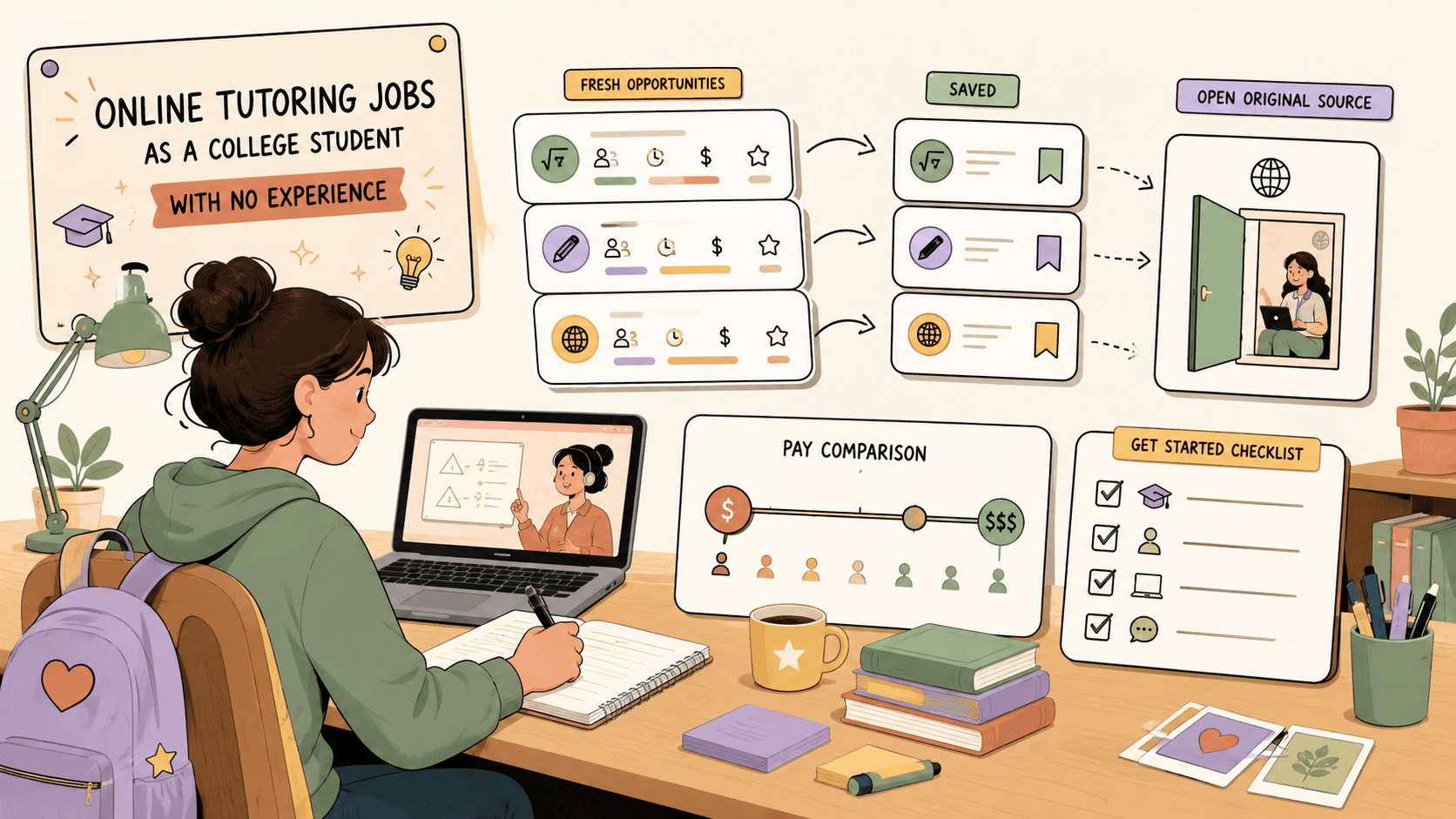
Where can college students find online tutoring jobs?
1. Tutoring platforms and education companies
Check services such as Wyzant, Varsity Tutors, Tutor.com, Preply, Outschool, and Cambly. These services do not all use the same model:
- Wyzant is generally associated with independent tutor profiles and student inquiries.
- Varsity Tutors and Tutor.com may recruit tutors through company-specific application and screening processes.
- Preply is commonly used for language and subject tutoring through tutor profiles and student bookings.
- Outschool focuses on online classes, so instructors may need to propose or teach a suitable class format.
- Cambly is associated primarily with conversational English tutoring, subject to its current eligibility and application rules.
Requirements, subjects, screening, scheduling, fees, and payment terms can change. Review each service's official tutor or instructor page before investing time in an application. Do not assume that a platform accepts all college students or that advertised student demand guarantees bookings.
2. University employment portals and academic departments
Your college may list peer-tutor, supplemental-instruction, academic-coach, or online teaching-assistant roles through:
- The student employment portal
- The career center
- Academic department newsletters
- Learning or writing centers
- Residence-life and academic-success programs
- Faculty or graduate-student networks
These opportunities can be easier to evaluate because they are connected to your institution. Ask whether the role is paid, what training is required, which students can apply, and whether tutoring takes place online, in person, or in a hybrid format.
3. Public communities and student networks
Relevant posts can also appear in Reddit communities, Discord servers, Slack groups, student organization channels, and subject-specific communities. Search for terms such as:
- “online math tutor”
- “college biology tutor”
- “statistics homework help”
- “English conversation tutor”
- “peer tutor needed”
- “remote academic coach”
Use community rules and search filters where available. Check the poster's history, ask for the scope and payment terms in writing, and avoid moving directly to unpaid trial work or sharing sensitive identity documents before the opportunity is verified.
Can you get an online tutoring job with no experience?
Yes, some opportunities may consider applicants without formal tutoring employment, but “no experience” does not mean “no evidence.” You still need to show that you can explain concepts, organize a session, and work responsibly.
Useful substitutes for formal experience include:
- Strong recent grades in the subject, if you are comfortable sharing them
- Peer study-group experience
- Volunteer teaching or mentoring
- A lab, research, or project background
- A short lesson plan or worked example
- Recommendations from a professor, classmate, club leader, or prior volunteer coordinator
Never claim credentials, grades, certifications, or teaching experience you do not have. If a service requires a degree, teaching certificate, background check, or minimum age, treat that requirement as controlling and verify it on the current official application page.
See fresh gigs on Sidequestboard
What subjects should a beginner tutor teach?
Choose one or two subjects where you can explain the basics without relying on a textbook during every question. Good starting choices might include a recently completed introductory course, a language you use confidently, or a skill you have practiced through projects.
Before applying, test yourself by answering:
- Can I explain the main concepts in plain language?
- Can I show a worked example without giving a student the answer to submit?
- Can I identify common mistakes?
- Can I tell when a question is beyond my level?
- Can I prepare a 30- to 60-minute session outline?
Tutoring should support learning rather than complete graded work for someone else. Be especially cautious when a prospective client asks you to take an exam, write an assignment, or provide answers for submission.
How do you create proof of tutoring ability?
Create one short sample for each subject you plan to offer. A useful sample can include:
- The learner level or course level
- The concept being taught
- A plain-language explanation
- One worked example
- A common mistake and how to correct it
- Two practice questions
- A brief answer key or explanation
For example, a statistics sample could explain the difference between a mean and a median using a small data set. A biology sample could outline how to interpret a simple cell diagram. Keep the sample original, clear, and short enough for a prospective client or coordinator to review quickly.
You can share the sample as a Google Doc or PDF. Remove private student information and do not copy restricted course materials. A sample is not a substitute for a required credential, but it gives a beginner something concrete to discuss in an application.
How should a college student apply for online tutoring work?
Tailor each application to the subject and learner instead of sending a generic message. A concise application can follow this structure:
Hi, I’m a college student who recently completed [course or subject]. I can help with [specific topics] and focus on explaining the steps rather than simply providing answers. I’ve attached a short example showing how I would teach [concept]. I’m available [general schedule]. Could you share the learner’s level, session format, rate or payment terms, and expected start date?
Before sending, check four details:
- Whether the role is tutoring, teaching, coaching, or homework completion
- The expected schedule and time zone
- The payment amount, payment method, and any platform deductions
- Whether there is screening, training, a background check, or an unpaid trial
If the post is vague, ask a question before sharing personal information. A legitimate opportunity should be willing to explain the work and payment process.
How should you compare tutoring pay and time?
Do not compare hourly figures without checking whether they are gross or net and whether preparation, messaging, cancellations, or platform deductions are unpaid.
A simple comparison method is to record three current listings or platform terms for similar subjects and learner levels. For each one, note:
- Advertised or stated hourly amount
- Platform commission or other deductions
- Expected preparation and follow-up time
- Cancellation or scheduling rules
- Whether the opportunity supplies students
- Whether payment is guaranteed or depends on bookings
For a hypothetical example, suppose a session is advertised at $24 for one hour, a platform deduction is $4, and preparation plus follow-up takes 30 unpaid minutes. The tutor receives $20 for 1.5 total hours, which is an effective $13.33 per hour before taxes. This is a calculation method, not a market-rate benchmark. Use the current terms for the specific opportunity you are evaluating.
How can you find fresh tutoring leads without checking every site manually?
Create a repeatable search routine rather than relying on one platform. For example:
- Check your university employment portal and relevant department channels.
- Review tutoring-specific services such as Wyzant, Varsity Tutors, or Tutor.com.
- Search relevant Reddit, Discord, or Slack communities using subject and availability terms.
- Save promising leads with the original URL, date found, subject, deadline, and verification status.
- Apply promptly when the opportunity is legitimate and matches your schedule.
- Follow up once if the listing allows it, then record the result.
If you are monitoring several public communities, Sidequestboard can provide a cleaner place to discover and save fresh opportunity posts before opening the original source to verify the details and respond. For example, you could save a campus-adjacent tutoring lead, a Reddit request, and an education-community post in one workflow, then track applications separately in Notion or a spreadsheet.
Sidequestboard is a discovery and saving dashboard, not a tutoring marketplace, employer, or guarantee of work. Always open the original listing, confirm that it is still active, and evaluate the poster or organization yourself.
How can students avoid tutoring scams?
Treat an opportunity as high risk when it:
- Requires you to pay to access a job
- Promises unusually high pay without explaining the work
- Requests bank details or identity documents before a legitimate onboarding step
- Pressures you to cash a check or send money elsewhere
- Asks for extensive unpaid work unrelated to a reasonable screening task
- Refuses to provide the learner, subject, schedule, payment, or organization details
- Wants you to complete graded work or impersonate a student
Search the organization independently rather than trusting only the contact information in a message. Keep communication and payment terms in writing. If a platform or university has a reporting process, use it when a listing appears fraudulent or violates academic-integrity rules.
A seven-day plan for finding your first online tutoring lead
Day 1: Choose one or two subjects and define the learner level you can support.
Day 2: Build a short proof-of-skill sample and a one-paragraph tutor introduction.
Day 3: Review your university portal, career center, and academic department channels.
Day 4: Check Wyzant, Varsity Tutors, Tutor.com, Preply, Outschool, or Cambly and read the current requirements that apply to you.
Day 5: Search relevant Reddit, Discord, Slack, and student communities. Verify each promising post.
Day 6: Send two or three tailored applications and record the terms, date, and follow-up deadline.
Day 7: Review responses, improve your sample or pitch, and remove leads that cannot be verified.
The goal of the first week is not to apply everywhere. It is to build a credible offer, identify suitable channels, and create a process you can repeat without losing track of conversations.