August 20, 2026
Client Won't Pay an Invoice? Your 9-Step Recovery Plan (With Templates)
Review the contract, confirm the invoice and work records, and ask the client to identify any dispute in writing. Send a firm payment demand with a reasonable deadline, pause further work if your agreement allows it, and keep all evidence. If payment still doesn't arrive, weigh the balance against the cost of mediation, collections, or small claims before escalating.
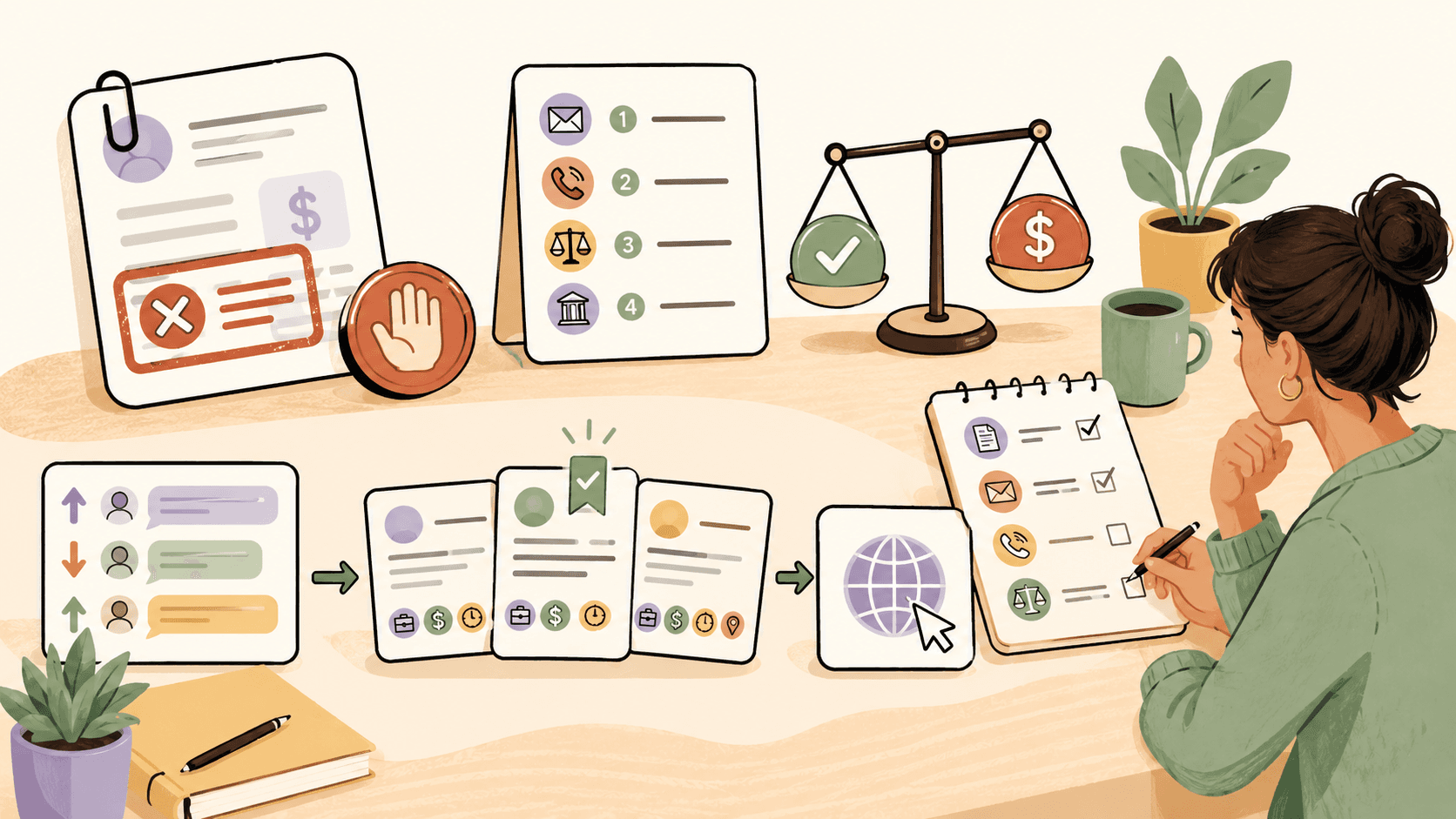
What do you do when a client refuses to pay an invoice?
A client refusing to pay an invoice is one of the most stressful situations a freelancer can face — but it becomes far more manageable when you follow a sequence instead of reacting emotionally. The steps below move from low-cost, relationship-preserving actions to firmer escalation, and each one strengthens your position if the dispute goes further.
The 9-step recovery plan at a glance
| Step | Action | Typical timing |
|---|---|---|
| 1 | Review the contract and scope | Day 1 |
| 2 | Verify the invoice and work records | Day 1 |
| 3 | Ask for the dispute in writing | Day 1–2 |
| 4 | Send a calm payment demand | Day 3–7 |
| 5 | Pause additional work (if allowed) | With the demand |
| 6 | Send a final notice | +7–14 days |
| 7 | Evaluate cost vs. balance | Before escalating |
| 8 | Escalate: mediation, collections, or small claims | As chosen |
| 9 | Replace the income and tighten prevention | Ongoing |
What this looks like in practice
Say a design client ghosts you on a $2,800 final invoice after two milestone payments went through fine. You re-read the contract (payment due net-15, late fee 1.5%/month), confirm the files were delivered and approved over email, and send a neutral "what's in dispute?" message. The client replies that their own client delayed a launch — not a quality complaint. You send the payment demand with a 7-day deadline, pause the retainer work the contract allows you to pause, and follow with a final notice. Payment lands on day six of the deadline. Most recoveries that succeed look exactly like this: calm, documented, sequential — not angry.
Step 1: Review the contract and scope
Before anything else, re-read your agreement. Look for the payment terms, due date, late-fee clause, dispute process, and any language about pausing work for nonpayment. If you used a contract template from a service like HelloBonsai (free contract templates for freelancers) or signed via DocuSign or Dropbox Sign, pull up the executed copy now.
If you have no written contract, don't panic — invoices, emails, messages, and delivered work still count as evidence in most places. But note the gap for next time.
Track fresh opportunities on Sidequestboard
Step 2: Verify the invoice and work records
Confirm the invoice number, amount, due date, and payment details are correct. Gather proof of delivery: files sent, messages approving the work, time logs if you track them in a tool like Toggl or Clockify, and any milestone sign-offs. A clean paper trail is what makes later escalation viable.
Step 3: Ask the client to identify the dispute in writing
"Refusing to pay" often hides a specific complaint — quality, scope, or an internal budget problem on their side. Send a short, neutral message:
"I want to resolve this quickly. Could you confirm in writing which part of the invoice or delivered work is in dispute, and what a fair resolution looks like from your side?"
This does two things: it sometimes resolves a misunderstanding in one email, and it forces the client to commit to a position you can respond to (or later show a court).
Step 4: Send a calm payment demand
If there's no real dispute, send a payment demand with a firm, reasonable deadline. Keep it professional — anger weakens your case and your reputation.
Template: payment demand
Subject: Invoice [#[number]] — payment required by [date]
Hi [Name],
Invoice [#[number]] for [amount] was due on [date] and remains unpaid. I've confirmed the work was delivered and approved per our agreement of [date].
Please arrange payment by [deadline — typically 7 days out]. If there's a specific issue with the invoice, reply to this email and I'll address it.
Thanks, [Your name]
If you invoice through a platform like Wave (free invoicing) or FreshBooks, enable automated payment reminders first — some clients pay purely from a system reminder, with no confrontation needed.
Step 5: Pause additional work if your agreement allows it
If work is ongoing, pausing is your strongest non-legal lever — but only if your contract permits it and local rules don't restrict it (some jurisdictions limit suspension for nonpayment).
Template: work pause notice
Hi [Name],
As invoice [#[number]] is overdue, I'm pausing work on [project] effective [date], per clause [X] of our agreement. Work will resume within [timeframe] of payment being received. I'm happy to discuss a payment plan if that helps.
Step 6: Send a final notice
After the demand deadline passes, send a final notice stating what happens next (mediation, collections, or small claims). This is often when payment suddenly appears.
Template: final notice
This is a final notice for invoice [#[number]] ([amount]), overdue since [date]. If payment is not received by [date], I will pursue recovery through [mediation / a collections service / small claims court], and late fees of [X%] per our agreement will apply.
Step 7: Compare the balance against the cost of recovery
Before escalating, run this checklist:
- Mediation: low cost, preserves the relationship, non-binding unless agreed.
- Collections agency: typically takes a percentage of the recovered amount; rates vary, so get quotes.
- Formal demand letter: a lawyer's letter often costs a few hundred dollars but triggers payment surprisingly often.
- Small claims court: low filing fees, usually no lawyer needed — but check your local court's current limit. As a rough anchor, many US states cap small-claims claims somewhere between roughly $5,000 and $10,000, though limits change and vary by state and even by court — verify with your court's official website before filing.
A $400 invoice rarely justifies formal legal action; a $6,000 one might.
Step 8: Escalate deliberately
Choose the option that fits the balance and the relationship. File in the correct jurisdiction (usually where the client or the contract says), bring your full evidence trail, and follow the court's or agency's process exactly. For anything ambiguous, a short consultation with a qualified lawyer is worth the fee.
One note: this article is general information, not legal advice — rules on debt recovery, work suspension, and court limits vary by jurisdiction, so verify with official sources or a local lawyer before acting.
Step 9: Replace the income — and vet the next client better
Recovery takes weeks or months. Your rent doesn't. Once the demand letters are sent, shift energy toward refilling your pipeline with clients who actually pay.
Prevention beats recovery every time:
- Take deposits (30–50% upfront is common) and use staged milestone billing so no single unpaid invoice is catastrophic.
- Check payment terms before you apply — a gig post that's vague about budget and terms is a warning sign.
- Watch how a client communicates early. Slow, evasive replies during the sales conversation often predict slow payment later.
For finding replacement work, fresh listings appear daily across Upwork, Contra, and communities like r/forhire and r/freelance on Reddit, plus various freelance Discord servers. Manually patrolling all of those tabs is exactly the kind of time sink you can't afford while chasing an unpaid invoice.
That's where Sidequestboard fits: it pulls fresh opportunity posts from public communities and platforms into one calmer feed, so you can spot relevant gigs while they're still fresh, save the promising ones, and open the original listing to apply directly. Instead of a scattered search across a dozen tabs, you get a focused shortlist — and you can check each listing's payment terms before spending time on an application.
Frequently asked questions
Can I take a client to small claims court over an unpaid invoice?
Usually yes, if the amount is within your local court's limit. Many US states cap small-claims claims somewhere between roughly $5,000 and $10,000, but limits vary and change — check your court's official website for the current figure. Filing fees are typically low and lawyers often aren't required.
Should I keep working for a client who hasn't paid?
Generally no — but only pause if your contract allows it and your jurisdiction doesn't restrict suspension for nonpayment. Pausing future work is usually your strongest non-legal leverage, and offering a payment plan can keep the relationship salvageable.
Do late fees actually help recover an unpaid invoice?
They help in two ways: they compensate you for the delay if enforceable under your contract and local law, and they give the client a concrete reason to pay sooner. State them in the contract and repeat them in the final notice — but don't invent fees that weren't agreed to.
How do I prevent this from happening again?
Take a deposit (30–50% upfront is common), bill in milestones, put payment terms in writing before starting, and vet clients before you apply — including checking whether a gig post states clear budget and payment terms. Slow, evasive communication early on is a reliable early warning sign.
What should you know about what to do when a client refuses to pay an invoice?
Start with the practical intent behind the search: identify the type of work, confirm the source is credible, and decide what action you can take today.