July 13, 2026
How to Find Side Gigs as a Beginner: 12 Ways to Get Paid Leads
Beginners find side gigs fastest by choosing one specific service, using only three lead sources at first, and sending short, tailored pitches to fresh opportunities. A strong beginner mix is one marketplace, one online community, and one relationship-based channel such as local contacts, referrals, or overflow work from established providers.
What kind of side gig should a beginner look for first?
The best first side gig is small, easy to explain, low-risk for the client, and easy to prove with a sample. Beginners usually struggle when they offer vague help like “I can do marketing” or “I can do anything online.” You will get better responses when your offer has a clear deliverable.
Use this sentence formula:
I help [type of person or business] with [specific outcome] by delivering [specific asset] in [timeframe].
Examples:
- “I help local restaurants update their Google Business Profile, menu links, and weekly posts in 48 hours.”
- “I help creators turn long videos into three captioned short-form clips.”
- “I help small SaaS teams write one clear 1,000-word blog post from a provided outline.”
- “I help busy consultants organize Gmail, calendar tasks, and simple spreadsheets for five hours per week.”
- “I help small businesses fix basic WordPress layout issues and broken links.”
Beginner-friendly side gigs can be online, local, or hybrid:
| Category | Beginner-friendly examples |
|---|---|
| Writing | Blog posts, product descriptions, newsletters, editing, show notes |
| Design | Social media graphics, simple flyers, logo concepts, landing page sections |
| Video | Short-form edits, captions, thumbnail stills, podcast clips |
| Admin | Inbox cleanup, calendar scheduling, spreadsheet formatting, data entry |
| Tech support | Website fixes, local device setup, software setup, basic troubleshooting |
| Local business help | Google Business Profile cleanup, menu updates, event flyers, social scheduling |
| Education | Tutoring, test prep, language practice, software lessons |
| Finance/admin support | Bookkeeping cleanup assistance, invoice organization, receipt categorization |
Typical beginner-to-intermediate ranges vary widely by skill, scope, location, and proof. Virtual assistant work often falls around $15 to $35/hr, writing assignments may range from $20 to $200+, graphic design can range from $30 to $100/hr, UI design from $50 to $150/hr, and video editing from $100 to $1,000 per project depending on complexity. Treat these as reference points, not guarantees.
Your first action: write one clear service sentence before you open any job board.
Where can beginners find side gigs online and locally?
Beginners should look in five places: online communities, freelance marketplaces, direct outreach, referrals, and overflow partnerships. Each source works differently, so the mistake is trying to use all of them at once.
Start with three channels for the first two weeks:
- One high-volume source, such as Reddit, Upwork, or LinkedIn groups.
- One trust-based source, such as referrals, alumni contacts, local groups, or warm outreach.
- One proof hub, such as Contra, a simple portfolio page, or a focused Fiverr profile.
Good beginner sources include:
- Reddit communities: r/forhire, r/WorkOnline, r/HireaWriter, r/designjobs, r/freelance_forhire.
- Marketplaces: Upwork, Fiverr, Contra, PeoplePerHour.
- Social and professional channels: LinkedIn posts, LinkedIn groups, Facebook groups, niche Discord or Slack communities.
- Local sources: small businesses, cafes, gyms, salons, real estate agents, nonprofits, chambers of commerce, coworking spaces, churches, parent groups, neighborhood groups, and alumni networks.
- Referral sources: past coworkers, classmates, professors, family friends, local founders, creators, consultants.
- Overflow sources: agencies, established freelancers, web designers, MSPs, IT consultants, bookkeepers, marketers, and virtual assistant businesses.
Fastest does not always mean best. Marketplaces have volume but more competition. Warm outreach has fewer leads but more trust. Overflow work may take longer to start, but one reliable provider can send repeat tasks if you do good work.
See fresh gigs on Sidequestboard
Which lead sources are best for beginners?
Use this table to choose channels based on your situation, not based on what sounds popular.
| Lead source | Best for | Beginner difficulty | Competition | Trust level | Speed to first conversation | First action |
|---|---|---|---|---|---|---|
| Writing, design, dev, VA, online gigs | Medium | High | Low to medium | Fast if posts are fresh | Sort target subreddits by New and reply to posts under 72 hours old | |
| Upwork | Admin, writing, design, dev, support | Medium | High | Medium | Medium | Build one focused profile and apply to small, clear jobs |
| Fiverr | Packaged creative or repeatable services | Medium | High | Medium | Slow to medium | Create one narrow gig with Basic, Standard, and Premium tiers |
| Contra | Portfolio-led independent work | Easy to medium | Medium | Medium | Depends on outreach | Create a profile and use it as your proof link |
| PeoplePerHour | Fixed-price projects, UK/EU-friendly freelance work | Medium | Medium to high | Medium | Medium | Create one “Hourlie” or bid on small fixed-scope projects |
| Professional services, referrals, B2B support | Medium | Medium | Medium to high | Medium | Post your specific offer and DM warm contacts politely | |
| Facebook groups | Local services, creator support, neighborhood gigs | Easy | Medium | Medium | Fast in active groups | Search local or niche groups for “looking for,” “need help,” and “recommend” posts |
| Local businesses | Website edits, social posts, flyers, tech setup, admin | Medium | Low to medium | Medium if local | Medium | Identify one specific improvement and send a respectful note |
| Referrals | Almost any beginner-friendly service | Easy to medium | Low | High | Medium | Tell 10 people exactly what kind of small project you can help with |
| Overflow partnerships | Admin, QA, research, dev fixes, design cleanup, bookkeeping support | Medium | Low to medium | High after trust is built | Slow to medium | Contact established providers and offer paid backup help for small tasks |
Recommendation: choose one high-volume source, one trust-based source, and one proof hub. For example, a beginner writer could use r/HireaWriter, warm LinkedIn contacts, and a Contra portfolio. A beginner designer could use r/designjobs, local business outreach, and Fiverr or Contra.
If you use Sidequestboard, this is where it can help: save promising leads from different sources, note where each lead came from, and track whether you pitched, followed up, or passed. It should support your workflow, not replace your judgment.
How do you find side gigs through Reddit and online communities?
Reddit can be useful because many side gigs appear as informal posts before they become polished job listings. The key is to search specific communities, sort by freshness, and reply only when the scope looks real.
Start with these communities:
- r/forhire: broad freelance work; check [Hiring] posts and sort by New.
- r/WorkOnline: remote and online work; filter by Hiring flair.
- r/HireaWriter: writing, editing, and content work; read the rules carefully.
- r/designjobs: design, UI, illustration, and graphics work.
- r/freelance_forhire: service posts and freelance offers.
Useful Google searches:
site:reddit.com/r/forhire hiring remotesite:reddit.com/r/forhire "looking for" developersite:reddit.com/r/forhire "need a" designersite:reddit.com/r/HireaWriter "Hiring" SaaSsite:reddit.com/r/WorkOnline "virtual assistant"
Before replying, check:
- Is the post recent?
- Does it include a task, budget, timeline, or payment method?
- Does the poster have normal account history?
- Are there already dozens of replies?
- Is the request specific enough to quote or ask one useful question?
Reddit pitch template:
Hi, I saw you need [specific task]. I can help with [specific deliverable] and have a relevant sample here: [link or mention]. What [one practical question] should I know before confirming scope? If it fits, I can send a short plan and timeline today.
Example for a video editing lead:
Hi, I saw you need help turning podcast clips into short-form videos. I can edit captioned 30–60 second clips and can share a sample. How many clips do you need per week, and do you already have timestamps selected?
Do not respond with only “interested.” The easier you make it for the poster to understand your fit, the better your odds.
Are Upwork, Fiverr, Contra, and PeoplePerHour worth it for beginners?
Yes, but only if you use each platform for the right type of offer. They are not magic lead machines. Beginners waste time when they create generic profiles everywhere and wait.
Upwork
Upwork is best when you want to apply to posted projects and build reviews. Start with small, clear jobs: spreadsheet cleanup, blog edits, landing page fixes, customer support, research, or basic design tasks. Upwork fees can vary by account and contract structure, so account for fees before quoting.
Profile positioning example:
I help small teams clean up messy spreadsheets, format reports, and organize recurring admin tasks in Google Sheets and Excel.
Fiverr
Fiverr can work for beginners when your service is packaged and searchable. It is a poor fit if your offer is vague, underpriced, or too broad.
Better Fiverr gig titles:
- “I will edit one captioned short-form video for TikTok or Reels.”
- “I will design a clean flyer for your local event.”
- “I will write a 500-word product description for your Shopify store.”
Fiverr charges a flat commission, commonly 20%, so your pricing needs room for revisions and communication time. Keep the Basic tier narrow, such as one 30-second edit or one flyer concept.
Contra
Contra is useful as a portfolio-style profile and proof hub. It can be helpful even when leads come from Reddit, LinkedIn, referrals, or local outreach because you can send one clean link with your work, services, and contact path. Contra has promoted no commission on earnings, with free and paid options depending on features.
Positioning example:
Portfolio for short-form video editing, including before-and-after examples, turnaround time, and starter packages.
PeoplePerHour
PeoplePerHour is useful for fixed-price projects and “Hourlies,” especially for freelancers working with UK/EU clients or clients comfortable with project-based services. Fees can vary by account and earnings level, so check current platform terms.
Positioning example:
I offer a fixed-scope website content cleanup: up to five pages edited for clarity, formatting, and broken links.
Your first action: choose one platform, create one narrow starter offer, and define the deliverable, delivery time, revision limit, and starting price.
How can beginners find local side gigs and direct clients?
Many beginner side gigs come from people who already trust you, share a local connection, or see you as easier to talk to than a large agency. Local and direct-client work is often less crowded than marketplace work, but it requires more thoughtful outreach.
Good local sources:
- Cafes, restaurants, gyms, salons, clinics, and small shops.
- Real estate agents and local service businesses.
- Local nonprofits and community organizations.
- Chambers of commerce and business associations.
- Coworking spaces and startup meetups.
- Neighborhood groups and local Facebook groups.
- Alumni networks, parent groups, churches, and community boards.
Beginner-friendly local offers:
- Google Business Profile cleanup.
- Menu, hours, or service page updates.
- Simple Canva flyers or event graphics.
- Basic website edits or broken link cleanup.
- Social media post scheduling.
- Inbox or appointment organization.
- Local tech setup for printers, email, booking tools, or point-of-sale software.
Local business outreach script:
Hi [Name], I’m local to [area] and noticed [specific observation, such as outdated hours, broken menu link, or inactive Google Business posts]. I help small businesses with small cleanup projects like [specific service]. If useful, I can send a short list of 3–5 quick fixes and a simple fixed price. No pressure either way — I just wanted to reach out directly.
Keep it specific. Do not mass-spam 100 businesses with the same message. One real observation beats a generic pitch.
How do you get overflow work from established freelancers and agencies?
Overflow work means a busy professional passes you small tasks when they have more work than time. This can be one of the best beginner paths because you are not asking a client to trust you with an entire project immediately. You are offering reliable support on smaller pieces.
People who may need overflow help:
- Web designers and developers.
- Marketing agencies.
- IT consultants and managed service providers.
- Bookkeepers and accounting firms.
- Content agencies and SEO consultants.
- Video editors and podcast producers.
- Virtual assistant businesses.
- Local service providers with admin backlogs.
Beginner-friendly overflow tasks:
- QA testing and link checks.
- Formatting blog drafts or newsletters.
- Research and data cleanup.
- First drafts from a brief.
- Simple design resizing.
- Caption cleanup and video clipping.
- Inbox sorting and admin support.
- Website content uploads.
- After-hours tech support triage.
Overflow partner outreach script:
Hi [Name], I’m building experience in [skill] and noticed you do [their service]. I’m not looking to compete with you — I’m looking for small paid overflow tasks where reliability matters: [task 1], [task 2], or [task 3]. If you ever need backup, I’d be happy to do a small scoped trial task with clear payment and deadlines.
The best tone is “reliable support,” not “please give me work.” Ask for a small paid trial task, not unpaid custom work.
How do you build trust when you have no reviews yet?
You do not need a huge portfolio to start, but you do need proof. If you have no reviews, create proof before asking strangers to trust you.
Ways to build trust quickly:
- Self-created samples.
- Before-and-after examples.
- Mini audits.
- Short Loom walkthroughs.
- References from school, work, volunteering, or past collaborators.
- A simple one-page portfolio.
- A clear starter package with scope and turnaround time.
Proof you can create in one weekend:
| Skill | Weekend proof project |
|---|---|
| Writing | Write one sample blog post and one product description in a niche you want to serve |
| Design | Redesign a fictional flyer, social post, and landing page hero section |
| VA/admin | Create a sample inbox cleanup workflow and spreadsheet tracker |
| Video editing | Edit three short clips from public or self-recorded footage |
| Tech support | Create a checklist for setting up email, backups, or a small business website audit |
| Local business help | Make a sample Google Business Profile improvement checklist |
A beginner portfolio should include:
- Your specific service.
- 2–4 relevant samples.
- A short explanation of each sample.
- Turnaround time.
- Starting price or price range if you are comfortable sharing it.
- Contact method.
- Testimonials or references once available.
A Contra profile, Notion page, Carrd site, Google Doc, or simple personal page is enough to start. The goal is not to look like a big agency; it is to make the buyer feel safe taking the next step.
What should your first pitch say?
A beginner pitch should be short, specific, and easy to answer. Do not apologize for being new. Do not send your life story. Show that you understood the task and can handle the next step.
Use this four-part structure:
- Confirm the task in the client’s words.
- Mention relevant proof, even if it is a self-created sample.
- Ask one practical question.
- Suggest the next step.
Bad pitch:
Hi, I’m interested. I’m hardworking and can do anything you need. Please consider me.
Better pitch:
Hi, I saw you need three short blog posts for a B2B software audience. I can help with clear first drafts based on your outline and can share one SaaS-style sample. What word count and target reader are you aiming for? If it helps, I can send a proposed outline for one post today.
Platform pitch template
Hi [Name], I saw your project for [specific task]. I can deliver [specific deliverable] by [timeframe] and have a relevant sample here: [link]. One question before I quote: [question]? If the scope matches, I can send a short plan and fixed price.
Warm contact script
Hi [Name], I’m starting to take on small [service] projects for [type of client]. If you hear of anyone who needs [specific deliverable], I’d appreciate an introduction. I’m keeping projects small right now, such as [example 1] or [example 2], so they are easy to scope.
LinkedIn DM script
Hi [Name], I noticed your team posts about [topic/business]. I help [type of business] with [specific service]. If you ever need help with [small deliverable], I’d be happy to send a sample or a quick idea. No pressure — just wanted to connect around that.
Local business script
Hi [Name], I’m local to [area] and noticed [specific observation]. I help small businesses with quick fixes like [service]. Would it be useful if I sent a short list of suggested updates and a simple fixed-price option?
Overflow partner script
Hi [Name], I see you handle [their service]. If you ever need backup on smaller tasks like [task], [task], or [task], I’d be glad to help on a paid, clearly scoped basis. I can send a sample and start with a small trial task if useful.
Your pitch should make the next reply obvious. If the person has to ask what you do, what you charge, or whether you read the post, your pitch is too vague.
How should beginners follow up without being annoying?
Follow-up is part of finding side gigs. Many people are busy, and one polite reminder can recover a good lead. The key is to follow up only when the opportunity is legitimate and your message adds clarity.
Simple timing:
- First follow-up: 2–3 business days after your pitch.
- Final check-in: about one week later if the opportunity still seems active.
- Stop after that unless they respond.
Follow-up script:
Hi [Name], quick follow-up on [project/task]. I’m still available to help with [specific deliverable] if it is useful. If priorities changed, no worries — I just wanted to check before I close the loop on my end.
Do not follow up if the post looked scammy, the person was rude, payment terms were unclear, or the opportunity is obviously closed. Track follow-up dates in a spreadsheet, Notion table, Trello board, or Sidequestboard so you do not rely on memory.
How do you avoid scams and bad side gigs?
Beginner side gig searches attract vague offers, unrealistic clients, and scams. You do not need to be paranoid, but you do need a filter.
A decent opportunity usually includes:
- Clear task scope.
- Budget or rate range.
- Timeline.
- Communication expectations.
- Payment terms.
- A real person, business, or project context.
Red flags:
- Unpaid custom samples that could be used as finished work.
- Vague scope with urgent pressure to start immediately.
- Refusal to discuss payment.
- Requests for sensitive personal information.
- Off-platform payment pressure that violates marketplace rules.
- “Too good to be true” rates for little detail.
- Constantly changing requirements before an agreement.
- No written scope for local or direct-client work.
Safe-start checklist:
- Written scope.
- Deliverables.
- Deadline.
- Payment amount and method.
- Deposit or milestone for larger fixed-price work.
- Revision limit.
- Communication channel.
- Ownership/usage expectations if you are creating written, visual, or technical assets.
For writers, a short paid test is more reasonable than a custom unpaid 1,500-word article. For designers, a portfolio review is normal; a free custom logo concept is risky. For developers, do not send full code or complete unpaid debugging before an agreement.
How should beginners price their first side gigs?
Beginner pricing should balance confidence with scope control. Do not underprice so much that you attract unrealistic clients, but do not quote blindly without understanding the work.
Two common pricing models:
| Pricing model | Best for | Watch out for |
|---|---|---|
| Hourly | Admin, support, troubleshooting, ongoing work | Client may worry about open-ended hours |
| Fixed price | Clear deliverables like one blog post, one flyer, one short video, one audit | Scope creep if revisions and limits are not defined |
For beginners, fixed-scope starter packages are often easier to sell because the client knows what they are buying.
Examples:
- Writing: one 800–1,000 word blog draft from a provided outline, one revision included.
- Video: one 30–60 second captioned short, one revision, client provides footage.
- Design: one event flyer concept, two size exports, one revision.
- VA/admin: five-hour inbox cleanup block with summary notes.
- Tech support: basic website audit with broken links, speed observations, and top five fixes.
- Local business: Google Business Profile cleanup checklist plus two updated posts.
Account for:
- Platform fees.
- Revision time.
- Calls and messages.
- Research.
- Taxes.
- Payment processing.
- Rush timelines.
If you are unsure, quote a small paid starter project instead of a large open-ended commitment.
How can you find side gigs while unemployed or job searching?
If you are between jobs, side gigs can help with income, confidence, and recent work examples. But they should not damage your main job search if full-time employment is the priority.
Use these boundaries:
- Choose low-risk projects with short timelines.
- Avoid gigs that require unpredictable availability during interview hours.
- Set a weekly cap, such as 5–10 hours.
- Prefer fixed deliverables over open-ended responsibilities.
- Keep mornings or key blocks open for applications, interviews, and networking.
- Do not take on urgent client work that would make you miss interviews.
Good options while job searching:
- Resume editing for peers if you have that skill.
- Admin cleanup blocks.
- Short writing or editing assignments.
- Website audits.
- Local tech setup.
- One-off design or video projects.
- Overflow tasks with clear deadlines.
The goal is conversations, cash flow, and proof — not locking yourself into commitments you cannot keep.
What 30-minute daily routine helps beginners find side gigs?
A short daily routine beats random browsing. You do not need hours per day; you need consistency and tracking.
Use this 30-minute routine:
- 10 minutes: check saved searches and fresh posts.
- Reddit sorted by New.
- One marketplace search.
- One LinkedIn or Facebook group search.
- 10 minutes: send or improve pitches.
- Aim for 2–3 quality replies, not 20 generic messages.
- 5 minutes: send one warm outreach message.
- A past coworker, local contact, alumni connection, or provider who may need overflow help.
- 5 minutes: update your tracker.
- Source, link, status, pitch sent, follow-up date, quoted price, and next action.
Daily targets:
- 3 quality replies to fresh leads.
- 1 warm outreach message.
- 1 follow-up when due.
- 1 tracker update.
If you are job searching, reduce the routine to 15 minutes: check one saved search, send one strong pitch, and update your tracker. Consistency matters more than volume.
What does a realistic 7-day beginner plan look like?
This plan is designed to create momentum, not guarantee income in a week.
| Day | Action | Output |
|---|---|---|
| Day 1 | Choose one service and write your service sentence | One clear offer |
| Day 2 | Create one sample or before-and-after example | One proof asset |
| Day 3 | Choose three lead sources | One community, one marketplace, one trust-based channel |
| Day 4 | Improve one profile or portfolio hub | Contra, Notion, Carrd, Google Doc, or platform profile |
| Day 5 | Send pitches to fresh online leads | 3–5 tailored messages |
| Day 6 | Contact warm contacts, local leads, or alumni connections | 5 respectful outreach messages |
| Day 7 | Contact overflow partners and follow up | 3 provider messages and follow-up notes |
At the end of the week, review what happened:
- Which source produced replies?
- Which pitch got the best response?
- Did people understand your offer?
- Were your prices too vague?
- Did you need better samples?
Your first goal is not guaranteed income. Your first goal is feedback, conversations, and a clearer offer.
How does Sidequestboard fit into a beginner side gig workflow?
Beginners often lose momentum because leads are scattered across Reddit, marketplaces, DMs, email, local conversations, LinkedIn comments, and referral threads. A lead you forget to follow up on is functionally the same as a lead you never found.
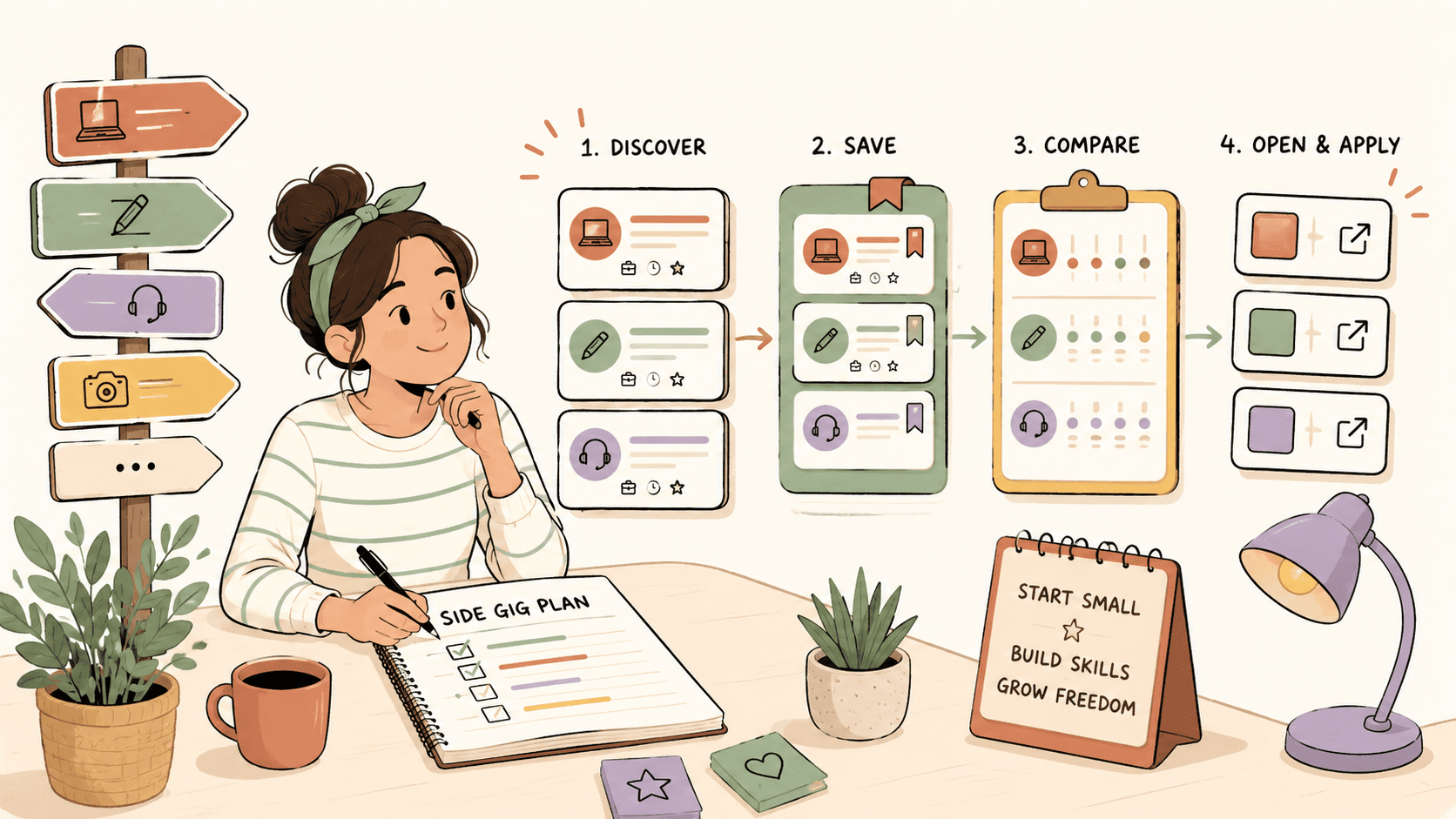
Sidequestboard fits as an opportunity discovery and tracking workflow, not as a fake marketplace or guaranteed job source. You can use it to organize public opportunities, save leads worth reviewing, open the original source, and keep track of where you need to respond.
A simple tracking setup should include:
- Source: Reddit, Upwork, Fiverr, Contra, PeoplePerHour, LinkedIn, local, referral, overflow partner.
- Link or contact.
- Service category.
- Scope.
- Quoted price or budget.
- Pitch sent date.
- Follow-up date.
- Status: saved, pitched, replied, follow-up, won, lost, passed.
- Notes and red flags.
Sidequestboard is most useful after you have chosen your service and lead sources. It helps reduce tab chaos so you can spend more time sending better replies and less time rediscovering the same posts.
What should you do next?
Do three things today:
- Choose one specific side gig offer.
- Pick three lead sources: one high-volume source, one trust-based source, and one proof hub.
- Send five focused pitches this week and track every response.
Do not wait until your portfolio is perfect. Create one useful sample, write a clear offer, and start small. If you want a cleaner way to save leads, track follow-ups, and organize opportunities from different sources, Sidequestboard can fit into that workflow.
FAQ
What is the easiest side gig for beginners?
The easiest side gig is usually one with a small, clear deliverable: blog writing, short-form video editing, virtual assistant work, simple design, local tech setup, tutoring, or Google Business Profile cleanup. The best choice depends on what you can show with a sample and deliver reliably.
How can I find side gigs with no experience?
Choose one specific service, create 1–3 self-made samples, and look for small projects where the risk is low for the client. Use a mix of Reddit or marketplace leads, warm contacts, and local outreach. Do not pretend to have experience you do not have; show proof of the work instead.
Are Fiverr and Upwork worth it for beginners?
They can be worth it if your offer is narrow and your profile is focused. Upwork is better for applying to posted projects, while Fiverr is better for packaged, searchable services. Both are competitive, so beginners should also use referrals, local outreach, and online communities.
How do I get side gigs while working full-time?
Choose small fixed-scope projects with clear deadlines, avoid urgent work that requires daytime availability, and set a weekly hour limit. Good options include weekend writing, evening video editing, admin cleanup blocks, simple design work, tutoring, or local business updates.
How do I find side gigs while unemployed?
Use side gigs as a structured supplement, not a replacement for your job search unless that is your goal. Pick short projects that do not interfere with interviews, such as audits, writing assignments, admin cleanup, local tech setup, or overflow tasks. Keep time blocks protected for applications and networking.
How many pitches should I send per week?
A beginner can start with 10–20 quality pitches per week across online leads, warm contacts, local outreach, and overflow partners. Quality matters more than volume. Track replies so you can improve your offer instead of sending the same weak message repeatedly.
Should I work for free to get experience?
Avoid unpaid custom work that a client can use as a finished deliverable. If you need proof, create your own sample project, volunteer for a cause you care about, or offer a small paid trial with clear scope. Free speculative work often attracts poor clients.
How do I find side gigs on Reddit?
Use specific subreddits such as r/forhire, r/WorkOnline, r/HireaWriter, r/designjobs, and r/freelance_forhire. Sort by New, check the post date, review the poster’s history, and reply with a short message that confirms the task, shows proof, asks one question, and suggests the next step.
How much should a beginner charge for side gigs?
Pricing depends on skill, scope, location, urgency, and proof. As rough reference points, virtual assistant work often ranges from $15 to $35/hr, writing from $20 to $200+ per assignment, graphic design from $30 to $100/hr, UI design from $50 to $150/hr, and video editing from $100 to $1,000 per project. Start with clear scope boundaries rather than simply charging the lowest possible rate.
How does Sidequestboard help with finding side gigs?
Sidequestboard helps you organize opportunity discovery and follow-up by saving leads, tracking sources, and keeping your side gig search in one cleaner workflow. It is not a marketplace, recruiting agency, or guarantee of paid work; you still apply or respond at the original source.