July 18, 2026
Find Contract Opportunities Faster When Boards Feel Crowded
To find contract opportunities when boards feel crowded, stop browsing broad feeds and build a smaller, faster lead system. For freelance and independent contractor work, use niche sources, buyer-intent searches, a 10-point qualification checklist, and short tailored replies so you spend less time applying to weak posts.
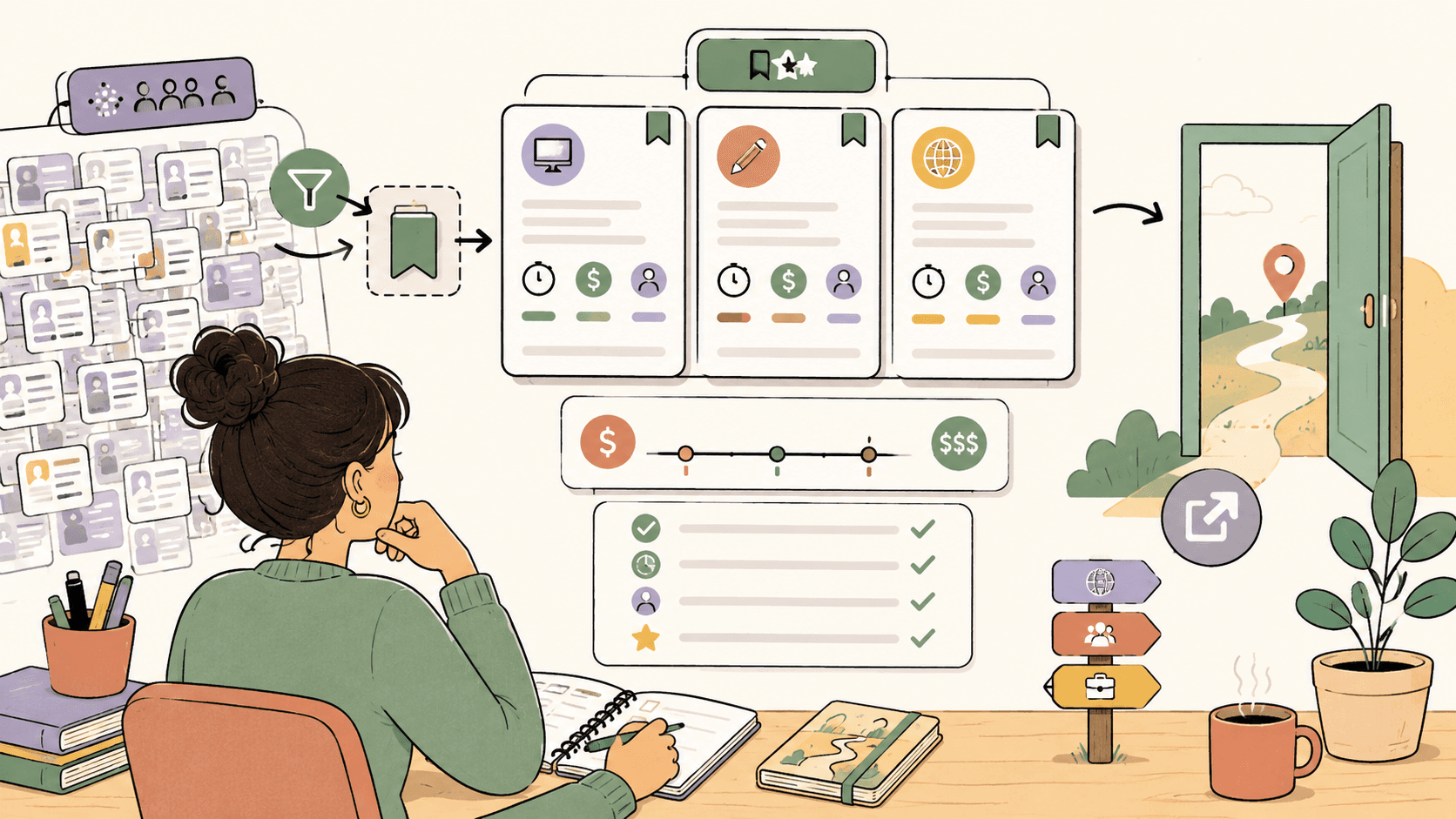
Why do contract boards feel so crowded?
Contract boards feel crowded because most people search them the same way. They open Upwork, Fiverr, Reddit, or a general job board, scroll the newest posts, and apply to anything that looks close enough. That creates noise for buyers and frustration for freelancers.
There are three common reasons the search feels impossible:
- Everyone sees the obvious posts. Broad job feeds surface the same listings to thousands of people.
- Generic services attract generic competition. “Writer,” “designer,” “developer,” and “virtual assistant” are too broad unless you add a specific outcome.
- Established profiles get an advantage. On marketplaces, buyers often filter by reviews, earnings, completion rate, and portfolio proof.
The answer is not to apply more. The answer is to qualify faster, search with better intent signals, and reply only when the post has enough evidence of being real and winnable.
A healthier goal is: 10 carefully qualified leads per week, not 100 random applications.
What kind of contract opportunities are we talking about?
In this article, “contract opportunities” means paid freelance or independent contractor work: design projects, writing assignments, development tasks, marketing retainers, admin support, video editing, consulting, and similar client work.
That matters because Google often shows government contracting results for this kind of query. Those pages are useful if you are selling goods or services to public agencies, but they usually do not help a solo designer, writer, developer, marketer, or virtual assistant find work this week.
For freelance-style contracts, you are usually looking for posts with:
- A clear problem or deliverable
- A short-term project, trial, retainer, or contract role
- A buyer who can make a decision quickly
- A way to respond directly through a platform, email, DM, form, or application link
- Enough budget information to decide whether it is worth your time
Examples include:
- “Hiring a Webflow developer to fix mobile responsiveness”
- “Need a writer for three SaaS onboarding articles”
- “Looking for a designer to create a pitch deck”
- “Need a VA for inbox cleanup and weekly spreadsheet updates”
- “Hiring a video editor for weekly short-form clips”
Those are the opportunities this guide is built around.
Browse today’s opportunities on Sidequestboard
Which platforms should you check first?
Start with a focused platform stack instead of trying to monitor every board. A strong beginner-friendly stack usually includes one broad marketplace, one niche community, and one portfolio hub.
Reddit communities for fresh public posts
Reddit can be noisy, but niche communities are useful when you sort by freshness and check legitimacy carefully.
- r/forhire: useful for mixed freelance and contract posts. Sort by New, look for hiring posts, and prioritize listings with scope, budget, and contact instructions.
- r/HireaWriter: useful for blog writers, copywriters, editors, and content marketers. Compare rates before replying.
- r/designjobs: useful for logo, brand, UI, illustration, and graphic design work. Look for deliverables, timeline, usage rights, and portfolio requirements.
- r/WorkOnline: useful for online work discussions, admin roles, remote gigs, and occasional hiring posts.
- r/freelance_forhire: useful for studying how other freelancers package offers, rates, and portfolios, even when buyer posts are less frequent.
Marketplaces for active buyer demand
Marketplaces are competitive, but they still work better when matched to your service model.
- Upwork: best for broad freelance services including writing, admin, design, development, marketing, automation, and consulting. Check buyer history, proposal count, payment verification, and project clarity.
- Fiverr: best for packaged services with clear deliverables, such as “edit one 60-second vertical video” or “design three Canva carousel templates.” Fiverr commonly charges a 20% commission, so price accordingly.
- Contra: useful for portfolio-led independent professionals and commission-free client work on the platform. It works best when your profile clearly shows outcomes and examples.
- PeoplePerHour: often useful for UK/EU freelancers, fixed-price services, and packaged “Hourlies.”
- Toptal: better for experienced developers, designers, finance experts, and consultants who can pass screening and command higher rates.
A simple three-source setup
Pick three sources only for your first two weeks:
- One marketplace: Upwork, Fiverr, Contra, PeoplePerHour, or Toptal
- One niche community: r/forhire, r/HireaWriter, r/designjobs, or another industry-specific group
- One portfolio hub: Contra, Notion, Carrd, Webflow, Framer, personal website, or a clean PDF portfolio
Examples:
- A UI designer could use Contra + r/designjobs + Upwork.
- A writer could use r/HireaWriter + Upwork + a Notion portfolio.
- A developer could use r/forhire + Contra + LinkedIn.
- A video editor could use Fiverr + r/forhire + a Notion or Frame.io sample page.
How can you search crowded boards without wasting hours?
Search for buyer language, not job titles. Buyers often describe problems using phrases like “need a,” “looking for,” “hiring,” “help with,” “quick turnaround,” “fix,” “build,” “write,” “design,” or “set up.” These phrases show intent because the person is already asking for help.
Reddit’s internal search can be inconsistent, so use Google site searches to find relevant posts faster.
Copy and paste these searches:
site:reddit.com/r/forhire hiring remote
Use this for general remote contract posts across different skills.
site:reddit.com/r/forhire "looking for" developer
Use this for web development, WordPress, React, Shopify, automation, app development, and technical support leads.
site:reddit.com/r/forhire "need a" designer
Use this for logo design, UI design, branding, pitch decks, illustration, and graphic design leads.
site:reddit.com/r/HireaWriter "hiring" "blog"
Use this for writing, SEO content, editing, newsletters, and copywriting work.
site:reddit.com/r/designjobs "hiring" "Figma"
Use this for UI, product design, landing pages, and SaaS design leads.
For each search, time-box yourself to 10 minutes. Open only posts from the last 24 to 72 hours first. Freshness matters because good public posts can receive many replies quickly.
A fast search workflow looks like this:
- Run one saved search query.
- Open only recent posts that match your service.
- Check the post for scope, budget, timeline, and contact instructions.
- Check the poster’s account history or platform credibility.
- Score the lead using the checklist below.
- Reply only if the post is worth it.
Do not let “research” become avoidance. The point of search is to find a few qualified leads, not build a perfect database of every possible job.
How do you know which contract posts are worth replying to?
Use a simple 10-point checklist before you spend time pitching. This prevents you from replying to vague, underpaid, or suspicious posts just because you are tired of searching.
Copy this checklist into Notion, Google Docs, Apple Notes, Trello, or your CRM:
Contract Lead Scorecard — 10 Points

[ ] Clear scope or deliverable: 2 points
    Example: landing page, 3 blog posts, logo package, React bug fix

[ ] Budget, rate, or serious payment signal: 2 points
    Example: fixed budget, hourly range, paid trial, past buyer spend

[ ] Fresh post: 2 points
    Best: posted in the last 24 hours
    Still useful: posted in the last 72 hours

[ ] Clear response instructions: 1 point
    Example: email this address, fill this form, DM with portfolio, apply through platform

[ ] Strong fit with your portfolio: 2 points
    Example: you have a directly relevant sample, case study, or similar past project

[ ] Buyer looks legitimate: 1 point
    Example: account history, verified payment, real company page, consistent posting history

Total: __ / 10
Decision:
7–10 = Reply
4–6 = Reply only if fit is excellent
0–3 = Skip
Red flags to skip
Be careful with posts that include:
- No budget, no scope, and no next step
- Requests for unpaid test projects
- Pressure to move to unusual payment methods immediately
- Vague promises of “exposure,” “future work,” or “equity” instead of pay
- A brand-new account asking for sensitive information
- Work that seems much larger than the stated budget
- Requests to violate a platform’s terms of service
A low score does not mean the buyer is always fake. It means the opportunity is not worth your limited search time.
What should your first reply say when competition is high?
Your first reply should prove fit quickly. Crowded boards punish long, generic cover letters because buyers are often scanning dozens of responses.
Use this five-part structure:
- Problem: Name the thing they need.
- Experience: Show you have done something similar.
- Proof: Include one relevant link or example.
- Next step: State availability, rough process, or rate range.
- Question: Ask one useful question that moves the project forward.
Developer reply template
Hi [Name], I can help with [specific technical problem].

I’ve worked on similar [platform/framework] projects, including [relevant example or outcome]. Here’s a related sample: [link].

I’m available [timeframe], and projects like this usually fall around [rate/range] depending on scope. Do you already have [access/designs/specs], or would the first step be a quick technical review?
Example:
Hi, I can help fix the React checkout issue. I’ve handled similar frontend bugs where the main problem was state handling between the cart and payment step. Here’s a related project: [link]. I’m available this week, and my development work usually falls in the $80–$200+/hr range depending on scope. Do you have a reproducible bug report or staging link?
Designer reply template
Hi [Name], I can help with [specific design deliverable].

I’ve designed similar work for [type of client/project], especially around [outcome]. Here’s a relevant sample: [link].

I’m available [timeframe]. My design work usually falls around [rate/range] depending on deliverables and revisions. Do you already have copy/content, or should the first pass include structure and messaging suggestions too?
Example:
Hey, I can help design the SaaS landing page in Figma. I’ve designed B2B landing pages where the goal was clearer trial signup flow and stronger above-the-fold messaging. Relevant sample: [link]. I’m available this week, and UI design usually falls in the $50–$150/hr range depending on page count and revisions. Do you already have copy, or should the first pass include layout plus suggested messaging?
Writer reply template
Hi [Name], I can help with [specific writing project].

I’ve written similar content for [industry/use case], including [relevant topic or format]. Samples: [link].

Depending on research depth, projects like this usually fall around [rate/range]. Do you already have target keywords and an outline, or would you want those included?
Example:
Hi, I can write the three B2B onboarding articles. I’ve written SaaS content using product screenshots, founder notes, and SEO briefs, so I’m comfortable turning rough inputs into publishable drafts. Samples: [link]. Depending on research depth, my writing projects usually fall between $20 and $200 per piece. Do you already have target keywords and outlines?
Virtual assistant reply template
Hi [Name], I can help with [specific admin workflow].

I’ve handled similar recurring work in [tools], including [specific task]. My VA rate is usually [range] depending on volume and turnaround.

How many hours per week do you expect this to require?
Example:
Hi, I can help with inbox cleanup and weekly spreadsheet updates. I’ve handled recurring admin workflows in Gmail, Google Sheets, and Trello, and I’m comfortable following SOPs. My VA rate is typically $15–$35/hr depending on volume and turnaround. How many hours per week do you expect this to require?
How should beginners find contract opportunities without looking inexperienced?
Beginners should avoid pretending to be senior. Instead, package a narrow, low-risk offer that is easy for a buyer to understand.
Bad beginner positioning:
I can do design, writing, marketing, websites, and social media. DM me.
Better beginner positioning:
I design 3 clean Canva carousel templates for coaches and small service businesses. Delivery in 3 days, includes 1 revision round, examples here: [link].
Specific offers feel safer because the buyer can quickly understand the deliverable, price, timeline, and risk.
Beginner offer examples
- Writer: “I write one SEO blog draft from your outline, 1,000–1,500 words, with title options and meta description.”
- Designer: “I design a simple logo package with 3 concepts, 2 revision rounds, and PNG/SVG delivery.”
- Developer: “I fix one WordPress layout or mobile responsiveness issue within a defined page scope.”
- Video editor: “I edit one 60-second vertical video with captions, jump cuts, and basic sound cleanup.”
- VA: “I clean and organize one inbox, label emails, and create a weekly follow-up spreadsheet.”
On Fiverr, turn these into Basic, Standard, and Premium tiers. On Upwork, use them as focused proposal angles. On Reddit, use them in a concise [For Hire] post or as the proof behind your reply.
For pricing, stay honest about your proof and scope. Common broad ranges include:
- Virtual assistant work: about $15–$35/hr
- Graphic design: about $30–$100/hr
- UI design: about $50–$150/hr
- Development: about $80–$200+/hr
- Finance or specialized consulting: about $100–$250+/hr
- Logo projects: often $50–$500 for basic work, and $200–$2,000+ for more developed identity projects
These are not guaranteed rates. They are reference ranges to help you avoid pricing blindly.
How can you bypass crowded boards entirely?
You do not have to rely only on public job posts. The best long-term contract search system combines outbound replies, inbound profile optimization, and off-platform relationship building.
Optimize marketplace profiles for inbound search
Your Upwork, Fiverr, Contra, or PeoplePerHour profile should make one thing obvious: who you help and what outcome you create.
Improve your profile with:
- A headline tied to a specific result, not just a role
- A first paragraph that names your target client
- Three to five portfolio examples with short context
- Service packages with clear deliverables
- Keywords buyers actually search for
- A simple next step, such as “Send me your current landing page and goal”
Weak headline:
Freelance Designer and Creative Professional
Stronger headline:
SaaS Landing Page Designer for Trial Signup and Demo Flow Improvements
Weak profile intro:
I am passionate, detail-oriented, and hardworking.
Stronger profile intro:
I help early-stage SaaS teams redesign landing pages, pricing pages, and onboarding screens in Figma so visitors understand the product faster and reach the signup or demo step with less friction.
Use a simple portfolio hub
If you do not have a full website, create a lightweight portfolio in Notion, Contra, Carrd, Framer, Webflow, Google Drive, or a PDF.
A strong portfolio page includes:
- One sentence explaining your service
- Three relevant samples
- A short note under each sample explaining the goal, your role, and the result or deliverable
- Rate range or starting price if you are comfortable sharing it
- A clear contact method
Name the page around your service, not your personality. For example: “B2B SaaS Landing Page Design Samples” is more useful than “My Creative Portfolio.”
How can LinkedIn help you find contract work before it hits a board?
LinkedIn can help you bypass crowded boards because many contract needs start as informal posts, founder updates, hiring manager comments, or team announcements before they become formal listings.
Use LinkedIn in three ways.
1. Search for buyer-intent posts
Try searches like:
"looking for a freelance" "designer"
"hiring a contractor" "developer"
"need help with" "Webflow"
"looking for a writer" "SaaS"
"fractional" "marketing" "hiring"
Filter by Posts and sort by recent when possible. Reply publicly only if useful; often the better move is to send a short connection request or DM that references the exact need.
2. Create a “zero-click application” post
A zero-click application is a post that lets a buyer understand your offer without clicking away. It should include the service, who it is for, proof, availability, and a low-friction next step.
Template:
I have [number] openings this month for [specific service].

Best fit: [type of client]
Deliverable: [what they get]
Timeline: [timeframe]
Relevant examples: [brief proof or project types]
Starting point: [rate, package, or discovery call]

If you’re working on [problem], comment “info” or DM me with [specific thing to send].
Example:
I have 2 openings this month for SaaS landing page audits.

Best fit: early-stage B2B tools with traffic but weak trial/demo conversion.
Deliverable: a teardown with copy, layout, and UX recommendations.
Timeline: 3 business days.
Relevant examples: onboarding tools, analytics products, and internal workflow software.
Starting point: $250 fixed-scope audit.

If you’re working on a landing page that is not converting, DM me the URL and your main goal.
This reduces dependency on crowded boards because you are creating a visible offer in your own network.
3. Engage with people likely to buy
Spend 15 minutes a day commenting on posts from founders, agency owners, hiring managers, creators, and consultants in your niche. Do not spam pitches. Add useful observations that show how you think.
For example, a designer might comment on a founder’s landing page launch with one thoughtful conversion suggestion. A writer might comment on a marketing lead’s content strategy post with a useful content angle. A developer might answer a technical founder’s question about a stack or integration.
The goal is to become familiar before the need appears.
How can Sidequestboard help when you are tired of tab chaos?
Once you know which sources matter, the bottleneck becomes repetition. Manually checking r/forhire, r/WorkOnline, r/HireaWriter, r/designjobs, Upwork, Contra, Fiverr, PeoplePerHour, LinkedIn, and other communities can eat the time you should spend replying, improving your portfolio, or doing paid work.
Sidequestboard is designed for that workflow problem. It is not a fake marketplace and it does not guarantee clients, jobs, interviews, or income. It is a curated opportunity discovery dashboard that helps you monitor fresh public opportunities, save promising leads, and open the original source so you can apply or respond directly where the post was published.
A practical Sidequestboard workflow looks like this:
- Review fresh public opportunities in one cleaner feed.
- Save posts that match your skill, rate range, and availability.
- Open the original source for the best leads.
- Check scope, budget, account history, and response instructions.
- Score the post with the 10-point checklist.
- Send a tailored reply using your template.
- Track which sources and pitches produce replies.
The benefit is not magic. The benefit is fewer tabs, less repetitive searching, and a more consistent daily lead routine.
For example, a designer could save a r/designjobs post for a UI project, skip a vague logo request with no budget, and open a stronger r/forhire post asking for SaaS design experience. A developer could catch a “looking for developer” post earlier instead of finding it after dozens of replies.
If your current system is five or more tabs, Sidequestboard can become the place where you review opportunities first, then open only the original posts that pass your filter.
What weekly routine keeps contract searching manageable?
A good routine separates discovery, pitching, profile improvement, and follow-up. Most freelancers burn out because they try to do everything in the same session: browse boards, rewrite their portfolio, compare rates, send pitches, refresh inboxes, and worry about silence.
Use this weekly routine instead:
Monday: Refresh your source stack
Choose your three main sources for the week. Remove any board that consistently produces low-quality leads. Add one new niche community only if it matches your service.
Tuesday to Thursday: Run focused lead sessions
Spend 30 to 45 minutes per day:
- Review fresh opportunities.
- Score each promising post.
- Reply to 2 to 5 qualified leads.
- Log the source, date, service type, and response status.
Do not keep browsing after you have found enough qualified leads for the session.
Friday: Improve one asset
Improve one thing that will help next week:
- Rewrite your profile headline
- Add one portfolio example
- Turn one project into a short case study
- Improve your reply template
- Publish one LinkedIn zero-click application post
- Create one clearer service package
Weekend: Review without spiraling
Look at simple numbers:
- How many qualified leads did you find?
- How many did you reply to?
- Which source produced the best leads?
- Which replies got responses?
- Which service angle seemed strongest?
Do not judge the entire week by one silence or rejection. Contract search is a signal-gathering process. Your goal is to improve the system, not emotionally relive every non-response.
How do you avoid burnout when applications go nowhere?
Crowded boards can make skilled people feel invisible. That does not always mean your work is bad. It may mean you are replying too late, applying to weak-fit posts, using a generic pitch, or spending too much time on sources where buyers are not serious.
To reduce burnout:
- Set a daily cap on applications.
- Use the scoring checklist so you skip weak leads without guilt.
- Keep a reusable reply structure instead of rewriting from scratch.
- Track responses by source so you stop guessing.
- Build inbound assets so you are not always chasing posts.
- Take silence as data, not a verdict.
A useful rule: If a source produces no qualified leads or replies after two focused weeks, change the source or offer before increasing volume.
More applications are not always the answer. Better targeting usually is.
FAQ
What is the best site to find contract opportunities?
There is no single best site for everyone. Upwork is strong for broad freelance projects, Fiverr works for packaged services, Contra is useful for portfolio-led independents, and Reddit communities like r/forhire, r/HireaWriter, r/WorkOnline, and r/designjobs can surface fresh public posts. The best setup is usually one broad platform, one niche community, and one portfolio hub.
How do I find contract work if Upwork is too competitive?
Use buyer-intent searches outside Upwork. Try searches like site:reddit.com/r/forhire hiring remote, site:reddit.com/r/forhire "looking for" developer, or site:reddit.com/r/HireaWriter "hiring" "blog". Also optimize your LinkedIn and Contra profiles so some opportunities can come inbound instead of only through applications.
Is Upwork too saturated for beginners?
Upwork is competitive, but beginners can still use it if they focus on small, specific, lower-risk projects instead of broad high-budget posts with dozens of proposals. A $150 audit, $200 WordPress fix, or $75 data cleanup task may be more realistic than competing for a large project with no reviews or proof.
How fast should I respond to contract posts?
For public communities like Reddit, responding within the first few hours helps because strong posts can attract many replies quickly. You do not need to reply instantly to everything, but you should have a short template ready so you can customize and respond quickly when a post scores well.
What rates should I charge for contract work?
Rates depend on skill, proof, scope, geography, and buyer quality. Broad reference ranges include virtual assistants at about $15–$35/hr, graphic design at $30–$100/hr, UI design at $50–$150/hr, development at $80–$200+/hr, and specialized consulting at $100–$250+/hr. Price based on the deliverable, complexity, usage rights, and your proof.
Are Reddit hiring boards safe?
Reddit hiring boards can be useful, but they require caution. Check account age, posting history, budget clarity, payment terms, and whether the request seems realistic. Avoid unpaid tests, vague promises, unusual payment pressure, and requests for sensitive personal information.
Is Sidequestboard a place where clients post jobs?
No. Sidequestboard is not a marketplace or hiring platform, and it does not guarantee jobs or clients. It is a curated discovery dashboard that helps you find fresh public opportunities, save relevant leads, and open the original source so you can apply, pitch, or respond directly.
What is a zero-click application?
A zero-click application is a public post or profile section that explains your service, proof, availability, and next step without requiring the buyer to click away first. It works well on LinkedIn because potential clients can understand your offer quickly and message you if the timing fits.