June 25, 2026
How to Price Freelance Services as a Beginner: Rates, Formulas, and Quote Examples
To price your first freelance service, define one specific deliverable, estimate production, communication, research, and revision time, then multiply the total by your internal hourly rate. Add applicable payment or platform costs, keep taxes separate, and send a fixed-price quote with exclusions, revision limits, and a scope-change rule.
What should you charge for your first freelance service?
There is no single beginner rate that fits every country, service, client, or level of complexity. A useful starting point is to calculate an internal hourly rate and use it to price a defined project.
Your internal rate is for planning. You do not necessarily need to show it to the client.
Use this formula:
Project price before fees = estimated total hours × internal hourly rate
Count more than production time. Include:
- reading the brief and researching the client
- planning and outlining
- creating or completing the deliverable
- client messages and meetings
- file preparation and handoff
- revisions included in the agreement
- reasonable administration time
For example, if a project takes 5.5 total hours and your planning rate is $25 per hour:
5.5 × $25 = $137.50
You could round that to a clear project price, such as $140 or $150, depending on the scope and client context. The number is not a universal market rate; it is a transparent starting calculation.
How do you choose a beginner freelance hourly rate?
Choose a rate you can defend based on your current skills, the service complexity, the client type, and the amount of support required. Review rates for comparable services in your market, but do not assume that a profile on Upwork, Fiverr, or Contra represents the full price of a similar project.
Consider these questions:
- Can you complete the work without extensive supervision?
- Do you have samples, relevant experience, or transferable skills?
- Is the client asking for a simple task or a business-critical outcome?
- How much research, strategy, or project management is involved?
- Will the project require meetings, fast turnaround, or multiple stakeholders?
- What price allows you to complete the work carefully rather than rushing it?
If you are unsure, calculate two numbers:
- Minimum viable price: the lowest amount that makes the project worthwhile.
- Standard quote: the amount you would normally charge for the defined scope.
Use the minimum price privately as a boundary. Do not automatically present it as your first offer.
See fresh gigs on Sidequestboard
How do you price a freelance project step by step?
1. Define one deliverable
Avoid pricing a vague promise such as “help with marketing” or “make the website better.” Define an outcome instead:
- one 1,000-word blog post
- five edited social-media graphics
- a spreadsheet cleaned and formatted
- one landing-page copy draft
- two hours of administrative support
A clear deliverable makes your estimate and quote easier to understand.
2. Estimate the complete time requirement
Break the work into stages. A writing project, for example, may include briefing, research, outlining, drafting, editing, formatting, and one revision.
| Task | Estimated time |
|---|---|
| Brief and research | 1.25 hours |
| Outline and first draft | 2.5 hours |
| Editing and formatting | 1 hour |
| Client communication and revision | 0.75 hours |
| Total | 5.5 hours |
Avoid estimating only the time spent inside the main tool. A project completed in Google Docs may also require research, messages, feedback handling, and final delivery.
3. Multiply by your internal rate
If your internal rate is $25 per hour and the estimated time is 5.5 hours, your baseline is $137.50.
Add a modest buffer when the brief is incomplete or the client has not confirmed the content, assets, or decision-maker. Do not hide an unlimited buffer inside the price; clarify what assumptions the quote depends on.
4. Check payment and platform costs
If you receive work through Upwork, Fiverr, Contra, PeoplePerHour, or another service, review that platform's current official pricing or help page before quoting. Fees, payment-processing terms, currency conversion, withdrawal rules, and client charges can change.
If a platform cost applies, calculate the amount you need to receive rather than simply adding an unverified percentage. For example, if your target net amount is $150, use the platform's current official calculator or fee instructions to determine the required quote.
Also check payment costs when invoicing directly. Your bank, payment processor, or country may apply separate charges. Taxes are a separate planning issue and should not be treated as a platform fee.
5. Convert the estimate into a fixed-price quote
A fixed price is often easier for a beginner client to approve than an open-ended hourly arrangement. State exactly what the price includes, what it excludes, and how changes are handled.
6. Compare the quote with the expected value and effort
Before sending it, ask whether the price is reasonable for the stated scope. If it feels too high, reduce the deliverable rather than promising unlimited work for less money. If it feels too low, look for omitted tasks such as meetings, research, revisions, or file preparation.
What are realistic beginner freelance pricing examples?
The examples below demonstrate the method. They are not universal market prices.
Blog writing example
You agree to write one 1,000-word article using client-provided background information.
- Research and outline: 1.25 hours
- Drafting: 2.5 hours
- Editing and formatting: 1 hour
- Communication and one revision: 0.75 hours
- Total: 5.5 hours
- Internal rate: $25 per hour
- Baseline: $137.50
A quote of $150 could be reasonable if the scope includes one article, basic formatting, and one revision. Exclude extensive interviews, new research rounds, image sourcing, publication, and additional revisions unless separately priced.
Canva design example
You agree to create five branded social graphics from supplied copy and brand assets.
- Reviewing assets and planning: 0.75 hours
- Initial designs: 2.5 hours
- Adjustments and exports: 1.25 hours
- Communication: 0.5 hours
- Total: 5 hours
- Internal rate: $25 per hour
- Baseline: $125
Your quote should specify the number of concepts, final files, dimensions, editable-file access, and included revision round. “Five graphics” does not automatically include five different concepts, animated versions, or unlimited resizing.
Virtual assistant example
You provide four hours of inbox, calendar, or data-entry support.
- Work time: 4 hours
- Setup and instructions: 0.5 hours
- Weekly update: 0.25 hours
- Total: 4.75 hours
- Internal rate: $20 per hour
- Baseline: $95
Clarify which systems you will use, the response window, the type of tasks included, and whether urgent requests or weekend work are excluded. Google Sheets, Notion, and Airtable projects may require different setup time depending on the client's workflow.
Landing-page copy example
You agree to draft copy for one landing page using a client brief and existing product information.
- Brief review and research: 1.5 hours
- Structure and first draft: 3 hours
- Editing and one revision: 1.5 hours
- Client communication: 0.5 hours
- Total: 6.5 hours
- Internal rate: $30 per hour
- Baseline: $195
The quote should say whether it includes customer research, competitor research, SEO work, messaging strategy, page design, or implementation. If those items are not included, list them as exclusions.
Should beginners charge hourly or use project pricing?
Use hourly pricing when the work is open-ended, difficult to estimate, or likely to change frequently. It can work well for ongoing administrative support, troubleshooting, or consulting.
Use project pricing when the deliverable can be defined in advance. A project quote gives the client a predictable cost and encourages you to improve your process over time.
You can combine both approaches:
- quote a fixed price for the defined deliverable
- state an hourly rate for work outside the scope
- require written approval before starting extra work
This protects both sides from assuming that every possible request is included.
How should you create freelance packages?
Packages make comparison easier when each option has a clear limit. For example:
| Package | Includes | Best for |
|---|---|---|
| Basic | One deliverable and one revision | A focused first project |
| Standard | More research, detail, or deliverables | A client with a broader need |
| Premium | Additional strategy, faster turnaround, or support | A client seeking more involvement |
Do not create packages by adding vague benefits such as “more value.” State the exact deliverables, turnaround, revision limit, communication method, and exclusions for each option.
What should a freelance quote include?
A useful quote contains:
- your name or business name
- the client's name
- quote date and expiry date, if applicable
- project summary
- exact deliverables
- delivery date or turnaround assumption
- number of included revisions
- client responsibilities and required assets
- exclusions
- total price and currency
- payment schedule
- late-payment or cancellation terms, where appropriate
- scope-change process
You can write the first version in Google Docs, Notion, or a proposal tool. The tool matters less than the clarity of the agreement.
Beginner freelance quote template
Project: [specific project name]

Scope:
- [deliverable 1]
- [deliverable 2, if applicable]

Included:
- [format, file type, or channel]
- [number of revisions]
- [delivery date or turnaround]

Not included:
- [out-of-scope work]
- [additional revisions]
- [rush work or extra meetings]

Project price: [amount and currency]
Payment terms: [deposit, milestone, or payment timing]

Changes to the agreed scope will be quoted separately before the additional work begins.

Please confirm acceptance of this scope and price before work starts.
How can you avoid undercharging?
Undercharging often happens because beginners count only visible production time. Track the real time for your first few projects, including messages, revisions, research, and handoff.
After delivery, compare:
Effective hourly rate = project revenue ÷ actual total hours
If a $150 project takes 8 hours in practice, your effective rate is $18.75 per hour, not the $25 used in your estimate. Use that information to improve the next quote, narrow the scope, raise the price, or improve your process.
You can also avoid undercharging by limiting:
- the number of deliverables
- revision rounds
- meeting time
- turnaround speed
- research depth
- channels or file formats
- post-delivery support
How can you research freelance opportunities before setting a package?
Look at current public opportunity posts to understand what clients are requesting. Search relevant communities on Reddit, review suitable posts on LinkedIn, and check professional Discord communities where their rules allow opportunity sharing. You can also compare listings on Upwork, Fiverr, Contra, or PeoplePerHour.
Focus on patterns rather than copying one budget. Record:
- the requested deliverable
- the apparent client type
- deadline and turnaround
- required experience or tools
- whether the client describes a budget
- what successful applicants appear to offer
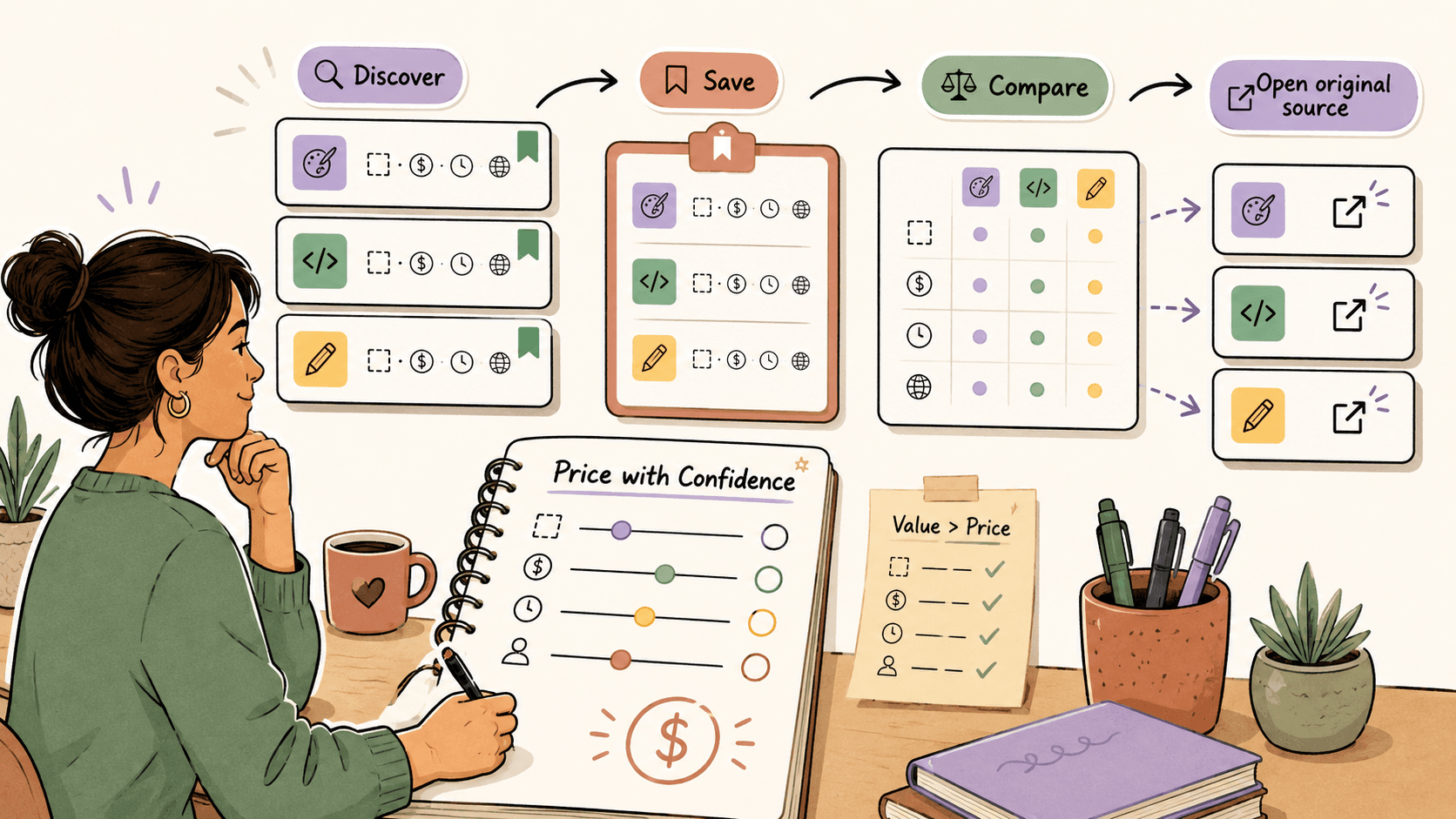
Sidequestboard can help reduce tab switching by bringing fresh public opportunities from multiple communities into a calmer discovery feed. Save relevant posts, open the original listing, and compare real scopes and budgets while the opportunity is still actionable.
A simple six-step opportunity-to-price workflow
- Find several recent opportunities related to your service.
- Save the listings that match your skills and availability.
- Compare their deliverables, deadlines, budgets, and requirements.
- Group similar requests into one possible service package.
- Estimate the time and exclusions for that package.
- Respond to suitable opportunities with a specific scope and price.
Start finding fresh public freelance opportunities with Sidequestboard. Create a free account, save five relevant posts, and use their scopes and budgets to test your first service package: https://www.sidequestboard.app/signup?source=autoblogger
What should you do if a client says your price is too high?
Do not immediately cut the price while keeping the same scope. Ask which part of the proposal does not fit the client's budget, then offer a smaller option.
For example:
- reduce one revision to no revisions or one limited revision
- deliver one concept instead of three
- shorten the article or remove extra research
- extend the deadline
- remove implementation or ongoing support
You can say:
I can work within that budget if we reduce the scope to [specific deliverable]. The original quote includes [removed item], which would need to be added separately if required.
This turns a price negotiation into a scope decision.
Beginner freelance pricing checklist
Before sending your quote, confirm:
- The deliverable is specific.
- You estimated research, communication, revisions, and handoff.
- Your internal rate is realistic for your current ability and market.
- Applicable platform and payment costs were checked using official information.
- Taxes were considered separately.
- The price, currency, and payment timing are clear.
- The revision limit is written down.
- Exclusions and client responsibilities are included.
- Scope changes require approval before extra work begins.
- You can explain how you calculated the price.
Pricing becomes easier after you collect real project data. Start with a defined service, track your actual time, and revise your packages as your skills, demand, and results improve.
Sources
- Upwork — Freelancer Service Fee — Official platform fee information; verify current terms before relying on pricing.
- Fiverr — Your Earnings — Official platform fee information; verify current terms before relying on pricing.
- PeoplePerHour — Service Fees — Official platform fee information; verify current terms before relying on pricing.
- Contra — Pricing — Official platform fee information; verify current terms before relying on pricing.
Sources
- Upwork — Freelancer Service Fee — Official platform fee information; verify current terms before relying on pricing.
- Fiverr — Your Earnings — Official platform fee information; verify current terms before relying on pricing.
- PeoplePerHour — Service Fees — Official platform fee information; verify current terms before relying on pricing.
- Contra — Pricing — Official platform fee information; verify current terms before relying on pricing.