August 9, 2026
How to Prioritize Work Opportunities as a Beginner
Beginners should prioritize work opportunities by scoring each one on freshness, skill fit, credibility, pay clarity, portfolio value, and response effort. Start with public leads on r/forhire, r/designjobs, Dribbble, Behance, and similar sources, then respond fastest to posts that are fresh, specific, paid, and aligned with your strongest proof.
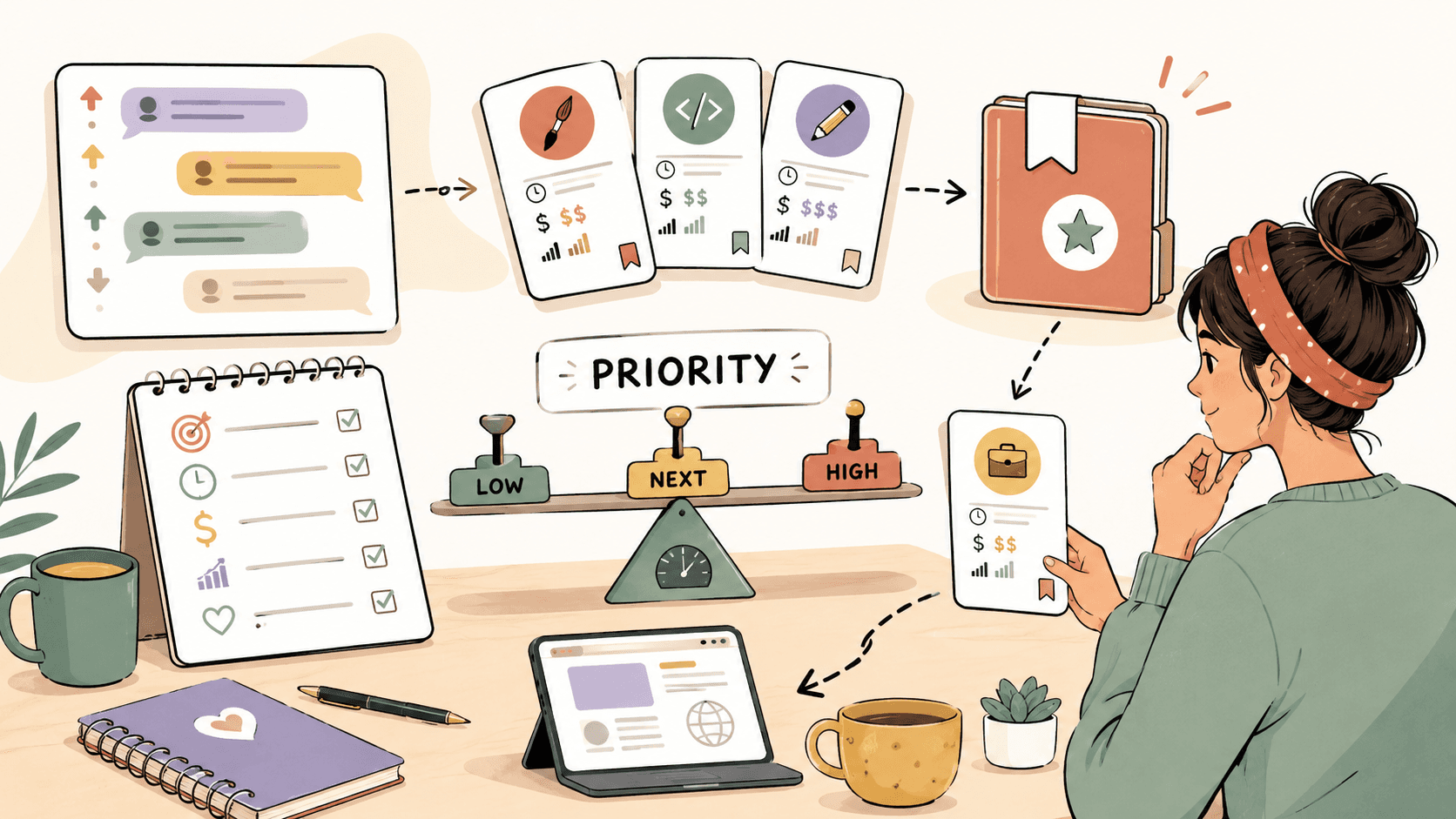
What makes a work opportunity worth prioritizing as a beginner?
A beginner-friendly opportunity should have five qualities: it is fresh, specific, credible, realistically paid, and close enough to your current skill level that you can respond with proof.
Freshness matters because public opportunities go cold quickly. On r/forhire, which has about 1.3M members, a good [Hiring] post can attract dozens of replies within hours. On r/designjobs, which has about 150K members, design posts with clear scope and budget can also get competitive fast. If a post is two days old and already has a long comment thread, it may still be worth saving, but it should not beat a strong post from the last few hours.
Specificity matters because vague posts waste beginner time. “Need a designer” is weaker than “Need a logo designer for a fitness coaching brand, budget $500, deliverables include logo mark, wordmark, and color palette.” A specific post lets you write a specific response.
Pay matters because beginner does not mean free. The research benchmarks for creative work vary widely: logo design commonly ranges from $200 to $2,000+, UI design often ranges from $50 to $150/hr, graphic design from $30 to $100/hr, and illustration from $50 to $500+ per illustration. You may start at the lower end while building proof, but you still need to avoid opportunities that hide the budget, ask for unpaid tests, or frame exposure as compensation.
Credibility matters because public communities include both serious buyers and time-wasters. Before replying on r/forhire, check the poster’s account age, recent comment history, prior hiring posts, and whether the post follows subreddit rules. On portfolio-based platforms like Dribbble Jobs and Behance Joblist, credibility is easier to assess because listings are structured, but you still need to read the company, role details, and application path carefully.
Do this now: pick your next 10 opportunities and label each one as fresh, specific, credible, paid, and relevant. Only pursue the ones with at least four of those five labels.
How should beginners score opportunities before applying or pitching?
Use a simple 25-point score. Give each opportunity 0 to 5 points in these five categories:
- Freshness: Was it posted today, ideally within the last few hours?
- Fit: Does it match a skill you can prove with a portfolio sample?
- Pay clarity: Is there a budget, rate, range, or clear compensation model?
- Credibility: Does the source or poster look legitimate?
- Response effort: Can you send a strong custom reply in 10 to 20 minutes?
A beginner should prioritize anything scoring 19 or higher. Save 15 to 18-point opportunities for later. Skip anything below 15 unless it has unusual portfolio value or a warm connection.
Here is what this looks like in practice:
| Opportunity | Freshness | Fit | Pay clarity | Credibility | Response effort | Total | Decision |
|---|---|---|---|---|---|---|---|
| r/designjobs [Hiring] logo project, posted 2 hours ago, $600 budget | 5 | 5 | 5 | 4 | 5 | 24 | Respond now |
| Dribbble UI role, posted this week, asks for 5 years experience | 3 | 2 | 4 | 5 | 2 | 16 | Save for later |
| 99designs logo contest, many entries already, prize unclear | 2 | 4 | 2 | 3 | 2 | 13 | Skip or low priority |
| Behance Joblist junior graphic design role, clear company, portfolio required | 4 | 4 | 3 | 5 | 4 | 20 | Apply today |
The response effort score is especially useful for beginners. If a post requires a custom proposal, three portfolio samples, a design test, and a long intake form, it may not be your best first move unless the fit is excellent. You want opportunities where you can write a tight reply, attach relevant proof, and move on.
Do this now: create a Notion, Google Sheets, or Trello board with columns for source, link, posted date, score, response status, and follow-up date.
Track fresh opportunities on Sidequestboard
Which platforms should beginners check first?
Start with platforms where public opportunities are easy to scan and the expected action is clear.
For design and creative work, check these first:
- r/forhire: Large general freelance subreddit with about 1.3M members. Search for “designer,” “design,” “logo,” “illustrator,” or “UI” inside [Hiring] posts.
- r/designjobs: Design-specific subreddit with about 150K members. Check the [Hiring] flair for project posts.
- r/Design: A larger design community with about 400K members. It is better for networking and spotting leads in discussions than for direct job posts.
- Dribbble Jobs: Browse UI/UX, graphic design, and illustration opportunities at https://dribbble.com/jobs. It is free to browse.
- Behance Joblist: Browse creative design roles at https://behance.net/joblist. It is free to browse.
- 99designs: Useful for logo and branding contests at https://99designs.com, but contest dynamics vary and commission or contest terms can differ by project.
If you are a beginner, I would not treat all of these equally. r/forhire and r/designjobs can reward fast, direct replies. Dribbble and Behance are better when your portfolio is already presentable. 99designs can help some beginners practice briefs, but contests can be risky because you may spend time without winning the paid project.
A practical daily order looks like this:
- Check r/forhire sorted by New and search [Hiring] plus your service keyword.
- Check r/designjobs [Hiring] flair for fresh project posts.
- Scan Dribbble Jobs for roles that match your portfolio level.
- Scan Behance Joblist for junior or contract creative roles.
- Use r/Design for networking, critique threads, and relationship-building rather than immediate pitching.
- Review 99designs only if the brief is clear, the prize is worth the effort, and you can reuse the work as portfolio practice if you do not win.
Do this now: choose three platforms for your first week. For most beginner designers, start with r/forhire, r/designjobs, and Behance Joblist.
How do you evaluate pay when you have little experience?
Use market ranges as guardrails, not as rigid rules. Beginner rates can sit below experienced specialist rates, but they should still make sense for the scope.
For design work, use these benchmarks:
- Logo design: $200 to $2,000+
- UI design: $50 to $150/hr
- Graphic design: $30 to $100/hr
- Illustration: $50 to $500+ per illustration
If someone posts on r/forhire asking for a complete brand identity, social media templates, and packaging mockups for $75 total, that is not a beginner opportunity. That is a mismatch between scope and budget. If someone needs one simple event flyer and offers $75 to $150, that may be reasonable for an early graphic design project depending on revisions, deadline, and usage.
For hourly work, beginners often underprice because they only count production time. Count communication, revisions, file prep, and admin. A “quick logo refresh” can become six rounds of feedback if the client has no clear direction. A $250 fixed-price logo project may be fine if the brief is tight and revisions are capped. It becomes poor if the buyer expects unlimited concepts and same-day delivery.
Use this pay filter before replying:
- Is the budget stated or easy to infer?
- Does the scope match the rate range?
- Are revisions, deadlines, and deliverables clear?
- Can the project become a portfolio piece?
- Would you still accept it if it took 25% longer than expected?
For 99designs, be extra strict. Since it runs on contests for many design categories, you may put in work before getting paid. That does not make it useless, but it means you should only enter contests where the brief is strong, the prize is worth the time, and the deliverable helps your portfolio even if you do not win.
Do this now: write your minimum acceptable project numbers. For example: “I will not take logo projects below $200, flyer projects below $75, or UI design below $40/hr while I am building proof.”
What does a strong beginner workflow look like in a real search session?
Here is a concrete 45-minute search session for a beginner designer.
Minute 0 to 10: Open r/forhire and sort by New. Search for “designer” inside [Hiring] posts. You see a post from 3 hours ago: “[Hiring] Logo designer needed for local coffee brand, budget $400.” Before replying, click the poster’s profile. Check whether the account has normal comment history, whether they have hired before, and whether the post includes deliverables and deadline. If the account looks real and the scope is clear, score it.
This post might score 23 out of 25: fresh, strong fit, clear pay, decent credibility, easy response. Reply or message with a short note: one sentence showing you read the brief, two relevant portfolio links, your process, and one clarifying question.
Minute 10 to 20: Open r/designjobs and filter for [Hiring]. You find a post looking for an illustrator for a podcast cover. The budget is $150. Illustration benchmarks range from $50 to $500+ per illustration, so this could be reasonable if the style is simple and usage is limited. If they want full commercial rights, layered files, and multiple characters, the budget is probably low. Ask about usage rights and revision count before committing.
Minute 20 to 30: Open Behance Joblist. Look for junior graphic design, contract designer, or freelance creative roles. Behance is free to browse, but roles may expect a polished portfolio. If your portfolio has three relevant pieces, apply to roles where you meet around 60% to 75% of the requirements. Do not spend 45 minutes applying to a senior role asking for agency leadership if you have only two student projects.
Minute 30 to 40: Open Dribbble Jobs. Search UI/UX if that is your lane. UI design benchmarks often run $50 to $150/hr, but Dribbble listings may include full-time, contract, and remote roles with different expectations. Prioritize listings where your portfolio visually matches the work. If the company sells SaaS and your portfolio includes a dashboard redesign, that is a better fit than a beautiful poster project.
Minute 40 to 45: Update your tracker. Mark each opportunity as “responded,” “saved,” “skip,” or “follow up.” Add a follow-up date for anything you applied to directly.
Do this now: run this exact 45-minute session once, then review which sources produced the highest-scoring opportunities.
How should beginners decide between applying, pitching, saving, and skipping?
Use four action buckets.
Apply now when the opportunity is fresh, relevant, credible, and has clear next steps. Example: a Behance Joblist post for a junior graphic designer asking for a portfolio and resume, posted recently, with responsibilities matching your work.
Pitch now when the post invites direct replies and you can show relevant proof quickly. Example: an r/forhire [Hiring] post asking for a logo designer with a $500 budget. Your reply should be direct, not a generic biography.
Save for later when the opportunity is credible but not urgent or not a perfect fit. Example: a Dribbble Jobs UI role that asks for more experience than you have, but the company matches your niche. Save it, study the requirements, and use it to improve your portfolio positioning.
Skip when the opportunity is vague, unpaid, underpriced, suspicious, or too far outside your proof. Example: a 99designs contest with unclear prize terms, many existing entries, and a broad request for a complete brand system. You may learn from the brief, but it should not displace higher-quality leads.
A beginner mistake is treating “possible” as “priority.” Many opportunities are technically possible. Your job is to pursue the ones where you can respond well before the post goes cold.
Do this now: add a dropdown to your tracker with four statuses: Apply, Pitch, Save, Skip. Do not leave opportunities in an undecided pile.
How can beginners write faster replies without sounding generic?
Use a reusable structure, but customize the proof and first sentence.
For r/forhire or r/designjobs, a strong beginner reply can be five to seven sentences:
“Hi, I saw your post looking for a logo designer for a local coffee brand. I’ve worked on two identity concepts with similar warm, neighborhood-focused positioning: [link 1] and [link 2]. For a $400 logo project, I’d usually include 2 initial directions, 1 selected refinement path, and final files in SVG, PNG, and PDF. I can start this week and send first concepts within 3 to 5 business days after the brief is confirmed. One question before estimating accurately: do you need just the logo, or a small color and type guide as well?”
That reply works because it proves fit, respects the budget, sets process boundaries, and asks one useful question. It does not beg. It does not overexplain that you are a beginner.
For Behance Joblist or Dribbble Jobs, your application should align portfolio pieces with the role. If a UI role asks for mobile app design, do not lead with a poster. Put the closest UI case study first. If a graphic design role asks for social ads, show social layouts before brand explorations.
Keep a small reply bank in Notion or Google Docs:
- Logo design response
- UI design response
- Illustration response
- Graphic design response
- Follow-up message
- “Not a fit, but thank you” message
Do this now: write one reusable reply for your main service and leave brackets where you will customize the client, project type, link, timeline, and question.
How can Sidequestboard help once you know what to prioritize?
Once you have a scoring system, the next bottleneck is checking too many sources manually. Sidequestboard is built for people who monitor public communities and social platforms for fresh work opportunities, then want a calmer way to discover, save, and open relevant posts at the original source.
That fits the workflow above: you still evaluate the opportunity, check credibility, and apply or respond directly. The difference is that you are not relying on a dozen open tabs across Reddit, X/Twitter, Discord, and public communities just to notice something while it is still fresh.
For a beginner, the practical use is simple: scan a cleaner feed, save opportunities that score well, open the original listing, and respond with your best tailored reply. It is not a guarantee of work and it is not a middleman. It helps reduce search chaos so you can spend more time pitching, applying, improving your portfolio, and following up.
Do this now: if your current system is scattered across bookmarks, screenshots, and forgotten tabs, move to one daily opportunity review workflow and track every lead you actually respond to.
What beginner mistakes make good opportunities go cold?
The first mistake is over-researching before replying. If an r/forhire post is strong and only 2 hours old, do not spend the whole afternoon redesigning your portfolio. Send a relevant response, then improve your materials afterward.
The second mistake is replying without proof. “I’m interested” is not enough. Link to one or two relevant samples. If you do not have client work yet, use a self-initiated sample that matches the brief. For a logo lead, show a logo. For UI design, show a screen flow or landing page, not only a mood board.
The third mistake is ignoring scope. A $300 project can be good or terrible depending on deliverables. One illustration for $300 may be strong. A full brand identity for $300 with unlimited revisions is likely a bad trade.
The fourth mistake is chasing prestige too early. Dribbble Jobs and Behance Joblist can include attractive roles, but if every application takes an hour and you are underqualified, mix in faster public leads from r/designjobs and r/forhire where a direct, relevant pitch can compete.
The fifth mistake is failing to follow up. For direct replies, follow up once after 3 to 5 business days if the post still appears active and you have not heard back. Keep it short: “Hi, just checking whether you’re still looking for a designer for this project. Happy to send a more specific estimate if the scope is still open.”
Do this now: review your last five applications or pitches and identify whether the problem was timing, proof, scope, fit, or follow-up.
What is the simplest weekly prioritization routine?
Use a weekly rhythm that separates finding, responding, and improving.
Monday through Friday, spend 30 to 45 minutes scanning fresh sources. Start with r/forhire and r/designjobs if you want direct project leads. Add Dribbble Jobs and Behance Joblist for structured roles. Use r/Design for networking and market awareness. Check 99designs selectively when you want contest practice and the brief is worth the unpaid risk.
Each day, aim to identify 5 to 10 possible opportunities, score them, and respond to the top 1 to 3. Beginners often get better results from three tailored replies than from 20 vague ones.
Once per week, review your tracker:
- Which sources produced the most high-scoring leads?
- Which replies got responses?
- Which portfolio pieces were missing?
- Which budgets were too low to repeat?
- Which services were easiest to pitch clearly?
Then adjust your next week. If logo posts on r/forhire keep matching your proof and budget, prioritize them. If UI roles on Dribbble Jobs all require case studies you do not have, spend the weekend creating one focused case study instead of sending weak applications.
Do this now: set a recurring 45-minute calendar block called “Opportunity scan and score,” then treat it like client work.
How do you know when to stop looking and start responding?
Stop looking when you have three opportunities scoring 19 or higher. Searching more can feel productive, but it often becomes avoidance. Beginners need reps: replies sent, portfolios shared, questions asked, and follow-ups tracked.
A good beginner day is not “I checked every platform.” A good beginner day is “I found three relevant opportunities, sent two strong replies, saved one for later, and improved one portfolio gap.”
Use this final rule: if an opportunity is fresh, paid, credible, and you can prove fit with one relevant sample, respond before you keep browsing. Speed will not fix a bad fit, but delay can ruin a good one.
Do this now: choose one opportunity from your current list, score it honestly, and either respond, save it with a reason, or skip it. Do not leave it open in a tab.
Related guides
- How to Get Freelance Clients on LinkedIn: Profile, Search, Outreach, and Lead Workflow
- How to Start Freelancing as a Graphic Designer: A 7-Day Launch Guide
- How to Start Freelancing as a Student with No Experience
- Freelance Work for Beginners: Get Brand, Video, and Film Clients
- How to Retract a 2 Weeks Notice Letter (With Template)