August 8, 2026
Can You Apply to the Same Job Twice After Rejection? When to Reapply and What to Change
Yes, you can apply to the same job twice after rejection if something meaningful has changed: the role was reposted, your qualifications improved, the job requirements shifted, or your first application undersold your fit. Do not resubmit the same resume immediately; update your materials, check the posting details, and reapply strategically.
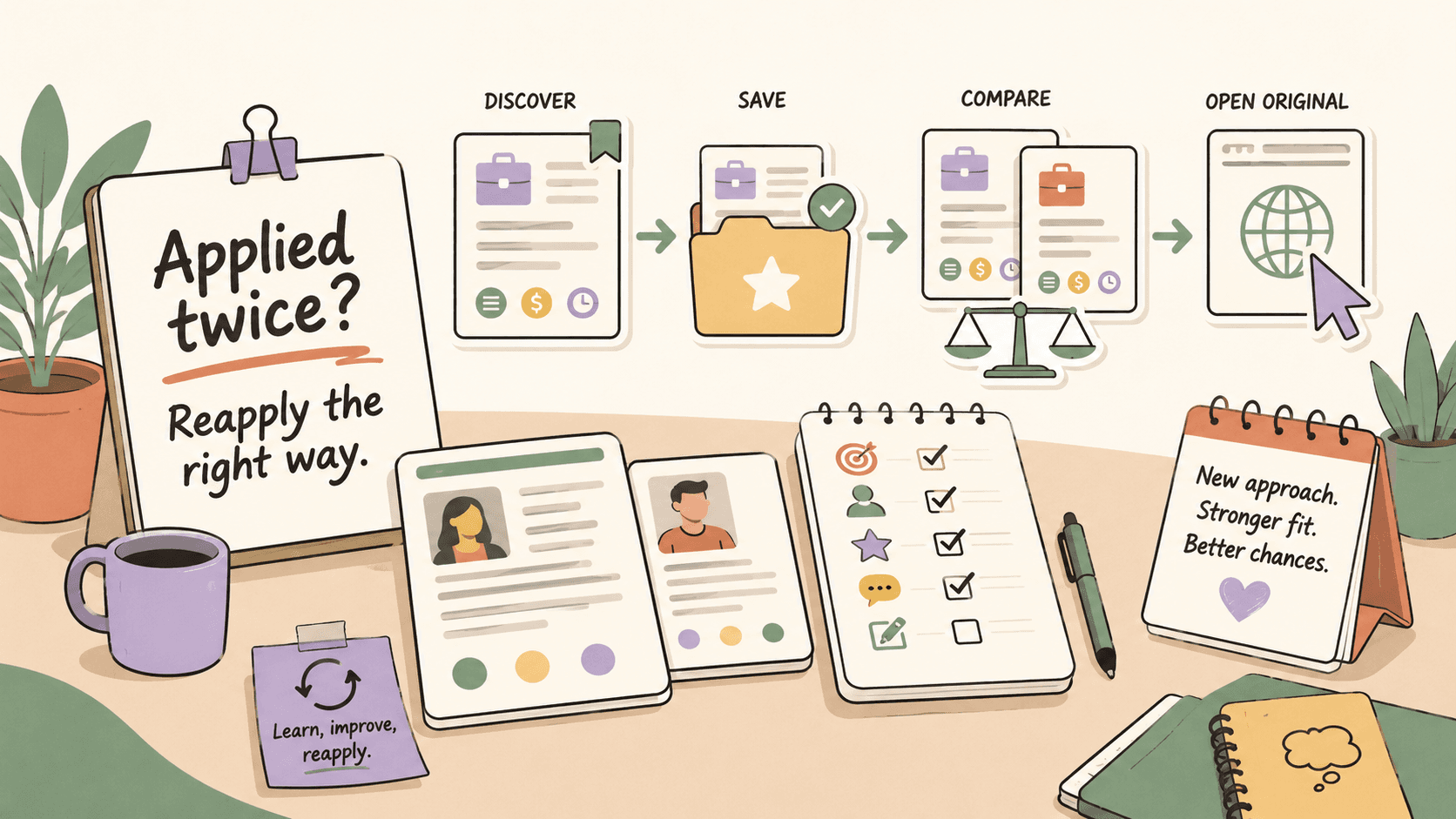
Quick answer: yes, but do not send the same application twice
You can apply to the same job twice after being rejected. Employers repost roles, hiring needs change, candidates drop out, budgets reopen, and applicant tracking systems sometimes filter out qualified people for imperfect keyword matches.
But reapplying only helps when your second application is meaningfully better than your first one.
A strong reapplication usually has at least one of these changes:
- The job was reposted with a new job ID or updated requirements.
- You gained relevant experience, certifications, portfolio work, or measurable results.
- Your first resume was too generic and did not clearly match the role.
- You were rejected early by an automated screen and never spoke to a person.
- You now have a referral, recruiter contact, or stronger explanation of fit.
A weak reapplication is simply uploading the same resume again a few days later and hoping for a different result.
This question comes up often in job-search communities like Reddit’s r/jobsearchhacks because candidates see the same role reposted on LinkedIn, Indeed, or a company careers page after receiving a rejection. That can feel confusing, but it does not always mean you are permanently disqualified.
When is it okay to reapply to the same job after rejection?
It is usually reasonable to reapply when the role is still open or has been reposted and you can improve the application in a specific way.
Good reasons to reapply
| Situation | Should you reapply? | What to change |
|---|---|---|
| The job was reposted with a new requisition ID | Yes | Confirm it is not the exact same posting, then tailor your resume to the updated description |
| You were rejected within hours or one day | Maybe | Improve keywords, role alignment, and required qualifications before trying again |
| You now meet a requirement you did not meet before | Yes | Put the new qualification near the top of your resume |
| Your first resume was generic | Yes | Rewrite it around the employer’s stated needs |
| You interviewed and were rejected | Maybe | Wait longer, address the reason if you know it, and consider contacting the recruiter first |
| You were told not to reapply or the company has a waiting period | No, or wait | Follow the company’s instructions |
| Nothing has changed | Usually no | Apply to similar roles instead |
The simplest rule: reapply when you can honestly say, “This application is stronger and more relevant than the first one.”
Find current openings on Sidequestboard
How long should you wait before applying again?
There is no universal waiting period. Company policies vary, and some employers may have rules about repeat applications. Always verify instructions in the job posting, rejection email, or official careers portal.
As a practical guideline:
- Same posting, same job ID: avoid reapplying immediately unless the system specifically allows updates.
- Reposted role after 2–4 weeks: check whether the job ID, hiring manager, location, or requirements changed.
- After an interview rejection: consider waiting 3–6 months unless the recruiter invited you to apply again.
- After gaining a major new qualification: reapply when your resume can clearly show the improvement.
If you were rejected instantly, your application may have been screened out before a human reviewed it. In that case, reapplying can make sense, but only after fixing the resume and application answers that may have caused the screen-out.
How reapplying works on LinkedIn, Indeed, Workday, Greenhouse, and Lever?
Repeat applications are not handled the same way everywhere. Before you reapply, check which platform or applicant tracking system is being used.
On LinkedIn, a role may appear as an “Easy Apply” listing or send you to the employer’s site. If it is Easy Apply, you may be able to update your resume and submit again only if the employer reposted the job or created a new listing. If LinkedIn redirects you to the company site, the actual application may be managed by Workday, Greenhouse, Lever, or another ATS.
Before reapplying from LinkedIn:
- Compare the posting date and job title.
- Check whether the company added or removed requirements.
- Replace your old resume with a tailored version.
- If you can identify a recruiter, send a brief note instead of relying only on the application form.
Indeed
On Indeed, employers may repost jobs to refresh visibility. A repost does not always mean it is a new role. Check the employer name, location, job title, and description before applying again.
If you previously applied through Indeed:
- Update your Indeed resume or upload a role-specific file.
- Look for the same job on the company careers page to confirm whether it is still active.
- Avoid applying repeatedly to the same unchanged listing.
Workday
Many company career portals use Workday. Workday often keeps your candidate profile and application history. Some employers allow you to update your profile, while others may not allow a second application to the same requisition.
Before trying again in Workday:
- Log in to the same candidate account you used before.
- Check whether the role has the same requisition ID.
- Update your profile, resume, work history, and skills.
- If the system blocks duplicate applications, do not create multiple accounts to bypass it.
Creating duplicate profiles can make your application history messy and may violate the employer’s process.
Greenhouse
Greenhouse application pages are often simpler and may let you submit to a new posting if the employer has created one. If the role looks identical, look for clues such as department, location, and posting date.
For a second application through Greenhouse:
- Use a revised resume.
- Add a concise cover note if the form allows it.
- Make sure your LinkedIn, portfolio, or GitHub link matches the role, if relevant.
Lever
Lever often lets candidates apply through a clean form with resume, links, and optional notes. Like Greenhouse, whether you can reapply depends on how the employer configured the role and whether it is the same opening.
If you are applying through Lever again:
- Keep your note short and specific.
- Mention what changed since your previous application only if it helps.
- Do not sound frustrated about the first rejection.
How to tell whether it is the same job or a new posting?
Before reapplying, compare the old and new listing. If you did not save the first posting, use your email confirmation, browser history, or a tracking sheet to reconstruct the details.
Look for:
- Job ID or requisition number: a new ID may indicate a new or refreshed opening.
- Posting date: a recent date may mean the role was reposted.
- Location or remote status: a change may make you more competitive.
- Seniority level: “Associate” vs. “Senior” can change the fit.
- Required skills: new keywords should be reflected in your resume if truthful.
- Salary range: if listed, confirm whether it changed.
- Department or manager: a different team may evaluate candidates differently.
A reposted role is not automatically an invitation to reapply, but it is a signal to investigate.
What should you change before reapplying?
Do not start with the cover letter. Start with the job description.
1. Rewrite your resume around the role
Your second application should make your fit obvious in the first 10 seconds.
Change:
- Your headline or summary.
- The order of your bullet points.
- The keywords that match the job description.
- The measurable outcomes you emphasize.
- The projects, tools, or industries you highlight.
For example, if the posting emphasizes customer onboarding, do not lead with a generic operations summary. Lead with onboarding results, support metrics, implementation work, or relevant customer-facing experience.
Weak bullet:
Worked with customers and internal teams on product issues.
Stronger bullet:
Coordinated customer onboarding requests across support, product, and operations teams, reducing unresolved handoff issues and improving response consistency.
Only include metrics you can support. If you do not have a number, describe scope, frequency, or business impact honestly.
2. Fix keyword gaps without keyword stuffing
Applicant tracking systems and recruiters both look for role-specific language. If the job description says “Salesforce,” “B2B SaaS,” “case management,” or “SQL,” and you genuinely have that experience, include those terms clearly.
Do not add skills you do not have. A second application built on inflated claims may get you an interview, but it can fall apart quickly.
3. Add proof of recent improvement
If time has passed since your rejection, include what changed:
- A new certification.
- A completed project.
- A stronger portfolio sample.
- A measurable win from your current role.
- A freelance or contract project related to the job.
- A new tool you can now use confidently.
For product, engineering, design, writing, marketing, or data roles, a portfolio update can be especially useful. Make sure your portfolio link is easy to find and directly relevant.
4. Update your application answers
Many applications ask screening questions. If you rushed the first time, your answers may have hurt you.
Review questions about:
- Years of experience.
- Work authorization.
- Location and time zone.
- Salary expectations.
- Required tools.
- Industry background.
- Availability.
Answer honestly, but avoid underselling yourself with vague or incomplete responses.
Should you email the recruiter before reapplying?
If you have a recruiter contact, a short message can help. Do not ask, “Why did you reject me?” and do not write a long defense of your candidacy.
Use the message to explain what changed and ask whether a renewed application would be useful.
Recruiter message template
Subject: Reapplying for [Role Title]
Hi [Name],
I previously applied for the [Role Title] position and noticed the role is open again. Since my last application, I have [briefly mention relevant change: completed X project, gained Y experience, updated portfolio, etc.].
I’m still very interested in the role because [one specific reason tied to the company or work]. Would it be appropriate for me to submit an updated application?
Thank you, [Your Name]
If you do not have a recruiter contact
Apply with a stronger resume first. Then, if appropriate, send a concise LinkedIn message to a recruiter or hiring team member.
Example:
Hi [Name], I applied for [Role] and wanted to share a quick note because my background in [specific skill] aligns closely with [specific requirement]. I submitted an updated resume through the careers page and would be glad to provide any additional context. Thanks for your time.
Keep it professional and low-pressure.
Should you mention that you applied before?
Sometimes yes, sometimes no.
Mention it if:
- You interviewed previously.
- You have communicated with the recruiter.
- The application asks whether you have applied before.
- Your prior application gives useful context.
You do not need to emphasize it if:
- You were rejected automatically.
- You never spoke to anyone.
- The new posting has a different job ID.
- Mentioning it would distract from your fit.
If asked directly, be honest. A simple line is enough:
I previously applied for this role and have since updated my application to better reflect my experience with [specific requirement].
What if you were rejected after an interview?
Reapplying after an interview rejection requires more care than reapplying after an automated rejection.
If you interviewed, someone likely made a specific decision. That does not mean you can never work there, but your second attempt should address the likely gap.
Ask yourself:
- Did they say you lacked a certain skill?
- Were you too junior or too senior?
- Did you struggle with a case study or technical screen?
- Did the role shift after your interview?
- Did the hiring team encourage you to apply again later?
If you received feedback, use it. If you did not, do not guess aggressively. Wait until you can show a meaningful improvement or apply to a better-fit role at the same company.
A good message after an interview rejection might be:
Hi [Name], I appreciated the chance to interview for [Role] earlier this year. I noticed the position is open again and wanted to ask whether it would make sense to be reconsidered. Since our last conversation, I have strengthened my experience in [specific area]. I understand if the team is looking for a different profile, but I wanted to express continued interest.
When should you not reapply?
Do not reapply just because seeing the repost bothers you. Rejection is frustrating, but repeated applications without changes can make you look careless.
Avoid reapplying when:
- The rejection email says you are not eligible to reapply for a certain period.
- The company told you the role requires a qualification you still do not have.
- You were rejected after multiple interview rounds and nothing has changed.
- The job description is identical and your application is identical.
- You are applying emotionally instead of strategically.
- You would not accept the job if offered.
Sometimes the better move is to apply to similar roles elsewhere instead of getting stuck on one employer.
A practical reapplication workflow
Use this workflow before sending a second application.
Step 1: Save the new posting
Save the role link, job title, company, posting date, platform, and job ID if available. If you found the role on LinkedIn or Indeed, also open the company’s official careers page to verify the listing is active.
Step 2: Compare it with your first application
Use Google Sheets, Notion, Airtable, or a simple spreadsheet to compare:
| Field | First application | New posting |
|---|---|---|
| Job title | ||
| Job ID | ||
| Platform | ||
| Posting date | ||
| Top requirements | ||
| Resume version used | ||
| Rejection stage | ||
| What changed? |
If you cannot identify what changed, pause before reapplying.
Step 3: Rewrite your resume for the top 5 requirements
Highlight the five most important requirements in the job description. Your resume should clearly show evidence for the ones you meet.
Step 4: Check the application system
If the job uses Workday, Greenhouse, or Lever, check whether it is the same requisition. If it blocks duplicate applications, update your candidate profile instead of creating a duplicate account.
Step 5: Send a short recruiter note if useful
Only send a message if you can be concise and relevant. The note should support the application, not replace it.
Step 6: Keep applying elsewhere
Do not wait on one reposted role. Build a broader pipeline of similar opportunities so your job search does not depend on a single company changing its mind.
This is where a discovery tool can help. Sidequestboard lets you find and save fresh public opportunities from communities and social platforms, then open the original source to apply or respond directly. Use it alongside job boards and company career pages so you are not refreshing the same rejected posting every day.
Example: turning a rejected application into a stronger second attempt
Imagine you applied for a Customer Success Manager role and were rejected within 24 hours. Three weeks later, the same company reposts the job on LinkedIn and its careers page.
Your first resume summary said:
Customer-focused professional with experience supporting clients and working cross-functionally.
That is too broad.
The job description emphasizes onboarding, retention, CRM hygiene, and executive business reviews. Your revised summary could say:
Customer Success professional with experience onboarding B2B accounts, coordinating support and product handoffs, maintaining CRM records, and preparing customer-facing account updates for retention-focused teams.
Your first application may have looked generic. Your second application now directly reflects the role.
Then you might add a recruiter note:
Hi [Name], I noticed the Customer Success Manager role is open again and submitted an updated application. I revised my resume to better show my onboarding and account management experience, especially around CRM process and customer handoffs. Thanks for your consideration.
This is a better reapplication because it changes the evidence, not just the timing.
How many times can you apply to the same company?
You can apply to multiple roles at the same company if each role is a genuine fit. But applying to every opening can hurt your credibility.
A good limit is not a fixed number; it is relevance.
Apply when:
- You meet the core requirements.
- Your resume can be tailored honestly.
- You can explain why the role fits your background.
- The roles are not wildly different from each other.
Be cautious if you are applying to roles in unrelated departments, levels, and functions. A recruiter may see a scattered pattern and assume you are not focused.
How to avoid needing to reapply so often?
The best way to reduce repeat applications is to improve your first application process.
Before applying, ask:
- Did I verify the role is still active on the company site?
- Did I tailor my resume to the job description?
- Did I use the same language the employer uses for key skills?
- Did I include proof, not just responsibilities?
- Did I save the posting and resume version?
- Did I apply early enough to be competitive?
Many candidates lose track of where they applied and which resume they used. A basic Google Sheets tracker is enough to start, but the key is consistency.
For fresh leads beyond traditional job boards, Sidequestboard can fit into the top of that workflow: discover relevant public opportunities, save the ones worth pursuing, then apply or respond at the original source while tracking your follow-up separately.
Final verdict: should you reapply?
Reapply if the role is active, you are still a real fit, and your second application is stronger than your first.
Do not reapply if you are only trying again because the rejection felt unfair. Instead, improve your materials, check the platform details, and keep building a pipeline of similar opportunities.
The best job search strategy is not “convince one company to reconsider me.” It is “make each application sharper while giving myself more chances to find the right match.”
Related guides
- Freelance Work for Beginners: Get Brand, Video, and Film Clients
- How to Get Freelance Clients on LinkedIn: Profile, Search, Outreach, and Lead Workflow
- Where to Find Web Design Clients on Reddit
- How to Find Remote Jobs from Multiple Sites Without Tab Chaos
- PDF vs DOCX Resume: Which Format Gets More Interviews?