July 25, 2026
Internship Red Flags: What Students Should Check Before Applying
If an internship has red flags, pause before applying or accepting. Verify the employer, ask direct questions about pay, hours, supervision, learning outcomes, and written terms, and keep comparing other options until the risk is resolved.
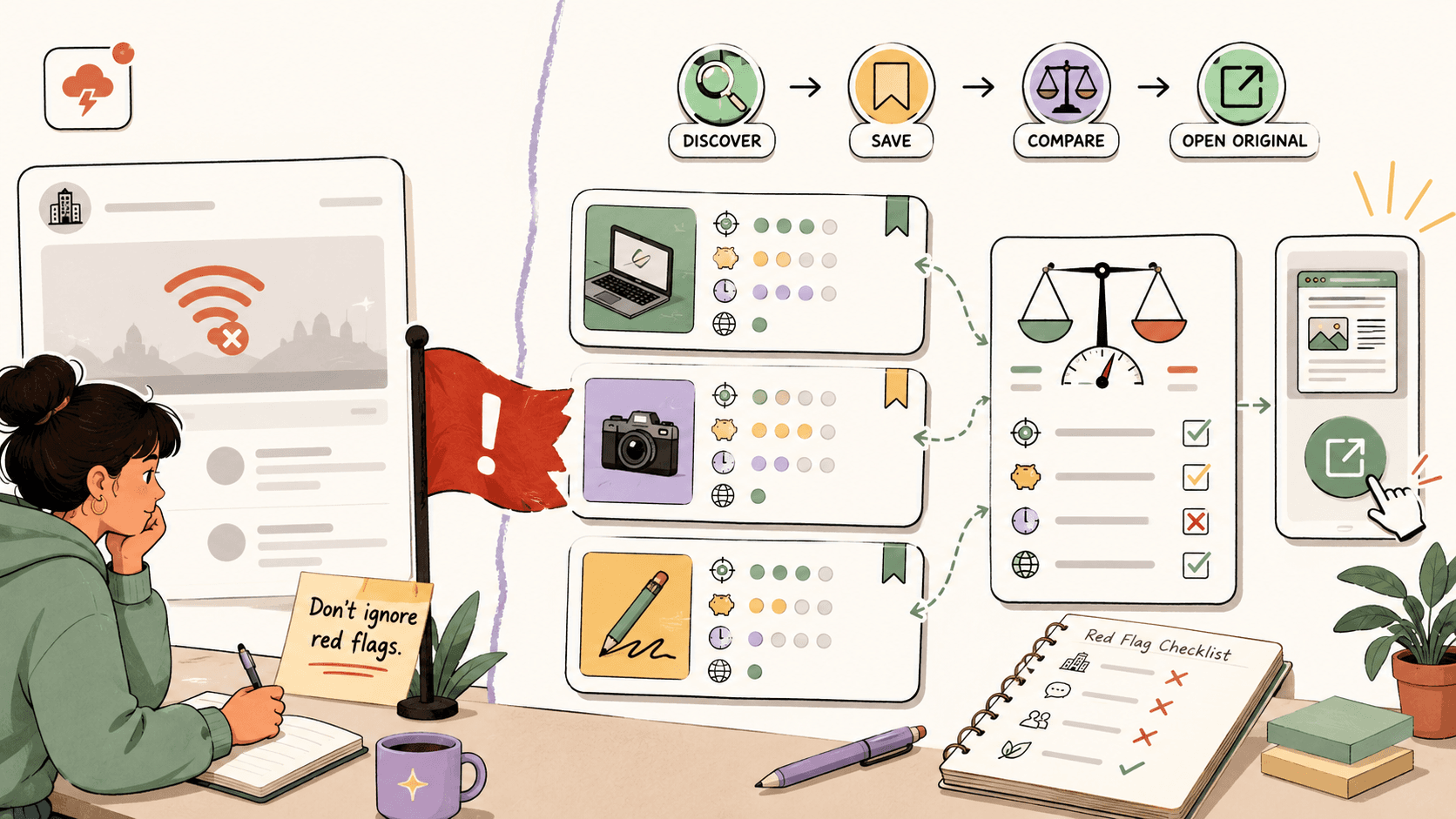
What should students do when an internship feels off?
Use this one-screen response plan: pause, verify, ask, document, compare, decide.
- Pause before spending hours on a cover letter, interview, or test assignment.
- Verify that the company, people, domain, and job post are real.
- Ask for missing details about compensation, weekly hours, start date, supervisor, feedback, tools, and expected outcomes.
- Document important answers in writing before accepting.
- Compare the role against other internships, campus jobs, freelance projects, research roles, and portfolio-building options.
- Decide whether to apply, investigate further, or pass.
The goal is not to reject every imperfect posting. Small startups, nonprofits, labs, and student organizations may have less polished recruiting processes. The problem is when basic details remain unclear after you ask.
What is the 5-minute pre-application checklist?
Before you invest time in an application, scan the internship post with this checklist. If you cannot answer several of these, ask for clarity before continuing.
- Can I identify the company or organization?
- Can I identify the team, department, or supervisor?
- Does the post state whether the role is paid, unpaid, stipend-based, academic-credit-based, commission-only, or contractor-style?
- Are the weekly hours, start date, end date, location, remote expectations, and time zone clear?
- Are the responsibilities specific enough that I could later describe them on a resume?
- Is there a learning structure, mentorship plan, training plan, or feedback process?
- Does the application ask for anything unusual, such as payment, bank details, passport information, national ID information, or a large original work sample?
- Can I find credible signs that real people work there?
- Does the opportunity fit my class schedule, exam periods, work obligations, financial needs, and visa or academic-credit requirements?
If the role fails this checklist, it may still be worth investigating, but it is not ready for blind trust.
Browse today’s opportunities on Sidequestboard
What are the biggest internship red flags and how should you respond?
Use this table to turn red flags into action. A warning sign does not always mean the internship is bad, but the employer should be able to answer reasonable questions.
| Red flag | Why it matters | Question to ask | Acceptable answer | Walk-away trigger |
|---|---|---|---|---|
| Vague description like “wear many hats” or “help with everything” | You may end up doing random busywork with little learning value | “What would I work on during the first month?” | Specific projects, examples, and priorities | They cannot name real tasks or outcomes |
| Pay is missing or avoided | You cannot compare the role honestly without compensation details | “Can you confirm whether this is paid, unpaid, stipend-based, commission-based, or for academic credit?” | Clear pay rate, stipend terms, credit rules, or unpaid learning structure | They shame you for asking or keep changing the answer |
| “Exposure” replaces pay or training | Exposure can become a cover for unpaid production work | “What mentorship, feedback, and learning outcomes are built into the internship?” | Named mentor, feedback schedule, and learning goals | They only say it will “look good on your resume” |
| Commission-only internship | Earnings may depend on selling to friends, family, or cold leads | “Is there a base pay, and what sales activity is expected?” | Transparent base pay or realistic, ethical commission structure | You must recruit friends, buy inventory, or pay to participate |
| Large unpaid test assignment | The company may be trying to get free work | “How long should this take, will it be used commercially, and is it paid?” | Short, time-limited, clearly non-commercial test or paid trial | It resembles real client work or a full campaign/build/design |
| No named supervisor | Internships need guidance, not just tasks | “Who would supervise me, and how often would I receive feedback?” | Named manager and feedback rhythm | No one owns your training or evaluation |
| Unrealistic hours | Your grades, health, and other work may suffer | “What are the expected weekly hours, and is there exam-week flexibility?” | Clear, realistic schedule | “Part-time” quietly becomes always available |
| Pressure to accept immediately | Urgency can prevent due diligence | “Can I have the written details and 24–48 hours to review?” | Reasonable review window | They threaten to withdraw unless you accept on the spot |
| Requests to buy equipment, pay fees, or purchase tools | Legitimate internships rarely require students to pay to work | “Are required tools, software, or equipment reimbursed?” | Clear reimbursement or no required purchase | You must pay upfront to start |
| Bank details or personal documents too early | Sensitive data should come after verified hiring steps | “At what stage are documents collected, and through what secure process?” | Secure HR process after a written offer | They ask through DMs, forms, or messaging apps before verification |
| Messaging-app-only communication | Scams often avoid official email and traceable channels | “Can you email me from your company or university domain?” | Official email or verifiable contact path | They refuse and keep everything on WhatsApp, Telegram, or Discord |
| No written offer or agreement | Verbal promises are hard to enforce | “Could you send the internship terms in writing?” | Written role, hours, pay/credit, dates, and supervisor | They say written terms are unnecessary |
Is internship ambiguity normal or dangerous?
Some ambiguity is normal. Dangerous ambiguity is different.
Normal ambiguity can happen when a small team is still planning the exact project. For example, a startup may say, “We are deciding between two product research projects, but you would report to our product manager, work 10 hours per week, join a weekly feedback call, and produce a research summary by the end.”
Dangerous ambiguity sounds like, “We’ll figure it out after you start,” with no clear manager, schedule, compensation, training plan, or deliverable.
A fair employer does not need a perfect internship brochure. But they should be able to explain:
- what problem you will help with,
- who will supervise you,
- how many hours are expected,
- whether and how you will be paid or receive credit,
- what you should learn,
- how your work will be evaluated.
If the organization is small but honest, your questions should make the opportunity clearer. If the answers become more evasive, treat that as data.
How can you verify an internship before applying?
Do a quick legitimacy check before sharing personal information, completing tests, or accepting an offer.
- Check the company website. Look for a real domain, contact page, team page, product or service description, and consistent branding.
- Check email legitimacy. A message from a free email address is not always fake, especially for small groups, but an established company should usually communicate through an official domain.
- Review LinkedIn. Look for a company page, founder profiles, employee profiles, and whether those people appear connected to the organization over time.
- Search for prior interns or alumni. Use LinkedIn, your university network, or alumni directories to find people who mention the company.
- Check review sites carefully. Glassdoor, Indeed, Reddit, and other review spaces can help, but focus on repeated patterns rather than one angry post.
- Ask your university career office. They may know whether the employer has posted before, been reported, or met school requirements.
- Look for the job on the company’s own careers page. This is especially useful for established companies.
- Be careful with reposted screenshots. If a role only exists in a DM, screenshot, or messaging-app thread, verify it through an official source.
For international students, students on visas, and students using internships for academic credit, verification is even more important. Confirm work authorization, credit approval, and policy details through official university and government sources rather than relying only on employer claims.
Are unpaid internships, stipends, academic credit, or commission-only roles red flags?
They can be, but the answer depends on the structure, location, school policy, visa status, and type of work. Avoid blanket assumptions and verify the rules through official sources.
Common arrangements include:
- Hourly paid internship: You are paid for hours worked.
- Stipend internship: You receive a fixed amount, sometimes regardless of hours.
- Academic-credit internship: The role is tied to a university course or credit requirement.
- Unpaid learning placement: The employer claims the role is primarily educational.
- Contractor-style project: You may be treated like an independent project worker rather than an employee.
- Commission-only role: Your income depends on sales, referrals, or performance.
Questions to ask before continuing:
- Is this internship paid? If yes, what is the rate or stipend?
- When and how is payment made?
- If unpaid, what learning structure and supervision are provided?
- Is academic credit required or optional?
- Who at my school approves the credit?
- What work will I do, and will the organization directly use my production work?
- Are there any fees, required purchases, or unreimbursed expenses?
- Does this affect my visa, scholarship, financial aid, or work authorization?
Use official resources such as your university career office, academic department, international student office, government labor agency, or qualified advisor. An employer’s explanation is not enough when legal, visa, pay, or academic-credit rules are involved.
What are remote internship red flags?
Remote internships can be excellent, but they need structure. Watch for these remote-specific warning signs:
- no onboarding plan,
- no named manager,
- no team introduction,
- unclear time zone expectations,
- “always-on” Slack, Discord, WhatsApp, or Telegram availability,
- unpaid software, hardware, travel, or setup costs,
- no secure process for accounts, passwords, client data, or company data,
- no written agreement about hours, deliverables, communication, and feedback,
- work that depends on your personal accounts or devices without guidance,
- meetings scheduled at unreasonable hours for your location.
Ask for a written remote-work plan before accepting:
“Could you share the expected weekly hours, primary time zone, communication tools, meeting schedule, onboarding plan, supervisor, and feedback process for the remote internship?”
A serious remote internship should not require you to guess how work gets assigned, reviewed, or protected.
What questions should you ask before you apply, interview, or accept?
You do not need to send a long interrogation. Pick the questions that match the risk you see.
Before applying
- Is this role paid, unpaid, stipend-based, commission-based, contractor-style, or for academic credit?
- What are the expected weekly hours?
- Is the role remote, hybrid, or in-person?
- What are the start and end dates?
- Are students from my location, school, year, major, or visa status eligible?
- Is there a named supervisor or team?
During the interview
- What would I work on in the first month?
- What skills should I expect to develop?
- Who reviews intern work?
- How often do interns receive feedback?
- What tools or systems would I use?
- What does a successful intern produce by the end?
- Have past interns received references, return offers, portfolio projects, or paid roles?
Before accepting
- Can you send the offer details in writing?
- What is the payment schedule or credit approval process?
- Who is my direct manager?
- What are the confirmed hours and schedule expectations?
- Are any tools, software, travel, or equipment costs covered?
- Can any work be used in my portfolio, if confidentiality allows?
- What happens if project scope or hours change?
What copy-paste messages can students use for internship red flags?
Use these scripts as professional, low-drama ways to get clarity.
Ask about compensation
Hi [Name], thank you for sharing the internship opportunity. Before I apply, could you confirm whether the role is paid, unpaid, stipend-based, commission-based, contractor-style, or tied to academic credit? I’d also appreciate the expected weekly hours and dates.
Ask about first-month work
Hi [Name], I’m interested in the role and wanted to understand the work more clearly. Could you share examples of projects or responsibilities an intern would handle during the first month?
Ask about mentorship
Hi [Name], could you clarify who supervises interns and how feedback works? I’m looking for an internship where I can contribute while also receiving guidance and learning from the team.
Ask about a test assignment
Hi [Name], I’m happy to complete a reasonable skills exercise. Could you confirm the expected time limit, whether the assignment is paid, whether it will be used commercially, and what skills it is meant to evaluate? If helpful, I can also share an existing portfolio sample.
Ask about remote expectations
Hi [Name], could you share the remote-work expectations for this internship, including time zone, weekly hours, meeting schedule, communication tools, onboarding, and who I would report to?
Ask for written confirmation before accepting
Hi [Name], I’m excited about the opportunity. Before I formally accept, could you send the internship terms in writing, including role title, responsibilities, compensation or credit arrangement, start and end dates, expected hours, supervisor, and feedback process?
Decline before applying
Hi [Name], thank you for sharing the opportunity. After reviewing the role, I don’t think it is the right fit for my current schedule and goals, so I’ll step back from applying. I appreciate your time and wish you the best with the search.
Decline after an offer
Hi [Name], thank you for the offer and for taking the time to speak with me. After careful consideration, I’ve decided not to accept because the role does not fully align with my current academic schedule and experience goals. I appreciate the opportunity and wish your team well.
How should you decide whether to apply, investigate, or pass?
Sort the opportunity into one of three categories.
Apply
Continue if the internship has:
- clear responsibilities,
- transparent pay, stipend, credit, or unpaid learning terms,
- realistic weekly hours,
- a named supervisor,
- a feedback plan,
- reasonable application steps,
- a credible employer presence,
- learning value that supports your next step.
Investigate
Ask more questions if:
- the company is new or small,
- pay details are missing but the role seems relevant,
- reviews are mixed,
- the schedule sounds flexible but undefined,
- the test assignment is small but not fully explained,
- the work could be useful but mentorship is unclear,
- the post is exciting but too broad.
Pass
Strongly consider walking away if:
- you are pressured to accept immediately,
- the role is unpaid production work with no learning structure,
- the company asks for payment or required purchases,
- the company wants bank details or identity documents too early,
- communication is only through unofficial messaging apps,
- no one can explain supervision or feedback,
- the workload conflicts with student life,
- the opportunity would block better paid or educational work,
- two or more serious red flags remain unresolved after you ask.
If you decide to pass, keep your search active instead of treating one weak role as your only chance. Sidequestboard can fit into that workflow by helping you monitor public freelance, remote, gig, and opportunity posts from communities and social platforms in a cleaner feed. It does not replace verification or apply for you; it simply helps you find and save leads so you can evaluate and respond at the original source.
What if you already applied or accepted?
If you already moved forward, you still have options.
If you already applied
Ask clarifying questions before completing interviews, tests, or onboarding steps. Do not send sensitive documents or large original work samples until the employer and role are verified.
If you received an offer
Request written terms before accepting:
“Before I formally accept, could we confirm the compensation or credit arrangement, expected weekly hours, start and end dates, supervisor, responsibilities, and feedback process in writing?”
If you already accepted
Send an alignment message:
“Hi [Name], I’m looking forward to starting. Before my first week, could we confirm the expected weekly hours, main responsibilities, reporting manager, feedback schedule, tools, and key deliverables for the internship?”
If the role changes after you start
Document the changes and ask for a reset:
“I want to make sure I’m meeting expectations while balancing my student schedule. Could we clarify the top priorities, expected hours, and what success should look like by the end of the internship?”
If the situation feels unsafe or exploitative
Contact your university career office, academic advisor, international student office, trusted faculty member, or appropriate official labor or legal resource. If pay, visa status, safety, harassment, discrimination, or academic credit is involved, use official channels rather than relying only on the employer’s interpretation.
What can students do instead of a bad internship?
A weak internship is not the only way to build experience. Depending on your field, alternatives may produce stronger proof of work.
Freelance or project-based work
Small projects can help you practice deadlines, communication, client expectations, and delivery. This can work for writing, design, web development, video editing, tutoring, research, data analysis, operations, marketing, and social media work.
Be careful with platform fees, payment terms, client quality, and competition. Verify terms directly on any platform or community before relying on it.
Campus roles and research work
Look for research assistant roles, teaching assistant roles, lab work, library jobs, student media, residence life, event teams, department admin roles, and student organization leadership. These often fit student schedules better than chaotic external internships.
Portfolio projects
A strong project can beat a vague internship if it clearly shows your skill. Examples:
- a developer builds a useful app and writes a GitHub README,
- a designer creates a UX case study with problem, process, and result,
- a writer publishes researched articles,
- a marketer runs a small campaign and reports performance,
- a data student analyzes a public dataset,
- a video editor publishes before-and-after edits,
- a product student creates a teardown of a real workflow.
Open-source and community projects
Open-source contributions, student clubs, hackathons, community research, and nonprofit projects can build credibility when expectations and boundaries are clear.
Public opportunity communities
Students often monitor LinkedIn, Reddit, Discord servers, Slack groups, newsletters, university boards, company career pages, and niche job boards. Examples of public communities may include r/forhire, r/WorkOnline, r/HireaWriter, r/jobs, field-specific Discord servers, alumni Slack groups, and student newsletters.
These sources can be useful but noisy. Read the rules, verify the poster, avoid unpaid speculative work, and do not share sensitive information too early.
How do you compare a questionable internship with freelance or remote work leads?
Compare the opportunity by value, not just title.
| Factor | Weak internship | Better alternative might be |
|---|---|---|
| Learning | Vague tasks, no feedback | Portfolio project with a defined skill goal |
| Pay | Unpaid or unclear | Small paid freelance project or campus job |
| Time | “Flexible” but expands constantly | Fixed weekly hours |
| Supervision | No named mentor | Research role, club lead, or client with clear scope |
| Proof of work | Resume line only | Case study, shipped project, sample, or reference |
| Risk | Unclear employer or terms | Verified role with written expectations |
A smaller paid project with a clear deliverable can sometimes be more useful than a prestigious-sounding internship that teaches little and consumes your semester.
For tracking leads, use a simple spreadsheet, Notion table, Airtable base, Trello board, Google Sheet, or notes app. Track:
- organization or client,
- role or project,
- source link,
- pay or credit status,
- application date,
- next step,
- red flags,
- follow-up date,
- decision.
Sidequestboard can support this search by surfacing public freelance, remote, gig, and opportunity posts from community and social sources in a cleaner feed. Use it as a discovery and saving workflow, then still verify each lead, read the original post, follow the community rules, and respond where the opportunity was posted.
What final checklist should you use before committing?
Before you apply, accept, or start, make sure the opportunity has four clear things:
- Clear role: You understand what you will do.
- Clear terms: Pay, stipend, credit, unpaid structure, schedule, and dates are stated.
- Clear supervision: You know who manages you and how feedback works.
- Clear learning value: You can explain what skill, project, reference, or proof of work you may gain.
Also confirm:
- the employer is credible,
- the communication channel is legitimate,
- no payment or equipment purchase is required to start,
- no sensitive documents are requested before verification,
- the workload fits your student life,
- legal, visa, labor, and academic-credit details have been checked through official sources when relevant.
Students are allowed to ask basic questions. If an internship cannot survive polite due diligence, it may not deserve your semester.
FAQ
Is an unpaid internship always a red flag?
No. Some unpaid internships are structured around academic credit, formal learning, volunteer work, or specific educational arrangements. But unpaid production work with no supervision, no credit process, no learning plan, and no clear legal or school approval is a serious warning sign. Rules vary by location, school, visa status, and work type, so verify through official sources.
Is a vague internship description normal?
A little vagueness can be normal, especially at small organizations. It becomes a red flag when the employer cannot explain the projects, hours, supervisor, compensation or credit terms, and learning outcomes after you ask.
Should I do a free test assignment for an internship?
Only if it is short, clearly scoped, relevant to the role, and not usable as free commercial work. Ask how long it should take, whether it will be used, what it evaluates, and whether an existing portfolio sample can substitute.
How do I ask about internship pay without sounding rude?
Ask directly and professionally: “Could you confirm whether this internship is paid, unpaid, stipend-based, commission-based, contractor-style, or tied to academic credit, and what the expected weekly hours are?” Serious employers should be able to answer.
What if I need an internship for graduation?
Talk to your academic department or career office before accepting a questionable role. Ask whether the employer meets credit requirements, who approves the internship, what documentation is needed, and what to do if the role changes after you start.
What if the company has no reviews online?
No reviews does not automatically mean the company is fake, especially if it is small or new. Look for other proof: a real website, official email, active LinkedIn profiles, alumni connections, university career-office history, founder credibility, and written role details.
How do I know if a remote internship is legitimate?
Verify the employer, ask for official email communication, confirm the supervisor, request a written remote-work plan, and avoid sending sensitive documents through unofficial channels. Be cautious if the role only exists in DMs or requires payment, equipment purchases, or bank details before a verified offer.
Can I quit an internship if it is not what was promised?
Often you can leave, but the best process depends on your school requirements, contract terms, visa status, pay arrangement, and local rules. Document what changed, ask for a reset first if appropriate, and contact your university career office, advisor, or official support resource before making a decision with academic or legal consequences.