July 8, 2026
My Coworker Hard Quit: What Should I Do Next for My Job Search?
If your coworker hard quit, do three things fast: document what work shifts to you, ask your manager what will be deprioritized, and quietly restart your job search. Treat the quit as a workplace signal, not proof you must leave immediately. Update your resume, portfolio, and opportunity-tracking workflow this week.
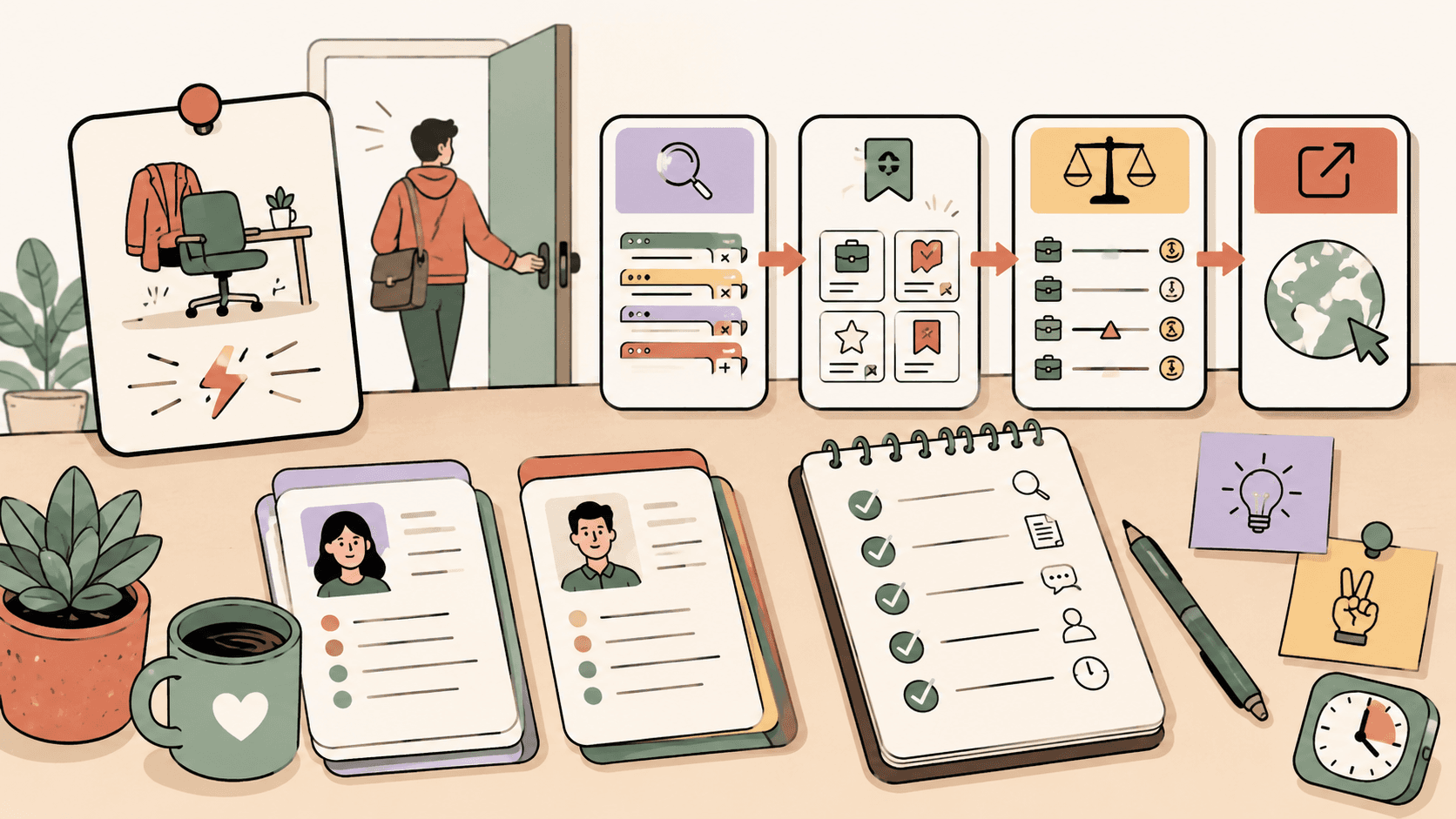
What should you do first when a coworker hard quits?
If a coworker hard quits, your first move is not to panic or gossip. Your first move is to protect your workload and your options. A hard quit usually means someone left abruptly, sometimes without notice, sometimes after a breaking point. You may not know the full story, but you can still respond professionally.
Start by writing down what changed. List the coworker’s responsibilities you know about, the projects they owned, the recurring meetings they attended, and anything that may now land on your desk. If you are a designer, this might mean open Figma files, brand requests, social graphics, UI review tickets, logo concepts, or illustration work that was previously split across the team.
Then ask your manager one direct question: “Which of these responsibilities should I pause, decline, or deprioritize if I’m being asked to cover this work?” Do not accept a second job silently. If your coworker handled five design tickets per week and you already handle eight, the conversation needs to be about tradeoffs, not heroics.
Use a simple note format in Notion, Google Docs, or Trello:
- Tasks I already own
- Tasks reassigned after the resignation
- Deadlines affected
- Questions that need manager approval
- Work I cannot absorb without dropping something else
This protects you if expectations shift later. It also gives you clean material for a resume update if you end up leading a project, covering a client handoff, or stabilizing a process after someone leaves.
Do this today: make a one-page workload change log before you take on any abandoned tasks.
Does a hard quit mean you should start job searching too?
A coworker hard quitting is a signal, not a verdict. Sometimes the person had a personal reason. Sometimes they were underpaid, overloaded, ignored, or already had another offer. You should not assume their experience is identical to yours, but you should take the moment seriously.
The practical question is: did their exit expose a problem you were already feeling?
Start looking if you see any of these signs:
- Their work is being permanently redistributed with no raise or title change.
- Management avoids explaining what will happen next.
- Deadlines remain the same even though headcount dropped.
- Your manager frames burnout as “team spirit.”
- You are asked to train others, cover missing work, and keep your normal workload.
- The company has no timeline for backfilling the role.
For design workers, the warning signs can be very specific. If a graphic designer leaves and suddenly you are covering brand assets, UI screens, ad creatives, and illustration without a scope conversation, you are no longer doing the same job. Market rates matter here: graphic design work often runs $30 to $100 per hour, UI design commonly falls around $50 to $150 per hour, logo design can range from $200 to $2,000+, and illustration can range from $50 to $500+ per illustration depending on complexity and usage.
Those numbers do not mean your employer must pay you freelance rates internally, but they help you understand the value of the extra work. If your workload suddenly includes 10 hours per week of UI design at market value, that is not a small favor.
Do this today: compare your current job description with what you are now being asked to do, then highlight anything that belongs in a compensation or job-search conversation.
Browse today’s opportunities on Sidequestboard
How should you talk to your manager after a coworker quits?
Keep the conversation calm and specific. Avoid “Are we all doomed?” and ask operational questions instead. The goal is to get clarity, create a paper trail, and avoid becoming the silent replacement.
Use this script:
“Since Alex left, I want to make sure I’m focused on the right priorities. I can help cover some urgent items, but I need clarity on what should move down the list. Can we review the projects that are changing ownership and decide what will be paused, reassigned, or delayed?”
If you are in a creative role, bring examples. For instance:
- “The landing page redesign needs UI review.”
- “The sales deck refresh needs graphic design support.”
- “The logo exploration for the partner campaign is still open.”
- “The illustration request for the product launch was originally assigned to Alex.”
Then ask: “Which two of these matter most this week?”
This does two useful things. First, it stops everything from becoming urgent. Second, it shows that you are not refusing to help, you are asking for prioritization. Managers often respond better to a capacity conversation when you bring concrete work items rather than general stress.
If your manager says, “Just do your best,” follow up in writing:
“Thanks for talking today. My understanding is that I should prioritize the landing page UI review and sales deck refresh this week, while the partner logo exploration and launch illustration will move to next week unless priorities change.”
That email is not hostile. It is professional memory. If deadlines blow up later, you have documented the decision.
Do this today: send one written summary after any workload conversation connected to the hard quit.
How can you turn this into a stronger resume or portfolio story?
If your coworker’s abrupt exit forces you to stabilize work, you may be gaining resume material. The key is to describe it without sounding like you are exploiting drama. Do not write “survived chaos after coworker quit.” Write the business outcome.
A weak resume bullet says:
- Took over coworker’s projects after they quit.
A stronger bullet says:
- Assumed ownership of 12 active design requests after an unexpected team departure, reprioritized deadlines with stakeholders, and delivered launch-critical assets on schedule.
For UI design, you might write:
- Led UI cleanup for a product release after team capacity changed, resolving navigation, spacing, and component consistency issues across 8 screens.
For graphic design:
- Managed brand asset production during a team transition, delivering social, email, and sales collateral while creating a reusable Trello intake board for future requests.
For illustration:
- Completed 6 product illustrations during a staffing gap, standardizing file naming, review stages, and export formats for handoff.
Your portfolio can use the same structure. Show the problem, your role, the constraints, and the result. If the work is confidential, create a sanitized case study. Use phrases like “unexpected team transition” or “capacity shift” rather than naming the coworker or criticizing the company.
If you are exploring freelance work, this story can also become a pitch angle. Many clients need someone who can enter messy situations and ship. Designers who can handle ambiguity are valuable, especially when logo design ranges from $200 to $2,000+, UI design often runs $50 to $150 per hour, and ongoing graphic design support can be priced at $30 to $100 per hour.
Do this today: draft three resume bullets from the extra responsibilities you have absorbed, even if you do not publish them yet.
Where should you look for fresh opportunities if this was your warning sign?
If the hard quit confirmed that your workplace is unstable, start a quiet opportunity search before you are desperate. Do not wait until your workload doubles for three months. Build a daily search habit that checks specific places where real opportunities appear.
For design-focused job seekers and freelancers, start with these public sources:
- r/designjobs, which has about 150K members. Check the [Hiring] flair for design projects.
- r/forhire, which has about 1.3M members. Search “designer” or “design” inside [Hiring] posts.
- r/Design, which has about 400K members. Use it more for networking and lead discovery than direct applications.
- Dribbble Jobs at https://dribbble.com/jobs for UI/UX, graphic design, and illustration roles. It is free to browse.
- Behance Joblist at https://behance.net/joblist for creative design roles. It is also free to browse.
- 99designs at https://99designs.com for logo and branding contests. Commission and contest terms vary, so read the details before spending time.
Here is a realistic 30-minute daily workflow:
- Open r/forhire and search “design” in [Hiring] posts. Sort by New, not Hot. A post from 2 hours ago is usually more useful than one with many comments from yesterday.
- Open r/designjobs and filter by [Hiring]. Look for posts that name the deliverable, budget, timeline, and contact method.
- Check Dribbble Jobs for UI/UX and visual design roles that match your portfolio.
- Check Behance Joblist for creative roles, especially if your portfolio is already on Behance.
- Save anything relevant in a spreadsheet, Notion database, Trello board, or opportunity tracker.
Your tracker should include source, role type, posted time, rate or budget, portfolio fit, response deadline, and status. A simple status column can be: Saved, Responded, Follow-up, Closed, Not a fit.
Do this today: choose three sources from the list above and check them for 15 minutes before or after work.
What does a good response look like when you find an opportunity?
Speed helps, but relevance matters more. When a post is fresh, your goal is to send a response that proves you read the request. Do not send a generic “I’m interested” message.
Walkthrough scenario 1: responding on r/forhire
Say you search r/forhire, filter for [Hiring], and find a post from 3 hours ago looking for a designer to create a landing page and app dashboard. The post says the budget is flexible and asks for portfolio links.
Before replying, check the poster’s account history. Look for normal activity, previous hiring posts, and whether they respond professionally. If the account is brand new, be more cautious. Then send a concise reply:
“Hi, I saw your [Hiring] post for landing page and dashboard design. I’ve designed SaaS onboarding and analytics screens, including responsive landing pages and component-based dashboards. Relevant examples: [portfolio link]. For UI design, my usual range is $50 to $150/hr depending on scope, or I can quote a fixed project after reviewing the page count and dashboard states. If helpful, I can send 2 to 3 initial layout directions after a short brief.”
That response does four things: it references the post, connects your experience, gives a realistic rate range, and suggests a next step.
Walkthrough scenario 2: evaluating a 99designs contest
Say you find a logo and branding contest on 99designs. The prize looks attractive, but the brief is vague. Before entering, compare the time required against typical logo design pricing of $200 to $2,000+. If you would need 10 hours to produce polished concepts and the contest is crowded, the risk may not be worth it unless the brief is strong, the prize fits your target rate, or the work would strengthen your portfolio.
A smarter move might be to use 99designs selectively for practice, portfolio pieces, or specific contests where the brief is clear and the brand category matches your niche. Do not make unpaid speculative work your only pipeline.
Do this today: write one reusable response template for r/forhire or r/designjobs, then customize the first two lines for each post.
How do you avoid jumping from one bad job into another?
A coworker hard quitting can make any outside opportunity look better. Slow down enough to evaluate the next role. You are not just looking for escape. You are looking for better conditions.
When you review a listing on Dribbble Jobs or Behance Joblist, look for signals of scope and sanity:
- Does the post describe the actual work, such as UI/UX, graphic design, illustration, or branding?
- Does it name the team or reporting structure?
- Does it clarify remote, hybrid, or onsite expectations?
- Does it mention salary, hourly rate, project budget, or contract length?
- Does the portfolio requirement match the role?
- Does the company expect one person to do brand, product, motion, copy, and front-end development without saying so clearly?
For freelance posts on r/designjobs and r/forhire, be even more direct. Ask about budget, timeline, decision-maker, usage rights, revision rounds, and payment schedule before starting. For illustration, where rates can range from $50 to $500+ per illustration, usage rights matter. A spot illustration for an internal deck is not the same as a commercial campaign asset.
Use a red/yellow/green system:
- Green: clear scope, budget, timeline, contact method, and reasonable expectations.
- Yellow: interesting work but missing budget or timeline.
- Red: vague scope, rushed deadline, no payment details, or requests for free custom samples.
Do this today: create a checklist you will run before applying or pitching, especially if you feel emotionally pushed by the hard quit.
How can Sidequestboard help after a coworker hard quits?
Once you decide to monitor opportunities, the hard part is consistency. Checking r/forhire, r/designjobs, r/Design, Dribbble Jobs, Behance Joblist, and other public sources manually can turn into tab chaos. Good posts also go stale quickly. A design opportunity posted this morning may already have dozens of replies by evening.
Sidequestboard is built for people who want a calmer way to discover fresh public opportunities from communities and social platforms. It is not a marketplace, recruiting agency, or guaranteed job source. It helps you find and save relevant public opportunities, open the original source, and apply or respond directly where the post lives.
That matters after a coworker hard quits because your time and attention are limited. You may be covering extra work during the day, updating your portfolio at night, and trying to avoid burnout. A cleaner opportunity feed can help you spend less time refreshing tabs and more time sending thoughtful replies.
A practical workflow could look like this:
- Morning: review fresh opportunities in one feed.
- Save anything relevant to design, UI, branding, or illustration.
- Open the original source for posts worth pursuing.
- Respond directly on the platform, such as r/forhire, r/designjobs, Dribbble, or Behance.
- Track which opportunities you responded to so nothing gets lost.
The point is not to apply to everything. The point is to notice better-fit posts while they are still fresh and respond with context.
Do this today: decide whether your search workflow needs fewer tabs, better saving, or faster first replies. If yes, use a tool instead of relying on memory.
What should your 7-day plan be after a coworker hard quits?
Use the first week to stabilize your current job and reopen your options. Here is a realistic plan.
Day 1: Document the change. Write down what work shifted to you and ask your manager what should be deprioritized.
Day 2: Update your resume. Add draft bullets for any new ownership, leadership, cleanup, process, or delivery work.
Day 3: Audit your portfolio. If you are a designer, make sure your best UI design, graphic design, logo design, or illustration work is easy to find. Dribbble and Behance viewers should understand your specialty within 20 seconds.
Day 4: Set up your opportunity sources. Check r/designjobs for [Hiring] flair, r/forhire for “designer” or “design” in [Hiring] posts, r/Design for networking leads, Dribbble Jobs, Behance Joblist, and selective 99designs contests.
Day 5: Write response templates. Create one for hourly UI design at $50 to $150/hr, one for graphic design at $30 to $100/hr, and one for logo or branding projects where pricing may range from $200 to $2,000+.
Day 6: Apply or pitch to three strong-fit opportunities. Prioritize fresh posts with clear scope and budget. Customize each message.
Day 7: Review your workplace signal. Did management clarify priorities, or did they quietly pile on more work? Your answer should influence how aggressively you search.
Do this today: put these seven tasks on your calendar, not just your to-do list.
What is the bottom line if your coworker hard quit?
Do not treat your coworker’s hard quit as gossip. Treat it as information. Protect your workload, ask for clear priorities, document what changes, and quietly build options. If the company responds well, you may not need to leave. If it responds by dumping work on you without support, you will already have your resume, portfolio, and opportunity pipeline moving.
For design job seekers and freelancers, fresh opportunities exist across r/designjobs, r/forhire, r/Design, Dribbble Jobs, Behance Joblist, and 99designs, but the best results come from checking consistently and responding before posts go cold. Know your numbers: logo design can run $200 to $2,000+, UI design $50 to $150/hr, graphic design $30 to $100/hr, and illustration $50 to $500+ per piece.
Your next move is simple: stabilize your current work, restart your search quietly, and build a system that helps you act faster when a better opportunity appears.