June 15, 2026
What Job Seekers Should Learn From: I Got a Job Offer Today After 8 Months
An 8-month job search reveals that standard applications often fail. To find work faster, diversify your approach: hunt for leads on specific communities like r/forhire, secure side income on r/beermoney, and organize your search so you can respond to fresh opportunities within hours, not days.
Why Do Standard Job Applications Take So Long?
The online application process is fundamentally broken for the applicant. When you apply through a corporate portal, your resume enters an Applicant Tracking System (ATS) alongside 200 to 500 other resumes. Human eyes might never see it. Companies take 40 to 60 days on average to fill a role, and that timeline stretches even further in uncertain economic climates.
When you rely solely on LinkedIn Easy Apply or corporate career pages, you are competing in the most crowded pool possible. Your acceptance rate on these platforms will likely hover around 2% to 3%. At that rate, you need 50 applications just to get one or two callbacks. Over eight months, that means hundreds of applications sent into voids.
Action step: Calculate your current response rate. If you have sent 100 applications and received 2 calls, your response rate is 2%. Knowing this number helps you decide when to change tactics rather than just sending more applications into the same black hole.
Where Can You Find Work That Traditional Job Boards Miss?
Public communities host thousands of fresh work opportunities every day that never appear on major job boards. Hiring managers and founders post directly to these communities when they need someone immediately, bypassing the ATS entirely.
r/forhire is the primary subreddit for direct hiring. People post roles ranging from freelance graphic design to full-time developer positions. When you search r/forhire, filter by the "Hiring" flair, sort by New, and look for posts from the last few hours. Because these posts age quickly, responding within the first 24 hours dramatically increases your chances. I have seen freelance writing gigs posted at $25 to $75 per hour, and remote contract developer roles at $50 to $100 per hour, all posted directly by the person who needs the work done.
r/sidehustle (1.2 million members) focuses on side income strategies. While not a traditional job board, users frequently share what is actually working for them right now, from local service businesses to digital product sales. You can learn which income streams have the fastest time to first pay and lowest startup costs.
r/beermoney (1.5 million members) covers quick extra income ideas like platform testing, surveys, and micro-tasks. The earnings here are smaller, typically $200 to $500 a month, but the time to first pay is often just 1 to 3 days. When your savings are depleting, fast cash matters.
r/personalfinance (20 million members) offers income comparison strategies and financial planning. During a long search, knowing how to stretch your runway is as important as finding the next interview.
Action step: Open r/forhire right now, sort by New, and find one post from the last 24 hours that matches your skills. Read the requirements and draft a response tailored to exactly what the poster asked for.
Browse today’s opportunities on Sidequestboard
How Can You Generate Income While Searching For Full-Time Work?
An eight-month search without income creates financial panic, which leads to worse interview performance and desperation in applications. You need cash flow to maintain your composure.
Freelance your current skill. Time to first pay: 1 to 4 weeks. Potential: $500 to $5,000 per month. If you are a marketer, writer, designer, or developer, offer your skills on r/forhire or reach out to your LinkedIn network directly. A single recurring client can cover your rent.
Part-time remote contract work. Time to first pay: 1 to 3 weeks. Potential: $500 to $3,000 per month. Many companies hire contractors for specific projects rather than full-time employees. These roles are frequently posted on community boards.
Weekend gig work. Time to first pay: 1 to 3 days. Potential: $200 to $1,500 per month. Delivery apps, TaskRabbit, or local event staffing provide immediate cash. The hourly rate is lower, but the money hits your bank account fast.
Sell a digital product. Time to first pay: 2 to 6 weeks. Potential: $100 to $10,000 per month. If you have expertise, package it into a Notion template, a short guide, or a mini-course. Gumroad makes this simple to set up.
Action step: Pick the income strategy above with the shortest time to first pay that matches your current situation. Spend one hour today setting up the basics, whether that is creating a r/forhire post offering your services or signing up for a weekend gig platform.
What Is A Concrete Walkthrough For Finding Leads On Reddit?
Here is exactly how to find and respond to a fresh lead on r/forhire.
- Go to reddit.com/r/forhire and click "New" to sort by the most recent posts.
- Scan for posts tagged with the "Hiring" flair. Ignore "For Hire" posts, which are other job seekers.
- Look for posts made within the last 3 to 6 hours. Posts older than 24 hours usually have enough responses that yours will be buried.
- Read the post carefully. Note the specific skills requested, the project scope, and any requested application format. If they ask for a portfolio link and an hourly rate, provide exactly those two things.
- Check the poster's account history. Click their username and look at their post and comment history. An account active for years with normal activity is a legitimate lead. A brand new account with no history is a red flag.
- Draft a concise response. State your relevant experience in two sentences, link to a specific portfolio piece that matches their request, give your rate, and ask one clarifying question about the project to show engagement.
I used this exact method to find a freelance writing client who paid $60 per hour for ongoing blog posts. The post was 2 hours old, they needed someone familiar with SaaS content, and I had a relevant sample ready to link.
Action step: Complete this walkthrough today. Find one active post and write a tailored response. Even if you do not land the gig, the practice of writing targeted pitches improves your communication for every future opportunity.
How Do You Organize Your Search So You Can Respond Faster?
One of the biggest time sinks in a long job search is the daily routine of checking too many places. You open LinkedIn, then Indeed, then r/forhire, then a Slack community, then Discord, then Twitter. By the time you finish scanning, half your day is gone and you have not actually applied or pitched anything.
You need a system that reduces search time and increases action time.
Use a tracking system. A simple Notion database or Trello board works. Create columns for: Opportunity, Source, Date Found, Status, and Next Step. When you find a lead, log it immediately. This prevents you from losing track of good opportunities and helps you follow up when a company goes quiet.
Batch your search time. Dedicate 45 minutes in the morning to scanning sources for new leads. Spend the rest of your work hours on applications, pitches, networking, and skill-building. Searching feels productive, but applying and pitching actually moves the needle.
Set a follow-up cadence. If you have not heard back after 5 to 7 business days, send one polite follow-up. Add a reminder in your tracker. Most people do not follow up, so doing this one thing sets you apart.
Action step: Create a simple Notion or Trello tracker right now with the columns listed above. Move any active opportunities you are tracking into it.
How Can You Spend Less Time Searching And More Time Responding?
The core problem with long job searches is not usually a lack of effort. It is effort misdirected toward low-yield activities. Manually checking 8 different platforms every day burns time. Opportunities go cold because you found them 48 hours late. You forget to follow up because you have no system.
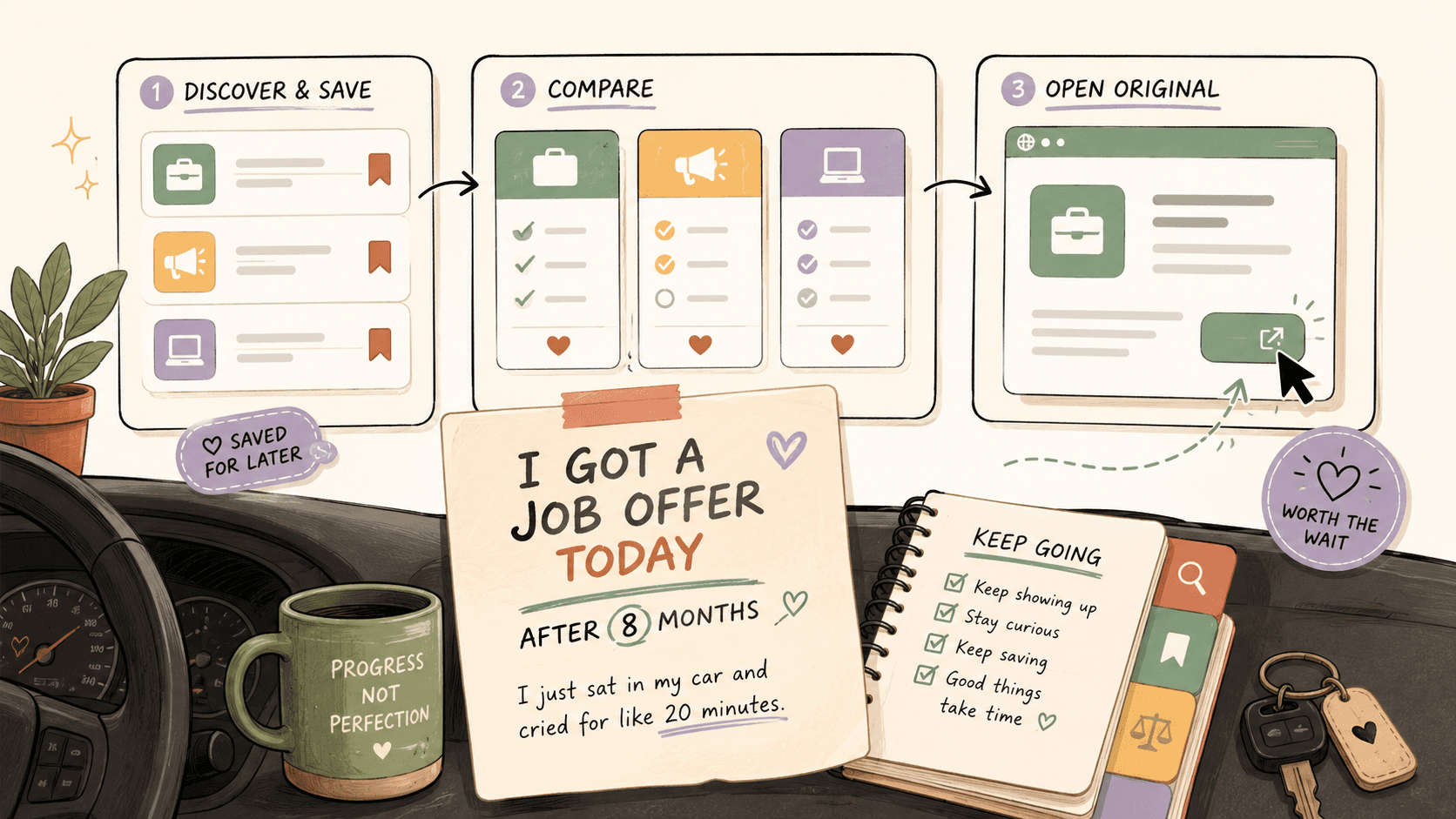
This is where a tool like Sidequestboard helps. Sidequestboard pulls fresh freelance and work opportunity posts from public communities and social platforms into one cleaner feed. Instead of opening dozens of tabs across Reddit, X/Twitter, and Discord, you check one dashboard. You can save relevant opportunities, open the original listing to apply or respond directly, and draft faster first replies when appropriate.
There is no marketplace commission or middleman. You still apply at the original source. Sidequestboard just reduces the time between when an opportunity is posted and when you see it. In a long job search, speed is the advantage you need. When a hiring manager posts on a community and gets 30 responses in two days, being in the first 5 responses matters.
If your current search feels like throwing applications into a void, changing how you discover and track opportunities can shift the odds. Sidequestboard offers a 7-day trial so you can test whether a faster discovery workflow actually improves your response rate.
Action step: Start your Sidequestboard trial and connect it to the types of opportunities you are looking for. Spend 15 minutes scanning the feed, save 3 relevant opportunities, and respond to at least one today.
What Should You Do Right Now If Your Search Has Lasted Months?
- Stop relying solely on traditional job boards. Dedicate at least 30% of your search time to community-sourced opportunities on platforms like r/forhire (direct hiring posts) and r/sidehustle (income strategies).
- Start generating income immediately. Pick one side income strategy with a 1 to 3 day time to first pay, like weekend gig work from r/beermoney, to reduce financial pressure.
- Organize your pipeline. Build a tracker in Notion or Trello so you can follow up on every lead within 5 to 7 business days.
- Consolidate your search tabs. Use Sidequestboard to monitor fresh public opportunities in one feed instead of manually checking multiple communities daily.
- Respond within hours, not days. When you find a fresh opportunity, prioritize sending a tailored response the same day.
An eight-month job search teaches you that the standard approach is not enough. The people who find work faster are the ones who diversify their sources, organize their pipeline, and act quickly when fresh opportunities appear.
Related guides
- How to Get Freelance Clients on LinkedIn: Profile, Search, Outreach, and Lead Workflow
- Best Side Hustle Ideas on Reddit for Finding Work
- How to Find Freelance Leads in Online Communities
- How to Find Job Opportunities in Reddit Communities
- Career Changes Are Not Easy in the U.S. Here Is How to Make One Less Risky