June 25, 2026
Career Changes Are Not Easy in the U.S. Here Is How to Make One Less Risky
Career changes in the U.S. are not easy because employers often demand direct experience, referrals, proof of work, and time you may not have. The safer path is to make a staged transition: test paid projects, build portfolio evidence, use targeted communities like r/forhire and r/WorkOnline, and apply before fresh opportunities go cold.
Why do career changes feel so much harder than people say?
Career changes feel hard because most hiring systems reward evidence from your last role, not your potential. A resume screener, recruiter, or client usually looks for familiar job titles, tools, industries, portfolio samples, and recent proof that you can do the exact work they need. If you are moving from customer support to UX writing, teaching to project coordination, or retail management to virtual assistance, you are not only learning new skills. You are also rebuilding trust from scratch.
The Reddit discussion behind this topic, posted in r/jobs, resonated because it says the quiet part out loud: the U.S. labor market may offer many paths on paper, but changing tracks often means taking a pay cut, competing with entry-level candidates, paying for training, or finding employers willing to take a chance. That does not mean a career change is impossible. It means you need a lower-risk plan than simply quitting, getting a certificate, and hoping applications work.
The practical answer is to treat your career change like a proof-building project. Instead of asking the market to believe your pivot, collect small pieces of evidence that make the pivot obvious: paid freelance work, public samples, specific outcomes, community references, and targeted applications. Today, write down the new role you want and one proof item you can create in the next 14 days, such as a writing sample, design case study, GitHub project, edited video, or VA process checklist.
What should you do before quitting your current job?
Before quitting, separate your career change into three tracks: money, proof, and access. Money means knowing how long you can afford lower income. Proof means showing you can do the new work. Access means knowing where real opportunities appear before hundreds of people apply.
Start with a simple runway calculation. If your monthly essentials are $3,200 and you have $9,600 saved, you have about three months of runway before taxes, emergencies, and health insurance surprises. That is not much time for a full pivot. If you can keep your current job while testing the new field, even for 5 to 8 hours per week, you reduce pressure and make better decisions.
Next, pick one paid-work test. If you want to move into writing, r/HireaWriter has about 250K members and regularly includes [Hiring] posts for blog writers, copywriters, editors, and content creators. If you want online support or admin work, r/WorkOnline has about 1.6M members and lets you filter by Hiring flair to find online work discussions, job postings, and gig shares. If you want broader freelance projects, r/forhire has about 1.3M members and is useful when you sort by New and search the [H]iring flair.
Use real market rates to check whether your pivot can support your life. Writing projects often range from $20 to $200 depending on scope and experience. Virtual assistants commonly charge $15 to $35 per hour. Designers may charge $75 to $150+ per hour, while developers often charge $80 to $200+ per hour. Logo projects can range from $50 to $500, video editing from $100 to $1,000, voiceover from $25 to $250, and finance consulting from $100 to $250+ per hour. Pick one rate range that matches your target field and compare it to your monthly expenses today.
See fresh gigs on Sidequestboard
How can you test a new career without starting from zero?
The fastest test is a small paid project with a clear deliverable. You do not need to rebrand your entire life first. You need one credible sample that proves you can solve a problem for someone in the new lane.
Here is a concrete walkthrough. Say you are an operations coordinator trying to move into freelance project management for small agencies. Go to r/forhire, sort by New, and search for posts with [H]iring. Then run a Google search like site:reddit.com/r/forhire hiring remote to catch recent posts that Reddit search may miss. Look for a post from the last few hours with a clear scope, payment terms, and a poster whose account history does not look brand new or spammy. If the post asks for help organizing client deliverables, reply with a short message: your relevant background, one specific process you would use, and a link to a Notion or Trello sample board.
Do not write a generic “I am interested” reply. Write something like: “I managed weekly deliverables for a 12-person support team and can set up a Trello board with intake, priority, owner, due date, and client status columns. I can also send a daily 5-line update so nothing slips. Here is a sample board.” That gives the poster something concrete to evaluate.
You can do the same for creative work. If you want to become a designer, search site:reddit.com/r/forhire "need a" designer. Compare the requested deliverables against current rates. A simple logo might pay $50 to $500, but ongoing design support can move toward $75 to $150+ per hour. Build one sample around the exact kind of request you see twice in the same week. Today, choose one subreddit and save three real posts that match your target career.
Which platforms are useful for career changers trying to build proof?
Use different platforms for different stages of the pivot. Do not treat every site as the same kind of opportunity source.
r/forhire is good for fresh freelance demand if you move quickly. It has about 1.3M members, and the best routine is to sort by New, search [H]iring, and respond only to posts with clear scope and payment details. Use Google queries such as site:reddit.com/r/forhire "looking for" developer if you are moving into development, or site:reddit.com/r/forhire "need a" designer if you are building a design portfolio.
r/freelance_forhire, with about 90K members, is better for studying how freelancers position themselves. Browse [For Hire] posts in your target category and note how people structure their titles, rates, portfolio links, and deliverables. If you post your own ad, include your rate, three services, turnaround time, and one portfolio link. Do not make readers ask what you do.
r/WorkOnline is useful if you want online work but are still exploring categories. Filter by Hiring flair and prioritize posts with clear payment terms. r/HireaWriter is more specialized. If you are moving into content, copywriting, editing, or blog work, check [Hiring] posts and compare expectations against the writing benchmark of $20 to $200 per assignment or project scope.
For platform-based freelancing, Upwork is often useful for beginners building a portfolio, but it charges a 10% to 20% sliding commission depending on the arrangement. Fiverr works better when your service can be packaged into clear Basic, Standard, and Premium tiers, but it charges a 20% flat commission. Contra can be attractive because it offers a portfolio-based setup and 0% commission on earnings on its free tier. PeoplePerHour is common for UK and EU freelancers and lets you create fixed-price “Hourlies,” with commissions typically in the 5% to 20% range. Toptal is more relevant once you are already experienced in development, design, or finance because it has a screening process and positions itself around top-tier talent. Pick two platforms maximum this week so you can learn their norms instead of scattering effort everywhere.
How should you rewrite your resume or profile for a career change?
A career-change resume has to translate your old experience into the new buyer’s language. Do not lead with every task you performed in your previous job. Lead with the parts that reduce risk for the new role.
If you are moving from teaching into content operations, your old resume might say “Created lesson plans and managed classroom activities.” Your pivot version should say “Planned weekly content sequences, adapted materials for different audiences, tracked completion, and communicated progress to stakeholders.” That language fits writing, training, customer education, and operations roles more cleanly.
For freelance profiles on Upwork, Fiverr, Contra, or PeoplePerHour, write around deliverables instead of identity. “Career changer seeking opportunities” sounds risky. “I create SEO blog outlines, edit drafts for clarity, and deliver publish-ready articles in Google Docs” is easier to buy. On Fiverr, turn that into three tiers: Basic could be a 500-word edit, Standard could be a full blog edit plus headline options, and Premium could include content brief, edit, and meta description. On Contra, build a portfolio page with two to four samples and a short case note for each.
Use rates carefully. If you are new to writing, a first small assignment might land closer to $20 to $75, while more experienced writers can move toward $100 to $200+ depending on the client and scope. If you are moving into virtual assistance, $15 to $35 per hour is a realistic range. Do not underprice forever, but do not pretend you have senior proof before you have samples. Today, rewrite your headline so it names the deliverable you can provide, not just the career you want.
What does a realistic 30-day career-change plan look like?
A good 30-day plan does not promise a new career in a month. It gives you enough market feedback to decide whether the pivot deserves more time.
Days 1 to 3: choose one target role and one service version of that role. “Marketing” is too broad. “Landing page copy editing for SaaS founders” is specific. “Tech” is too broad. “Frontend fixes for Webflow and React landing pages” is specific. Check r/forhire, r/HireaWriter, r/WorkOnline, and r/freelance_forhire to see whether people actually request that service.
Days 4 to 10: build one sample. For writing, create a blog post, email sequence, or product page rewrite. For design, create a mini case study with before-and-after screens. For development, publish a GitHub repo or live demo. For video editing, edit a 30 to 60 second sample clip and show the source-to-final transformation. Use the relevant benchmark to frame your offer: video editing projects often run $100 to $1,000, while development work can range from $80 to $200+ per hour once you have proof.
Days 11 to 20: send 20 targeted responses. Ten can come from Reddit communities such as r/forhire and r/WorkOnline, five from Upwork or PeoplePerHour, and five from direct outreach to small businesses or creators who clearly need the service. Track each response in a simple spreadsheet with source, date, role, pay range, link, reply status, and follow-up date.
Days 21 to 30: review the data. If nobody responds, your offer may be unclear, your samples may be weak, or you may be too broad. If people respond but do not buy, your rate, trust signals, or scope may need work. If one person pays you, turn that into a case study immediately. Today, create the tracking sheet before you send another application.
How do you avoid scams and dead-end opportunities?
Career changers are vulnerable because urgency makes bad offers look better than they are. Use a basic screening process before sending personal information, doing unpaid work, or accepting vague arrangements.
On r/forhire, r/WorkOnline, and r/HireaWriter, check whether the post includes scope, pay, timeline, and how to apply. A post that says “DM me for an amazing remote opportunity” without details deserves skepticism. Look at the poster’s account history. A real poster often has normal comments, past hiring activity, or a business link. A throwaway account is not automatically fake, but it raises the bar for proof.
On Upwork, keep communication and payment inside the platform until you understand the client. On Fiverr, define revisions and deliverables clearly in your package tiers because the 20% platform commission already reduces your margin. On PeoplePerHour, read the project details carefully and avoid vague fixed-price work that could expand beyond the agreed scope.
A good rule: never do a full unpaid sample that the requester can use commercially. A short custom paragraph, low-resolution mockup, tiny code explanation, or 10-minute Loom audit can be reasonable. A complete article, full logo package, production-ready code, or finished edited video should be paid. Before replying to any fresh post today, check for scope, pay, timeline, poster history, and whether the requested sample is usable work.
How can Sidequestboard fit into a career-change workflow?
Once you know the kind of opportunity you want, the hardest part is checking enough public sources without losing your day to tabs. r/forhire, r/WorkOnline, r/HireaWriter, r/freelance_forhire, X/Twitter posts, Discord communities, Upwork, Fiverr, Contra, PeoplePerHour, and other public sources all have different rhythms. Good posts can go cold quickly, especially when dozens of people reply in the first few hours.
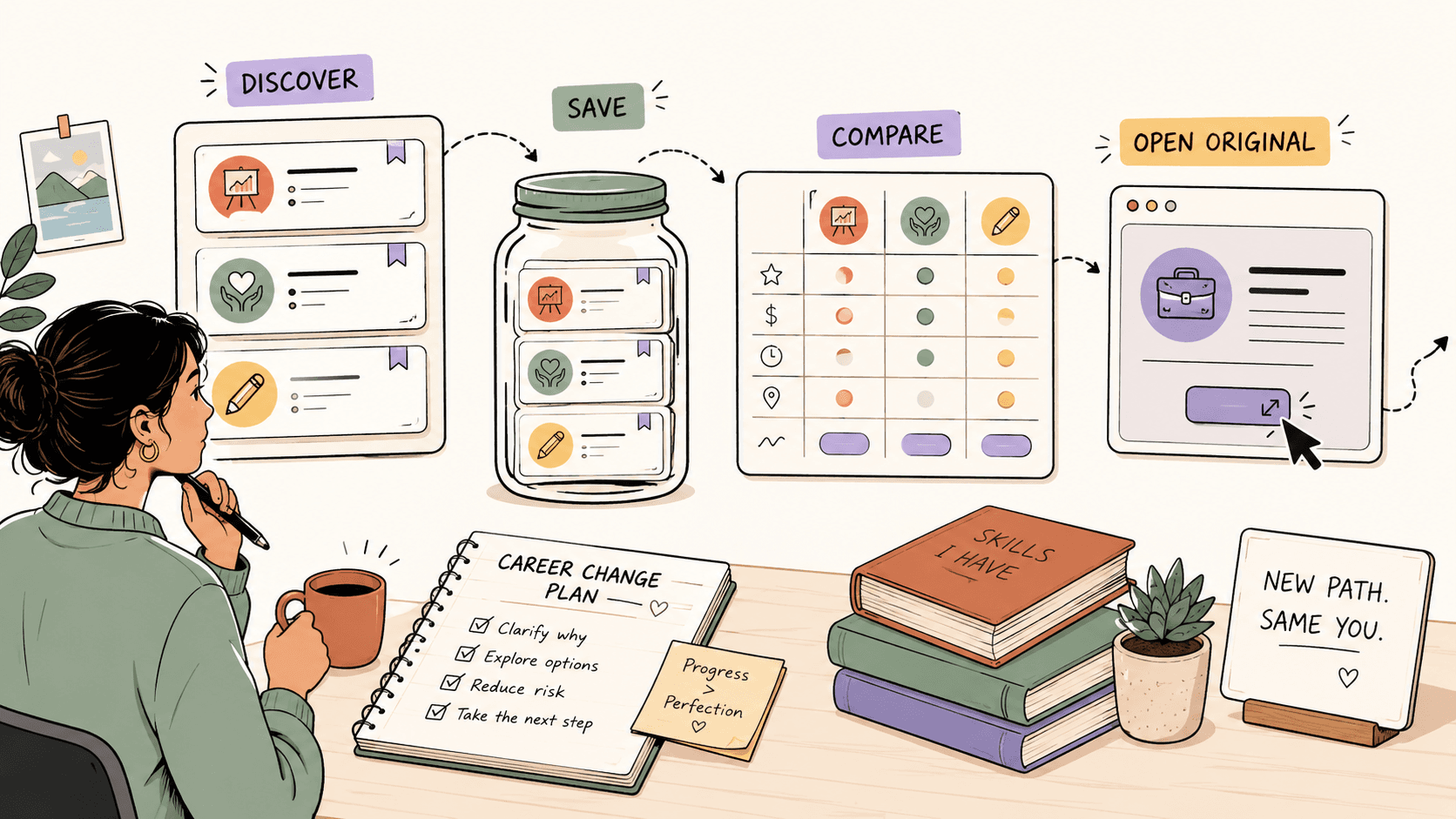
Sidequestboard is built for that search problem. It is a curated job and opportunity discovery dashboard for people looking for fresh work opportunities from public communities and social platforms. You can use it to discover public freelance, job, and opportunity posts in a cleaner feed, save interesting opportunities, open the original source, and apply or respond directly there. There is no marketplace commission or middleman.
For a career changer, the useful workflow is simple: define your target role, monitor fresh public opportunities, save the ones that match your proof, and respond quickly with a tailored message. Sidequestboard does not make the career change easy, and it does not guarantee jobs, interviews, clients, or income. It helps reduce the tab chaos so you can spend more of your limited time improving samples, applying, pitching, and following up.
If you are currently checking r/forhire in one tab, r/WorkOnline in another, Discord in another, and saving links in random notes, consolidate that workflow. Today, decide which three opportunity types you want to monitor and set up a calmer system for saving and responding before posts go cold.
What should you say when someone tells you career changes are easy?
You do not need to argue that career changes are impossible. The more accurate response is: “They are possible, but they are not frictionless. You need money runway, proof, targeted opportunities, and a way to respond quickly.”
That answer keeps you grounded. It avoids the fantasy that a certificate automatically leads to a new job, and it avoids the defeatist idea that your previous career traps you forever. Most successful pivots are built through adjacent moves. A support rep becomes a customer success specialist, then an implementation manager. A teacher becomes a curriculum writer, then a learning experience designer. A hobbyist editor takes $100 to $300 video editing projects, then builds enough proof for larger $500 to $1,000 work.
Your immediate move is not to solve the whole career change. It is to create one piece of evidence and put it in front of one real demand source. Search r/forhire by New. Filter r/WorkOnline by Hiring flair. Check r/HireaWriter if you write. Build a Contra portfolio if you want a commission-free profile. Test Upwork if you need a broader project pool and can handle the 10% to 20% commission. Then track what happens.
Career changes in the U.S. are not easy. But they become less chaotic when you stop relying on motivation and start building proof, watching real demand, and responding while opportunities are still fresh.