June 9, 2026
How to Find Side Income Opportunities After Work
To find side income after work, pick one skill you can monetize, set up profiles on two to three platforms where clients actively post, and check those sources daily during a fixed 30-minute window. Most freelancers land their first paid project within one to four weeks using Reddit communities, design job boards, and freelance marketplaces.
Why Look for Side Income After Work?
A full-time job covers your baseline expenses. But between rising rent, student loan payments, and the general cost of living, that baseline often is not enough. Bankrate reported in 2024 that 39% of U.S. adults have a side hustle, and most of them started because they needed extra cash, not because they wanted to be entrepreneurs.
The good news: you do not need to build a business from scratch. You need a repeatable system for finding paid opportunities that fit into your evenings and weekends. This guide walks through exactly where to look, what to expect in terms of income, and how to build a daily workflow that does not consume your life.
Which Side Income Strategy Matches Your Schedule?
Before you pick a platform, pick a strategy. Each one trades different amounts of time for different income ceilings.
Freelance in your current skill — If you already do something professionally (writing, design, coding, marketing), this is the fastest path. Time to first pay: one to four weeks. Potential: $500 to $5,000 per month depending on your rate and availability.
Part-time remote contract work — Some companies hire part-time contractors for ongoing work. These roles pay less per hour than freelance but offer more stability. Time to first pay: one to three weeks. Potential: $500 to $3,000 per month.
Sell a digital product — Templates, guides, Notion dashboards, Figma kits. This takes longer to build but can earn passively. Time to first pay: two to six weeks. Potential: $100 to $10,000 per month, though most creators earn on the lower end initially.
Weekend gig work — Delivery apps, TaskRabbit, pet sitting. Low friction, low ceiling. Time to first pay: one to three days. Potential: $200 to $1,500 per month.
If you have a professional skill, start with freelance. If you need cash this week, start with gig work. If you want to build something scalable over months, start with digital products. You can always layer strategies later.
Track fresh opportunities on Sidequestboard
Where Do You Actually Find Paid Opportunities?
Here are the specific platforms worth your time, organized by type. I have used or tested every one of these, and the rate benchmarks come from actual market data, not wishful thinking.
Reddit Communities with Active Hiring Posts
Reddit is one of the most underrated sources for freelance and contract work. The key is knowing which subreddits to watch and how to filter.
r/forhire (1.3 million members) — The largest freelance hiring community on Reddit. Posts tagged [Hiring] come from individuals and companies looking for designers, developers, writers, marketers, and more. Search terms like "designer" or "developer" within [Hiring] posts, sort by New, and respond quickly. Most posts get flooded within a few hours, so timing matters.
r/designjobs (150K members) — Focused specifically on design work. Check the [Hiring] flair for logo design, UI/UX, branding, and illustration projects. Rates here tend to be higher than general freelance boards because the community is specialized.
r/beermoney (1.5 million members) — For small online tasks that pay modest amounts. Check the daily thread for active opportunities like surveys, app testing, and micro-tasks. This will not replace your income, but it can generate $50 to $200 per month with minimal effort.
r/slavelabour (300K members) — Small tasks for small pay. The name is tongue-in-cheek, but the tasks are real: data entry, quick graphic edits, transcription. Respond to [Hiring] posts fast. Good for building a track record if you have no portfolio yet.
r/WorkOnline (1.6 million members) — Broader discussion about online work, including freelance platforms, remote job boards, and side gig recommendations. Less of a direct hiring board and more of a research hub.
r/beermoneyglobal (200K members) — The international version of r/beermoney. Useful if you are outside the U.S. and want region-specific opportunities.
Design and Creative Job Boards
If you do any kind of visual work, these boards consistently have fresh listings.
Dribbble Jobs (dribbble.com/jobs) — UI/UX, graphic design, and illustration roles. Free to browse. Companies post both full-time and freelance positions here. UI designers can command $50 to $150 per hour on freelance projects sourced through Dribbble.
Behance Job List (behance.net/joblist) — Adobe's creative community job board. Strong for branding, illustration, and motion design roles. Free to access. Many listings are from agencies looking for freelance support.
99designs (99designs.com) — Logo and branding design contests. You submit work, and if the client picks your design, you get paid. Logo design projects on 99designs typically range from $200 to $2,000+. The contest model is controversial among designers, but it can be a good way to build a portfolio quickly.
Rate Benchmarks You Should Know
Before you quote a price or accept an offer, know what the market pays:
- Logo design: $200 to $2,000+ per project
- UI design: $50 to $150 per hour
- Graphic design: $30 to $100 per hour
- Illustration: $50 to $500+ per illustration depending on complexity and usage rights
If someone offers you $50 for a full logo design with revisions, that is below market rate. You can do better, even as a beginner, by knowing where to look.
How Do You Build a Daily Opportunity Search Workflow?
The biggest mistake people make when looking for side income is searching randomly. They scroll through job boards for an hour, get overwhelmed, and give up. Here is a structured approach that takes 30 minutes per day.
The 30-Minute Evening Routine
Minutes 0-5: Open your sources. Open r/forhire sorted by New, r/designjobs sorted by New (if you do design work), and one job board like Dribbble Jobs or Behance. That is three tabs, not thirty.
Minutes 5-15: Scan and save. Skim post titles. If something matches your skill and looks legitimate, save it. On Reddit, click Save. On job boards, bookmark the listing. Do not apply yet. Just build your list.
Minutes 15-25: Respond to your top three. Pick the three most promising opportunities you saved. Write tailored responses. On Reddit, this means a comment or direct message. On job boards, this means an application email or form. Keep your responses short: who you are, one relevant project you have done, and a link to your portfolio or work samples.
Minutes 25-30: Track and close. Write down what you applied to, when, and any follow-up needed. Close your tabs. Done.
Walkthrough: Responding to a Reddit Hiring Post
Here is exactly how this works in practice. Say you find a post on r/forhire tagged [Hiring] from someone looking for a freelance graphic designer for ongoing social media assets. The post is two hours old.
First, check the poster's account history. Click their username. Look at their post and comment history. A legitimate poster will have a history of activity, not a brand new account with one post. If they look real, proceed.
Second, read the brief carefully. What exactly do they need? What is the timeline? Is there a budget mentioned?
Third, write your response. Keep it under five sentences. Example: "I do freelance graphic design and have worked on social media assets for [type of client]. Here is a link to my portfolio: [URL]. My rate for this type of work is $40-60/hr depending on scope. Happy to do a quick test piece if that helps."
Fourth, send it and move on. Do not wait for a reply. Go to the next opportunity.
Walkthrough: Pitching a Logo Design Project on 99designs
On 99designs, clients launch contests with a brief. You read the brief, create a design, and submit it. If the client picks your design, you get the prize money.
Say a client launches a logo contest for a new coffee shop with a $500 prize. Read the brief carefully. Look at any mood boards or references they provided. Create two to three initial concepts. Submit your strongest one first.
The key to winning contests is not submitting the most designs. It is reading the brief more carefully than anyone else and submitting one design that nails what the client actually described. Most contestants ignore half the brief and submit generic work.
If you win, you now have a real project for your portfolio. If you lose, you still practiced your craft and can often repurpose the design concepts for other clients or your portfolio.
What Mistakes Should You Avoid When Starting?
Mistake 1: Checking too many sources. Pick two or three platforms and check them daily. Checking ten sources once a week is worse than checking three sources every day. Freshness matters more than volume.
Mistake 2: Sending generic applications. "I am a hard worker and quick learner" means nothing. Show one relevant thing you have done. Link to it. Be specific about your rate.
Mistake 3: Underpricing to get the first client. If you do design work, do not accept $15/hr just to land a gig. You will attract clients who value cheap work over quality work, and those clients are the hardest to work with. Start at a fair market rate, even if it means waiting longer for your first yes.
Mistake 4: Spending more time searching than applying. If you spend two hours browsing job boards and zero minutes writing proposals, you are doing it backwards. Cap your search time and force yourself to respond to at least two opportunities per session.
Mistake 5: Not tracking what you applied to. A week later, you will not remember which posts you responded to. Use a simple spreadsheet or a Notion database. Columns: Source, Opportunity, Date Applied, Rate Quoted, Status, Follow-up Date.
How Do You Manage the Tab Chaos?
Here is the real problem with finding side income after work. You start with r/forhire. Then someone mentions r/designjobs. Then you check Dribbble. Then Behance. Then a couple of Discord servers. Before you know it, you have 23 tabs open, it is 10 PM, you have not applied to anything, and you close your browser exhausted.
I know this because I have done it. The cycle of open-check-scroll-close without action is the single biggest waste of time for people looking for side income.
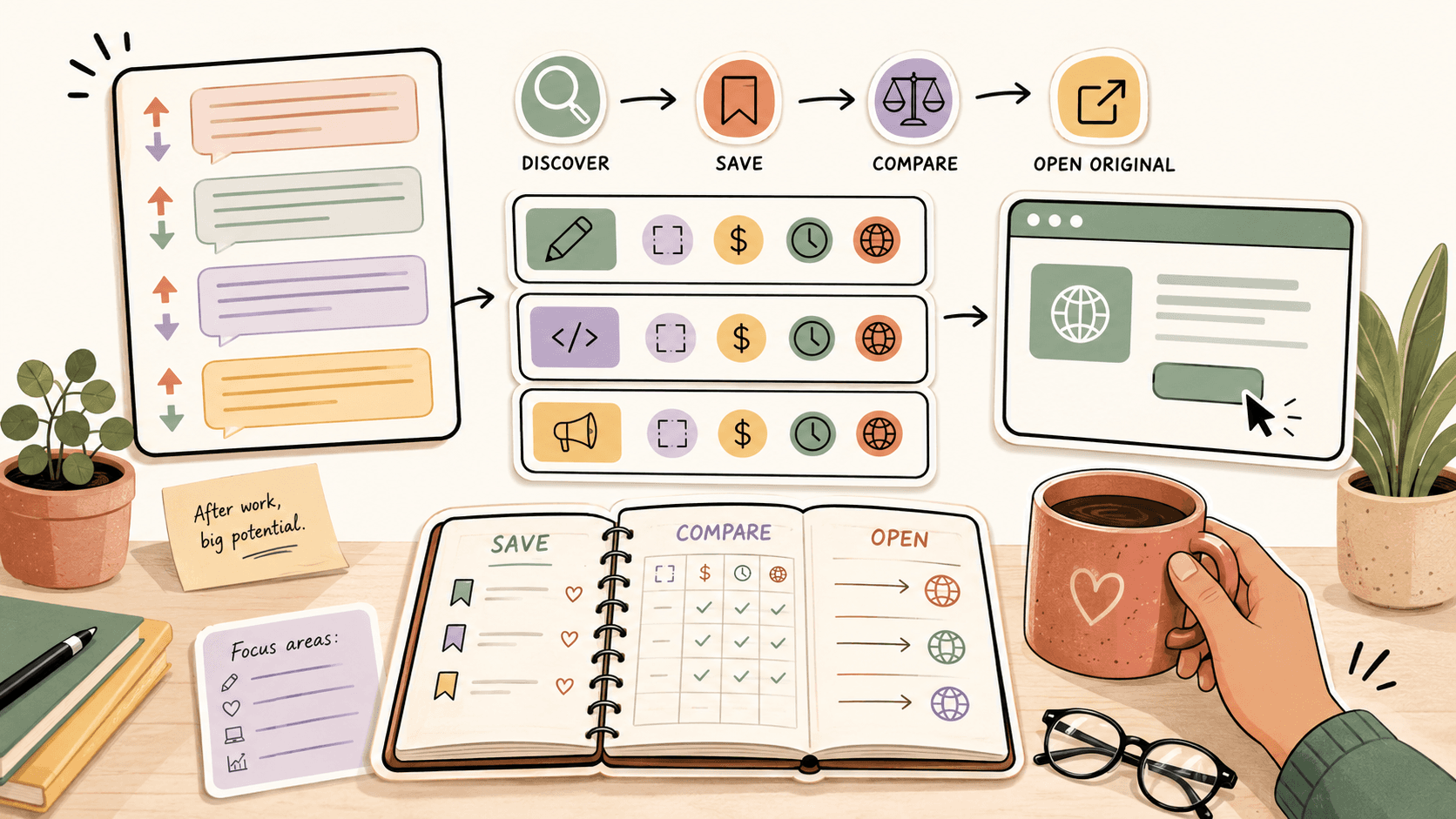
This is exactly the problem Sidequestboard was built to solve. It pulls fresh opportunity posts from public communities and social platforms into one feed. Instead of opening Reddit, Dribbble, Behance, and three Discord servers separately, you open one dashboard, see what is new, save what interests you, and click through to the original listing when you are ready to respond.
No marketplace commission. No middleman between you and the client. You still apply directly at the original source. Sidequestboard just removes the part where you spend 45 minutes opening and closing tabs.
If you are spending more than 30 minutes a day just searching for opportunities, try the 3-day trial. Set up your feed, check it during your evening window, and see if it cuts your search time in half. The link is below.
What Should You Do Tonight?
Here is your action plan for this evening, step by step.
-
Pick one skill you can monetize. Be specific. Not "I can do stuff on the computer." Write down: "I can design social media graphics" or "I can write blog posts" or "I can build landing pages."
-
Pick two platforms where people hire for that skill. If you do design work, choose r/designjobs and Dribbble Jobs. If you do general freelance work, choose r/forhire and one job board.
-
Set a 30-minute timer. Open those two platforms. Scan for opportunities posted in the last 24 hours. Save three that match your skill.
-
Respond to all three. Use the short format: who you are, one relevant example, your rate, a link to your work.
-
Track what you did. Open a Google Sheet or Notion page. Log the date, source, opportunity description, and your response.
-
Close your tabs and stop. Do not keep browsing. Come back tomorrow at the same time and repeat.
Consistency beats intensity. Thirty minutes every evening for two weeks will outperform one five-hour session on a Saturday every time.
If you want to streamline the search part of this workflow, Sidequestboard can help. It aggregates fresh public opportunities into one feed so you spend those 30 minutes responding instead of scrolling through tabs. Sign up for a 3-day trial and see if it fits your routine.