September 1, 2026
How to Find Work Without Sending Job Applications
To find work without sending job applications, identify a person or company with a visible need, contact them with a specific offer and relevant proof, and track your follow-up. Use referrals, public hiring discussions, professional communities, direct company outreach, and clearly packaged services instead of relying only on anonymous application forms.
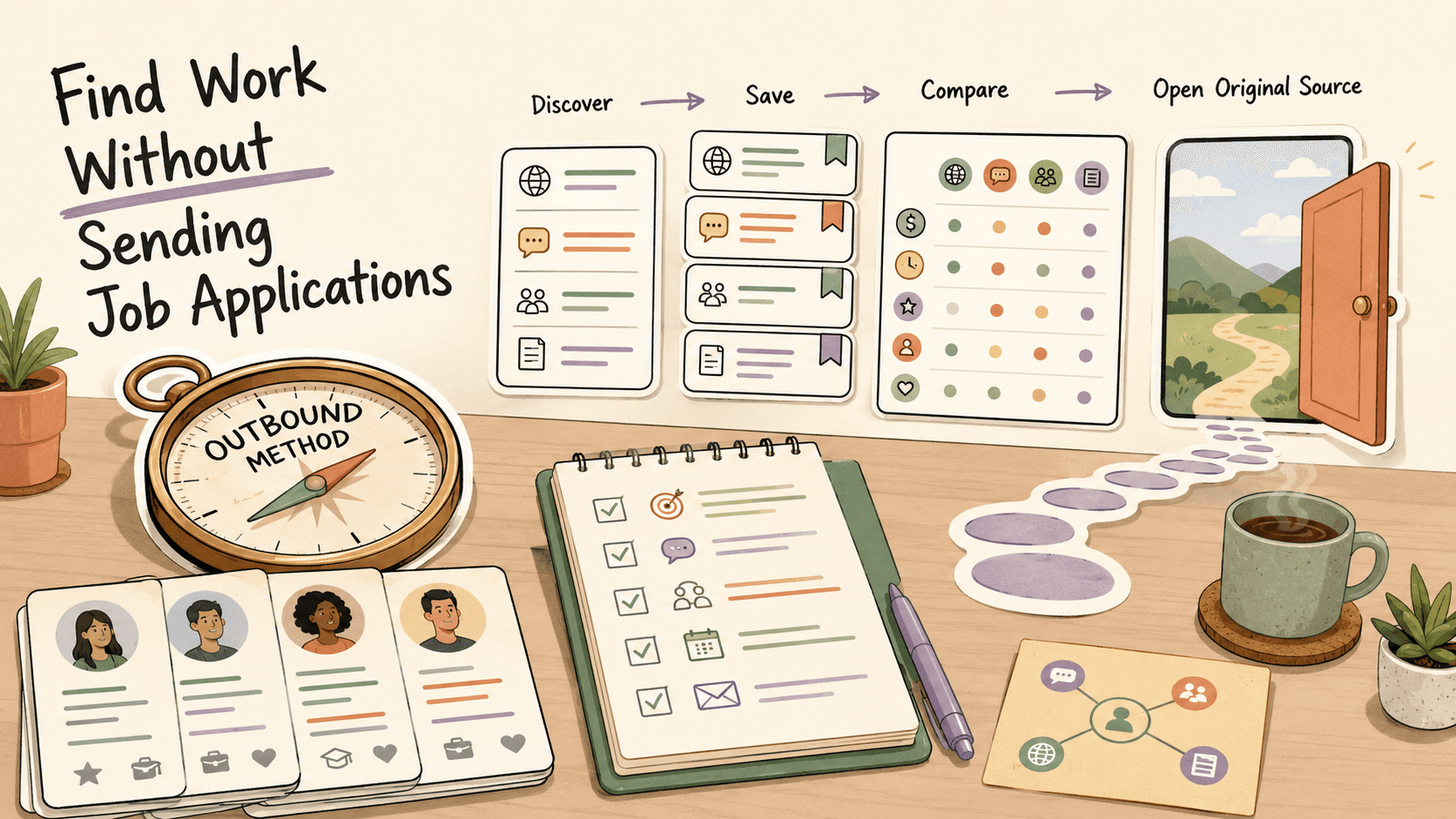
How can you find work without sending job applications?
Use five routes, choosing the one that fits your experience and the kind of work you want:
- Warm introductions and referrals: Ask former colleagues, classmates, clients, community members, and friends whether they know someone who needs your skill. This is often the best route when trust matters and you already have a small network.
- Public need signals: Respond to a recent post that clearly says someone needs a writer, developer, designer, editor, virtual assistant, or other specialist. Reddit communities such as r/forhire, r/WorkOnline, and r/HireaWriter can be useful discovery points, but check their current rules before posting or responding.
- Direct company outreach: Find a company with an observable problem and send a respectful message to a relevant person. This works best when your observation is specific and your proposed first step is small.
- Professional communities: Participate in Slack groups, Discord servers, alumni networks, local business groups, industry associations, and specialist forums. Answer useful questions first; then mention your service when it genuinely fits.
- Packaged services and marketplaces: List a clearly defined offer on platforms such as Contra, Fiverr, Upwork, or PeoplePerHour. These can reduce the need for traditional applications, although proposals, buyer inquiries, or platform screening may still be involved. Describe them accurately as marketplaces, not guaranteed sources of work.
For any route, use the same basic sequence: find a real signal, verify the person or organization, send a concise message, offer a defined next step, and record what happened. Your first action can be as simple as asking two relevant contacts for introductions, saving three fresh public posts, or selecting one company whose website genuinely needs attention.
Which non-application route fits your situation?
The right route depends on your proof, urgency, network, and preferred type of work. Use this table to choose one primary channel rather than scattering your effort across every platform.
| Route | Best for | Where to look | First contact | Proof to include | Main risk |
|---|---|---|---|---|---|
| Warm introduction | People with former colleagues, clients, or classmates | Email, LinkedIn, alumni groups, private communities | Ask for a specific introduction, not a vague job request | One relevant result, sample, or short case study | Making contacts feel pressured or sending an irrelevant referral request |
| Public need signal | Freelancers and specialists who can respond quickly | r/forhire, r/HireaWriter, r/WorkOnline, industry communities | Reply to the exact post and mention its scope | One or two matching samples | Outdated, competitive, or fraudulent posts |
| Direct company outreach | Designers, developers, marketers, writers, and consultants | Company websites, product launches, local directories, founder posts | Point out one observable opportunity and propose a small deliverable | A focused audit or similar project | Sounding critical, spammy, or overconfident |
| Professional community | Beginners and people changing industries | Slack, Discord, meetups, associations, alumni networks | Contribute an answer, then offer relevant help | A useful answer plus a sample or profile | Self-promotion without participation |
| Packaged service | People with a repeatable deliverable | Contra, Fiverr, PeoplePerHour, personal site | Publish a defined service with scope and price logic | Before-and-after work or a sample project | Treating a listing as a guarantee of inbound work |
| Referral partnership | Specialists who complement another service | Agencies, consultants, bookkeepers, recruiters, studios | Suggest a clear collaboration or overflow arrangement | Your role, capacity, and handoff process | Unclear ownership, payment, or client communication |
Beginners can start with a small, honest sample project and warm contacts rather than pretending to have years of experience. Specialists may get better results from direct outreach because a narrow problem makes their expertise easier to recognize. Someone changing industries can use alumni groups, former colleagues, and community conversations to get context before asking for paid work.
Separate the outcome you want. A referral may lead to a full-time role, a public post may lead to a short contract, and a packaged service may create a one-off project. Do not describe all three as a “job” if the terms are different. Confirm whether the opportunity is freelance, contract, part-time, full-time, or a trial engagement.
See fresh gigs on Sidequestboard
Where can you find visible signals that someone needs help?
Look for evidence of an active problem rather than guessing that every company needs your service. Useful signals include a public hiring discussion, a product launch, a founder asking for recommendations, a company expanding into a new market, a local business with outdated customer-facing material, or a community member describing a task they cannot complete.
On Reddit, you might review current posts in r/forhire, r/freelance_forhire, r/WorkOnline, and r/HireaWriter. Community names, rules, flairs, member counts, and moderation policies can change, so check each community’s current rules before contacting anyone. Search by the skill or problem, sort for recent posts where available, and read the full request before writing.
Other sources include:
- Alumni and professional networks: Search your school’s alumni directory or professional association for people in industries you understand. Ask for a short conversation or a relevant introduction rather than immediately asking whether they can hire you.
- Local business directories: Restaurants, clinics, tradespeople, and small retailers may have visible content, design, accessibility, or website issues. Contact owners respectfully and avoid presenting an unsolicited criticism as an emergency.
- Product and founder communities: Product Hunt, industry Slack groups, startup communities, and founder posts can reveal launches and operational gaps. Respond to the stated need rather than pitching every service you offer.
- Company websites and public changelogs: A new product page, hiring expansion, pricing change, or international launch can indicate a need for documentation, localization, design, development, or customer education.
- Referrals from adjacent providers: A copywriter may partner with a web designer; a bookkeeper may know a small business that needs process documentation; a video editor may work with a social media consultant. Make the proposed handoff clear.
Save each opportunity in Notion, Trello, or Google Sheets with the source URL, date found, contact name, stated problem, likely deliverable, risk notes, and follow-up date. This prevents you from repeatedly researching the same lead and helps you notice which signals produce real conversations.
A good signal is recent, specific, attributable, and connected to a plausible budget or business purpose. A vague post saying “need help with everything” is harder to quote than a request for three edited videos by a stated deadline. If the person cannot explain the work, payment, or decision process, verify those details before investing time.
How do you write a short outreach message?
Use five parts: context, observation, offer, proof, and next step. Keep the first message short enough to scan on a phone. Mention only samples that resemble the requested work.
Template for a public hiring signal:
Hi [name] — I saw your post in [community] about [specific need]. I noticed you need [deliverable or skill], and I have worked on [similar type of project]. I can help by [specific first deliverable], with [scope or deadline]. Here is one relevant example: [link]. Would it be useful to discuss [simple next step]?
Template for a warm introduction:
Hi [name] — [mutual contact] suggested I reach out because your team is working on [project or business area]. I help [type of client] with [specific outcome], and my most relevant example is [link]. If this is relevant, I would be glad to send a short outline for [defined deliverable]. Would you be open to a 15-minute conversation, or is there someone else I should contact?
Template for direct company outreach:
Hi [name] — I was reviewing [company or product] and noticed [specific, observable issue]. I work on [relevant service] and can prepare [small paid audit, prototype, rewrite, or plan] focused on [outcome]. Here is a comparable example: [link]. Is improving [specific area] a current priority, or should I contact someone else on the team?
Avoid claims that require private data, such as saying you can double conversion rates after a quick review. Do not write, “Your website is bad.” Write, “The pricing page currently makes visitors compare three plans before explaining who each plan is for.” Describe the observation without insulting the people who built it.
A low-friction first deliverable might be a paid landing-page review, a two-hour technical audit, a content brief, a three-post sample package, or a short process map. It should be valuable on its own and small enough for the buyer to approve without committing to a large project.
If there is no response, follow up once after three to five business days. Add a useful clarification or narrower proposal. Do not send daily reminders, contact multiple employees with identical messages, or treat silence as an invitation to escalate.
How do you quote the first piece of work?
Start with scope, not a random number. Define the deliverables, deadline, format, number of revisions, required access, payment schedule, and ownership of the final work. Then choose hourly, fixed-price, or paid-discovery pricing.
A practical estimate is:
Estimated hours × target hourly rate + contingency buffer = working project quote
For example, suppose a video editor expects four hours for editing, one hour for captions and exports, and one hour for feedback. At a target rate of $50 per hour, the base estimate is six hours × $50, or $300. If the brief is incomplete, add a clearly explained contingency or remove uncertainty through a paid discovery step. The final quote should say whether it includes three clips, captions, two file formats, one revision round, and delivery by a particular date.
Use hourly pricing when the scope is likely to change, the client needs ongoing support, or the work is advisory. Use fixed pricing when the deliverable and revision limit are clear. Use paid discovery when the client wants a diagnosis before approving implementation. Do not perform a large unpaid strategy project merely to prove that you are interested.
The original article’s illustrative ranges can help you think about positioning, but they are not universal rates: writing may range from roughly $20 to $200 per assignment, design from about $75 to $150 or more per hour, development from about $80 to $200 or more per hour, and virtual assistance from about $15 to $35 per hour. Experience, location, specialization, urgency, client budget, and project complexity can move the number substantially.
Before starting, confirm who approves the work, when invoices are paid, what happens if the deadline changes, and who owns the files or intellectual property. If using Upwork, Fiverr, Contra, Toptal, or PeoplePerHour, check the platform’s current official terms and fees rather than relying on an old comparison.
How do you check an opportunity before you respond?
Use a quick safety gate before spending time on a pitch or accepting work. A public post is not automatically legitimate because it appears in a large community or has positive comments.
Pre-contact checklist:
- Can you identify the person, company, or organization through an independent source?
- Does the account or company history match the work being requested?
- Is the scope specific enough to describe a first deliverable?
- Are the deadline, location requirements, communication method, and payment terms plausible?
- Is the requester asking you to pay money, buy equipment from a named seller, or purchase access before work begins?
- Are they requesting an excessive unpaid test or a complete strategy document without compensation?
- Are they pressuring you to use an untraceable payment method or move immediately to a suspicious channel?
- Are they asking for identity documents, banking information, passwords, or sensitive client data before there is a legitimate contractual reason?
A legitimate opportunity can still be poorly organized, so uncertainty is not proof of fraud. Ask direct questions and pause when the answers remain evasive. Before beginning paid work, get the scope and terms in writing. For larger projects, use a contract or the platform’s protected workflow, define milestones, and avoid delivering all valuable files before the agreed payment stage.
If a post promises unusually high pay for trivial work, uses urgency to prevent verification, or asks you to recruit others or reship goods, treat it as a serious warning sign. Never let the desire to avoid applications override basic safety checks.
What does a seven-day workflow for finding work without applications look like?
Run a small experiment instead of trying to contact everyone. Track qualified conversations and paid opportunities, not only the number of messages sent.
Day 1: Define the offer. Choose one skill, one target customer, and one first deliverable. Create or select two relevant proof links. Write down your minimum acceptable scope, rate, and availability.
Day 2: Build a prospect list. Find 10 relevant prospects or recent need signals using one community, one professional network, and one direct company search. Record the source, date, problem, and contact details. Remove vague or suspicious opportunities.
Day 3: Verify and prioritize. Complete the safety checklist. Rank prospects by fit, freshness, clarity of need, and likelihood that your proof is relevant. Do not spend an hour researching a lead that has no observable need.
Day 4: Send targeted messages. Send two or three tailored messages. Request two introductions from people who know your work or target industry. Ask for a specific introduction, such as “Do you know a small SaaS team that needs onboarding copy?” rather than “Let me know if you hear of anything.”
Day 5: Publish one clear offer. Post a concise service offer in an appropriate community, on your portfolio site, or through a platform such as Contra or Fiverr. State the audience, deliverable, timeframe, starting scope, and proof. Do not imply that publishing guarantees inbound work.
Day 6: Follow up once. Contact people who have not replied after three to five business days. Narrow the offer or clarify the next step. Reply promptly to anyone who asks a question, and document any changes to scope or pricing.
Day 7: Review the evidence. Count messages sent, replies, conversations, qualified opportunities, proposals, and paid outcomes. Look for patterns: perhaps your developer pitch gets replies from agencies, while your general “available for anything” message gets none. Improve the offer and run another focused test.
A tracker can be a simple Google Sheet with columns for date, route, prospect, problem, message link, follow-up date, response, qualification status, quoted amount, and outcome. Sidequestboard can support discovery and organization by helping you keep fresh public opportunities in one calmer workflow. It is not a recruiter or guaranteed marketplace: open the original listing, verify it, and respond at the original source.
What should you do next?
Choose one skill and one target customer today. Find three genuine need signals or ask two relevant contacts for introductions. Send one message using the context, observation, offer, proof, and next-step structure, then record the follow-up date in Notion, Trello, Google Sheets, or Sidequestboard.
The goal is not to avoid effort or to send zero messages. The goal is to stop treating every opportunity as an anonymous application and start having specific conversations with people who may already have a problem you can solve. After seven days, keep the route that produces credible replies and discard channels that produce only vague, unsafe, or irrelevant leads.
FAQ
Can this replace job applications completely?
Sometimes it can reduce reliance on applications for freelance, contract, referral-based, and small-business work. It cannot replace every formal hiring process. Many full-time roles still require an application, resume, assessment, interview, or background check.
How many outreach messages should you send?
Start with five highly tailored messages rather than fifty generic ones. A small test gives you time to research each prospect, select relevant proof, and improve the offer. Increase volume only if the quality of the opportunity and your follow-up remain strong.
What if you have no portfolio?
Create one or two honest samples based on a fictional brief, an open-source project, a volunteer project, or a small improvement to your own website. Label speculative work clearly. Do not claim that a sample was paid client work, and do not complete substantial unpaid work for a prospect merely to build proof.
How soon should you follow up?
A single follow-up after three to five business days is reasonable for many freelance conversations. Use the timing implied by the original post when one is provided. If the person says they will decide next month, follow up closer to that date rather than repeatedly contacting them.
How do you avoid scams when finding work this way?
Verify the person and organization independently, clarify scope and payment, limit unpaid tests, avoid paying to access work, and be cautious with requests for sensitive documents or untraceable payments. Get the agreement in writing before starting and use a reputable platform or contract process when appropriate.
Is this better for freelance work than full-time employment?
It is usually easier to use for freelance and contract work because the buyer can approve a defined deliverable without creating a formal role. It can also uncover full-time opportunities through referrals, networking, and direct conversations, but formal employers may still require their standard application process.
Is Sidequestboard a job board or recruiter?
No. Sidequestboard is a discovery and tracking tool for fresh public opportunities. You still open the original listing, evaluate the person or organization, and apply, pitch, or respond directly at the source. It does not guarantee leads, employment, or payment.
What should a first message include?
Mention the exact context, one observable need, one proposed deliverable, one or two relevant proof links, and an easy next-step question. Avoid a long biography, unrelated samples, exaggerated results, and promises you cannot control.
Should I use Upwork, Fiverr, Contra, Toptal, or PeoplePerHour?
Choose based on how your service is purchased. Upwork and PeoplePerHour can expose you to project requests, Fiverr suits clearly packaged services, Contra emphasizes independent portfolios, and Toptal is oriented toward experienced specialists who can complete its screening process. Check each platform’s current terms, fees, eligibility, and payment protections before relying on it.
Related guides
- Freelance Work for Beginners: Get Brand, Video, and Film Clients
- How to Get Freelance Clients on LinkedIn: Profile, Search, Outreach, and Lead Workflow
- Where to Find Web Design Clients on Reddit
- Best Reddit Side Hustle Job Boards for Finding Work
- University Job Fair Was a Joke? What to Do Instead
Sources
- Reddit communities: r/forhire, r/WorkOnline, and r/HireaWriter. Check current rules, flairs, and posting requirements before responding.
- Upwork Freelancer Service Fee. Verify the current fee and contract terms before calculating take-home pay.
- Fiverr Help Center. Review current seller earnings, withdrawal, and marketplace policies.
- Contra. Review current portfolio, payment, and plan information on the official site.
- Toptal. Review the current screening and talent-network information before treating it as a suitable channel.
- PeoplePerHour. Review current project, payment, and service terms.
The examples and workflow in this article are practical guidance, not evidence that outbound work guarantees employment. Platform policies, community rules, fees, pricing, and availability can change; confirm current information at the original source.