August 6, 2026
Job Offer Rescinded After You Gave Notice: Can You Get Unemployment?
You may be eligible for unemployment after an accepted job offer is rescinded, but approval is not automatic. State agencies assess whether leaving your prior job was justified and whether you meet other requirements. File promptly, preserve the offer and rescission, contact your former employer, and verify the rules with your state agency.
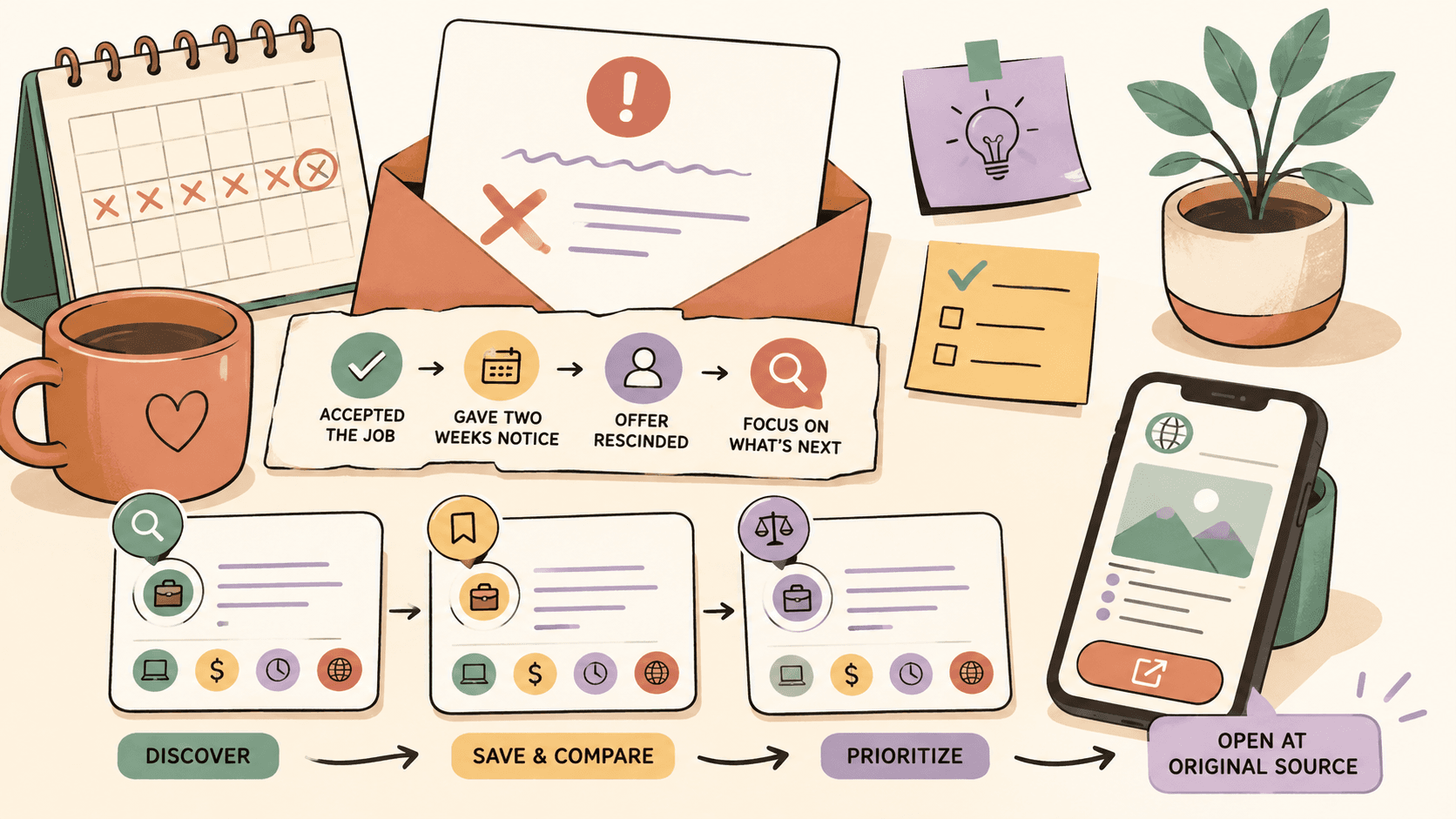
Can you get unemployment after quitting for a job offer that was rescinded?
Possibly. An agency may treat leaving an existing job for a definite, bona fide job opportunity differently from an ordinary voluntary quit. However, the result depends on state law and the facts of your case.
Factors that may matter include:
- whether you had a written offer or employment agreement;
- whether the offer identified the job, pay, start date, and other material terms;
- whether you gave notice because you reasonably relied on that offer;
- whether the new employer withdrew the offer before you started;
- whether your former employer would allow you to return or withdraw your resignation;
- whether you are able and available to accept suitable work; and
- whether you meet your state's earnings and work-history requirements.
Do not assume that an accepted offer automatically establishes eligibility. File a claim and let the agency make the determination. If the agency denies the claim, read the determination carefully and follow the appeal deadline printed on it.
What should you do in the first 24 hours?
Treat the situation as both an unemployment matter and an urgent employment-recovery problem.
1. Save every document
Create a folder with the offer letter, emails, text messages, application records, onboarding instructions, start-date confirmations, and the rescission notice. Save copies in a personal account or device rather than relying only on an employer system that you may lose access to.
Write a short timeline while the events are fresh. Include when you accepted the offer, when you gave notice, your planned final day, when the new employer withdrew the offer, and the exact reason provided. Do not alter messages or remove context.
2. Ask the new employer for written confirmation
If the offer was withdrawn in a phone call, send a calm follow-up email confirming your understanding. Ask whether the position was canceled, whether the start date was postponed, or whether the employer expects to reopen the role. You can also ask whether the company will consider a different position, temporary work, or compensation connected to the withdrawal.
There is no guarantee the employer must pay severance or rescission compensation. Do not describe a payment as legally required unless a contract, settlement, or applicable law supports that conclusion. Keep the request factual and professional.
3. Contact your current or former employer immediately
Ask whether you can withdraw your resignation, extend your end date, return to the same role, or perform temporary bridge work. Your employer may say no, but asking quickly gives you the best chance of preserving an income source.
Get any response in writing. If the employer agrees to bring you back, clarify the role, schedule, pay, benefits, and start date before relying on the arrangement.
4. Start the unemployment claim
Use your state unemployment agency's official website, not a paid third-party filing service. Explain what happened accurately: you left or planned to leave for a specific job, the offer was later withdrawn, and you are now seeking work. Upload the requested evidence and answer every question consistently.
The U.S. Department of Labor provides general unemployment program information, but state agencies make individual eligibility decisions. You can use CareerOneStop's unemployment-benefits directory to locate the official agency for your state. Verify filing instructions, identity requirements, weekly certifications, and appeal deadlines directly with that agency.
What should you do over the next 48 to 72 hours?
Follow up with the unemployment agency
Keep confirmation numbers, notices, and submission dates. Continue completing weekly or periodic certifications if the agency instructs you to do so, even while a claim is pending. Report work, earnings, or other changes as required.
If an interviewer or claims examiner contacts you, answer directly and avoid guessing. You can explain that you relied on a confirmed offer, gave notice, and then received a written rescission. Do not exaggerate the offer's certainty or omit facts that could affect the decision.
Restart your job search immediately
Use several channels rather than waiting for the unemployment decision. LinkedIn can help you reconnect with former colleagues and search for newly posted roles. Indeed can provide a broad job-search source, while Glassdoor may help you research employers and compare employee information. Reddit communities such as r/jobs or industry-specific communities may surface leads, but verify any opportunity independently before sharing personal information or doing unpaid work.
Keep a simple record of applications, contacts, interviews, and follow-ups. Your state may have work-search documentation requirements, and a record also helps you avoid repeating applications or losing track of promising leads.
For public opportunities spread across Reddit, LinkedIn, Discord, and other communities, Sidequestboard can provide a more organized way to discover fresh job, freelance, and project leads, save relevant listings, and open the original source before responding. Start monitoring fresh public work opportunities in Sidequestboard when you are ready to rebuild a repeatable search routine.
Can you ask the employer for severance or compensation?
You can ask, but the answer depends on the offer terms, applicable law, company policy, and the circumstances of the withdrawal. Review the offer for conditions such as background checks, funding, client approval, or a right to cancel before the start date. A written offer may still contain contingencies.
A practical message should state the dates, explain that you relied on the offer when giving notice, identify the income gap, and ask whether the company can provide a transition payment, temporary assignment, or another role. Avoid threats or public accusations while the issue is unresolved. If the employer proposes a release or settlement, consider getting legal advice before signing.
How can you protect yourself if a future offer is withdrawn?
Until you start work, continue a limited job search when possible. Ask whether the offer is contingent, whether the employer has approved the headcount, and whether the start date is firm. Do not resign solely because of a verbal promise when a written offer is reasonably available.
Even a written offer may contain conditions, so read it carefully. Keep applying until you have started and understand the employer's onboarding process. If you must give notice, ask whether the new employer can confirm the role and start date in writing shortly before your final day.
Avoid sending sensitive identity documents through unofficial channels. Verify recruiters, domains, job descriptions, and payment requests. No legitimate employer should require you to pay to receive a job.
A practical example
Suppose Maya accepts a written marketing job beginning Monday and gives her current employer two weeks' notice. On Friday, the new company emails that its budget was cut and the position is canceled.
During the first day, Maya saves the offer and cancellation email, writes a timeline, asks her current employer whether she can stay, and requests written clarification from the new company. She then files with her state unemployment agency and keeps the confirmation number. Over the next two days, she applies through LinkedIn and Indeed, checks relevant Reddit communities, records her search activity, and asks the new company whether temporary work or a transition payment is available.
Maya may receive unemployment, but the agency—not this article—decides. Her documentation gives the agency a clearer record of what happened, while her job-search activity reduces the time she spends waiting for one answer.
Sources and verification
For general federal information, review the U.S. Department of Labor unemployment insurance resources. To locate the appropriate state office, use CareerOneStop's unemployment benefits finder. Always verify current eligibility standards, filing instructions, and appeal deadlines with your state unemployment agency.
Sources
- USA.gov — Unemployment Benefits — Official federal starting point for checking current unemployment-benefit eligibility and filing information.
- U.S. Department of Labor — Unemployment Benefits — Official DOL reference for unemployment insurance; verify current state rules before filing.
- U.S. Department of Labor unemployment insurance resources — Official or institutional source referenced in the article body.
Sources
- USA.gov — Unemployment Benefits — Official federal starting point for checking current unemployment-benefit eligibility and filing information.
- U.S. Department of Labor — Unemployment Benefits — Official DOL reference for unemployment insurance; verify current state rules before filing.
- U.S. Department of Labor unemployment insurance resources — Official or institutional source referenced in the article body.