August 7, 2026
How to Find Small Gigs with No Experience: Beginner Platforms, Searches, and Reply Templates
To find small gigs with no experience, look for low-risk tasks with clear scopes on Reddit, freelance marketplaces, creator communities, and public job boards. Sort by newest posts, avoid vague offers, reply with a specific mini-sample or plan, and track every lead so fresh opportunities do not slip away.
What counts as a small gig when you have no experience?
A small gig is a short, clearly scoped task that can usually be completed without joining a company full-time or managing a complex project. For beginners, the best gigs have three traits:
- The deliverable is obvious. You know exactly what the client wants.
- The risk is low. A mistake would be annoying, not catastrophic.
- You can show proof quickly. You can send a small sample, outline, screenshot, checklist, or mini plan.
Beginner-friendly examples include:
- Proofreading a short article or landing page
- Turning messy notes into a clean Google Doc
- Creating simple Canva social graphics
- Formatting a resume or one-page PDF
- Researching 20 potential leads in a spreadsheet
- Testing a website and reporting bugs
- Writing short product descriptions
- Cleaning up a Notion, Trello, or Airtable workspace
- Cropping images or renaming files
- Transcribing a short audio clip, if the client’s expectations are realistic
- Making a basic Loom walkthrough for a product or website
Small gigs are not always easy, but they are easier to evaluate than open-ended roles like “marketing assistant,” “growth hacker,” or “full-stack developer needed.”
Where can beginners find small gigs online?
Use a mix of marketplaces, public communities, and niche boards. Each source has tradeoffs.
Reddit communities
Reddit can be useful because many posts are public, recent, and informal. Look for communities where people post hiring requests, task requests, or freelance opportunities.
Places to explore include:
- r/forhire
- r/HireaWriter
- r/WorkOnline
- r/slavelabour, with caution because rates can be very low
- r/designjobs, if you have basic design samples
- Niche subreddits related to your skill, such as writing, Notion, Excel, Shopify, WordPress, video editing, or data analysis
Do not rely on member counts. Activity matters more than size. Sort by “new,” read the rules carefully, and avoid communities that appear full of spam or unrealistic pricing.
Freelance marketplaces
Marketplaces can help beginners package simple services, but competition can be intense. Check each platform’s current fee pages, payout rules, dispute policies, and terms before pricing your work. Fee structures change over time and may differ by contract type, country, or payment method.
Platforms to research include:
- Upwork
- Fiverr
- Contra
- PeoplePerHour
- Freelancer.com
- Guru
For beginners, the goal is not to apply to everything. The goal is to find small postings where you can respond with a specific plan.
Good beginner marketplace searches:
- “data entry Google Sheets”
- “Canva template”
- “blog proofreading”
- “Shopify product upload”
- “WordPress formatting”
- “Notion setup”
- “research assistant”
- “website testing”
- “PDF formatting”
- “virtual assistant one-time task”
Public creator and startup communities
Small teams often post quick tasks in public communities before creating formal job listings. Look for communities around:
- Indie hackers
- No-code tools
- Startup founders
- Newsletter operators
- Podcasters
- YouTubers
- SaaS builders
- Local business groups
- Design, writing, and marketing communities
These posts may appear on Reddit, X/Twitter, Discord communities, Slack groups, LinkedIn, public forums, or niche job boards. If a community is private, respect its rules and do not scrape, spam, or cold-message people aggressively.
Portfolio and social platforms
If you have even two or three samples, platforms like GitHub, Medium, Behance, Dribbble, Notion pages, personal websites, or a simple Google Drive folder can help you look more credible.
You do not need a polished brand. You need proof that you can complete a small task.
Find current openings on Sidequestboard
What should you search for instead of “no experience gigs”?
Search for task names, not beginner labels. Clients rarely write, “I want to hire someone with no experience.” They write the thing they need done.
Use searches like:
- “need someone to format”
- “looking for someone to proofread”
- “need a VA for”
- “one-time task”
- “quick help with spreadsheet”
- “Canva help needed”
- “Notion help”
- “WordPress cleanup”
- “Shopify product upload”
- “need beta testers”
- “website feedback needed”
- “research list of”
- “turn this into a PDF”
- “fix formatting”
- “write product descriptions”
Add platform or community terms:
site:reddit.com/r/forhire "looking for" "Google Sheets"site:reddit.com/r/HireaWriter "hiring" "blog post"site:reddit.com "need someone" "Canva"site:reddit.com "one-time task" "Notion""hiring" "virtual assistant" "one-time""paid" "beta tester" "feedback"
Use filters like “past 24 hours” or “past week” when available. Freshness matters because small gigs often close quickly.
How do you know if a gig is beginner-friendly?
Before replying, score the post with this quick checklist.
Green flags
A beginner-friendly gig usually includes:
- A specific task
- A clear deadline
- A realistic deliverable
- A named tool or format
- A reasonable amount of work
- A public posting history or credible profile
- Instructions for how to apply
- A chance to show a small sample
Example:
“Looking for someone to organize 80 rows of lead data in Google Sheets and remove duplicates by Friday. Please send one example of spreadsheet cleanup work or explain your process.”
That is much easier to respond to than:
“Need marketing person. Must know everything. DM rates.”
Red flags
Avoid or be very cautious with posts that include:
- Vague promises of future payment
- “Exposure” instead of pay
- Requests for free full projects as a test
- Unrealistic deadlines
- No clear scope
- Pressure to move to suspicious payment links
- Requests for sensitive personal documents before trust is established
- Work that appears unethical, illegal, deceptive, or against a platform’s rules
- Very high pay for very easy work from an unknown poster
If a post feels off, skip it. Beginners often lose more time to bad leads than to lack of opportunities.
What should you charge for small gigs as a beginner?
There is no universal beginner rate. Pricing varies by location, buyer type, niche, urgency, usage rights, quality of proof, and scope. Marketplace fees and payment processing can also change what you actually keep, so verify current fee pages before quoting.
Instead of anchoring on a random rate range, price using scope:
- Tiny task: one clear deliverable, low complexity, short turnaround
- Small task: a few related deliverables, some judgment required
- Starter package: a repeatable bundle, such as “format five blog posts” or “clean one spreadsheet and add notes”
For your first few gigs, your goal is to avoid under-scoping. A low price can still be a bad deal if the task is endless.
Use this simple pricing question:
“What exactly will I deliver, how many revisions are included, and when is the work considered done?”
If you cannot answer that, do not quote yet. Ask a clarifying question first.
How should you reply when you have no experience?
Do not lead with “I have no experience.” Lead with relevance, clarity, and proof.
A strong beginner reply has five parts:
- A specific reference to the task
- A short reason you can do it
- A simple process
- A small proof sample or offer to send one
- A clear next step
Reply template for Reddit or community posts
Hi [Name], I saw you need help with [specific task]. I can help with this.
My approach would be: [step 1], [step 2], [step 3].
I can send a small sample using 2–3 rows/pages/items first so you can check the style before I complete the rest.
If helpful, I can start with [specific deliverable] and send it by [realistic time].
Reply template for Upwork-style proposals
Hi [Name], your post about [specific task] stood out because the scope is clear: [repeat the deliverable].
I would handle it by [brief process]. To reduce risk, I can start with a small sample or first milestone before completing the full task.
A couple of quick questions:
- [Clarifying question]
- [Clarifying question]
If that matches what you need, I can begin with [first step].
Reply template for writing gigs
Hi [Name], I can help with the [article/page/product description] you posted.
I would first confirm the target reader and tone, then draft a short outline before writing. I can also send a brief sample paragraph so you can check fit before moving forward.
Do you already have examples of the style you want, or should I suggest a direction?
Reply template for spreadsheet or research gigs
Hi [Name], I can help clean up the spreadsheet/research list.
I would first confirm the required columns, remove duplicates, standardize formatting, and add notes for anything uncertain. I can do a small sample first so you can confirm the structure.
What format do you want the final file in: Google Sheets, Excel, CSV, or another format?
What proof can you show if you have never had a client?
You can create proof without pretending it came from paid work. Label it clearly as a sample.
Examples:
- Rewrite a public product description and explain what you changed
- Create three sample Canva graphics for a fictional brand
- Clean a messy sample spreadsheet and show before/after screenshots
- Write a sample blog intro and outline
- Record a Loom website feedback video for a public site
- Build a one-page Notion dashboard template
- Create a small GitHub project if you are technical
- Make a PDF formatting before/after example
Keep proof short. A client hiring for a small gig does not need a 40-page portfolio. They need to know you can do the task they posted.
How can you run a 30-minute daily gig search?
A focused daily search beats random scrolling.
Use this 30-minute workflow:
Minutes 0–5: Pick one task category
Choose one category for the session:
- Writing and editing
- Spreadsheets and research
- Design and Canva
- Website feedback
- Notion or Airtable
- Virtual assistant tasks
- Product uploads
- Simple automation or coding tasks
Do not search every category at once. You will write better replies when your session has a theme.
Minutes 5–15: Search fresh posts
Check two or three sources only. For example:
- Reddit + one marketplace
- X/Twitter search + one niche community
- Contra + Reddit
- Upwork + public founder community
Sort by newest when possible. Save anything that looks relevant before judging too deeply.
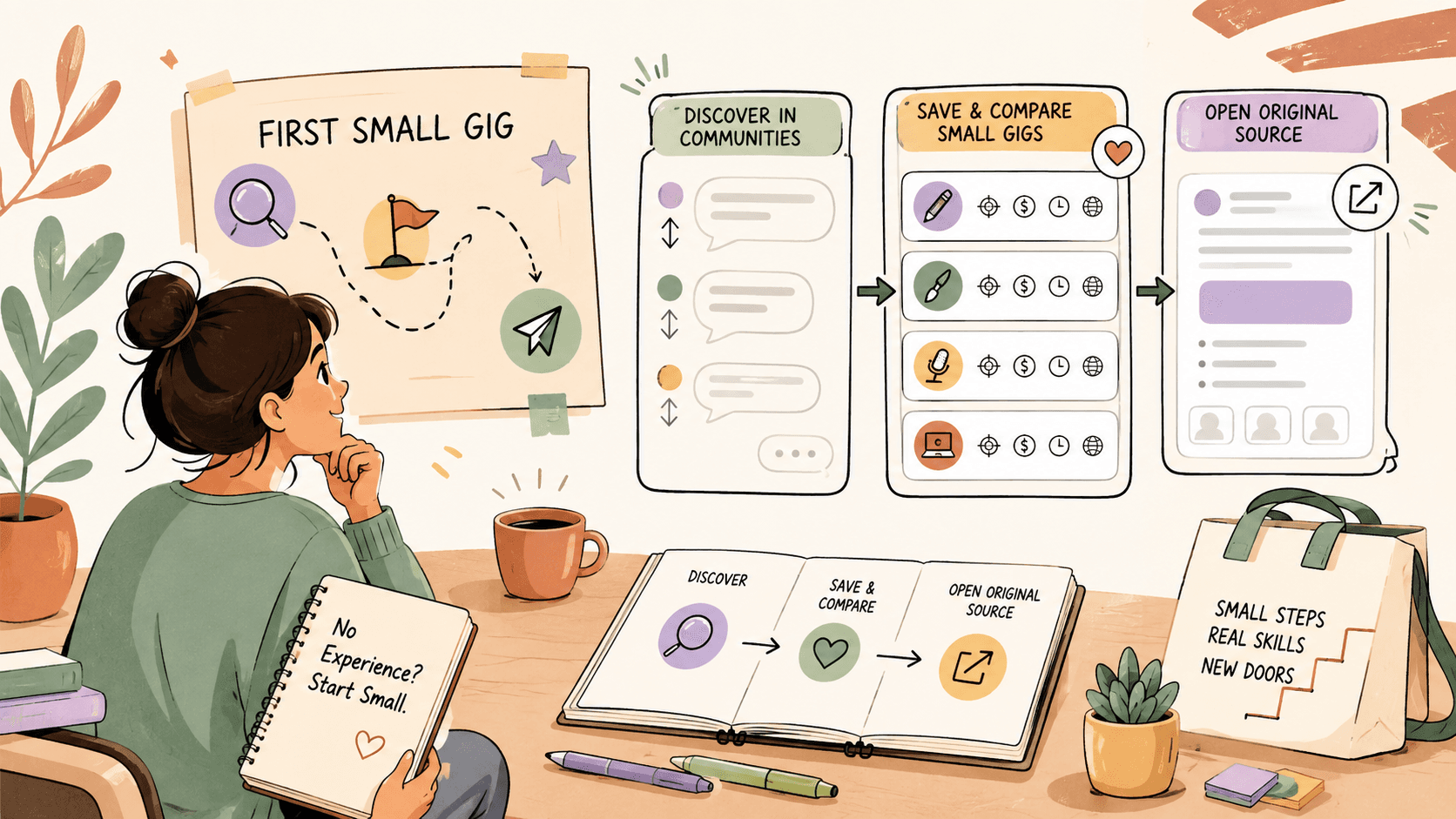
This is where a curated discovery dashboard can help. Sidequestboard gives opportunity seekers a cleaner feed of fresh public posts so they can spend less time jumping between tabs and more time deciding what to act on.
Minutes 15–22: Filter hard
Remove posts that are vague, suspicious, too advanced, unpaid, or outside your skill level.
Keep only posts where you can answer:
- What is the deliverable?
- Can I show a small proof sample?
- Can I complete the first milestone confidently?
- Is the poster asking for a reasonable next step?
Minutes 22–30: Send two strong replies
Do not send ten generic replies. Send two specific ones.
For each reply, include:
- The task you noticed
- Your mini process
- One clarifying question
- A sample offer or first milestone
- A realistic timeline
After sending, record the lead in a tracker.
How should you track small gig leads?
Use a simple spreadsheet, Notion table, Airtable base, or Trello board. The tool does not matter as much as consistency.
Track these columns:
- Date found
- Source
- Original link
- Task type
- Client or poster name
- Deadline
- Pay or budget, if listed
- Your reply status
- Follow-up date
- Notes
- Outcome
Suggested statuses:
- Saved
- Replied
- Waiting
- Followed up
- Won
- Lost
- Skipped
Saving links matters because public posts disappear, close, or get buried quickly. If you use Sidequestboard during your daily search, save interesting opportunities there, then open the original source and reply directly where the post was published.
What should your first 7 days look like?
Use the first week to build proof and learn where good posts appear.
Day 1: Pick two task categories
Choose categories that match what you can do today, not what you hope to learn someday.
Good beginner combinations:
- Proofreading + blog formatting
- Canva graphics + social post resizing
- Spreadsheet cleanup + online research
- Website feedback + bug notes
- Notion setup + workspace cleanup
Day 2: Create two samples
Make one sample for each category. Keep them short and easy to view.
Examples:
- A before/after spreadsheet cleanup screenshot
- A one-page writing sample
- A Canva carousel mockup
- A Loom website feedback video
- A Notion template page
Day 3: Build your lead tracker
Create your spreadsheet or board. Add columns for source, link, task, status, and follow-up date.
Day 4: Send your first replies
Search fresh posts for 30 minutes. Send two specific replies using the templates above.
Day 5: Improve your proof
Look at the gigs you found. If most posts ask for something you cannot prove yet, create a new sample that matches those posts.
Day 6: Follow up politely
If the post allows follow-ups and you have not heard back, send a short note:
Hi [Name], just following up on this. I’m still available to help with [specific task] and can start with [small first step] if useful.
Do not badger people. One follow-up is enough in most cases.
Day 7: Review what worked
Ask:
- Which sources had the clearest posts?
- Which replies got responses?
- Which task category felt easiest to prove?
- Which searches produced spam?
- What sample should I improve next?
Then repeat the workflow for another week.
What mistakes should beginners avoid?
Applying to everything
If you apply to every gig, your replies become vague. Choose tasks where you can be specific.
Hiding the lack of proof
You do not need to claim client experience. Use honest samples instead.
Accepting unclear work
A vague gig can expand into unpaid extra work. Define the deliverable before starting.
Ignoring platform rules
Every marketplace and community has rules about communication, payment, fees, and disputes. Read them before replying or moving work off-platform.
Competing only on low price
Low prices may help you get early practice, but they can also attract difficult clients. Compete on clarity, speed, reliability, and a low-risk first milestone.
Waiting until your portfolio is perfect
A simple relevant sample is often better than a beautiful portfolio that does not match the task.
What is the simplest beginner workflow?
Use this checklist daily:
- Pick one task category.
- Search two or three fresh sources.
- Save promising posts.
- Remove vague or risky gigs.
- Send two specific replies.
- Track every lead.
- Follow up once when appropriate.
- Improve one sample based on what buyers are asking for.
The first goal is not to win every gig. The first goal is to learn which opportunities are real, which replies get responses, and which small services you can deliver reliably.
FAQ
Can I really get a small gig with no experience?
Yes, but it is easier when you target small, specific tasks and show honest sample work. Most beginners struggle because they apply to broad roles with generic replies. A focused sample and a clear process can make you less risky to hire.
What are the best small gigs for beginners?
Good beginner gigs often involve proofreading, formatting, spreadsheet cleanup, online research, Canva graphics, website feedback, simple data entry, product uploads, and virtual assistant tasks. The best choice depends on what you can prove with a short sample.
Should I use Reddit or freelance marketplaces first?
Use both if you can manage them, but keep your search focused. Reddit and public communities can surface fresh informal posts, while marketplaces offer structured profiles and payment systems. Always read community rules and platform terms before replying.
How many gigs should I apply to each day?
A good beginner target is two to five thoughtful replies per day. Quality matters more than volume. A specific reply with a mini plan usually performs better than a copied message sent to dozens of posts.
How do I avoid scams when looking for small gigs?
Avoid vague posts, unrealistic pay, requests for free full projects, suspicious payment links, and pressure tactics. Use platform protections where available, verify the poster when possible, and never share sensitive personal information unless there is a legitimate reason and trusted process.
Do I need a portfolio before applying?
You do not need a full portfolio, but you should have at least one or two relevant samples. A small before/after example, short writing sample, Canva mockup, spreadsheet cleanup, or Loom walkthrough can be enough for many beginner tasks.
How should I price my first small gig?
Price based on the deliverable, deadline, revision limit, and platform fees. Avoid quoting before the scope is clear. Check each platform’s current fee and payout information before setting your rate so you understand what you will actually receive.
Final takeaway
To find small gigs with no experience, stop searching for permission to be a beginner. Search for small problems you can solve, reply with a clear process, show a tiny proof sample, and track every lead. Freshness, specificity, and follow-through matter more than a perfect resume.
Related guides
- Freelance Work for Beginners: Get Brand, Video, and Film Clients
- How to Get Freelance Clients on LinkedIn: Profile, Search, Outreach, and Lead Workflow
- How to Start Freelancing as a Graphic Designer: A 7-Day Launch Guide
- How to Start Freelancing as a Student with No Experience
- How to Evaluate Contract Opportunities Still Fresh