June 25, 2026
How to Follow Up on Job Applications Without Being Annoying
Follow up once 5 to 7 business days after applying, unless the listing gives a different timeline. Keep the message short, specific, and useful: mention the role, when you applied, why you are a strong fit, and ask whether they need anything else. Stop after two polite follow-ups.
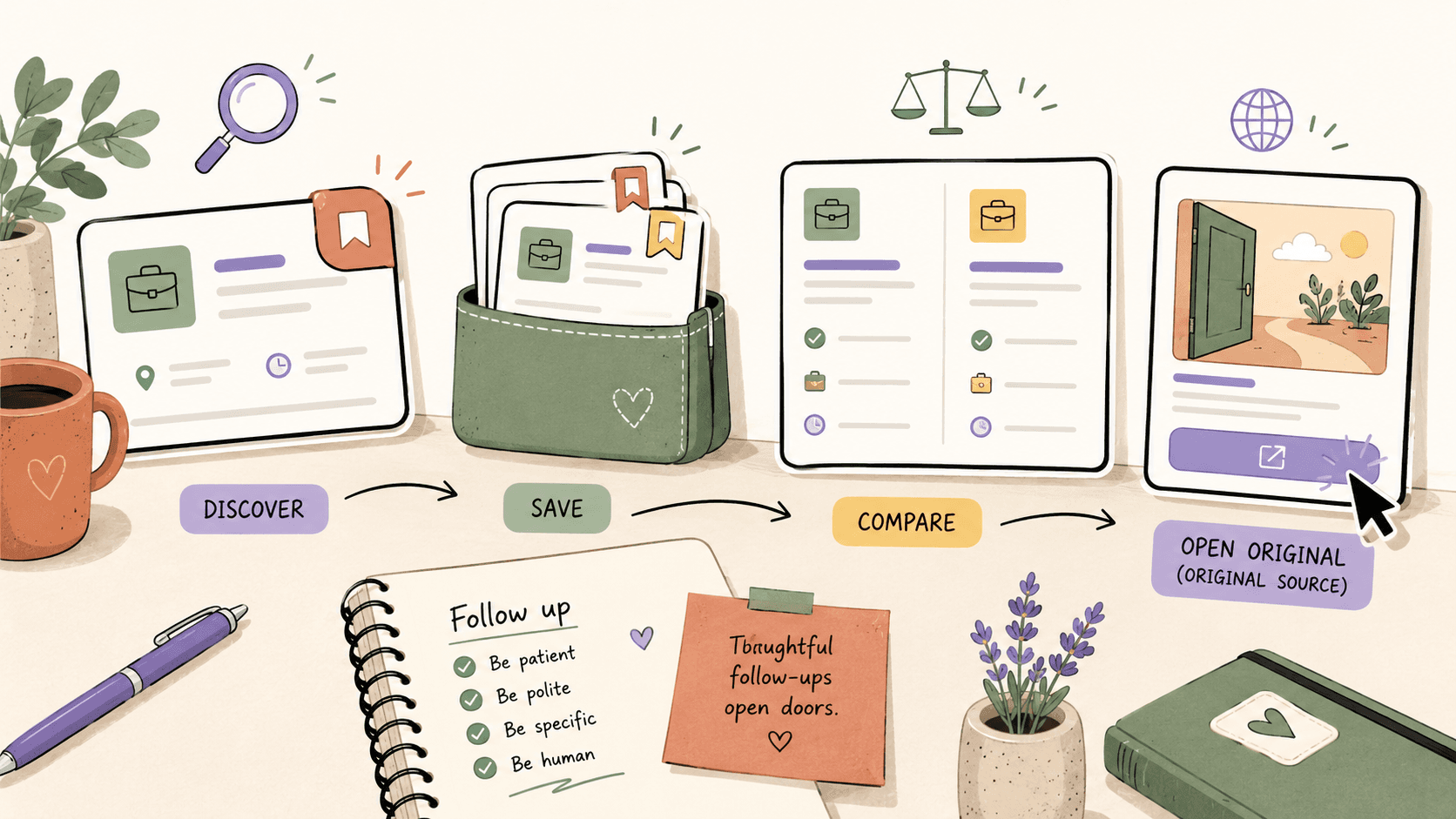
How do you follow up on a job application without annoying the hiring team?
The least annoying follow-up is short, timely, and easy to answer. Wait 5 to 7 business days after applying, reference the exact role or post, add one useful proof point, and ask a simple question. If you found the opportunity on Dribbble Jobs, Behance Joblist, r/forhire, r/designjobs, or another public source, mention the original listing so the recipient does not have to guess what you are talking about.
A good follow-up should do three things:
- Remind them who you are.
- Reconnect your application to the job need.
- Make the next step low-friction.
For example, if you applied to a UI design role from Dribbble Jobs, your follow-up should not say, “Just checking in.” It should say something like: “I applied last Tuesday for the remote UI designer role listed on Dribbble. I noticed the post mentioned dashboard redesign experience, so I wanted to share one relevant case study from a SaaS analytics project where I redesigned a data-heavy onboarding flow.”
That is not annoying because it adds context. It helps the hiring manager connect your application to the problem they posted about.
Do this now: find your last three applications and add the source, date applied, role title, contact name, and next follow-up date in a simple tracker using Notion, Google Sheets, Trello, or Airtable.
When should you follow up after applying?
For most job applications, follow up after 5 to 7 business days. For freelance or project-based posts in fast-moving communities like r/forhire, which has about 1.3M members, or r/designjobs, which has about 150K members, move faster. If a post is only a few hours old and the client is likely reviewing replies immediately, send your first response quickly, then follow up after 48 to 72 hours if you have a direct contact.
Here is a practical timing rule:
- Corporate job application: follow up after 5 to 7 business days.
- Small company or startup role: follow up after 4 to 6 business days.
- Freelance gig from r/forhire or r/designjobs: follow up after 2 to 3 days if you have not heard back.
- Creative job from Dribbble Jobs or Behance Joblist: follow up after 5 business days unless the listing says otherwise.
- Contest-style design opportunity on 99designs: follow the contest timeline rather than sending repeated direct follow-ups.
The reason timing matters is simple: follow up too soon and you look impatient. Follow up too late and the opportunity may already be closed, especially in design categories where good posts can attract strong portfolios quickly.
Design and creative roles can also have wide pay ranges, which affects urgency. Logo design work can range from $200 to $2,000+, UI design often lands around $50 to $150/hr, graphic design commonly sits around $30 to $100/hr, and illustration can range from $50 to $500+ per illustration. When an opportunity is worth pursuing, put it on a timeline instead of relying on memory.
Do this now: for each active application, write one follow-up date. If the listing is from r/forhire or r/designjobs and it is a short-term freelance project, use a 2 to 3 day follow-up window. If it is from Dribbble or Behance, use 5 business days.
Find current openings on Sidequestboard
What should your follow-up message say?
Your message should be specific enough to prove you are not mass-emailing, but short enough that someone can read it in under 30 seconds. The best structure is:
- Greeting with the person’s name if available.
- Role or project title.
- Date or source of your application.
- One reason you are a fit.
- One clear ask.
- Simple sign-off with portfolio or resume link.
Here is a strong template for a design role:
Hi [Name], I applied last week for the [Role] position I found on Behance Joblist. I wanted to follow up because the role’s focus on brand systems matches my recent work on a multi-channel identity project. Here is the portfolio link again: [link]. Are you still reviewing applicants for this role?
Thanks, [Your Name]
Here is a better version for a freelance UI design project:
Hi [Name], I responded on Monday to your UI designer post from r/forhire. You mentioned needing help with a dashboard flow, and I have done similar SaaS interface work at $75/hr. If the project is still open, I can send a short audit of the current flow and two examples from my portfolio.
Best, [Your Name]
Notice what these messages do not include. They do not guilt the recipient. They do not say, “I haven’t heard back.” They do not demand a timeline. They connect the application to the work.
If you are applying for creative work, always include one direct portfolio link. Do not send five links. If you are a logo designer, pick the most relevant identity case study. If the post is for illustration and your rate is $50 to $500+ per illustration depending on usage and complexity, mention the range only if budget is already part of the conversation.
Do this now: write one reusable follow-up template, then create three versions: one for full-time jobs, one for freelance projects, and one for creative portfolio-based opportunities.
How many times should you follow up before stopping?
In most cases, follow up twice. Send the first follow-up after the normal waiting period, then send one final message 5 to 7 business days later. After that, move on unless they respond or the listing says the process is still open.
A two-follow-up sequence works because it shows interest without turning into pressure. Hiring teams, founders, and freelance clients often deal with full inboxes. On public communities like r/forhire and r/designjobs, a single [Hiring] post can attract dozens or hundreds of replies, especially when the role involves remote design, branding, or UI work.
Your second follow-up should be even shorter than the first:
Hi [Name], I wanted to send one final follow-up on the [Role/Project] I applied for from [Source]. I’m still interested, especially because [one specific fit]. If the role has moved forward, no problem. Thanks again for reviewing my application.
This closes the loop without sounding resentful. It also leaves the door open if the first-choice candidate falls through.
For 99designs contests, be more careful. 99designs is contest-based for logo and branding design, and commission or fee structures vary by contest. Repeatedly messaging a contest holder outside the expected contest flow can look pushy. Instead, use the contest’s built-in process, submit clean work, respond professionally to feedback, and track the deadline.
Do this now: mark every application as “no follow-up sent,” “first follow-up sent,” “final follow-up sent,” or “closed.” Stop chasing anything that has already received two polite follow-ups.
How can you follow up differently for job applications, freelance gigs, and design opportunities?
The best follow-up depends on where the opportunity came from. A corporate job listing, a Reddit post, a Behance role, and a design contest all have different expectations.
For traditional job applications, keep the tone professional and concise. Mention the role title, date applied, and one qualification. If the role came from Behance Joblist, say that. If it came from Dribbble Jobs, say that. The source helps the recipient place your application.
For Reddit opportunities, move with more speed and more caution. On r/forhire, search for terms like “designer,” “design,” “[Hiring],” or the specific skill you sell. Sort by New. If you see a post from 3 hours ago looking for a graphic designer, check the poster’s account history before replying. Look for normal activity, clear project details, and whether they have posted previous hiring threads. Then respond with a tight pitch, your relevant portfolio link, and your rate range if appropriate. Graphic design commonly ranges from $30 to $100/hr, so do not bury your pricing if the poster asks for rates.
For r/designjobs, check the [Hiring] flair first. That subreddit is more focused, with about 150K members, so the signal can be cleaner than broad communities. If the post asks for logo work, do not send a general portfolio. Send 2 to 3 logo or identity examples and mention whether your logo packages typically start around $200 or whether larger brand systems can reach $2,000+.
For r/Design, which has about 400K members, treat it more as a networking and visibility space than a place to spam applications. Join discussions, answer critique threads, and connect naturally when someone mentions a need. If you later follow up with someone from a discussion, reference the actual thread instead of sending a cold generic pitch.
Do this now: choose one source you use most often, such as Dribbble Jobs, Behance Joblist, r/forhire, r/designjobs, or r/Design, and write a follow-up template that matches that source’s expectations.
What does a non-annoying follow-up workflow look like in practice?
Here is a realistic walkthrough for a freelance designer using public communities and creative job boards.
Monday morning, you check r/forhire and search “designer” in [Hiring] posts. You sort by New and find a post from 3 hours ago asking for a landing page designer. Before replying, you check the poster’s account history. They have several normal comments, a clear project description, and a budget that fits your UI design range of $50 to $150/hr. You reply with a short pitch, one SaaS landing page case study, your rate, and availability.
Then you add the opportunity to your tracker:
- Source: r/forhire
- Post age: 3 hours
- Role: Landing page designer
- Rate: $75/hr proposed
- Applied/responded: Monday 10:15 AM
- Follow-up date: Thursday morning
- Status: replied, awaiting response
On Thursday, you send a short follow-up:
Hi [Name], I replied Monday to your r/forhire post about landing page design. I’m still available this week and can start with a quick teardown of the hero section and conversion flow. If you have already found someone, no worries.
That message is useful because it reminds them of the source, repeats the relevant skill, and offers a specific next step.
Here is a second walkthrough for a full-time creative role.
You find a brand designer role on Behance Joblist. The listing asks for campaign design, typography, and identity systems. You apply with a resume and portfolio. Five business days later, you follow up with the hiring contact listed in the application confirmation or on the company site.
Your tracker looks like this:
- Source: Behance Joblist
- Role: Brand designer
- Applied: June 3
- Portfolio sent: identity system case study
- Follow-up date: June 10
- Status: first follow-up due
Your follow-up says:
Hi [Name], I applied on June 3 for the brand designer role I found on Behance Joblist. The focus on campaign systems stood out because my recent portfolio project covers launch assets, social graphics, and identity guidelines for one product release. Are you still reviewing candidates for this role?
That is enough. You are not asking them to explain the whole hiring timeline. You are making it easy to say yes, no, or still reviewing.
Do this now: build a follow-up tracker with columns for source, role, date applied, first follow-up date, final follow-up date, contact, link, rate or salary notes, and status.
How do you avoid sounding desperate or pushy?
You avoid sounding desperate by keeping the focus on fit, not frustration. The hiring team does not need to know how many applications you have sent. A freelance client does not need a reminder that you are waiting. They need to know whether you can solve the problem they posted.
Replace weak follow-ups like these:
- “Just checking in.”
- “I haven’t heard back yet.”
- “Can you update me?”
- “I really need this opportunity.”
Use stronger lines like these:
- “I wanted to share one relevant example from a similar UI project.”
- “I’m still available this week if the design support role is open.”
- “The dashboard redesign requirement matches a recent SaaS project in my portfolio.”
- “If the role has moved forward, no problem. Thanks for reviewing my application.”
If you are following up on creative work, use proof instead of pressure. For a logo design opportunity, send one relevant identity system link and mention your pricing only when useful. Logo design can range from $200 to $2,000+ depending on scope, usage, revisions, and deliverables. For illustration, include the style match and timeline. Illustration rates can range from $50 to $500+ per illustration, so context matters.
Do this now: remove “just checking in” from your follow-up templates and replace it with one sentence that connects your work to the posted need.
How can you track applications so follow-ups do not become chaotic?
Most annoying follow-ups happen because the applicant has no system. They forget when they applied, send duplicate messages, or follow up on a role that already gave instructions. A simple tracker prevents that.
Use Notion, Google Sheets, Airtable, or Trello. You do not need a complex CRM. For jobseekers and freelancers, these columns are enough:
- Opportunity source: Dribbble Jobs, Behance Joblist, r/forhire, r/designjobs, r/Design, 99designs, company site, referral.
- Original link.
- Role or project title.
- Contact name.
- Date applied or responded.
- First follow-up date.
- Final follow-up date.
- Rate or budget notes.
- Portfolio or resume version sent.
- Status.
- Next action.
This matters even more if you monitor several public sources. Dribbble Jobs and Behance Joblist are free to browse, while 99designs uses contest structures where commission or fees vary by contest. Reddit communities move fast, especially r/forhire with 1.3M members. Without a tracker, you will either miss good posts or follow up sloppily.
A useful status system looks like this:
- Saved, not applied.
- Applied, waiting.
- First follow-up due.
- First follow-up sent.
- Final follow-up due.
- Final follow-up sent.
- Interview or call.
- Closed.
- Not a fit.
Do this now: open a blank Google Sheet and create the columns above. Add every active opportunity from the last two weeks, even if you only remember half the details.
Where does Sidequestboard fit into a calmer follow-up process?
Sidequestboard helps with the discovery side of this workflow. If you are checking r/forhire, r/designjobs, r/Design, X/Twitter, Discord communities, Dribbble Jobs, Behance Joblist, and other public sources manually, the work can turn into tab chaos before you even apply.
Sidequestboard is a curated job and opportunity discovery dashboard for fresh public opportunities from communities and social platforms. It is not a marketplace, not a recruiting agency, and not a guaranteed job source. You still apply, pitch, or respond at the original source. The value is that you can spend less time hunting across tabs and more time writing better applications and follow-ups.
A calmer workflow looks like this:
- Use Sidequestboard to discover fresh public opportunities in one cleaner feed.
- Save the ones that match your skill, rate, and availability.
- Open the original listing or source.
- Apply or respond directly.
- Add the opportunity to your follow-up tracker.
- Follow up once or twice using the timing rules above.
For a designer, that means you can still evaluate the same kinds of opportunities: UI design at $50 to $150/hr, graphic design at $30 to $100/hr, logo design from $200 to $2,000+, or illustration from $50 to $500+ per piece. The difference is that your day starts from a cleaner feed instead of ten open tabs.
Do this now: if your current process involves checking more than three sources manually every day, try consolidating discovery first. The less time you spend searching, the more attention you can give to targeted applications and thoughtful follow-ups.
What follow-up mistakes should you avoid?
Avoid these mistakes if you want to stay professional:
- Following up the same day you applied, unless the post asks for immediate availability.
- Sending a generic message with no role title or source.
- Asking for a status update without adding any useful context.
- Sending multiple messages across email, LinkedIn, Reddit, and forms at the same time.
- Ignoring instructions in the listing.
- Following up repeatedly after two unanswered messages.
- Using the same portfolio link for every design role, even when the work requested is specific.
For example, if a r/designjobs [Hiring] post asks for a logo designer, do not send a broad Dribbble profile full of UI screens. Send a direct logo or brand identity case study. If a Dribbble Jobs listing asks for UI/UX experience, do not lead with illustration work unless it directly supports the role. If a 99designs contest has a clear deadline, do not try to bypass the contest process with repeated direct messages.
The best follow-up is often the one that shows you read carefully. Mention the platform, the project type, and one matching result. Keep it brief.
Do this now: review your last follow-up message. If it does not include the role title, source, and one specific reason you fit, rewrite it before sending anything else.
What is the best follow-up template to use today?
Use this template when you want a safe, professional follow-up:
Hi [Name], I applied on [Date] for the [Role/Project] I found on [Source]. I wanted to follow up because [specific requirement from the listing] matches my experience with [specific proof, project, or skill]. Here is the relevant link again: [Portfolio/Resume]. Are you still reviewing applicants for this role?
Thanks, [Your Name]
For a freelance design post:
Hi [Name], I responded to your [Source] post about [Project] on [Date]. I’m still interested and available [timeline]. My relevant experience is [specific proof], and my usual rate for this type of work is [rate] depending on scope. If the project is still open, I’d be happy to send a short next-step plan.
Best, [Your Name]
For a final follow-up:
Hi [Name], I wanted to send one final follow-up on the [Role/Project] from [Source]. I’m still interested because [specific fit]. If you have moved forward with someone else, no problem. Thanks again for considering my application.
Keep these templates in Notion, Trello, or a text expander. Then customize each one before sending. A 30-second customization is what separates a useful follow-up from inbox noise.
Do this now: copy the template, replace the bracketed fields for one real application, and schedule it for the right follow-up date instead of sending it impulsively.
Related guides
- How to Get Freelance Clients on LinkedIn: Profile, Search, Outreach, and Lead Workflow
- How to Compare Remote Work Leads from Reddit Communities
- How to Decide Which Freelance Gigs Are Worth Applying To
- How to Write a Freelance Proposal That Wins Clients
- Indeed Reposted Automatically or Fresh Opening? How to Tell Before You Apply