June 21, 2026
How to Write a Freelance Proposal That Wins Clients: Template, Examples, and Follow-Up
A winning freelance proposal shows you understand the client’s problem, gives one relevant reason to trust you, explains what happens next, clarifies scope or pricing assumptions, and makes replying easy. Keep it short, personalize the first lines, and send it while the opportunity is still fresh.
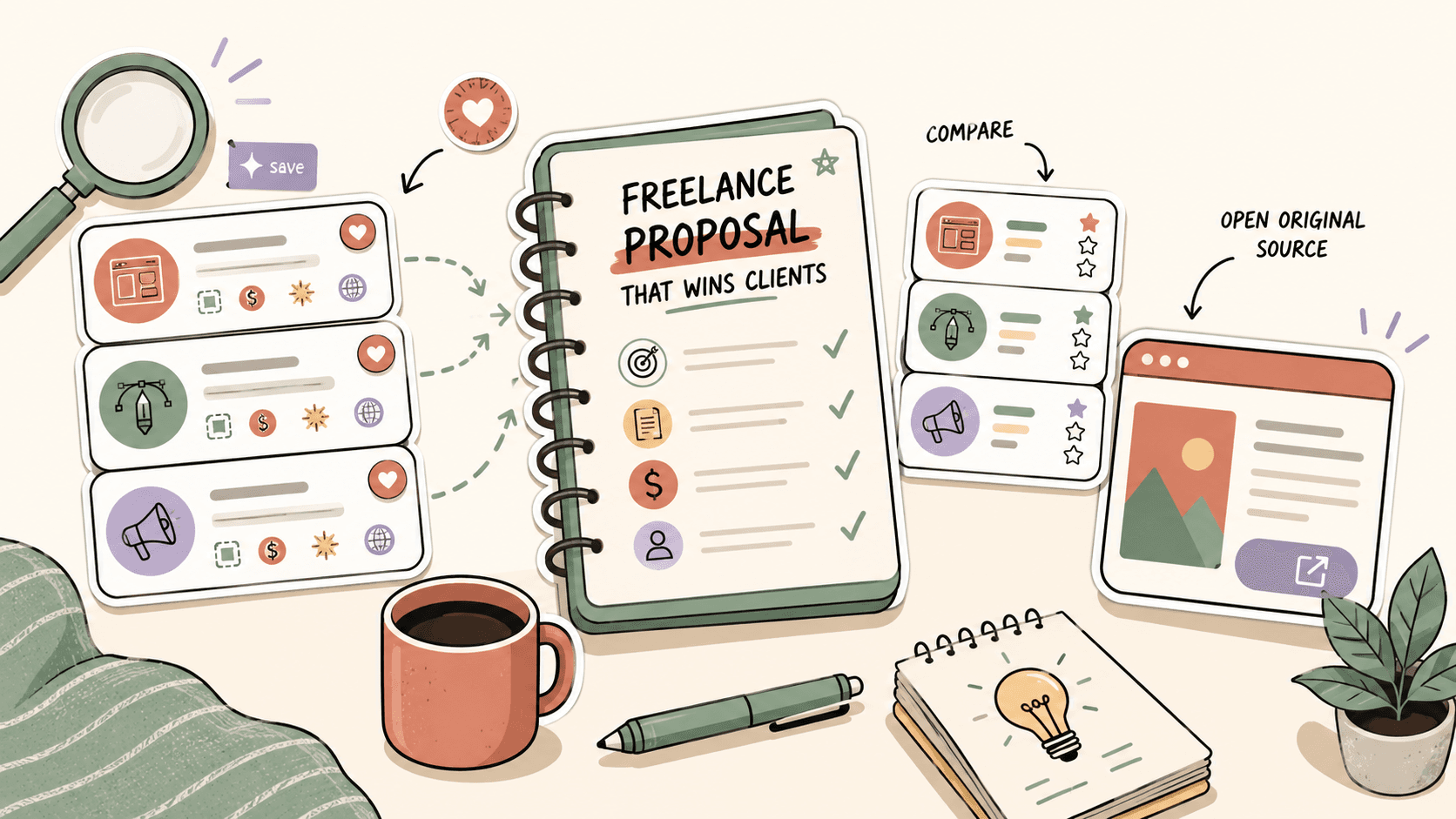
What should a freelance proposal include?
A strong freelance proposal is not a long biography. It is a short, specific answer to the client’s question: “Can this person solve my problem without creating more work for me?”
Whether you are replying on Upwork, sending a LinkedIn DM, responding to a Reddit post, applying through Contra, or emailing a founder after seeing a project on X/Twitter, your proposal should include five parts:
- A specific opening that proves you read the post.
- A short diagnosis of what the client likely needs.
- Relevant proof that connects your experience to this job.
- A simple scope or pricing line with clear assumptions.
- An easy next step so the client knows how to respond.
The goal is not to sound impressive. The goal is to reduce uncertainty.
A client comparing 20 proposals usually does not choose the longest one. They choose the one that feels easiest to trust, easiest to start, and most relevant to the exact job they posted.
What is the best freelance proposal structure?
Use this five-part structure when you do not know what to write:
1. Specific opener
Start with the job, not with yourself.
Weak opener:
Hi, I’m a freelance designer with 5 years of experience.
Stronger opener:
I saw you’re looking for a landing page redesign before your product launch next month. The biggest risk is probably getting a cleaner page live quickly without overcomplicating the brand work.
The stronger version shows attention. It also tells the client you understand the pressure behind the task.
2. Problem diagnosis
Write one or two sentences about what needs to happen.
Example:
For this to work, I’d focus on the hero section, offer clarity, social proof, and a mobile-first layout before touching secondary pages.
This makes your proposal feel like a plan instead of a pitch.
3. Relevant proof
Use proof that matches the job. Do not paste your entire work history.
Example:
I’ve recently helped two SaaS teams tighten landing page messaging and ship cleaner pages in Webflow. I can share relevant samples if helpful.
If you are newer, use adjacent proof:
I’m newer to client work, but I’ve built three Webflow landing pages for my own projects and can show the before/after structure.
Truth beats exaggeration. If you do not have direct proof, show a relevant sample, a small audit, or a clear process.
4. Scope or pricing line
A proposal does not always need a fixed price, especially when the scope is unclear. But it should give the client a sense of how you think about scope.
Examples:
If the scope is one landing page with existing copy and brand assets, I’d estimate this as a fixed project. I’d confirm the final price after reviewing the current page and launch timeline.
For a first pass, I can audit the current page and send a prioritized action list. If it looks like a fit, we can turn that into a fixed-scope redesign.
My rate depends on the number of pages and revision rounds, but I can give you a clear fixed quote after seeing the current site.
These lines are useful because they avoid fake certainty. You are not inventing a price before you know the work.
5. Easy next step
End with a low-friction question.
Examples:
If useful, send me the current page and your launch date, and I’ll reply with the first 2–3 things I’d fix.
Would you like me to send over two relevant examples?
If you’re still looking, I can take a quick look today and suggest a simple scope.
Do not end with vague phrases like “Let me know” if you can give a more specific next action.
Browse today’s opportunities on Sidequestboard
How do you write a proposal opening that gets replies?
The opening is where most freelancers lose the client.
Many proposals begin with:
Dear hiring manager, I am interested in this position. I have extensive experience and can deliver high-quality work.
This sounds generic because it could be sent to anyone.
A better opening does three things:
- names the actual project,
- reflects the client’s priority,
- hints at a useful approach.
Here are examples by platform.
Upwork example
Job context: A client needs a Shopify product page improved before a paid ads campaign.
Better opening:
I saw you’re preparing to send paid traffic to a Shopify product page. Before redesigning everything, I’d focus on the above-the-fold offer, product benefit clarity, reviews, and mobile checkout friction so the ad spend is not wasted.
LinkedIn DM example
Context: A founder posts that they need help turning podcast clips into short-form videos.
Better opening:
Saw your post about repurposing podcast clips. The main lift is probably not just editing, but picking the 20–40 second moments that can stand alone on LinkedIn and TikTok.
Reddit example
Context: Someone in a public subreddit asks for help fixing slow WordPress pages.
Better opening:
I noticed you mentioned the site slows down most on mobile. I’d start by checking hosting, image weight, plugins, and Core Web Vitals before recommending a rebuild.
Contra or portfolio-led proposal example
Context: A startup needs a brand identity refresh.
Better opening:
Your current brand already has a clear tone, so I would not treat this like a full rebrand. I’d focus on tightening the visual system, typography, and reusable assets so your product and marketing pages feel more consistent.
The best openings make the client think: “This person gets it.”
What is a simple freelance proposal template you can copy?
Use this template as a starting point, then edit it for the exact post.
Hi [Name],
I saw you’re looking for help with [specific project/problem]. The key thing I’d focus on is [your diagnosis of what matters most].
I’ve worked on [relevant proof, sample, project, or adjacent experience], so I’m comfortable with [specific task or constraint].
For scope, I’d suggest starting with [first deliverable or first step]. If [assumption], then this could likely be handled as [fixed project/hourly/audit/paid trial]. I’d confirm after seeing [asset/access/details needed].
If you’re still looking, send over [specific item], and I can reply with [useful next step].
Best, [Your name]
Short version for social posts
Use this when replying to fast-moving posts on X/Twitter, Reddit, Discord, or LinkedIn:
I can help with this. I’d start by [specific first step] because [reason tied to their problem]. Relevant example: [one proof point or sample]. If you’re still looking, send [specific detail] and I’ll suggest the cleanest next step.
Ultra-short version for warm replies
This is close to work I’ve done before. I’d approach it by [specific approach]. Happy to send a relevant sample or take a quick look if you’re still looking.
Templates are useful, but the first two lines should never feel templated.
How should beginners write proposals without much experience?
Beginners often try to hide their lack of experience with big claims. That usually backfires.
Instead, make the client feel safe by being clear, specific, and easy to evaluate.
If you do not have client results yet, use one of these proof types:
- a self-initiated sample,
- a small teardown or audit,
- a portfolio piece,
- a GitHub project,
- a Notion case study,
- a Loom walkthrough,
- a before-and-after example,
- a relevant school, volunteer, or internal project.
Beginner proposal example:
I’m newer to paid client work, but I’ve built two sample onboarding email sequences for SaaS products and can share them. For your project, I’d start by mapping the user’s first 7 days, then write a short welcome sequence with one clear goal per email.
That is stronger than:
I am passionate, hardworking, and willing to do anything.
Clients do not hire passion alone. They hire reduced risk.
How should you talk about pricing in a freelance proposal?
Pricing depends on the scope, timeline, expertise required, and how the client wants to work. Since those details are often missing from public posts, avoid pretending you know the final number too early.
Use pricing language that is clear without overcommitting.
If the scope is clear
If this is one blog post of around [client-provided length] using your existing brief, I can quote it as a fixed project after confirming the outline, deadline, and revision expectations.
Only include a specific price if you are confident and the platform rules allow it. If you do not know the right market rate, check current platform examples, your costs, and official platform fee information before quoting.
If the scope is unclear
I’d need to see the current site and the number of pages before giving a fixed quote. A good first step could be a paid audit so you have a clear scope before committing to the full build.
If the client asks for hourly work
Hourly could work if the tasks are ongoing. For a defined deliverable, I’d also be happy to suggest a fixed scope once I understand the priorities.
If the budget seems low
That budget may work for a smaller version of the project. I’d suggest starting with [reduced deliverable] rather than trying to fit the full scope into it.
This protects both sides. You are not rejecting the client immediately, but you are also not agreeing to unrealistic work.
Walkthrough: turning a weak proposal into a stronger one
Let’s rewrite a proposal step by step.
The public job post
Imagine a public post on Reddit or Upwork says:
Looking for someone to redesign my coaching website homepage. It looks outdated and does not explain what I do clearly. I need something cleaner that can help people book calls. Please send examples.
Weak proposal
Hi, I am a professional web designer with many years of experience. I can redesign your website and make it modern and responsive. I deliver high-quality work and unlimited revisions. Please hire me.
Why it is weak:
- It does not mention coaching.
- It does not address booking calls.
- It uses generic claims.
- It promises unlimited revisions, which can create scope problems.
- It does not ask for a useful next step.
Stronger proposal
Hi [Name],
I saw you’re looking to redesign a coaching homepage so it explains your offer more clearly and gets more visitors to book calls. I’d focus first on the headline, the promise of the coaching offer, proof from past clients, and the path from the hero section to the booking CTA.
I’ve worked on service-business landing pages where the goal was not just a nicer design, but making the offer easier to understand quickly. I can send a relevant example if helpful.
For scope, I’d suggest starting with the homepage only: structure, copy cleanup, visual redesign, and mobile layout. I’d confirm the quote after seeing the current page, your booking flow, and any brand assets you already have.
If you’re still looking, send me the current URL and I’ll reply with the first 3 things I’d improve.
Why it works:
- It repeats the client’s real goal.
- It gives a practical plan.
- It limits the scope to the homepage.
- It avoids fake pricing certainty.
- It makes the next reply easy.
Follow-up message after two days
Hi [Name], just checking in on the homepage redesign. If useful, I can still take a quick look at the current page and send the top 3 changes I’d make to improve clarity and booking flow.
This follow-up is short and useful. It does not guilt the client or ask, “Any update?” with no added value.
How fast should you send a freelance proposal?
Speed matters, especially for public opportunities. A thoughtful proposal sent early often has a better chance than a polished proposal sent after the client has already shortlisted people.
That does not mean you should spam every post immediately. It means you need a workflow that helps you find relevant opportunities while they are still fresh, then respond with a tailored message quickly.
A practical workflow:
- Check your main opportunity sources once or twice per day.
- Save posts that match your skills, budget range, and availability.
- Spend 5 minutes reading the post carefully.
- Draft a proposal using the five-part structure.
- Send the proposal or open the original source and respond there.
- Track follow-ups in a simple spreadsheet, Notion board, or CRM.
This is where a cleaner discovery process helps. Sidequestboard can be a useful next step if you are tired of manually checking too many public communities and social platforms. It brings fresh public opportunities into one calmer feed, lets you save interesting posts, and helps you open the original source so you can apply or respond directly.
What mistakes make freelance proposals lose clients?
Avoid these common mistakes:
Sending the same proposal to every client
Clients can feel when a message is copied. Keep a reusable structure, but personalize the opening, diagnosis, proof, and next step.
Talking too much about yourself
Your experience matters, but only after the client feels understood. Lead with their problem.
Making claims you cannot prove
Avoid promises like “I guarantee results” unless you have a truthful, specific basis and can stand behind it. Most freelancers should focus on process, relevant experience, and clear deliverables instead.
Ignoring scope
If the client asks for a “website redesign,” clarify whether that means one page, five pages, copywriting, development, branding, SEO, analytics, or ongoing support.
Asking the client to do too much work
A proposal should reduce work for the client. Do not ask five questions when one clear next step would do.
Replying too late
If you find the post days after it was published, the client may already be deep in conversations. You can still apply, but fresh opportunities are usually easier to act on.
How do you follow up without sounding pushy?
Follow up once or twice if the opportunity still seems active. Keep it short, polite, and tied to value.
Follow-up after 24–48 hours
Hi [Name], quick follow-up in case this is still open. I’d be happy to review [specific asset] and suggest the cleanest first step.
Follow-up with a useful idea
One extra thought: for this project, I’d prioritize [specific improvement] before [lower-priority task]. That should make the first version faster to ship.
Final follow-up
I’ll leave this here in case timing changes. If you revisit the project later, I’d be happy to take a look.
Do not chase indefinitely. A calm follow-up system helps you stay professional and move on to the next relevant lead.
How can you improve your proposal results over time?
Track the basics:
- where the lead came from,
- when you replied,
- what type of work it was,
- whether you included proof,
- whether you named a clear next step,
- whether the client replied,
- whether the project closed.
You can track this in Google Sheets, Airtable, Notion, or a lightweight CRM. After 20–30 proposals, patterns usually become clearer. You may notice that certain platforms, niches, budgets, or project types produce better conversations.
The point is not to obsess over every rejection. It is to improve your targeting and your message.
A better proposal helps, but a better opportunity pipeline helps too. If you only find old, vague, or mismatched posts, even strong writing will struggle. If you find fresh, relevant posts and respond with a clear proposal, your odds improve.
Freelance proposal checklist
Before sending, check:
- Did I mention the client’s specific project?
- Did I describe the real problem behind the task?
- Did I include one relevant proof point?
- Did I avoid exaggerated claims?
- Did I clarify scope or pricing assumptions?
- Did I make the next step easy?
- Did I keep it short enough to read quickly?
- Did I send it through the correct platform or original source?
- Did I save the opportunity so I can follow up?
If the answer is yes, send it. Do not over-edit until the opportunity gets cold.
A simple proposal you can adapt today
Here is a final copyable version:
Hi [Name],
I saw you’re looking for [specific outcome]. It sounds like the main challenge is [problem behind the task], not just [surface-level task].
I’d approach it by [step 1], [step 2], and [step 3]. I’ve done similar work with [relevant proof or sample], so I’m comfortable with [specific requirement].
For scope, I’d suggest starting with [clear first deliverable]. If [assumption], this could be handled as [fixed scope/hourly/paid audit]. I’d confirm after reviewing [needed detail].
If you’re still looking, send me [specific item] and I’ll reply with [helpful next step].
Best, [Your name]
Use the structure, but make the first lines unmistakably about the client’s post. That is what separates a proposal from a paste.