August 17, 2026
How to Get Copywriting Clients Without Experience: A 30-Day Plan for Your First Client
You can get copywriting clients without experience by showing evidence that you can solve a business's writing problem: two or three clearly labeled spec samples, a short list of well-matched leads, and personalized pitches. Price each defined project from its scope, put the terms in writing, and track every reply and follow-up. Timing and results vary, and nothing here guarantees a client.
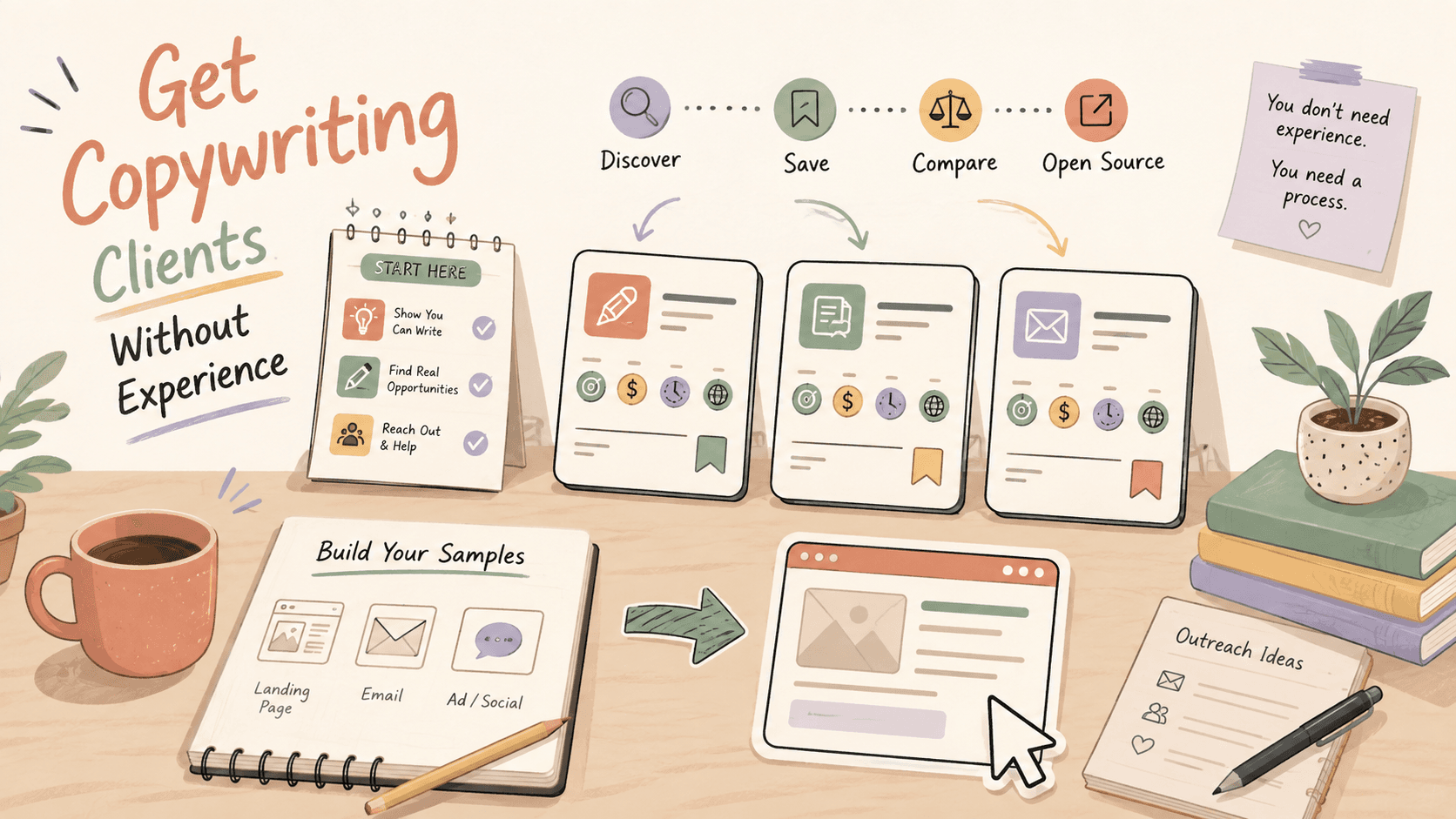
How do you get copywriting clients without experience?
Clients rarely need a long client history. They need confidence that you can understand their problem, follow a brief, and deliver on time. The loop of "I need experience to get clients and clients to get experience" breaks once you can show other evidence of your ability.
What counts as evidence:
- Labeled spec samples written for realistic businesses or fictional briefs
- Practice projects, such as a product description you researched and rewrote
- Volunteer, school, or friend projects that you can describe accurately
- A pitch that shows you read the prospect's page and noticed something specific and true
A practical process looks like this:
- Choose one or two services, such as website pages, email sequences, product descriptions, or social ads.
- Create two or three clearly labeled spec samples.
- Put them in a simple portfolio using Google Docs, Notion, or a basic portfolio page.
- Decide where you will look for leads, starting with people you already know.
- Send short, personalized pitches that identify a problem and suggest a useful next step.
- Agree on deliverables, deadline, revisions, payment, and usage rights in writing before any paid work begins.
Your first goal is not to look experienced. It is to make your ability easy to evaluate and to lower the client's risk of hiring you.
What should you put in a copywriting portfolio with no experience?
A beginner portfolio can include spec work, practice projects, volunteer work, school projects, or small projects for people you know. Label each item accurately, and never present a fictional campaign as a paid client result.
Aim for two or three samples that demonstrate the work you want to sell:
| Target service | Useful sample |
|---|---|
| Website copy | A home page and service page for a local business |
| Email copy | A three-email welcome sequence for a product or newsletter |
| Product copy | Several product descriptions for a fictional online store |
| Social ad copy | Multiple ad variations with different hooks and calls to action |
| B2B copy | A landing page or lead-magnet promotion for a software company |
For each sample, include the brief, audience, objective, your copy, and a short explanation of your choices. A reader should understand what you were trying to achieve without reading a biography. Keep everything behind one link so a prospect can open your work in a single click.
How do you create spec copy that attracts clients?
Start with a real business category and a specific communication problem. You can use a public website, product page, or job brief for research, but do not copy a business's existing text and present it as your own.
- Pick a narrow audience, such as independent fitness studios, local restaurants, or software startups.
- Choose one asset, such as a landing page, abandoned-cart email, or product description.
- Write a one-paragraph brief covering the audience, offer, desired action, and tone.
- Draft the copy with clear benefits and a specific call to action.
- Edit for accuracy, clarity, flow, and unnecessary claims.
- Add a short case-study-style note explaining your decisions.
Before adding a sample to your portfolio, run a quick quality check:
- No text copied from the business or another writer
- No invented results, testimonials, or statistics
- One clear call to action
- A rationale short enough to read in under a minute
A useful sample demonstrates judgment. It does not need conversion data, and you should not claim any if no real test took place.
Where should a beginner look for copywriting clients first?
Try sources in order of how much trust you already have, not by how many listings they show. This is a suggested order, not proven performance.
| Order | Source | Effort | What to send | Main risk |
|---|---|---|---|---|
| 1 | Warm network: friends, former colleagues, and local businesses you know | Low | A short note and one relevant sample | Awkwardness, so keep the ask specific and easy to decline |
| 2 | Public project listings on Upwork and Contra | Medium | A pitch tied to the brief and one matching sample | Competition and vague briefs |
| 3 | LinkedIn: founders, marketers, and agencies in your niche | Medium | A useful observation, then a sample | Generic messages read like spam |
| 4 | Reddit and Discord communities | Higher | A reply to a real request, where the rules allow it | Self-promotion rules and low-quality posts |
Platform rules, fees, and listing quality change. Check the current rules on each platform before contacting anyone, and do not send unsolicited messages where they are prohibited.
Is this listing worth pitching?
Before you spend time on a pitch, check that:
- There is a clear deliverable, not just "need a writer"
- The business is named or easy to identify
- Scope or budget is stated, or you can reasonably ask for it
- The request matches one of your samples
- The platform or community allows you to make contact
- None of the red flags in the scam section below apply
If a listing fails two or more of these checks, skip it. Fewer, better-matched pitches are easier to personalize and easier to learn from.
Checking several communities by hand makes it easy to miss a good post or lose track of one you meant to revisit. Get Sidequestboard for iPhone to find and save fresh public opportunities. Then open the original listing and respond there, after running it through the checklist above.
What should a beginner include in a copywriting pitch?
A good pitch connects a relevant sample to the client's stated need. Keep it short enough to scan and specific enough to show that you read the brief.
Weak versus strong opening
Weak:
Hi, I'm a passionate new copywriter and I would love to work with you. I can write anything you need.
Stronger:
Hi [Name], I saw that you need help with the product descriptions for [type of product]. I wrote a spec sample for a similar category: [link].
The stronger version names the need, offers proof, and asks the reader to do almost nothing.
Example response to a hiring post
Hi [Name], I saw that you need help improving the product descriptions for [type of product]. I write clear, benefit-focused product copy and recently created a spec sample for a similar ecommerce category: [link]. I would be happy to review one existing description and suggest an approach for the broader set. How many products and what deadline are you working with?
Example direct outreach message
Hi [Name], I noticed that your [page or email] explains the product well but places the main customer benefit below several paragraphs. I write landing-page and email copy for [business type]. I put together a short spec example showing how I would clarify the opening section: [link]. If improving that page is a current priority, I can outline a small project with defined deliverables.
No samples yet
If you have not built a sample, do not wait for a perfect portfolio, and do not imply paid experience. Offer something small and bounded:
Hi [Name], I read your [page] and noticed [specific, true observation]. I am building my copywriting portfolio, so I wrote a short, clearly labeled spec rewrite of your opening section: [link]. It is a sample, not a finished project. If it is useful, I can outline a small paid project.
Only cite what you actually reviewed. Do not claim you audited conversion data if you only read the page, and make it easy for the recipient to decline.
How much should a beginner charge for copywriting?
There is no single correct beginner rate. Pricing depends on the asset, research required, complexity, revisions, deadline, client type, and whether the work includes strategy or only writing. Check current comparable listings rather than relying on a universal number.
A safer method is to price a defined project instead of promising unlimited writing:
Project price = estimated hours × target hourly rate + complexity or rush adjustment
Worked example: a three-email welcome sequence
The hours below are illustrative only and are not a market rate.
- Research and brief review: 2 hours
- Drafting three emails: 3 hours
- Editing and one revision round: 2 hours
- Communication: 1 hour
- Total: 8 hours × your target hourly rate, plus a rush adjustment if the deadline is tight
Then put the scope in writing. An example set of terms:
- Deliverables: three emails with subject lines and body copy, and one round of consolidated revisions
- Deadline: first draft five business days after the brief; feedback within three business days
- Payment: a deposit before starting, the balance on delivery, and the accepted payment method named
- Usage rights: the client receives usage rights once the invoice is paid in full
- Changes: extra emails or additional revision rounds are quoted separately
For unfamiliar clients, consider a written contract and a deposit where local law and the client's process allow it. Do not start a large unpaid campaign as a test. A small, clearly bounded paid trial is easier to evaluate and safer to manage.
How long does it take to get a first copywriting client?
The timeline varies. Some beginners receive a response quickly, while others need several rounds of portfolio improvement and targeted outreach. There is no reliable deadline or guaranteed result.
Control the process rather than promising the outcome. A simple Google Sheets tracker can hold:
| Field | What to record |
|---|---|
| Opportunity | Company, person, platform, and listing URL |
| Fit | Why the project matches your sample or service |
| Pitch date | When you contacted the prospect |
| Follow-up date | Whether a follow-up is allowed and when to send it |
| Status | Drafted, sent, replied, call booked, won, lost, or closed |
| Lesson | What to improve in the next pitch |
An example workflow is to review 5 to 10 relevant listings twice per week, send 3 to 5 well-matched pitches, and follow up once where the platform or community permits it. This is an example, not a promise that any particular volume will produce clients.
What is a realistic 30-day plan for getting copywriting clients?
Days 1–7: Choose a service and build samples
Select one primary service and one audience. Create your first spec sample, then start a second one in a different format or from a different angle. Ask a careful reader to point out unclear claims, weak transitions, or missing context.
Deliverables: one defined service, one target audience, two draft samples, and a simple portfolio document.
Days 8–14: Improve your presentation and lead list
Finish the samples and add short explanations of the audience, objective, and approach. Build your lead tracker, then list relevant opportunities from your warm network, Upwork, Contra, LinkedIn, Reddit, and Discord without contacting every available listing.
Deliverables: two or three labeled samples, a short introduction focused on client problems, a list of opportunities that pass the fit checklist, and a pitch template with placeholders for personalization.
Days 15–21: Send targeted pitches
Review each opportunity before applying. Mention the specific service, connect it to a relevant sample, and ask one useful question. Use the example target of 3 to 5 well-matched pitches this week, adjusting it if research takes longer. Record the result of every pitch so you can tell a weak fit from a weak message.
Days 22–30: Follow up and refine
Follow up once when permitted and when your message adds context. Do not repeatedly contact someone who has not replied. Then review which pitches earned replies and where prospects asked for clarification.
If you are getting no replies, change one variable at a time, in this order:
- Lead fit: were the listings actually a match? Re-run the checklist.
- Sample match: does your sample resemble what the prospect asked for?
- Opening line: does the first sentence name the prospect's specific need?
- Follow-up: did you follow up once with something new to add?
Only after those checks should you narrow your niche or write another sample. Silence is information about the pitch, not proof that you cannot write. Rejection is part of the process, so share a sample and a pitch with a peer or a writing community that welcomes feedback, and ask what a skeptical client would question.
The purpose of the first month is to build a repeatable process and learn from real conversations, not to claim a fixed outcome.
How do you avoid copywriting scams?
Use the listing checklist above, and be cautious when a prospect:
- Requests a large amount of unpaid work
- Promises unusually high pay without a clear scope
- Asks you to pay money to access the job
- Wants to send an unexplained payment or have you forward money
- Refuses to identify the business, deliverables, or decision-maker
- Pressures you to move outside a platform before basic terms are clear
- Asks for sensitive identity or financial information before it is necessary
Verify the client independently. Keep the original listing, use written terms, and clarify payment before starting. If a post or community feels unsafe, do not respond just because it looks urgent.
How can you turn a first copywriting project into repeat work?
Deliver the agreed scope on time, make the revision process easy, and communicate when something is unclear. When the project ends, ask whether the client has a related asset that needs attention, such as an email sequence after a landing page.
Request a testimonial only when the client is satisfied, and keep it accurate. Ask permission before turning the work into a portfolio case study. Do not disclose confidential information or imply measurable results that were never verified.
FAQ
Do you need experience to get copywriting clients?
No. Clients need evidence that you can solve their writing problem. Labeled spec samples, practice projects, volunteer work, and a pitch that shows you read their brief can all serve as evidence.
Can I get copywriting clients without a degree?
Yes. Clients generally want proof that you can follow a brief, write clearly, and meet agreed terms. A degree may matter in some specialized industries, but it does not replace relevant samples and reliable project management.
Should I work for free to build a copywriting portfolio?
You do not need to complete a full unpaid campaign. Build spec samples, help a legitimate community organization with a tightly defined project if you genuinely choose to, or offer a small paid trial with clear limits. Label all work accurately.
Is Upwork the only place to find beginner copywriting clients?
No. Contra, LinkedIn, Reddit, Discord communities, referrals, local businesses, and direct outreach may also be relevant. Each source has different rules, competition, fees, and expectations, so verify current details before applying.
How many copywriting samples do I need?
Two or three focused samples are enough to begin testing your outreach. Relevance matters more than volume, so add samples that support the service and audience you are pitching.
What should I do if nobody replies to my pitches?
Work through the diagnostic order in the 30-day plan: lead fit first, then sample match, opening line, and follow-up. Change one variable at a time and keep tracking results instead of assuming that silence proves you cannot write.
How can I organize copywriting leads from different communities?
Use a tracker with the listing URL, source, fit, pitch date, follow-up date, status, and notes. Sidequestboard can also help you discover and save public opportunities in one feed before you open the original source to apply or respond.
Related guides
- Reddit Side Hustle Communities Worth Joining: 5 to Try
- Freelance Work for Beginners: Get Brand, Video, and Film Clients
- How to Get Freelance Clients on LinkedIn: Profile, Search, Outreach, and Lead Workflow
- Can Your Boss Make You Attend an Unpaid Mandatory Meeting? Your Pay Rights Explained
- How to Find Work When You Hate Talking to People
Sources
- Upwork — Freelancer Service Fee — Official platform fee information; verify current terms before relying on pricing.
- Contra — Pricing — Official platform fee information; verify current terms before relying on pricing.