June 20, 2026
How to Organize Remote Job Leads from Multiple Websites Without Tab Chaos
To organize remote job leads from multiple websites, use one tracker, one scoring system, and one daily review routine. Capture the source, role, pay range if listed, deadline, legitimacy checks, status, and next action for every lead. Prioritize fresh, relevant posts and apply from the original source.
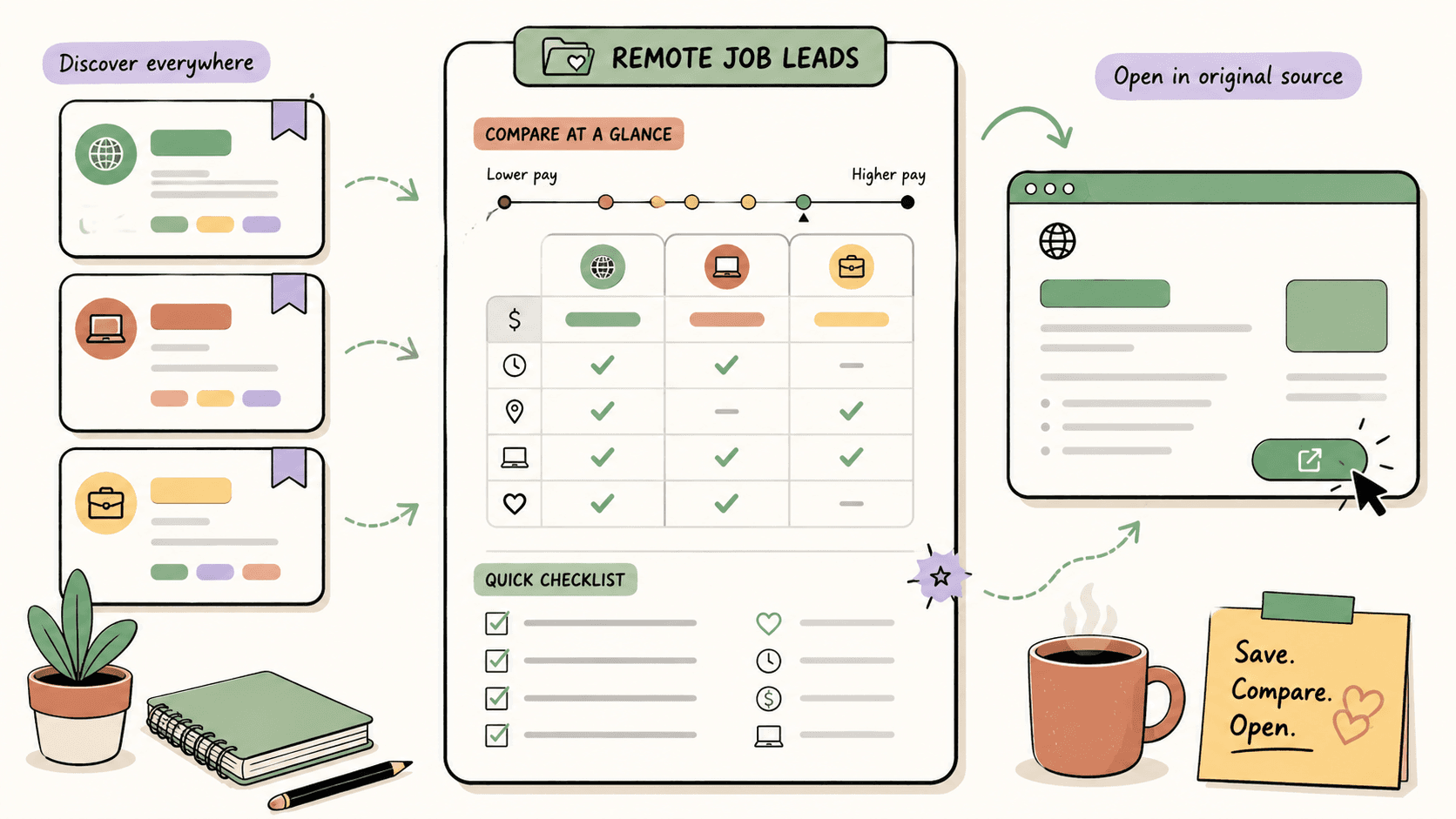
Remote job searches get messy fast. One promising lead is on LinkedIn. Another is buried in a Reddit thread. A contract role appears on Wellfound. A freelance gig shows up on a remote job board. By the end of the day, you have twelve tabs open, three saved posts, one half-written application, and no clear idea what to do next.
The fix is not to check more websites. The fix is to build a simple system for capturing, scoring, and reviewing leads before they go stale.
This guide gives you a practical workflow for organizing remote job leads from multiple websites, including job boards, public communities, social platforms, and curated discovery tools.
Quick answer: what is the best way to organize remote job leads?
The best way to organize remote job leads is to keep one central tracker and use it every day. For each lead, record the source, job title, company or client, link, pay range if listed, deadline, remote requirements, legitimacy checks, status, and next action.
Then score each opportunity based on fit, freshness, effort, and trust. Review your tracker once or twice per day so you can respond quickly to the strongest leads instead of repeatedly searching the same sites.
Why remote job leads are harder to manage than normal job applications
Traditional job searching often follows a predictable pattern: search, click, apply, wait. Remote work discovery is more scattered.
You might find useful opportunities across:
- LinkedIn Jobs
- Wellfound
- We Work Remotely
- Remote.co
- FlexJobs
- Reddit communities such as r/RemoteJobs, r/forhire, or niche professional subreddits
- X/Twitter posts
- Discord or Slack communities
- Company career pages
- Newsletter job roundups
- Public creator, startup, and freelance communities
Each source has a different format. Some posts include salary ranges. Some only include a short description. Some require a formal application. Others ask you to email, DM, or fill out a form.
That is why bookmarks alone are not enough. You need a workflow that answers four questions:
- Is this lead real and relevant?
- Is it still fresh enough to act on?
- What is the next action?
- Where does it sit compared with other leads?
Browse today’s opportunities on Sidequestboard
Step 1: Choose one place to capture every lead
Do not let your system depend on memory, browser tabs, or scattered screenshots. Pick one lead tracker and commit to it.
Good options include:
- Google Sheets for a simple spreadsheet
- Airtable for a more structured database
- Notion for a flexible job search dashboard
- Trello for a kanban-style pipeline
- A notes app if your search volume is very low
The tool matters less than consistency. The rule is simple: if you might apply, pitch, reply, or follow up, it goes into the tracker.
Step 2: Use a copy-and-paste tracker template
Here is a practical tracker setup you can copy into Google Sheets, Airtable, Notion, or another workspace.
| Column | What to record |
|---|---|
| Date found | The day you found the opportunity |
| Source | LinkedIn, Reddit, Wellfound, remote job board, company site, Sidequestboard, etc. |
| Role or project | The job title, gig type, or project name |
| Company/client | The organization or poster name if available |
| Link | The original listing or post URL |
| Remote type | Fully remote, hybrid, region-limited, timezone-limited, unknown |
| Pay/range | Only what is listed; leave blank if not provided |
| Deadline | Application deadline if listed |
| Freshness | New today, this week, older, unknown |
| Fit score | Your 1-5 rating for skill fit |
| Trust score | Your 1-5 rating after legitimacy checks |
| Effort score | Your 1-5 rating for how easy it is to apply well |
| Status | To review, applying, applied, followed up, rejected, closed |
| Next action | Apply, customize resume, write pitch, verify company, follow up |
| Follow-up date | The date you plan to check back |
| Notes | Anything important that does not fit elsewhere |
Example tracker row
| Date found | Source | Role or project | Company/client | Remote type | Pay/range | Status | Next action |
|---|---|---|---|---|---|---|---|
| 2026-06-20 | Public remote job board | Part-time content marketer | Example SaaS company | Fully remote, timezone not confirmed | Listed in post | To review | Verify company site, tailor two writing samples, apply today |
Keep the row simple. The goal is not to build a perfect database. The goal is to stop losing good leads.
Step 3: Capture the original source link, not just a screenshot
Always save the original listing or source post. This matters because remote opportunities often change quickly. A post may be edited, closed, deleted, or clarified.
For every lead, capture:
- The original URL
- The source platform
- The date you found it
- The date it was posted, if visible
- The exact application instruction
- Any deadline or timezone requirement
If you use a discovery dashboard such as Sidequestboard, treat it as a cleaner way to find and save public opportunities, then open the original listing or source when you are ready to apply or respond.
Step 4: Add a simple scoring system
A scoring system helps you avoid two common mistakes: applying to everything or overthinking every lead.
Use a 1-5 score for each category:
Fit score
Ask:
- Do I have the required skills?
- Do I have relevant proof, examples, or portfolio work?
- Is the role aligned with the kind of work I want?
Freshness score
Ask:
- Was it posted today or very recently?
- Is the application deadline still open?
- Does the post look active?
Trust score
Ask:
- Can I verify the company, client, or poster?
- Does the listing avoid suspicious payment or personal information requests?
- Are the expectations specific enough to evaluate?
Effort score
Ask:
- Can I apply well within 15-45 minutes?
- Do I already have a relevant resume, portfolio sample, or pitch angle?
- Is the application process reasonable?
A simple formula:
Priority score = fit + freshness + trust + effort
A lead with a score of 17-20 should usually be handled soon. A lead with a score under 10 may not deserve immediate attention unless it is unusually strategic.
Step 5: Use clear statuses so nothing gets stuck
Most job lead trackers fail because every item becomes a vague maybe. Avoid that by using a small set of statuses.
Recommended statuses:
- New: Captured but not reviewed
- Shortlist: Worth applying or investigating
- Needs verification: Interesting but requires legitimacy checks
- Applying: You are preparing the application or reply
- Applied: Application, email, form, or message sent
- Follow up: Waiting until a specific follow-up date
- Closed: Role closed, not a fit, rejected, or no longer relevant
Every lead should have both a status and a next action. If there is no next action, close it.
Step 6: Check legitimacy before you apply
Remote work attracts real opportunities and low-quality posts. Before sending personal information, doing unpaid work, or investing significant time, run a basic trust check.
Look for:
- A real company or client presence
- A consistent website, domain, or professional profile
- Clear role expectations
- A normal application process
- No request for payment to get hired
- No request for sensitive financial information early in the process
- No vague promise of unusually high pay for unclear work
Be careful with any listing that asks you to buy equipment through a specific vendor, move the conversation to an unrelated channel immediately, or provide sensitive documents before a credible hiring process begins.
If a platform has pricing, membership, or posting rules that affect your decision, verify those details directly with the official platform before relying on them. Pricing and policies can change.
Step 7: Build a daily remote lead routine
A good system should reduce search time, not create more admin work. Try this daily routine:
Morning: discover and capture
Spend 20-30 minutes checking your main sources. Capture promising leads into your tracker. Do not fully apply yet unless something is urgent and high fit.
Midday or afternoon: score and act
Sort your tracker by priority score. Apply, pitch, or respond to the best leads first. For lower-priority leads, either schedule a next action or close them.
End of day: clean up
Update statuses. Add follow-up dates. Close stale or weak leads. Choose your top three actions for tomorrow.
This routine keeps your search moving without letting discovery consume the whole day.
How should you organize leads from Reddit and public communities?
Public communities can be useful because opportunities often appear before they are widely syndicated. They can also be noisy.
When saving leads from Reddit, Discord, Slack, X/Twitter, or similar communities, capture extra context:
- Username or poster name
- Community name
- Date and time posted
- Whether the poster gives a company/client identity
- Instructions for replying
- Any comments that clarify the role
- Whether the opportunity appears reposted elsewhere
Use more caution with community posts than with verified company career pages. A promising community lead can still be worth pursuing, but you should verify the poster and avoid sending sensitive information too early.
How should you organize leads from job boards?
For job boards, focus on filtering and deadlines. Remote boards often include a mix of full-time jobs, contract roles, freelance projects, and region-restricted remote roles.
For each listing, record:
- Remote location restrictions
- Required timezone overlap
- Employment type
- Pay range if listed
- Application deadline if listed
- Whether the application happens on the job board or company site
Do not assume that “remote” means “work from anywhere.” Many remote jobs are limited by country, state, time zone, or legal hiring requirements.
How should freelancers organize remote gig leads?
Freelancers should add a few extra fields to their tracker:
- Project budget if listed
- Estimated project length
- Client type
- Portfolio sample to send
- Pitch angle
- Follow-up date
- Invoice/payment risk notes
For freelance leads, the best opportunity is not always the highest listed budget. A strong lead is one where you can understand the problem, show relevant proof, and respond quickly with a specific next step.
Example next action:
“Send a short pitch with two relevant case studies and ask whether they want a 20-minute scoping call this week.”
How should full-time jobseekers organize remote job leads?
Full-time jobseekers should focus on fit, timing, and application quality.
Add fields such as:
- Resume version to use
- Cover letter needed? yes/no
- Referral possibility
- Recruiter or hiring manager name if public
- Interview notes
- Follow-up date
Avoid applying to too many low-fit roles just because they are remote. A smaller number of targeted applications is usually easier to manage and improve over time.
How to follow up without losing track
Follow-up is where many leads disappear. Add a follow-up date as soon as you apply or reply.
A simple follow-up schedule:
- For freelance pitches: follow up after 3-5 business days if the post still appears active
- For job applications: follow up after about 7-10 business days if there is a clear contact and no instruction not to follow up
- For community posts: follow up once, politely, then move on
Sample follow-up message:
Hi [Name], I wanted to quickly follow up on my note about [role/project]. I’m still interested and happy to send more relevant examples if useful. Either way, thanks for considering it.
Keep follow-ups short. The tracker should remind you when to follow up, not pressure you to chase every lead forever.
Where Sidequestboard fits into this workflow
Sidequestboard is useful if your current remote job search depends on checking too many public communities, social platforms, and opportunity sources manually.
It gives you a cleaner feed for discovering fresh public opportunities, saving interesting leads, and opening the original source when you are ready to apply or respond. That makes it a practical discovery layer before your tracker.
A simple workflow could look like this:
- Use Sidequestboard to scan fresh public opportunities in a calmer feed.
- Save anything relevant.
- Open the original source to verify details and apply or respond directly.
- Add serious leads to your tracker with a status and next action.
- Use your saved lead details to write a faster first reply when appropriate.
Sidequestboard should not replace your judgment, your application materials, or the original source listing. It simply helps reduce the tab chaos that happens before you decide what is worth pursuing.
Common mistakes to avoid
Saving too many leads
If everything is saved, nothing is prioritized. Score leads quickly and close weak ones.
Ignoring freshness
Remote opportunities can get crowded quickly. Fresh, relevant posts deserve faster attention.
Applying without verification
Do basic legitimacy checks before sending personal information or investing hours in unpaid work.
Using too many tools
A spreadsheet plus a discovery feed is often enough. Do not turn your job search into a software project.
Forgetting the next action
Every active lead should answer: what do I do next, and when?
A simple weekly review
Once per week, review your tracker and ask:
- Which sources produced the best leads?
- Which applications or pitches got responses?
- Which types of roles were low fit?
- Which saved leads went stale before you acted?
- What should you stop checking?
- What should you check more often?
This is how your system improves. Over time, you should spend less time searching and more time applying to better-fit opportunities.
Final checklist
Use this checklist when organizing remote job leads:
- Choose one tracker
- Capture every serious lead in the same place
- Save the original source link
- Record source, role, company/client, remote requirements, pay if listed, and deadline
- Score leads by fit, freshness, trust, and effort
- Add a status and next action
- Verify legitimacy before applying
- Review your tracker daily
- Follow up on a schedule
- Close stale or weak leads quickly
The goal is not to track every remote job on the internet. The goal is to find the right opportunities while they are still fresh and move on them with less chaos.
Related guides
- How to Find Remote Jobs on Reddit
- How to Find Remote Work Opportunities Without LinkedIn
- How to Find Part-Time Remote Work Opportunities Without Wasting Hours Searching
- Where to Find Remote Jobs That Are Not Scams: 7 Legit Places and How to Verify Them
- How to Track Remote Work Leads from Public Posts