July 2, 2026
Stopped Volunteering for Extra Work? Turn It Into Job Search Leverage
If you stopped volunteering for extra work and your manager suddenly noticed, treat that as evidence of unrecognized scope. Document the recurring work, clarify priorities and compensation with your manager, update your resume and LinkedIn, and quietly test whether the same skills are valued elsewhere.
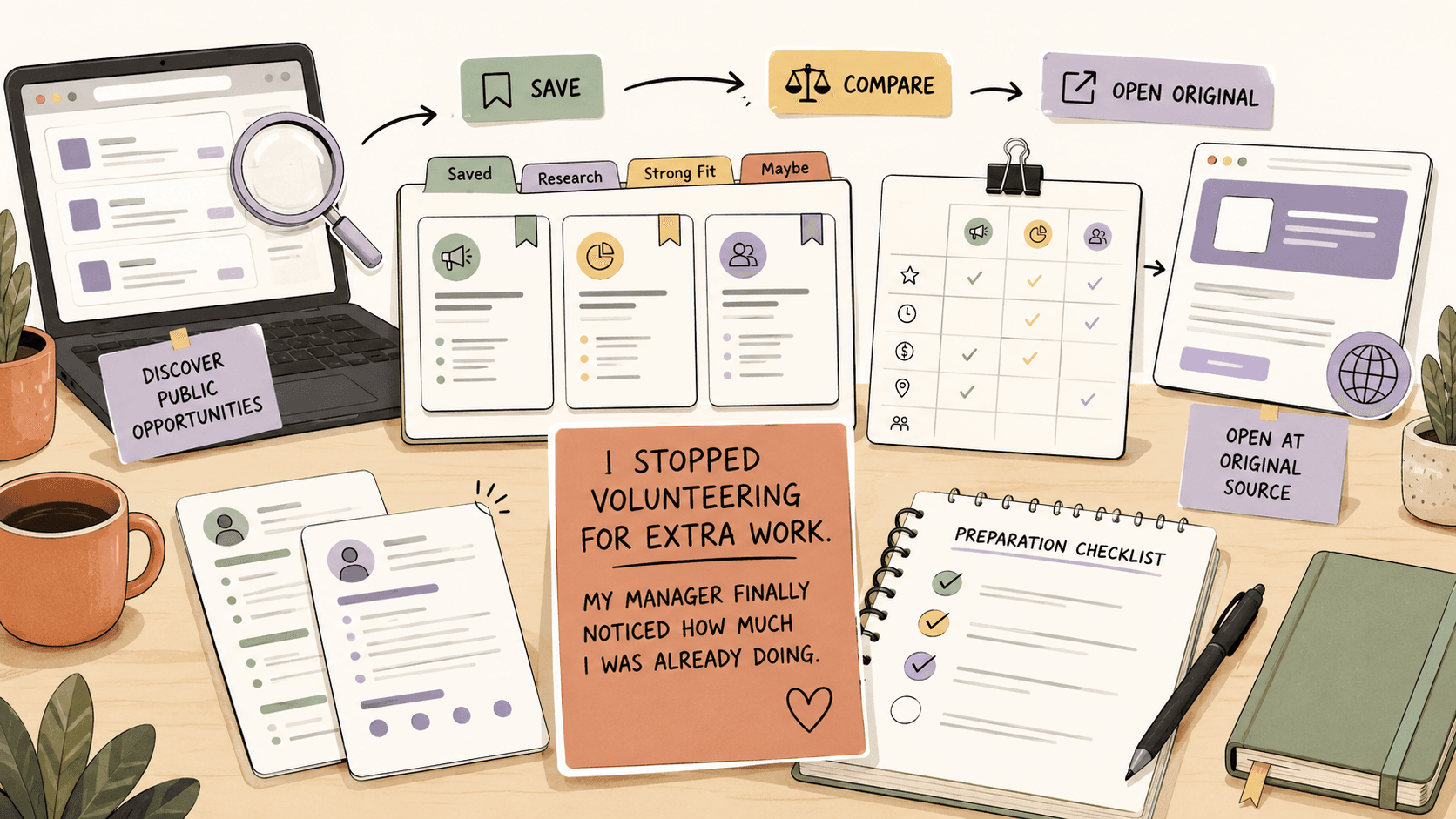
Why does stopping extra work suddenly make your value visible?
Extra work often stays invisible because it prevents problems before they become obvious. You answer the Slack question before it blocks someone. You fix the report before it reaches the client. You train the new hire before your manager has to step in. You clean up project details before the deadline slips.
When you stop volunteering for that work, the buffer disappears. The missing labor becomes visible because someone else has to own it, delay it, or explain why it is not getting done.
Common examples include:
- Onboarding new teammates
- Writing internal documentation
- Reviewing reports before delivery
- Handling client follow-ups
- Coordinating projects without the title
- Answering technical or process questions in chat
- Fixing last-minute errors
- Covering scheduling, QA, or cleanup work
- Creating marketing, design, analytics, or automation assets outside your role
That does not automatically mean your employer is malicious. Sometimes managers genuinely do not see the volume of invisible work until it stops. But it does mean you now have a useful data point: your role may have expanded beyond your title, compensation, goals, or workload plan.
The smartest move is to convert that realization into evidence. Evidence gives you four forms of leverage:
- Internal negotiation leverage for pay, title, scope, or priorities.
- Job-search leverage for resumes, LinkedIn, interviews, and recruiter conversations.
- Boundary leverage so you can stop absorbing recurring ownership for free.
- Market leverage if another team, company, client, or platform values the same work more clearly.
Is it a growth opportunity or unpaid scope creep?
Not all extra work is bad. Strategic stretch work can help you learn, get noticed, and move into a better role. The problem starts when extra work becomes recurring ownership without recognition, compensation, or workload adjustment.
Use this distinction before you decide how hard to push.
| Type of work | What it looks like | Usually healthy? | What to ask for |
|---|---|---|---|
| Occasional teamwork | You help during a deadline, vacation, or emergency | Yes, if temporary | Clarify duration and priority tradeoffs |
| Stretch project | You take on a visible project tied to your goals | Often yes | Ask how success will be measured and recognized |
| Recurring ownership | You are expected to keep doing the task every week or month | Risky | Ask whether it belongs in your role, goals, or compensation |
| Unpaid role expansion | You perform another role’s duties without title, pay, or reduced workload | Usually no | Ask for title/pay alignment, removal, or reprioritization |
A healthy opportunity is usually temporary, visible, skill-building, and connected to a career goal. Your manager knows you are doing it, stakeholders value it, and there is some path to recognition.
Scope creep is recurring, expected, invisible, and uncompensated. It gets treated as “just helping” until you stop doing it.
The same task can fall into either category. Creating one onboarding document might be a good stretch project. Owning all onboarding documentation forever while still doing your original job is a scope problem.
Browse today’s opportunities on Sidequestboard
How should you document extra work before asking for anything?
Do not rely on a vague statement like, “I do a lot more than my job description.” It may be true, but it is easy to dismiss. Build a scope evidence log instead.
Use a spreadsheet, Google Doc, Notion page, Airtable base, or simple table with these columns:
| Task | Category | Frequency | Stakeholder | Original owner | Business impact | Time spent | Proof link | Recurring? |
|---|---|---|---|---|---|---|---|---|
| Trained new support hire | Training | 4 sessions in 2 weeks | Support manager | Manager | Faster ramp-up, fewer repeat questions | 5 hours | Calendar invites, training doc | No |
| Reviewed client reports | QA/reporting | Monthly | Account team | Analyst | Reduced client-facing errors | 3 hours/month | Report comments, task links | Yes |
| Answered workflow questions in Slack | Team support | Daily | Operations team | Unclear | Prevented blockers | 20 min/day | Slack threads | Yes |
| Coordinated campaign assets | Project coordination | Weekly | Marketing | Project manager | Kept deadlines moving | 2 hours/week | Asana tasks, emails | Yes |
| Created landing page graphics | Design | As needed | Marketing | Designer/vendor | Supported launch deadlines | 6 hours | Approved files | Maybe |
Separate your work into four buckets:
- Assigned responsibilities: tasks already in your role.
- Emergency help: temporary support during unusual situations.
- Strategic projects: visible work that builds your career.
- Recurring extra responsibilities: ongoing work that may need title, pay, or priority alignment.
Be careful with proof. Use safe, non-confidential evidence such as calendar invites, task names, public artifacts, approved documents, performance feedback, or internal links you are allowed to reference. Do not download sensitive company data, customer records, private financials, source code, or confidential documents for personal use.
Your goal is not to build a legal case in a rage. Your goal is to make scope visible in a professional way.
What should you say to your manager when you stopped volunteering?
Ask for a scope conversation, not a confrontation.
A simple meeting request:
“Hi [Manager], I’d like to schedule 30 minutes to review my current scope and priorities. Over the past few months I realized I had been handling several recurring responsibilities beyond my core role, and I want to align on what should continue, what should pause, and whether any of it should be reflected in goals, title, compensation, or workload.”
In the meeting, bring three strong examples. Do not bring a 40-item grievance list. Choose examples that are recurring, business-relevant, and easy to prove.
Use this flow:
- Start with the business need: “I want to make sure the highest-priority work is covered.”
- Name the recurring extra work: “I have been handling monthly report QA, new-hire training, and weekly project coordination.”
- Explain the impact: “These tasks reduce errors, speed up onboarding, and keep deadlines moving.”
- Ask for alignment: “If this is now part of my role, can we discuss how it affects title, compensation, goals, or workload?”
- Force a priority decision: “If compensation or title cannot change right now, which lower-priority tasks should I pause so this work fits sustainably?”
A calm script:
“Over the last quarter, I noticed that several recurring tasks had moved to me even though they are not part of my current role description. I’m happy to contribute where it makes sense, but I want to avoid informal ownership that is not reflected in my goals or workload. Can we decide which of these tasks should remain with me, which should move elsewhere, and whether the expanded scope should be recognized through title, compensation, or a formal priority change?”
This gives your manager three reasonable outcomes:
- Compensation or title adjustment
- Priority tradeoff or workload reduction
- Removal of recurring extra duties
If none of those are available, you have useful information for your next move.
What if your manager pushes back?
Pushback is common. Stay calm, ask for specifics, and document the outcome after the meeting.
| Manager objection | Calm response |
|---|---|
| “Everyone helps out.” | “I agree that occasional help is part of teamwork. I’m trying to clarify recurring ownership. If this is expected weekly or monthly, I’d like it reflected in priorities, goals, or compensation.” |
| “Now is not the time.” | “Understood. When would be the right time to review it? Can we set a specific date or tie it to the next compensation cycle?” |
| “We do not have budget.” | “If budget is not available, can we discuss workload tradeoffs or remove some recurring responsibilities so the scope is sustainable?” |
| “This is part of being a team player.” | “I want to be a strong teammate. I also want to make sure ongoing responsibilities are assigned clearly so expectations are fair and realistic.” |
| “Let’s revisit later.” | “That works if we define later. Can we schedule a follow-up for [date] and agree on what data we’ll review?” |
| “I didn’t realize you were doing all of that.” | “That’s why I wanted to document it. I can send a summary after this meeting so we can decide what should formally stay with me.” |
| “If you want promotion, you need to keep doing extra work.” | “I’m open to stretch work when there is a clear path. Can we define the promotion criteria, timeline, and what evidence would show readiness?” |
After the meeting, send a short recap:
“Thanks for discussing scope today. My understanding is that I will continue owning [A], pause [B], and we will revisit title/compensation on [date]. Please let me know if I missed anything.”
That recap matters. It turns a vague conversation into a documented expectation.
How can you set boundaries without looking disengaged?
The goal is to stop absorbing unpaid recurring ownership, not to neglect your job. Keep doing your assigned work well. Communicate tradeoffs early. Avoid dramatic silence or surprise refusals.
Useful boundary scripts:
- “I can take this on if we pause or move [current task]. Which is the higher priority?”
- “I can help with this once, but I cannot own it weekly without reprioritizing my workload.”
- “This looks outside my current scope. Should I treat it as a one-time request or a recurring responsibility?”
- “I do not have capacity to add this today without delaying [deadline]. Do you want me to delay that, or should we find another owner?”
- “I’m happy to document the process, but I do not think I should be the long-term owner unless we update my role expectations.”
Avoid these moves:
- Do not let important assigned work fail to prove a point.
- Do not vent publicly about your manager or company.
- Do not issue an ultimatum unless you can live with the outcome.
- Do not abruptly drop work that was formally assigned to you.
- Do not take confidential documents for your personal job search.
- Do not confuse boundaries with disappearing.
You can be professional and firm at the same time. In fact, clear boundaries often make you look more senior because you are managing capacity instead of pretending it is unlimited.
How do you turn extra work into resume, LinkedIn, and interview leverage?
If you did the work, delivered value, and can discuss it honestly, it can strengthen your job search. You do not need the perfect title to describe real responsibilities.
Use this formula:
Action + scope + business result + tool/process/stakeholder
Examples:
| Weak version | Stronger version |
|---|---|
| Helped with extra tasks. | Coordinated weekly cross-functional task handoffs, reducing deadline confusion across operations and marketing teams. |
| Trained people sometimes. | Created onboarding documentation and trained two new team members, improving ramp consistency and reducing repeat manager questions. |
| Did reporting. | Reviewed monthly client reports for accuracy, flagged data inconsistencies, and coordinated fixes before client delivery. |
| Helped marketing. | Produced campaign graphics and layout updates in Figma to support weekly marketing launches alongside core operations work. |
| Answered support questions. | Served as informal process resource for support teammates, resolving workflow questions and documenting repeat issues for faster escalation. |
| Worked on analytics. | Built recurring performance summaries using spreadsheet dashboards, helping stakeholders identify trends before monthly reviews. |
For LinkedIn, you can position the expanded scope without exaggerating your title.
Headline examples:
- “Operations Coordinator | Reporting QA, Process Documentation, Team Enablement”
- “Customer Support Specialist | Knowledge Base, Onboarding, Workflow Improvement”
- “Marketing Assistant | Campaign Coordination, Design Support, Content Operations”
- “Administrative Professional | Project Coordination, Scheduling Systems, Process Improvement”
About-section example:
“In my current role, I support core operations while also contributing to documentation, reporting QA, onboarding, and cross-team coordination. I’m especially interested in roles where process improvement, stakeholder communication, and reliable execution are valued and formally part of the role.”
Interview story structure:
- Situation: “My role expanded informally during a busy period.”
- Action: “I documented the recurring work and clarified priorities.”
- Result: “The team had better visibility into ownership and I learned where I add the most value.”
- Forward-looking point: “I’m now looking for a role where that scope is intentional and aligned with the position.”
Avoid sounding bitter in interviews. Do not say, “My company took advantage of me.” Say, “I realized my actual responsibilities had grown beyond the role, and I’m looking for a position where that kind of work is clearly recognized and central to the job.”
How can you use the market to test whether your extra work has value?
External demand gives you leverage even if you decide to stay. You are not only looking for a new job; you are checking whether the work you have been doing has a market.
Search for the tasks, not just your current title.
If your title is “assistant” but you have been coordinating projects, search:
- Project coordinator
- Operations coordinator
- Program assistant
- Client operations associate
If you have been fixing reports or dashboards, search:
- Reporting analyst
- Data operations associate
- Business operations analyst
- Revenue operations coordinator
If you have been writing documentation, search:
- Documentation specialist
- Knowledge base writer
- Technical writer
- Content operations specialist
If you have been helping with marketing assets, search:
- Marketing coordinator
- Content coordinator
- Junior designer
- Creative operations assistant
Also check salary benchmarks from multiple sources. Depending on your country and industry, useful resources may include the U.S. Bureau of Labor Statistics Occupational Outlook Handbook, Glassdoor, Levels.fyi, Payscale, Robert Half Salary Guide, Built In salary pages, job postings with listed ranges, and recruiter conversations.
For freelance or side-work signals, rates vary widely by skill, niche, geography, experience, and buyer quality. As rough examples, writing projects may range from low fixed-fee assignments to several hundred dollars for specialized pieces; design and development can range from modest project fees to higher hourly rates for experienced specialists; virtual assistant and operations support rates vary heavily by complexity. Treat public rates as market clues, not guarantees.
The question is not “Can I instantly replace my salary with side gigs?” The better question is: “Are other employers or clients actively asking for the work I have already been doing?”
Where should you look for better-matched roles or paid side work?
Use several channels because each one gives different information.
| Channel | Best for | What to check |
|---|---|---|
| Traditional job boards | Full-time roles and salary ranges | Job titles, repeated requirements, posted compensation |
| Internal job postings | Moving teams without leaving the company | Whether another manager values your expanded scope |
| Recruiter outreach | Market feedback and interview practice | Whether recruiters respond to your revised positioning |
| Alumni networks | Warm introductions | Similar roles held by people with your background |
| Niche communities | Fresh leads and role language | Scope clarity, credibility, payment terms |
| Freelance platforms | Paid side projects and portfolio validation | Fees, competition, buyer quality, project size |
Specific resources to scan:
- LinkedIn Jobs, Indeed, Google Jobs, Wellfound, Otta, FlexJobs, Remote OK, We Work Remotely, and Built In for role research.
- Internal company career pages if your company is decent but your team dynamic is the problem.
- Alumni directories, Slack communities, Discord groups, and professional associations for warm leads.
- r/forhire for public freelance hiring posts; sort by New and look for clear scope and budget.
- r/WorkOnline for remote work discussions and gig leads; verify every post carefully.
- r/HireaWriter for writing and editing opportunities; check rate, niche, deadline, and samples requested.
- r/freelance_forhire for seeing how freelancers package their services.
- Upwork for broad freelance demand, while accounting for platform fees and competition.
- Fiverr for packaged services, while remembering the platform takes a commission.
- Contra for portfolio-first independent work and no commission on earnings.
- PeoplePerHour for fixed-price and hourly freelance projects, especially in UK/EU markets.
- Toptal for experienced developers, designers, finance experts, and other screened specialists.
Safety checks for public opportunities:
- Is the scope clear?
- Is the budget or pay range stated?
- Is the timeline realistic?
- Does the poster have credible identity signals?
- Are payment terms defined?
- Are they asking for excessive unpaid test work?
- Do they want sensitive personal information too early?
- Does the opportunity sound like “exposure” instead of compensation?
Track every lead with a simple table:
| Source | Link | Role/task | Compensation signal | Date found | Response sent? | Follow-up date | Next action |
|---|
This tracker becomes external proof. If you find 20 roles asking for reporting QA, documentation, project coordination, and stakeholder communication, you have evidence that your “extra work” is a real marketable skill set.
Should you stay, negotiate, transfer, freelance, or leave?
Use your manager’s response and market signal together. Do not make the decision based only on one frustrating week.
| Path | Choose this when | Watch out for |
|---|---|---|
| Stay | Your manager acknowledges the scope, adjusts priorities, and gives a real review timeline | Vague praise with no dates or changes |
| Negotiate harder | The extra work is recurring, business impact is clear, and replacing you would be costly | Overplaying your hand without market alternatives |
| Transfer internally | The company is good, but your manager or team treats extra work poorly | Moving without confirming the new team’s expectations |
| Freelance or side project | The extra skill has visible demand and you want optional income or proof | Replacing one overload situation with another |
| Active job search | You get repeated no’s, no timeline, retaliation, chronic underpayment, or better external interest | Rage-applying without tailoring your positioning |
Stay if your manager gives you a concrete path: “We will review title alignment during the August compensation cycle, and until then you should pause X and Y.”
Negotiate if the work is clearly business-critical and ongoing: “I am now owning monthly client reporting QA and onboarding documentation. I would like this reflected in my goals and compensation.”
Transfer if the organization has better teams where your work is valued: “I like the company, but my current role has expanded without a sustainable structure.”
Freelance if the extra work maps to a clear service: documentation cleanup, dashboard setup, workflow automation, design support, writing, video editing, customer operations, or project coordination.
Leave if your boundaries are framed as a performance problem, your added work is dismissed, or you are expected to keep expanding scope with no title, pay, timeline, or workload relief.
What should your next 7 days look like?
Use the next week to move from frustration to leverage.
Day 1: List extra work from the last 90 days.
Write down every recurring task you handled outside your core role.
Day 2: Categorize the work.
Mark each item as assigned responsibility, emergency help, strategic project, or recurring extra responsibility.
Day 3: Gather safe proof.
Collect calendar invites, task links, approved documents, public artifacts, performance notes, or non-confidential examples.
Day 4: Rewrite three resume bullets.
Use action, scope, business result, and tool/process/stakeholder.
Day 5: Scan the market.
Search job boards, salary resources, communities, and freelance platforms for the actual tasks you have been doing.
Day 6: Draft your manager agenda.
Prepare three examples, one scope-alignment script, and two boundary scripts.
Day 7: Choose your next move.
Schedule the manager conversation, start a targeted application plan, contact a recruiter, or begin a small market test.
Put one calendar block on your schedule called “scope proof and market check.” Treat it like real career work because it is.
What does a 30-day market test look like if your employer will not recognize the work?
A market test is not the same as quitting. It is a structured way to see whether your expanded skills create options.
Week 1: Package your proof.
- Update your resume with three to five stronger bullets.
- Refresh your LinkedIn headline and About section.
- Create or clean up a portfolio if your work is visible: writing samples, design examples, documentation samples with confidential details removed, dashboards using dummy data, or project summaries.
- Finish your scope evidence log.
Week 2: Find 20 relevant opportunities.
Search by task and skill, not only title. Look for roles or gigs involving documentation, reporting, coordination, customer success operations, marketing support, analytics, design, automation, training, or whatever extra work you actually performed.
Add each opportunity to your tracker with source, link, compensation signal, and next action.
Week 3: Send targeted applications, messages, or pitches.
For jobs, tailor your top resume bullets to the role. For recruiters, send a short message:
“Hi [Name], I’m exploring roles that combine [current function] with [expanded scope], especially [documentation/reporting/project coordination/etc.]. My current role has grown in that direction, and I’m interested in positions where that scope is formal. Is this aligned with any roles you’re seeing?”
For freelance leads, keep the pitch short:
“Hi, I can help with [specific task]. I’ve done similar work involving [proof or relevant result]. Based on your scope, I’d suggest [approach/timeline]. Samples: [link].”
Week 4: Measure signal, not just volume.
Review:
- Which titles match your real work?
- Which applications got replies?
- Which recruiters responded?
- Which compensation ranges appeared repeatedly?
- Which freelance leads had serious budgets?
- Does your current employer still look like the best option?
A good 30-day test gives you confidence. It may tell you to negotiate, transfer, freelance, or leave. It may also tell you that you need a stronger portfolio or clearer positioning before making a move.
How can Sidequestboard help you track fresh opportunities without tab chaos?
If you are testing the market, manual searching can get messy fast. You may end up checking Reddit, job boards, social platforms, Discord communities, freelance sites, saved searches, and old browser tabs every morning.
Sidequestboard helps you monitor fresh public opportunities from communities and social platforms in a cleaner workflow. It is useful when you want to find posts that match the extra work you have already been doing, save relevant leads, and open the original source when you are ready to respond.
Sidequestboard is not a fake marketplace, does not guarantee jobs, and does not replace judgment, recruiter outreach, job boards, or negotiation. It is a workflow tool for reducing search chaos and keeping promising public leads from disappearing into browser history.
A practical workflow:
- Use your scope evidence log to define target skills.
- Search for public opportunities that match those skills.
- Save relevant posts with clear scope, timing, and compensation signals.
- Track which leads you answered and when to follow up.
- Compare the market signal against what your current employer is offering.
If your 30-day market test involves communities like r/forhire, r/WorkOnline, r/HireaWriter, or public social posts, Sidequestboard can help you keep that search organized without opening ten tabs every morning.
What is the final takeaway?
If your extra work only became visible after you stopped volunteering, you have learned something important: you were likely carrying unrecognized scope.
Do not turn that realization into resentment alone. Turn it into a scope log, a manager conversation, better boundaries, stronger resume bullets, salary research, and a market test.
The best leverage is not anger. It is proof plus alternatives.
FAQ
Should I stop volunteering for extra work at my job?
You can stop volunteering for unpaid recurring extra work, but do it professionally. Keep meeting your assigned responsibilities, clarify priorities, document recurring extra scope, and ask whether that work should affect your title, compensation, goals, or workload.
How do I tell my manager I am doing too much extra work?
Ask for a scope-alignment conversation. Bring three specific examples of recurring work, explain the business impact, and ask what should continue, what should pause, and whether the expanded scope should be formally recognized.
What if my manager says everyone helps out?
Acknowledge that occasional help is normal, then separate it from recurring ownership. You can say, “I understand teamwork. I’m trying to clarify whether this is a one-time request or an ongoing responsibility that should be reflected in my priorities.”
Can extra work help my resume even if it was not in my job description?
Yes. If you performed the work honestly and can explain the result, you can include it. Write bullets that show the action, scope, business result, and tools or stakeholders involved.
How do I set boundaries without hurting my reputation?
Frame boundaries around capacity and priorities. Use phrases like, “I can take this on if we pause X,” or “I can help once, but I cannot own this weekly without reprioritizing.” Avoid public venting, sudden silence, or letting projects fail to prove a point.
Where can I find external proof that my extra work has market value?
Check job postings, salary guides, recruiter feedback, public hiring communities, freelance briefs, and internal openings. Search for the actual tasks you performed, such as documentation, reporting, project coordination, onboarding, design support, automation, or customer operations.
Should I negotiate, transfer, freelance, or leave?
Negotiate if the work is recurring and the impact is clear. Transfer if the company is good but the team dynamic is not. Freelance if the skill has external demand and you want optional income. Leave if there is repeated dismissal, no timeline, retaliation, chronic underpayment, or stronger external offers.
How does Sidequestboard fit into this process?
Sidequestboard helps you monitor and save fresh public opportunities from communities and social platforms so your market test is easier to manage. It does not guarantee work or replace job boards, recruiters, negotiation, or your own judgment.