July 11, 2026
100 Job Applications and No Replies? Diagnose What Is Going Wrong
One hundred job applications is enough to diagnose your job search, but it is not always enough to guarantee interviews. If those applications were generic, late, weak-fit, or sent only through saturated job boards, the next move is to fix targeting, resume alignment, source mix, and follow-up before sending 100 more.
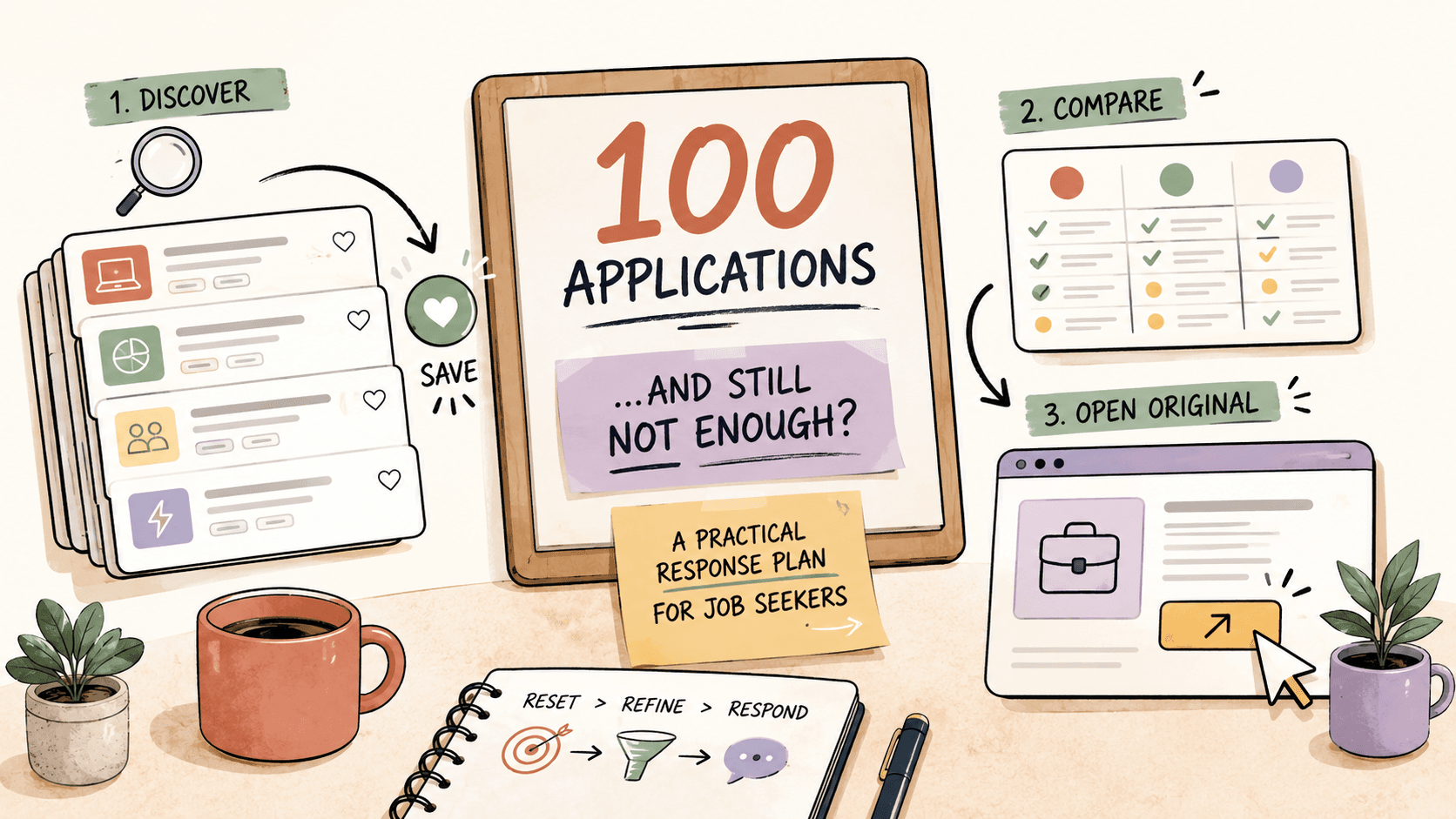
Is 100 job applications a lot?
Yes, 100 job applications is a lot if they were targeted, recent, role-aligned, and tracked. If you applied to roles where you matched most requirements, used a tailored resume, applied early, and measured responses by source, then 100 applications gives you meaningful data.
But 100 applications is less meaningful if most were one-click submissions, stale postings, weak-fit roles, or applications sent with the same generic resume. In that case, the number sounds large, but the signal is weak.
Use this rule: after 100 applications, evaluate conversion rates before increasing volume. Do not automatically send 100 more until you know where the funnel is breaking.
A better question than “Is 100 enough?” is: “What happened after those 100 applications?”
- No replies at all usually points to targeting, resume, timing, eligibility, or channel problems.
- Recruiter screens but no next steps usually points to positioning, salary fit, or unclear examples.
- Interviews but no offers usually points to evidence, interview stories, technical gaps, or closing strategy.
- Offers below target usually point to market selection, level mismatch, negotiation, or compensation expectations.
What are your last 100 applications really telling you?
Your job search is a funnel. Each stage tells you something different:
- You find a role.
- You apply.
- A recruiter or system reviews your profile.
- You get a screen.
- You get an interview.
- You reach later rounds.
- You receive an offer.
If you treat every rejection the same, you will fix the wrong problem. Use this table to diagnose the likely issue.
| Symptom after 100 applications | Likely cause | What to change next |
|---|---|---|
| Zero replies | Weak role fit, generic resume, stale postings, eligibility filters, crowded sources | Narrow your target roles, tailor the top third of your resume, apply earlier, and add referrals or niche channels |
| A few recruiter screens but no interviews | Unclear positioning, salary mismatch, weak role story, resume does not match conversation | Prepare a tighter “tell me about yourself,” align examples to the role, and clarify compensation range earlier |
| Interviews but no final rounds | Answers lack evidence, examples are too general, technical or case performance is weak | Use problem-action-result stories, practice role-specific questions, and debrief after each interview |
| Final rounds but no offers | Another candidate had stronger proof, better timing, or closer business fit | Improve closing questions, follow-up notes, references, and examples tied to business impact |
| Offers below target | Applying to lower-level roles, unclear compensation expectations, weak negotiation leverage | Target better-fit companies, clarify level, and discuss compensation earlier when appropriate |
This is why “send more applications” is not always the fix. If your resume is not getting read, more applications multiply the same problem. If you are getting interviews but no offers, the issue is probably not application volume at all.
Browse today’s opportunities on Sidequestboard
Why can 100 job applications still lead to silence?
One hundred applications can lead to silence when they are too broad, too late, or too dependent on crowded job boards. That does not mean every rejection is your fault. It means the modern job search has friction that raw volume does not solve.
Common reasons include:
- Crowded remote roles. Remote jobs often attract large applicant pools quickly, especially for entry-level, customer support, marketing, operations, writing, and junior tech roles.
- Stale postings. A job may still be online even if the company already has finalists, paused hiring, or is collecting candidates for later.
- Generic resumes. Recruiters scan quickly. If your top third does not immediately match the role, your relevant experience may never get noticed.
- ATS keyword gaps. Applicant tracking systems do not “hire” people, but missing required terms can make your resume harder to find or interpret.
- Role-level mismatch. Applying to senior roles as a junior, or entry-level roles while looking overqualified, can both reduce replies unless you explain the bridge.
- Low-signal channels. Relying only on Easy Apply or massive boards gives you little control over timing, differentiation, or referrals.
- Eligibility filters. Location, work authorization, salary range, shift availability, clearance, or required certification can silently disqualify you.
- Exploratory or duplicated posts. Some listings are not urgent, are reposted automatically, or are used to test the market.
The practical takeaway: you do not need to blame yourself, but you do need to inspect the system. Your goal is to increase the percentage of applications that are strong-fit, early, tailored, and trackable.
How do you audit your last 100 applications in 30 minutes?
Create a spreadsheet, Notion table, Airtable base, or Google Sheet called “100 Application Audit.” Do not overbuild it. You need enough data to see patterns quickly.
Use these columns:
| Column | What to record |
|---|---|
| Company | Employer or client name |
| Role | Exact job title |
| Source | LinkedIn, company site, Indeed, referral, recruiter, niche board, Reddit, Upwork, etc. |
| Date posted | When the role appeared, if visible |
| Date applied | When you applied |
| Fit score | 1 to 5 based on match quality |
| Resume version | The resume used, such as “Product Marketing v2” or “Data Analyst v1” |
| Referral/contact | Name of any person contacted, if any |
| Response | No reply, rejection, recruiter screen, interview, offer |
| Next action | Follow up, improve resume, stop source, retry similar role, etc. |
Score each application from 1 to 5:
- 5: The title, responsibilities, required skills, industry, location, and proof in your resume strongly match.
- 4: You match most requirements and can show relevant achievements.
- 3: You match the general function but miss some important keywords, tools, or industry context.
- 2: You are stretching into a new role with limited evidence.
- 1: You applied mainly because it was remote, easy, or available.
Then sort your applications into four buckets:
- Strong fit, applied within 48 hours.
- Strong fit, applied late.
- Weak fit.
- Unknown because you did not track enough information.
Now calculate reply rate by source and fit score. For example:
- LinkedIn Easy Apply: 40 applications, 0 replies.
- Company career pages: 20 applications, 2 replies.
- Referrals: 5 applications, 2 replies.
- Niche board: 10 applications, 1 reply.
- Weak-fit applications: 25 applications, 0 replies.
That tells you more than the number 100 ever could. Pause sources that mainly produce weak-fit applications. Double down on sources that produce replies, even if the volume is lower.
If you got zero replies, what should you fix first?
If you got zero replies after 100 applications, fix targeting before volume. Zero replies usually means one or more of these problems is happening near the top of the funnel:
- Your resume does not clearly match the roles.
- You are applying outside your realistic level.
- You are applying too late.
- You are relying on saturated sources.
- Your location, work authorization, salary, or availability conflicts with filters.
- Your target role is too broad.
Start by defining your target role clearly. Write down:
- 2 to 3 job titles you are actually targeting.
- Required tools or skills that appear repeatedly.
- Industries where your experience makes sense.
- Salary range or hourly range.
- Location, remote, hybrid, or timezone constraints.
- Proof you can show for the work.
Then use a 70% to 80% rule. You do not need to meet every requirement, but you should match most of the core requirements and have evidence for the important ones. If the job requires SQL, Salesforce, B2B SaaS experience, and lifecycle email campaigns, your resume should not make the recruiter hunt for those signals.
Before applying, ask:
- Was this posted recently?
- Do I match the title or a close equivalent?
- Do I meet the must-have requirements?
- Can I show proof in my resume or portfolio?
- Is the location or work authorization realistic?
- Can I tailor the resume in under 15 minutes without inventing anything?
- Is there a person I can contact or a referral path I can try?
If the answer is mostly no, skip it. A rejected application is not the problem; repeated low-fit applications are.
If you get recruiter screens but no interviews, what should you change?
Recruiter screens mean your resume is doing at least some work. If you get screens but no interviews, the issue is often positioning.
Common causes include:
- Your “tell me about yourself” answer is too general.
- Your salary expectations are outside the range.
- You cannot explain why this role is the logical next step.
- Your examples do not match the job’s priorities.
- The recruiter hears risk: job hopping, level mismatch, unclear motivation, or missing must-have skills.
Prepare a 45-second role story:
“I'm a [role] with experience in [specific domain or function]. Recently, I [achievement with measurable result]. I’m now looking for [target role] where I can use [key skills] to help with [business outcome]. That is why this role stood out.”
Also rewrite the top third of your resume and LinkedIn headline around the target role. The top third should answer three questions quickly:
- What role are you targeting?
- What proof do you have?
- Why are you relevant to this company’s problem?
Track which recruiter questions create friction. If three recruiters ask about the same gap, fix how you address it.
If you interview but do not get offers, what is missing?
If you are getting interviews, your application strategy is not completely broken. The gap is now evidence and follow-through.
Interviews without offers often happen when candidates give answers that are true but not convincing enough. “I managed campaigns” is weaker than “I rebuilt a lifecycle email sequence that increased demo bookings by 18% over two quarters.”
Use achievement stories with this structure:
- Problem: What was broken, missing, or important?
- Action: What did you personally do?
- Result: What changed, ideally with a number or clear outcome?
- Relevance: Why does this matter for the role you are interviewing for?
After each interview, debrief immediately. Write down:
- Questions you answered well.
- Questions where you rambled.
- Objections you sensed.
- Examples you wish you had used.
- Technical gaps or case-study gaps.
- Culture or communication signals.
- Follow-up action.
Send a useful follow-up email when appropriate. Do not just write “Thanks for your time.” Add one or two lines reinforcing fit:
“Thanks again for the conversation. I especially appreciated learning about the retention work planned for Q3. Based on my experience improving onboarding activation at [company/project], I’d be excited to help map the drop-off points and test lifecycle improvements.”
That kind of follow-up reminds the interviewer why your experience is relevant.
How do you make each application more likely to get read?
You cannot control every employer-side decision, but you can make your resume easier to understand. Recruiters often scan fast, so your strongest evidence needs to appear early.
Focus on these fixes:
- Mirror the job title when honest. If your experience supports “Customer Success Manager,” do not hide behind a vague headline like “Business Professional.”
- Tailor the top third. Adjust your headline, summary, core skills, and first few bullets to match the role.
- Use required terms accurately. If the job asks for Salesforce, HubSpot, SQL, GA4, Figma, React, payroll, SOC 2, or Excel modeling, include those terms where they truthfully apply.
- Quantify achievements. Replace “responsible for reports” with “built weekly revenue reports used by a 12-person sales team.”
- Remove unrelated clutter. Old or irrelevant details can bury the reasons you are a fit.
- Prioritize recent and relevant work. Recruiters should not have to search page two for your best proof.
- Use a short cover note only when it adds context. A cover note can help explain a pivot, relocation, referral, or unusually strong match. It should not repeat the resume.
A simple resume check: print or preview the first half of page one. If a recruiter saw only that section, would they know what job you want and why you are qualified? If not, fix that before applying again.
Where should you apply besides the same big job boards?
Do not abandon traditional job boards entirely, but do not rely on only one channel. A better job search uses a mix of formal listings, warm contacts, niche sources, and public opportunity channels.
Use these sources intentionally:
- Company career pages. Build a target company list and check directly. Company sites can be less crowded than reposted listings.
- LinkedIn. Search jobs, but also search hiring manager posts, recruiter posts, alumni, former coworkers, and mutual connections.
- Niche job boards. Use field-specific boards for design, data, engineering, nonprofits, climate, education, healthcare, remote work, or startups.
- Recruiters. For experienced candidates, external recruiters can be useful when they specialize in your function or industry.
- Alumni and professional networks. A short message to someone with shared context can outperform a cold application.
- Communities. Relevant Slack groups, Discord servers, industry forums, and Reddit communities can surface roles before they hit large boards.
- Public hiring posts. Communities such as r/forhire, r/WorkOnline, r/HireaWriter, and r/freelance_forhire can be useful for freelance, contract, writing, remote, and project-based opportunities.
- Freelance platforms. Upwork, Fiverr, Contra, PeoplePerHour, and Toptal can help with income, portfolio proof, or contract work, depending on your skill level and goals.
Use each source for the right reason. If you want a full-time role, company pages, LinkedIn, referrals, recruiters, and niche boards should usually be central. If you also need short-term income or portfolio proof, public communities and freelance platforms can complement the search.
Examples:
- A content writer might test r/HireaWriter, LinkedIn hiring posts, a niche content marketing board, and Contra.
- A virtual assistant might test r/WorkOnline, company career pages, LinkedIn, and carefully screened remote admin listings.
- A designer might test r/forhire, portfolio-based outreach, niche design boards, Fiverr packages, and PeoplePerHour.
- A senior developer might test company career pages, recruiter outreach, referrals, Toptal, Contra, and targeted Reddit searches.
Pick three primary sources for two weeks. Track replies by source. Do not join every platform at once.
What weekly application mix beats blind volume?
A sustainable job search needs enough volume to create opportunities, but enough quality control to avoid spam. Instead of aiming for 100 more applications, aim for meaningful weekly actions.
A practical weekly mix:
- 10 to 15 strong-fit formal applications.
- 5 to 10 warm outreach messages to alumni, former coworkers, recruiters, or hiring managers.
- 5 follow-ups on real conversations or applications with a contact.
- 3 to 5 community or freelance opportunity replies if relevant to your field.
- 1 to 2 resume, portfolio, or LinkedIn improvements based on patterns you are seeing.
An application only counts as meaningful if:
- You match most core requirements.
- The posting is recent or still clearly active.
- Your resume version fits the role.
- You know the source.
- You record it in your tracker.
- You can explain why you applied.
Batch the work:
- Sourcing: Find roles and save them.
- Qualification: Reject weak-fit postings quickly.
- Tailoring: Adjust the top third of your resume.
- Applying: Submit in focused blocks.
- Outreach: Contact relevant people after or before applying.
- Follow-up: Revisit warm leads and recruiter conversations.
The right number depends on seniority, market, industry, and urgency. A senior specialist may need fewer, deeper applications. An entry-level candidate may need more attempts, but still not random ones.
What mistakes should you stop making after 100 no-replies?
After 100 no-replies, the biggest mistake is changing nothing except the count. Stop repeating a process that gives you no signal.
Avoid these common traps:
- Sending the same resume to every role. You do not need a complete rewrite each time, but the top third should match the target.
- Applying only through Easy Apply. It is convenient, but it is often crowded and low-signal.
- Ignoring date posted. A role posted three weeks ago may already be deep in process.
- Ignoring applicant volume. High applicant counts do not mean you should never apply, but they do mean you need stronger fit or another route in.
- Applying outside your level with no bridge story. If you are changing roles or levels, explain the connection through proof.
- Skipping referrals. A referral does not guarantee anything, but it can help you get reviewed.
- Not tracking data. Without source, fit, and response data, you cannot improve the system.
- Changing everything at once. Test one major change at a time: resume headline, target role, source mix, outreach message, or interview story.
- Treating ghosting as personal proof. Many employers are slow or disorganized. Your job is to learn from patterns, not from one silent company.
What should your 7-day reset plan look like?
Use the next seven days to rebuild your process instead of panic-applying.
Day 1: Audit the last 100 applications
Fill in your tracker with company, role, source, date posted, date applied, fit score, resume version, referral status, response, and next action. Identify which sources produced any replies.
Day 2: Define your target roles
Choose 2 to 3 target job titles. Write down required skills, preferred industries, salary range, location constraints, and proof you can show. Reject weak-fit postings faster.
Day 3: Build resume variants
Create one resume version per major target role. For example: “Customer Success Manager,” “Implementation Specialist,” and “Account Manager.” Tailor the headline, summary, skills, and first bullets.
Day 4: Build a target company and contact list
Choose 25 to 50 companies. Find career pages, recruiters, hiring managers, alumni, former coworkers, or relevant team members. Do not ask strangers for a job immediately; ask concise, specific questions or request advice when appropriate.
Day 5: Apply to a small batch of strong-fit recent postings
Submit 5 to 8 strong applications. Prioritize roles posted recently, roles where your resume clearly fits, and roles where you can also contact a person.
Day 6: Send warm outreach and follow-ups
Follow up with recruiters, former colleagues, alumni, and people connected to target companies. Add context: the role you are targeting, why it fits, and one proof point.
Day 7: Review metrics
Measure:
- Applications sent.
- Strong-fit percentage.
- Reply rate by source.
- Recruiter screens.
- Interviews booked.
- Follow-ups sent.
- Resume changes made.
- Sources to cut or double down on.
At the end of the week, keep what produced signal and remove what only produced stress.
How can Sidequestboard help you find fresher opportunities?
One hidden cost of a modern job search is tab overload. You may check LinkedIn, company career pages, Reddit communities, Discord groups, Slack channels, niche boards, Upwork, Contra, and other sources manually. That can turn into hours of searching before you send a single strong reply.
Sidequestboard fits as a monitoring layer for fresh public opportunities. It helps you discover and save public job, freelance, and project posts from communities and alternative channels in a cleaner workflow. When something looks relevant, you still open the original source, verify the details, and apply or respond where the opportunity was posted.
That distinction matters. Sidequestboard is not a magic marketplace and it does not guarantee interviews, clients, jobs, or income. It also does not replace resume targeting, referrals, formal applications, or interview preparation.
It can help if your bottleneck is discovery: finding relevant opportunities early enough to respond well. A simple routine is:
- Check Sidequestboard once in the morning and once in the afternoon.
- Save opportunities that match your role, rate, location, and availability.
- Open the original listing or post.
- Verify scope, company or poster credibility, pay details, and application method.
- Send a tailored response using your strongest proof.
- Track the result in your application audit sheet.
If you are testing new sources for two weeks, Sidequestboard can be one way to reduce manual searching while keeping your focus on fit and response quality.
FAQ
Is 100 job applications a lot?
Yes, 100 applications is a lot if they were targeted, recent, role-aligned, and tracked. It is less meaningful if most were generic Easy Apply submissions, stale postings, or weak-fit roles.
Why am I not getting interviews after 100 applications?
Common reasons include a generic resume, poor keyword alignment, weak role fit, applying too late, relying only on crowded job boards, eligibility filters, or applying outside your level without a clear bridge story.
Is it normal to get no replies from job applications?
It is common to get some silence, especially in crowded markets, but zero replies after 100 applications is a sign to diagnose the process. Review your resume, sources, timing, fit scores, and referral strategy before increasing volume.
How many job applications should I send per week?
A practical target is 10 to 15 strong-fit formal applications per week, plus warm outreach, follow-ups, and a few community or freelance opportunities where relevant. Quality and tracking matter more than raw count.
Should I apply if I do not meet every requirement?
Yes, if you meet most core requirements and can show proof for the important parts of the role. If you meet only a small fraction of the must-haves, your time is usually better spent on stronger-fit roles.
Is it better to apply early?
Usually, yes. Applying within the first 24 to 48 hours can help, especially for crowded roles. Timing will not fix a weak application, but a strong application sent early has a better chance of being seen.
Do referrals matter more than applications?
Referrals can help your application get noticed, but they do not replace qualifications. The best approach is to combine strong-fit applications with relevant referrals or warm outreach when possible.
Should I use the same resume for every job?
No. You can keep a core resume, but you should tailor the headline, summary, skills, and most relevant bullets for each target role type. Do not invent experience; make the real fit easier to see.
When should I change my job search strategy?
Change your strategy after 50 to 100 applications if you have little or no response data. Also change it sooner if one source produces only weak-fit roles or if recruiters repeatedly flag the same concern.
Can Sidequestboard get me a job?
Sidequestboard does not guarantee a job, interview, client, or income. It helps you monitor and save fresh public opportunities so you can verify them and respond through the original source with a stronger, faster application.
Related guides
- Freelance Work for Beginners: Get Brand, Video, and Film Clients
- How to Get Freelance Clients on LinkedIn: Profile, Search, Outreach, and Lead Workflow
- Best Reddit Side Hustle Job Boards for Finding Work
- How to Use Reddit to Discover Freelance Opportunities
- Betrayed by a Reference? What to Say to the Recruiter and How to Save the Offer