June 28, 2026
How to Stack Multiple Side Hustles Without Burning Out
To stack multiple side hustles without burning out, set a weekly capacity limit before adding work, choose one primary income driver, and cap everything else. Use time blocks, a simple scoring system, shared admin routines, and protected recovery time. Pause any side hustle that drains energy without enough income, learning, or future upside.
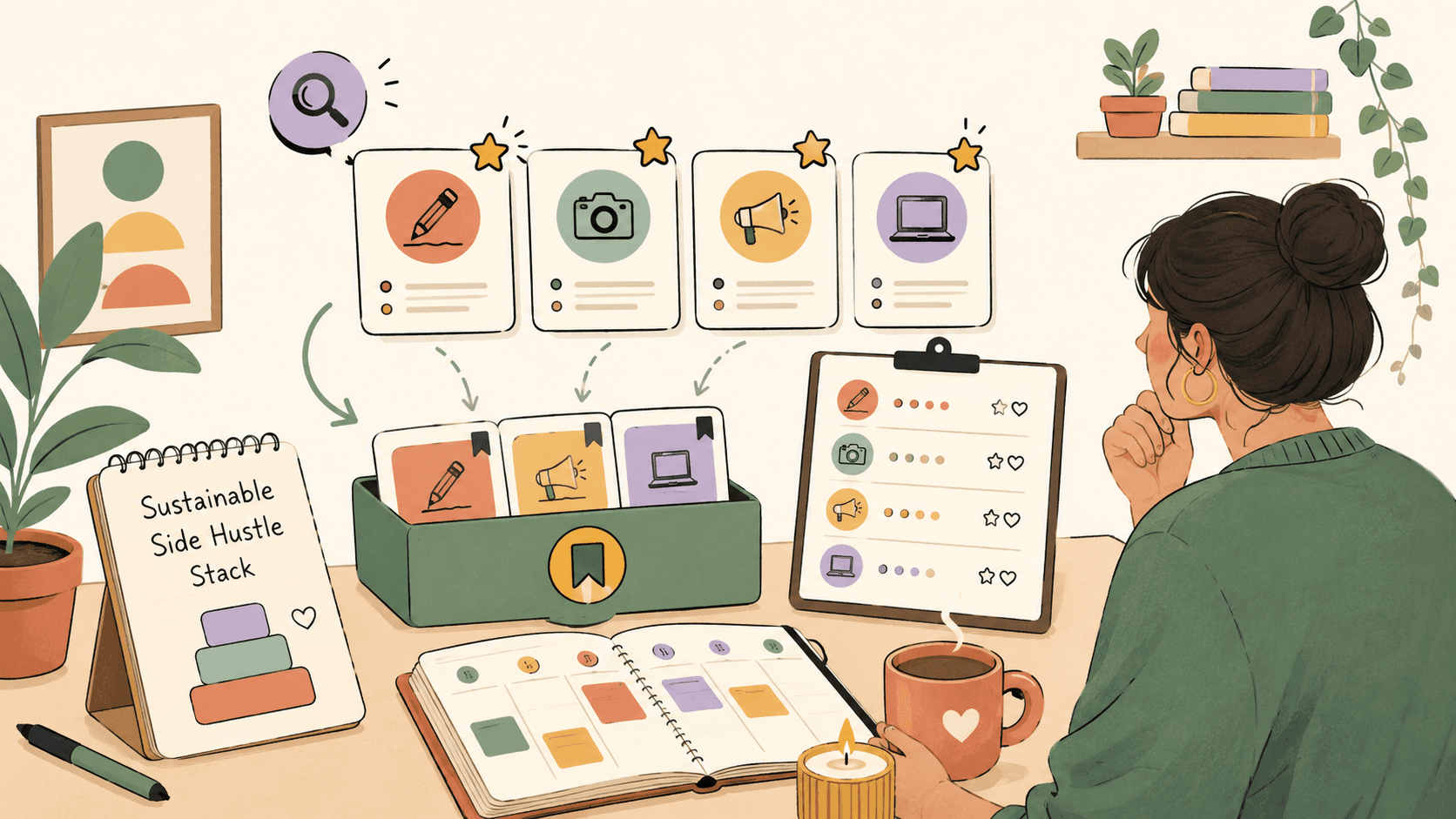
Why stacking side hustles causes burnout?
Stacking side hustles sounds efficient because each hustle feels small on its own. The problem is that each one adds hidden load:
- finding opportunities,
- comparing platforms,
- writing pitches,
- replying to messages,
- managing deadlines,
- tracking payments,
- updating portfolios,
- switching between different types of work,
- and deciding what to do next.
Burnout often comes less from the work itself and more from the constant switching and checking. A freelance project, a resale experiment, a newsletter, a tutoring slot, and a creator account may all be reasonable alone. Together, they can create a week with no clear finish line.
That is why the best first move is not a new app, platform, or productivity hack. It is a capacity limit.
Step 1: Set one weekly side hustle limit
Before you add another income stream, decide your maximum weekly side hustle capacity.
Use this simple audit:
| Category | Question to answer |
|---|---|
| Sleep | How many hours of sleep do I need to function well? |
| Main work | What hours are already committed to my job, school, caregiving, or core responsibilities? |
| Recovery | What time must stay protected for exercise, rest, meals, relationships, and quiet? |
| Admin | How much time do I need for email, money tracking, scheduling, and follow-up? |
| Focus | When do I actually have enough energy for valuable work? |
After that, choose a weekly number that feels almost too conservative. If you think you can do 15 hours, start with 10. If you think you can do 10, start with 6.
A useful rule: schedule only about 60–70% of your available side hustle capacity. Leave the rest for delays, messages, revisions, bad days, and life.
Example:
- You believe you have 12 hours available.
- You schedule 8 hours of actual side hustle work.
- You keep 4 hours unscheduled as a buffer.
That buffer is not wasted time. It is what keeps the system from collapsing.
Browse today’s opportunities on Sidequestboard
Step 2: Choose one primary revenue driver
A side hustle stack needs a hierarchy. If every idea is treated as equally important, everything competes for your best hours.
Divide your stack into three tiers:
| Tier | Role | Example |
|---|---|---|
| Primary | Main income or strongest near-term upside | Freelance design, writing, coding, tutoring, consulting |
| Secondary | Small experiment or support channel | Newsletter, template shop, affiliate content, resale test |
| Passive/admin-light | Low-maintenance asset or long-term bet | Digital product update, portfolio improvement, saved lead list |
Your primary side hustle gets your best focus blocks. Your secondary hustles get smaller, capped blocks. Your passive or admin-light work only gets time if it does not steal from your primary work or recovery.
A practical split:
- 70% of side hustle time for the primary hustle,
- 20% for one secondary experiment,
- 10% for admin, learning, and opportunity review.
If you have 8 weekly hours, that means:
- 5–6 hours for the primary hustle,
- 1–2 hours for a secondary bet,
- 30–60 minutes for admin and discovery.
This keeps the stack from becoming a pile of unfinished ideas.
Step 3: Score each side hustle before you keep it
Not every side hustle deserves a place in your week. Some earn money but drain you. Some feel exciting but never produce results. Some are useful learning bets but should stay small.
Use a simple scorecard from 1 to 5:
| Factor | Ask this |
|---|---|
| Income potential | Can this realistically produce useful income for me? |
| Speed to cash | Can it generate results soon, or is it a long-term bet? |
| Energy cost | Does it leave me tired, anxious, or scattered? |
| Skill growth | Does it build a skill I want to keep using? |
| Flexibility | Can I do it without wrecking my schedule? |
| Lead quality | Are the opportunities clear and worth responding to? |
Then sort each hustle into one of four decisions:
| Score pattern | Decision |
|---|---|
| High income, manageable energy | Keep and prioritize |
| High learning, low immediate income | Keep small as an experiment |
| Low income, high energy drain | Pause or remove |
| Unclear results after 30 days | Review and cap tightly |
The key is to avoid keeping a hustle just because you already started it. Your week is a limited budget. Spend it on the work that gives the best mix of money, learning, and future options.
Step 4: Put discovery in a time box
A major burnout trap is opportunity hunting with no endpoint. You check Upwork, Fiverr, LinkedIn, Reddit, Discord, X/Twitter, newsletters, job boards, and private communities. Then you feel busy even though you have not pitched, applied, delivered, or shipped.
Instead, create a discovery block.
Example:
- Tuesday: 30 minutes to scan new leads.
- Thursday: 30 minutes to follow up and send replies.
- Sunday: 20 minutes to review saved opportunities and plan next week.
During that block, use a strict rule:
Save or act on only the opportunities that match your scorecard.
A good lead should fit your skills, timeline, energy, and current focus. If it does not, skip it. The point is not to collect every possible opportunity. The point is to find a few relevant ones while they are still worth acting on.
This is where Sidequestboard can fit naturally into the workflow: use it as a calmer discovery dashboard for fresh public opportunities, save only the leads that match your scorecard, then open the original source when you are ready to apply or respond.
Step 5: Build a weekly schedule that protects energy
A sustainable stack needs dedicated blocks, not random scraps of time.
Here is a simple schedule for someone with a full-time job and 8 side hustle hours per week:
| Day | Block | Focus |
|---|---|---|
| Monday | 45 minutes | Admin, messages, planning |
| Tuesday | 90 minutes | Primary side hustle deep work |
| Wednesday | Off | Recovery |
| Thursday | 90 minutes | Primary side hustle delivery or pitching |
| Friday | 30 minutes | Lead review and follow-up |
| Saturday | 2 hours | Primary side hustle execution |
| Sunday | 90 minutes | Secondary experiment and weekly review |
Notice the off day. It is not optional. If every day has a side hustle task, your brain never gets a clean shutdown.
If your schedule is already intense, use fewer blocks:
| Capacity | Suggested structure |
|---|---|
| 3–4 hours/week | One primary hustle only |
| 5–8 hours/week | One primary hustle plus one tiny experiment |
| 9–12 hours/week | Primary hustle, secondary hustle, and admin block |
| 12+ hours/week | Only if sleep, health, and main responsibilities remain stable |
More hours do not always mean more progress. After a certain point, tired work produces slower replies, worse pitches, missed details, and avoidable mistakes.
Step 6: Separate deep work, admin, and outreach
Side hustles become exhausting when every session includes everything: searching, replying, delivering, invoicing, planning, and second-guessing.
Separate the work into three modes:
Deep work
Use this for delivery or asset creation:
- writing,
- design,
- coding,
- editing,
- tutoring prep,
- client work,
- portfolio projects,
- product improvements.
Deep work should happen during your best available energy.
Outreach and discovery
Use this for finding and responding to opportunities:
- scanning leads,
- saving relevant posts,
- writing short first replies,
- sending applications,
- following up.
Keep this in a time box so it does not take over your week.
Admin
Use this for maintenance:
- invoices,
- payment tracking,
- calendar updates,
- file organization,
- simple bookkeeping,
- project status notes.
Batch admin once or twice per week. Do not let it interrupt deep work blocks.
Step 7: Use minimum viable systems, not complex dashboards
You do not need a complicated operating system to manage multiple side hustles. You need a few reliable places to put things.
A simple setup can be:
| Need | Simple tool option |
|---|---|
| Track tasks | Trello, Notion, Airtable, Google Sheets, or a notebook |
| Track money | Spreadsheet, Wave, QuickBooks, or your preferred accounting tool |
| Send invoices/payments | PayPal, Stripe, bank transfer, or platform-native tools |
| Save leads | A lead tracker, bookmark system, or opportunity dashboard |
| Store reusable replies | Notes app, docs, or snippets tool |
Your system should answer four questions quickly:
- What am I working on this week?
- What leads are worth responding to?
- What money is expected or unpaid?
- What should I stop doing?
If your system takes more time to maintain than the work itself, simplify it.
Step 8: Create rules for saying no
Burnout often comes from weak boundaries, not weak motivation.
Create rules before you are tired:
- No same-day turnaround unless it is truly worth the disruption.
- No new hustle until one existing hustle is paused, finished, or capped.
- No client calls during protected rest blocks.
- No unpaid trial work unless you intentionally choose it and limit the scope.
- No checking leads in bed.
- No accepting work that requires skills you cannot reasonably deliver.
A good side hustle stack should make your life more flexible, not less.
Step 9: Watch for early burnout signals
Do not wait until you are completely exhausted to adjust. Burnout usually shows up in smaller signals first.
Watch for:
- avoiding messages you normally answer quickly,
- feeling resentful about work you chose,
- skipping meals, sleep, or exercise to keep up,
- constantly switching tasks without finishing anything,
- losing interest in your main work,
- making careless errors,
- checking opportunities compulsively,
- saying yes because you are afraid nothing else will come.
If two or more of these continue for more than a week, reduce the stack. Do not add another productivity tool and call it a solution.
Step 10: Run a 30-day side hustle review
Every 30 days, review the stack like a portfolio.
Ask:
- Which hustle produced income?
- Which hustle created useful leads?
- Which hustle improved a skill I care about?
- Which hustle drained the most energy?
- Which work would I gladly do again?
- Which work am I keeping only because I feel guilty stopping?
Then make one of four decisions for each hustle:
| Decision | Meaning |
|---|---|
| Double down | Give it more of your best hours |
| Maintain | Keep it stable without expanding |
| Shrink | Reduce time, scope, or frequency |
| Pause | Remove it from the next 30 days |
This review keeps your side hustle stack intentional instead of accidental.
A simple side hustle stack template
Here is a practical template you can copy:
Weekly limit
Total side hustle capacity: ____ hours
Scheduled work limit: ____ hours
Buffer: ____ hours
Primary hustle
Name: ____
Goal this month: ____
Weekly time: ____ hours
Success metric: income / clients / applications / shipped work / portfolio asset
Secondary hustle
Name: ____
Goal this month: ____
Weekly time cap: ____ hours
Stop rule: ____
Discovery block
Days and times: ____
Lead criteria:
- fits my skill,
- fits my timeline,
- fits my energy,
- has clear next steps,
- supports my current goal.
Rest rule
Protected time: ____
No-work boundary: ____
How to know if your stack is sustainable?
Your side hustle stack is probably sustainable if:
- you know your weekly limit,
- your best hours go to one priority,
- you are not checking opportunities all day,
- you can explain why each hustle is still in the stack,
- you have at least one real rest block each week,
- your admin system is simple enough to maintain,
- and your stack still leaves room for sleep, relationships, and basic health.
It is probably too heavy if every opportunity feels urgent, every night becomes a work night, or you cannot remember the last time you fully stopped.
Where Sidequestboard fits in the workflow?
If part of your stack depends on finding freelance gigs, public job posts, project calls, or fresh online opportunities, the discovery process can easily become the most chaotic part of the week.
Sidequestboard is useful as a scheduled discovery layer: scan a cleaner feed of public opportunities, save only the leads that fit your scorecard, open the original source to apply or respond, and then close the tab. That helps keep lead hunting inside your weekly system instead of letting it spill into every spare moment.
Final takeaway
The safest way to stack multiple side hustles is to treat your time and energy as the constraint. Start with one weekly limit, pick one primary revenue driver, cap experiments, batch admin, protect rest, and review the stack every 30 days.
A good side hustle stack should create more options for your life. If it removes all your breathing room, it is not a stack anymore. It is a second full-time job with worse boundaries.